
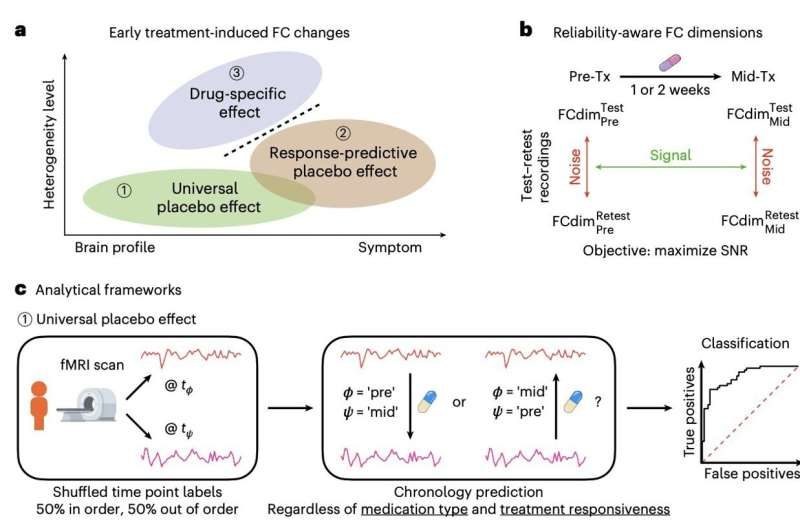
Researchers studied brain scans of 386 individuals with Major Depressive Disorder to observe changes in brain connectivity during the initial weeks after starting a placebo or one of two antidepressants. Their findings highlight both common changes across treatment groups and specific patterns related to the antidepressant treatments.
Scientists have identified a key mechanism that helps determine the length of myelin, the protective coating that surrounds many nerve fibers and allows signals to travel efficiently through the nervous system.
A study from Lund University published in Nature Neuroscience reveals that normal aging and Alzheimer’s affect brain communication differently, with distinct patterns of alterations. Notably, changes in Alzheimer’s patients occur early, prior to the onset of cognitive symptoms.
Researchers have developed 3D “mini-brains” they hope will help speed up the search for drug treatments for multiple sclerosis (MS).
A study reveals that childhood abuse affects brain structure, specifically cortical thickness, surface area, and subcortical volume, with more significant effects observed in young women. This research is the largest to investigate the neurobiological impacts of childhood maltreatment in a diverse, global population.
A graphene-based brain sensor could help doctors watch the hidden damage unfolding during a stroke in real time, offering new hope of preventing devastating brain injuries before they become irreversible.
Researchers at the University of Osaka found that stimulating the primary somatosensory cortex and the insular cortex simultaneously may enhance artificial touch sensations, producing effects beyond typical tingling or numbness. The study is published in Brain Stimulation.
Inflammatory conditions in the brain, including traumatic brain injury and degenerative diseases like Alzheimer’s, could be targeted with an existing drug thanks to new research that shows it can work in brain cells.
The largest genetic study of cognition to date has been published, involving nearly half a million people of European ancestry. This provides a new understanding of the genetic factors that shape cognitive differences and can help us better understand certain health conditions, including neurodevelopmental conditions.
Isolated REM sleep behavior disorder (iRBD) is an early indicator of brain changes linked to Parkinson’s disease or dementia with Lewy bodies, often emerging years prior to diagnosis.
A new study finds that adults with attention-deficit/hyperactivity disorder (ADHD) face a significantly higher risk of developing dementia or mild cognitive impairment later in life. The research, published in JAMA Psychiatry, also found that people who carry a higher genetic risk for ADHD face a greater chance of cognitive decline even without a documented diagnosis.
Researchers have led an international scientific team studying how a traumatic brain injury caused by a severe blow to the head affects the brain’s long-term response to subsequent stressful situations.
A long-term study of more than 4,500 older adults reveals that individuals who are overweight or obese when diagnosed with dementia exhibit a significantly lower risk of death than those of normal weight. Rigorous epidemiological modeling suggests this survival advantage is not merely an artifact of statistical bias, underscoring the critical protective role of nutrition and metabolic reserves in neurodegenerative decline.

