
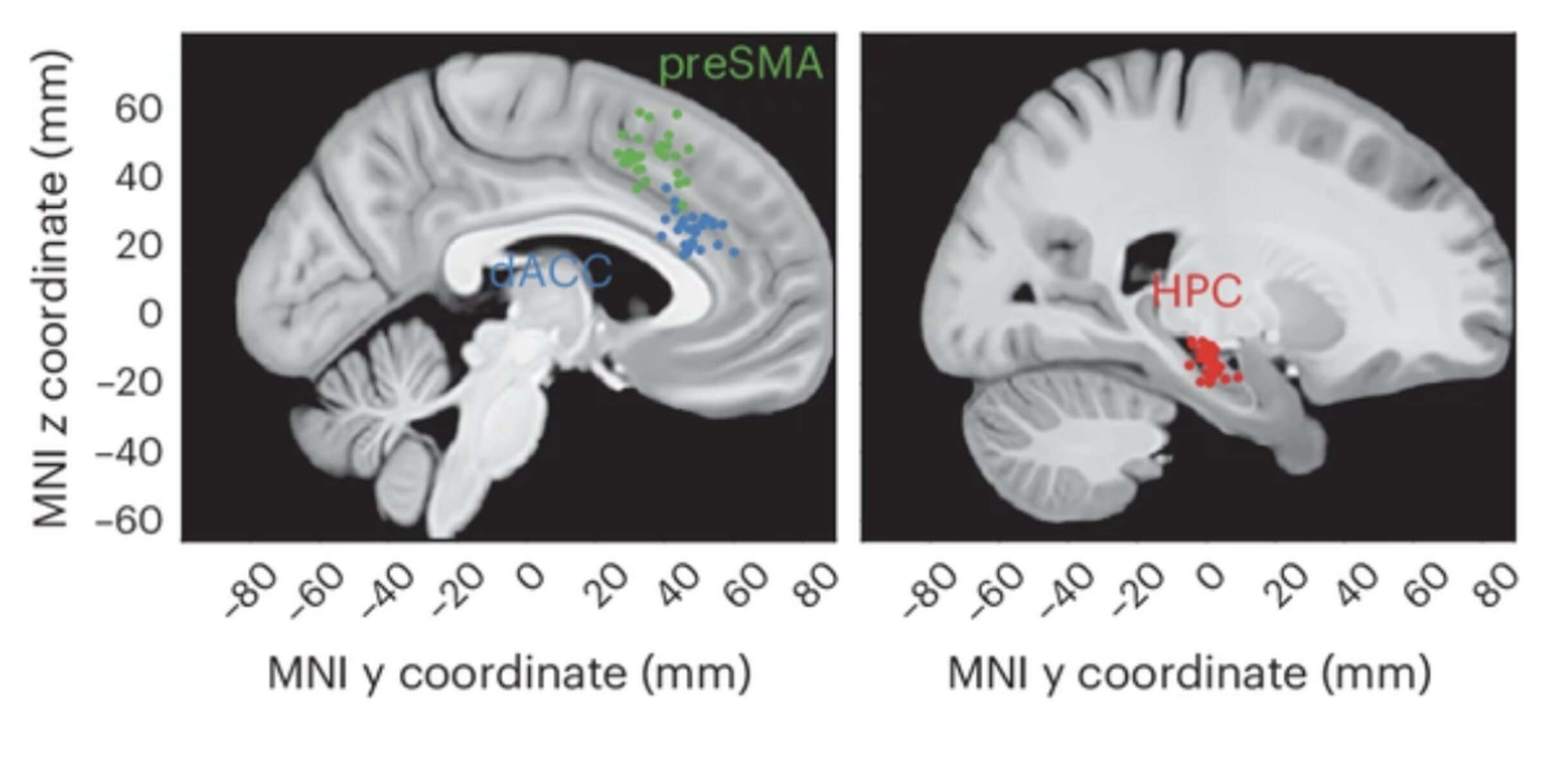
Scientists carried out a study aimed at better understanding how neurons preserve context over time as the goals of an ongoing task change. Their findings, published in Nature Human Behaviour, suggest that the brain can represent the same information through different patterns of neuronal activity that vary in stability and flexibility.
New research found that an unhealthy Western-style diet accelerates cognitive decline in individuals genetically predisposed to Alzheimer’s disease.
A scientific team has shown that a new brain-computer interface (BCI) can allow people with vocal tract and bodily paralysis to convey both speech and upper-body gestures simultaneously. While BCIs have facilitated one or the other in the past, this new system is the first to enable both modes of communication at once, more closely replicating natural expression.
In a study analysing nearly 3,000 brain MRI exams, researchers found that living in highly disadvantaged neighbourhoods was associated with adverse brain health.
Neuroscientists have found that a centralized genetic switch in the neuron’s cell body, rather than just local cues at the axon tips, directs axon navigation. By analysing over 12,000 developing neurons, they created a genetic atlas that could lead to new therapies for repairing damaged neural pathways after strokes or spinal cord injuries.
New research suggests that losing muscle as we age may indicate a higher risk of dementia, with individuals suffering from sarcopenia—characterized by muscle loss and decreased strength—facing a 42% increased risk.
Researchers have discovered that spontaneous eye-blink rate serves as a simple, noninvasive marker for tracking the development of executive function in early childhood. The study revealed that children aged 3–6 with higher blink rates performed better on cognitive flexibility tasks, an association specifically linked to focused activation within the right dorsolateral prefrontal cortex.
Scientists at the University of Galway have taken part in a first-in-human study of stroke patients using a thin wire fitted with sensors to assess and map their clots.
A new study reveals the human brain is composed of two independently evolved organs, enabling the first lab-grown human hindbrain neurons. Published in Nature Neuroscience, the research shows that what we call the human brain is actually two ancient, independent nervous systems assembled side by side over hundreds of millions of years of evolutionary history.
A clinical trial has found that exercise has a significant effect on mood and lab-based measures of new brain cell formation in healthy middle-aged participants.
A recent study reveals a connection between spinal deterioration and cognitive decline, indicating that individuals with lower bone density in thoracic vertebrae experience quicker cognitive decline and microstructural brain injury, as assessed through a deep learning model analysing clinical imaging data.
A new computational model shows how cortical feedback slashes neural chaos by 93%, explaining how our vision stays stable despite fluctuating brain activity.
A research team has created a vision transformer architecture named the 4D fMRI CrossFormer (4DfCF) to analyze four-dimensional fMRI data, aiming to enhance AI-assisted brain disorder diagnosis and promote a more transparent computer-aided diagnosis system for clinicians to review AI predictions.
Neurodivergent individuals, especially those with autism or ADHD, are diagnosed with type 2 diabetes at younger ages, with a significant prevalence among those diagnosed before age 20.
Scientists using magnetoencephalography (MEG) discovered five neurophysiological subtypes of major depressive disorder based on brain connectivity, revealing that patients with the same diagnosis can have opposite brain activity patterns, which explains previous research discrepancies and promotes personalized psychiatric treatment.
A new study found that 85% of patients with aura-dominant migraine experienced a reduction in monthly aura days by at least half following treatment with the anti-epileptic drug lamotrigine.
Researchers from Alzheimer Center Amsterdam and the Netherlands Institute for Neuroscience discovered that personally meaningful music elicits a stronger brain response than neutral music in individuals with dementia, with variations in response based on dementia type.
Finally, this week, chronic stress and perceived social support may play a role in how memory and thinking abilities change with age, according to a new study,

