
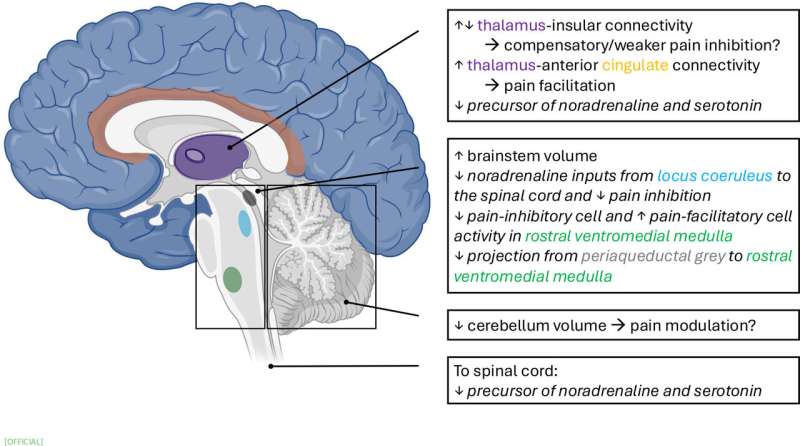
Changes within the central nervous system, including the brain and spinal cord, can be a key reason for pain in people with diabetes, and future treatments could focus on restoring the brain’s pain-blocking systems, according to new research.
A long-term MRI study reveals that lower abdominal fat accumulation is linked to slower brain atrophy, preserved brain structures, and improved cognitive performance in late midlife, regardless of weight loss. This relationship appears to be mainly influenced by glucose control and insulin sensitivity. The study uniquely connects repeated MRI observations of visceral fat with brain aging and cognitive changes over time.
Researchers have shown that a single dose of psilocybin, the psychedelic compound found in magic mushrooms, causes likely anatomical brain changes that last for up to a month after the experience.
A study in Developmental Medicine & Child Neurology indicates that children with epilepsy are at a higher risk of autism spectrum disorder (ASD), often having intellectual disabilities (56.5% vs. 15.4%), being mostly female (38.2% vs. 25.8%), and receiving an autism diagnosis at a younger age (7.4 vs. 8.7 years) compared to those without autism.
Researchers at Loma Linda University Health found that consuming one egg per day, five days a week, is linked to a 27% lower risk of Alzheimer’s disease in individuals aged 65 and older.
A recent study reveals that Parkinson’s disease can be categorised into distinct subtypes, highlighting the limitations of a one-size-fits-all treatment approach. The research identified two main groups and five subgroups through machine-learning analysis, paving the way for personalised therapies. The findings are published in Nature Communications.
A new study indicates that both extremely low and high resting heart rates are associated with a higher stroke risk, contradicting the idea that lower heart rates always signify good cardiovascular fitness.
A meta-analysis of 55 studies involving over 3 million people revealed that 31% of individuals with cannabis use disorder (CUD) also have major depressive disorder (MDD), and CUD is present in 10% of those with MDD, highlighting a mutual relationship between the two conditions.
Omega-3 supplements, commonly used by older adults for cardiovascular health and to reduce cognitive decline, may be associated with a quicker deterioration in cognitive function, according to recent research.
New research challenges the long-held belief that the brain makes decisions in a simple, top-down hierarchy. By discovering decision-making signals in the primary somatosensory cortex, researchers have revealed a system of bidirectional feedback loops that could be the key to building the next generation of energy-efficient, truly intelligent AI.
A recent study indicates that cognitive decline is not unavoidable with ageing, showing that individuals aged 19 to 94 can enhance their brain performance through consistent brain-healthy practices.

