
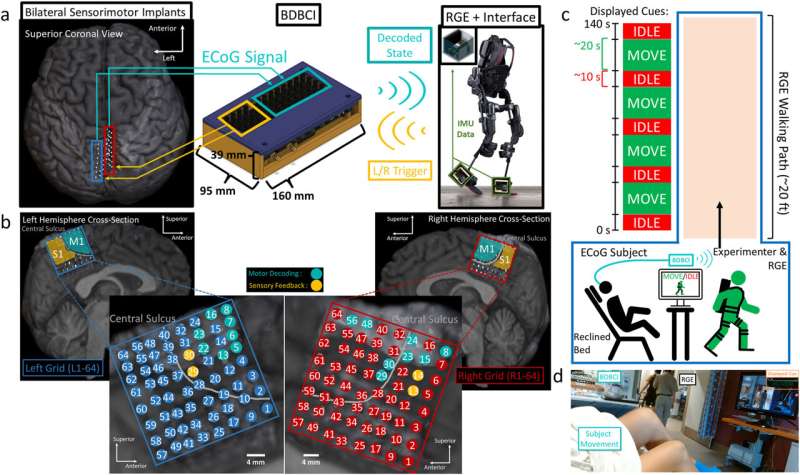
Researchers are developing a fully implantable brain-computer interface (BCI) that enables patients with paraplegia to control robotic exoskeletons with their thoughts, aiming to restore both walking and the sensation of walking.
New research indicates that time perception is a complex, multi-stage process in the brain, starting with sensory encoding and leading to a representation of time that helps us categorise experiences by duration and order. This insight paves the way for further studies on the links between cognitive functions and time perception, particularly in relation to disorders affecting this process.
Does a plant-based diet prevent Alzheimer’s? New research shows that healthful plant-based diets lower dementia risk by 7%, while unhealthful plant-based diets increase risk.
A new AI framework emulates human brain development by “pruning” unnecessary connections as it learns, becoming more compact and energy-efficient while mastering complex tasks. The study indicates that effective learning relies on the right connections rather than on an abundance of them. By mimicking infant brains, this AI enables continual learning and improves perception, motor control, and interaction, all while reducing size and energy consumption.
A new study reveals that school-age children and adolescents with medically diagnosed traumatic brain injury (TBI) have significantly higher rates of anxiety/depression, and strong family support and resilience help alleviate some of it.
Loneliness affects memory performance in older adults but does not accelerate cognitive decline, according to a European study of more than 10,000 participants over seven years. Although those reporting high levels of loneliness initially performed worse on memory tests, their decline in recall ability matched that of less lonely participants over time.
Researchers have developed a 15-minute blood test that uses europium nanoparticles and a smartphone to track melatonin levels, helping astronauts and shift workers manage their biological clocks.
A study from Mass General Brigham reveals that a blood test measuring plasma phosphorylated tau 217 (pTau217) can predict changes in amyloid PET scans and cognitive decline in healthy older adults, potentially allowing for earlier disease prediction and identifying those at risk for cognitive decline. The findings are published in Nature Communications.
A high-resolution study of 30 adult brains reveals over 3,000 genes with sex-biased expression. These findings link molecular sex differences to the prevalence of disorders like ADHD and Alzheimer’s.
Air pollution is associated with increased migraine activity, according to a study published in Neurology. Both short-term and cumulative exposure to air pollution, as well as climate factors such as heat and humidity, were associated with increased migraine activity.
A new study shows how subcortical pathways can make AI models more flexible and biologically accurate.
New research indicates that high sodium intake may harm episodic memory, which is essential for recalling personal experiences. These findings emphasise the broader cognitive effects of a salty diet, underlining the significance of making healthy dietary choices for brain health.
Can brain implants restore sight? Researchers have mapped how the brain reacts to neural probes, finding that flexible polyimide is the key to long-term biocompatibility.
Scientists analysed data from over 363,000 participants in the NIH’s All of Us Research Program and found that treatable middle ear conditions, such as eardrum perforations and cholesteatoma, are associated with nearly double the odds of developing dementia; however, treating these conditions with surgery or hearing aids significantly reduced or eliminated the dementia risk.
Finally, researchers printed artificial neurons that successfully “talk” to living brain cells. These flexible devices could lead to energy-efficient AI and advanced brain-machine implants.

