
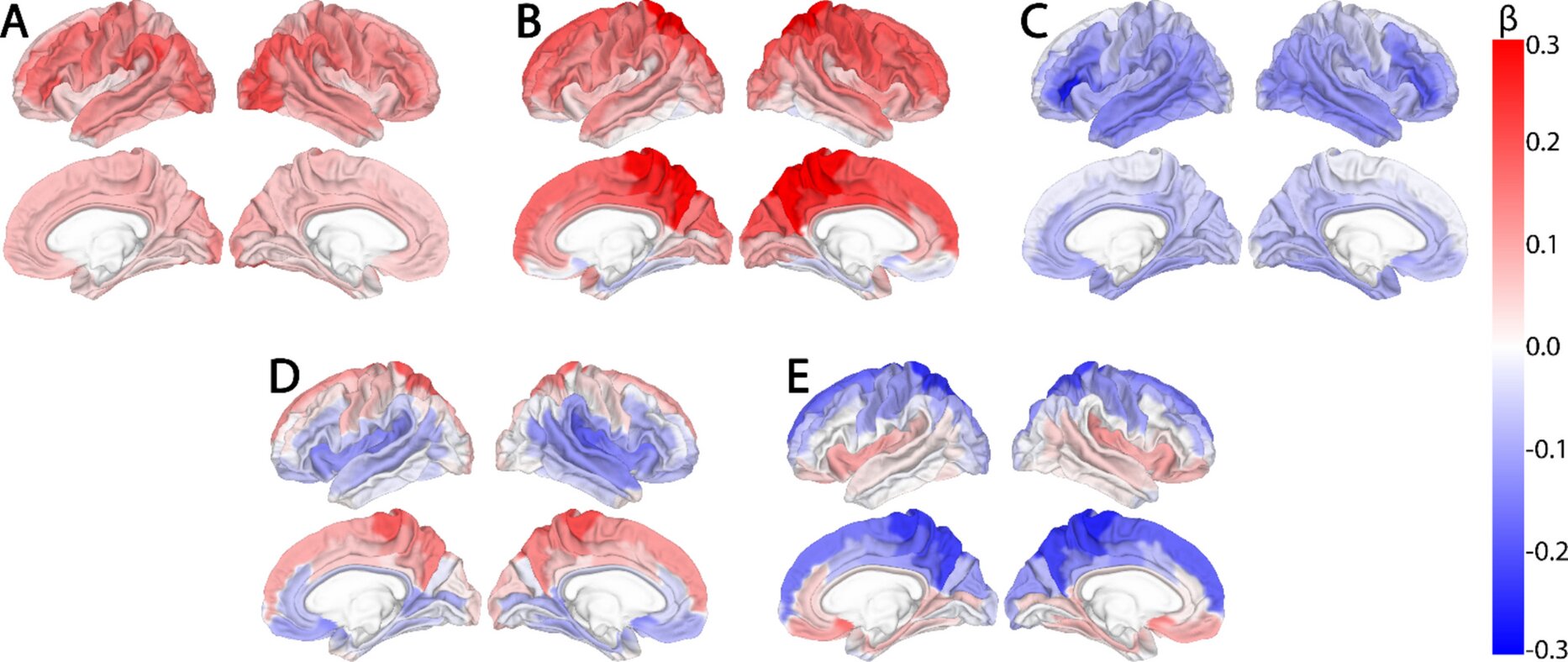
A landmark research paper for the first time maps the genetics of how individual regions of the brain age—and why some of those regions are the very ones most ravaged by Alzheimer’s and dementia. Published in the journal GeroScience, the paper is titled “Deep Neural Networks and Genome-Wide Associations Reveal the Polygenic Architecture of Local Brain Aging.”
A 19-year study reveals that mentally active sitting—such as reading or working—can reduce dementia risk, while passive sitting like watching TV increases it.
Can we “unlearn” fear using sound? Neuroscientists have shown that ultrasonic waves can help the brain overcome fearful memories. By targeting high-frequency vibrations at the amygdala, researchers slowed new fear formation and sped up the process of “unlearning” them. This non-invasive technology could be a breakthrough for treating PTSD and anxiety without surgery or drugs.
Older adults who develop delirium during a hospital admission face a substantially higher risk of dementia in later years, even if they had no prior health conditions, according to a major new population study.
A University of Michigan study indicates that young adults who frequently use substances like alcohol and cannabis may experience notably worse memory in later decades, with researchers comparing substance use from ages 18 to 30 to memory self-reports from ages 50 to 65.
A collaborative research study has, for the first time, identified a biological process that may help explain how the brain develops differently in people with Down syndrome.
Why do stressful moments so often push people toward habits like drinking? A new study offers one of the clearest answers yet, identifying a direct connection inside the brain that links stress to addiction-related behaviours. The work shows how alcohol disrupts the natural stress-response system, making it harder for the brain to adapt or make good decisions.
Researchers have developed a method that allows the increased movement of brain fluids during sleep to be tracked quickly and safely, without the need for injected contrast agents.
A research team has developed a synthetic “right-handed” protein fragment that is the mirror image of natural proteins, allowing it to intercept and neutralise disordered amyloid-beta proteins associated with Alzheimer’s disease, thereby preventing the formation of harmful plaques in the brain.
A new AI model can detect multiple cognitive brain diseases from a single blood sample.
Multiple regions of the brain engage in fast-moving conversations to understand language, researchers have discovered, dispelling a prior school of thought that only one region of the brain was responsible for language processing. The research was published in PLOS Biology.
The risk of Alzheimer’s disease significantly decreases in older adults who receive a higher dose of the influenza vaccine compared to the standard dose, according to new research.
Having higher levels of vitamin D in the blood in middle age is associated with lower levels of tau protein in the brain, which is a sign of dementia, years later, according to a study published in Neurology Open Access. The study does not prove that vitamin D levels lower the level of tau and the risk of dementia; it only shows an association.
How does the brain time its own development? A new study explores histone bivalency—an epigenetic “red and green light” system that prevents premature neuron maturation and helps adult brains respond to stress and injury.
An international study published across 34 countries shows that the biological age of the brain can be accelerated or delayed by environmental risk (air pollution, public housing conditions) and protective factors (socioeconomic equality, access to health care). The stronger effects arise from interactions among environmental, social, and political conditions.
Finally, this week, neuroscientists have demonstrated for the first time that noninvasive brain stimulation can alter the activity of a critical deep brain region involved in emotion and memory.
 inside-the-brain.com