Weekly Neuroscience Update

EPNorth

A virtual reality world called EVA Park can improve the communication of those who have impaired speech and language following a stroke, according to research by academics at City University London. The study, which is published in PLOS ONE, is the first exploration of multi-user virtual reality in aphasia therapy and shows the potential for technology to play an important role in improving the everyday lives of people with the condition.

A new study will look at how brain connections mature and develop from childhood to adulthood.

Neurons communicate by sending chemical signals called neurotransmitters across synapses, specialized connections between two individual cells. This communication requires a delicate and intricate molecular architecture. A recent paper published in Nature has now shown that the structure of this intercellular space is more complicated than previously thought, and it probably helps boost the efficiency of the signaling.

A new long term study of young marijuana users tracks the brain’s response to reward over time. The findings indicate a lower response to reward in marijuana users.

Neuroscientists at the University of Pittsburgh have identified the neural networks that connect the cerebral cortex to the adrenal medulla, which is responsible for the body’s rapid response in stressful situations. These findings, reported in the online Early Edition of the journal Proceedings of the National Academy of Sciences (PNAS), provide evidence for the neural basis of a mind-body connection.

A new study provides insight into how overconfidence can lead to poor decision making.

Scientists have identified part of our brain that helps us learn to be good to other people. The discovery could help understanding of conditions like psychopathy where people’s behaviour is extremely antisocial.

Finally this week, researchers have developed a neurodevelopmental model of a rare genetic disorder that could help shed light on the workings of the human social brain.

 

Weekly Neuroscience Update

reading-1156865_960_720

According to researchers, a brain area dedicated to reading skills has connections for the ability before children learn to read.

Researchers at the US Army Research Laboratory (ARL) have conducted studies to build a database on brain patterns that could help to predict how soldiers will react in  proactive and reactive states.

A new study reports vision relies on patterns of brain activity.

Eight people who have spent years paralyzed from spinal cord injuries have regained partial sensation and muscle control in their lower limbs after training with brain-controlled robotics, according to a study published Aug. 11 in Scientific Reports.

Contrary to an earlier study, researchers have discovered new hippocampal neurons formed as a result of exercise do not cause certain old memories to be forgotten.

Researchers report our gut bacteria is sensitive to melatonin and expresses its own circadian rhythm.

Researchers report the brain’s ‘physic engine’ helps predict how the world behaves.

A new study published in the journal Neurobiology of Aging revealed that middle-aged adults who were overweight had reduced white matter volume in the brain, compared with their lean counterparts.

A new study reports transcranial magnetic stimulation can significantly reduce phantom limb pain.

MIT engineers have developed a new device that replicates the neuromuscular junction — the vital connection where nerve meets muscle –  that could help test new treatments for ALS and other neuromuscular disorders.

Finally this week, researchers have identified two areas involved in a neural network that helps interpret situations as positive or negative.


Weekly Neuroscience Update

hearing-loss-frontal-cortex-neurosciencenews

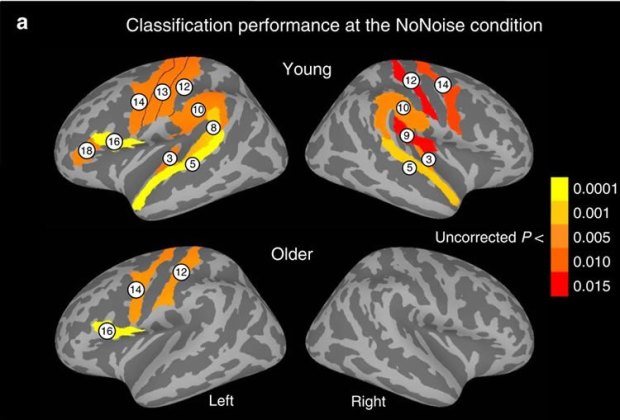
Regions with significant phoneme classification at the NoNoise condition for each group. NeuroscienceNews.com image is credited to the researchers/Nature Communications.

Researchers have pinpointed the specific part of the brain that older adults rely on to differentiate speech sounds in background noise, which could revolutionise the treatment of hearing loss.

New research has identified how cells protect themselves against ‘protein clumps’ known to be the cause of neurodegenerative diseases including Alzheimer’s, Parkinson’s and Huntington’s disease.

Transcranial alternating current stimulation may help to improve memory when targeted to a specific kind of brain activity achieved during sleep.

Researchers in the US and Australia have made a breakthrough discovery in the international quest to discover a new and potentially effective vaccine targeting the pathological proteins associated with Alzheimer’s disease.

A new study identifies different brain regions that become active when a strategy of categorisation is applied.

Researchers have developed a new machine learning system that analyses the entire human genome to predict which genes may cause autism spectrum disorder, raising the number of genes that could be linked to the disorder from 65 to 2,500.

Results from a study published in the online publication Nature Genetics finds 15 genomic regions that are significantly associated with a diagnosis of depression.

According to researchers, age related changes in the organization of neural networks when performing short term memory tasks may help to compensate for other aspects of brain aging.

Researchers report smoking related deficits in dopamine return to normal three months after quitting.

Genetic changes associated with Parkinson’s disease have been found in liver, fat, immune and developmental cells, a new study reports.

Brain imaging, twin studies and transcriptome data reveal genetic relationships between lobes.

Finally this week, a new study suggests regular physical activity may lead to greater hippocampal volume and could stave off dementia, especially in older people.


Weekly Neuroscience Update

protein-alzheimers-study-neurosciencenews

New research, using a Bayesian inference model of audio and visual stimuli, has shown how our perception of time lies mid-way between reality and our expectations.

Researchers have developed a virtual brain that can mimic the brain of a person with epilepsy. The model can help provide a better understanding of the disease.

Resting state brain activity may predict how quickly people are able to pick up a second language, a new study reports.

Researchers report that an odour identification test may prove useful in predicting cognitive decline and detecting early-stage Alzheimer’s disease.

A new study uses cutting-edge technique to image the process of neuronal transmission.

By scanning the brains of subjects while they were hypnotized, researchers were able to see the neural changes associated with hypnosis.

Yale University researchers have developed a way to picture synapses in living brains.

Music can influence how much you like the taste of beer, according to a study published in Frontiers in Psychology.

According to researchers, sleep twitches in babies could be linked to sensorimotor development.

A new study reports anatomical patterning in the brain’s cortex is controlled by genetic factors.

Finally this week, researchers have uncovered what goes on in our brains when we are faced with the decision to take a risk or play it safe.


Weekly Neuroscience Update

sleep

Sleep disturbances and long sleep duration are both associated with an increased risk for inflammation, a new study reports.

Abnormalities in brain regions involved in forming insight may help explain why some people with anorexia nervosa have trouble recognising their dangerous, dysfunctional eating habits.

A new study identifies different brain regions that become active when a strategy of categorisation is applied.

Researchers have identified – and shown that it may be possible to control – the mechanism that leads to the rapid build-up of the disease-causing ‘plaques’ that are characteristic of Alzheimer’s disease.

Using data from the largest ever genetic study of schizophrenia, researchers have shed light on the role of the immune system.

Using data from the Human Connectome Project, researchers have created a multimodal map of the human cortex that combines data from cortical architecture, function, connectivity, and topography. The map, detailed today (July 20) in Nature, identifies 180 brain areas, 97 of which are new to neuroscience.

A new study reports on how sensory neurons work together to transmit itch signals from the skin, via the spinal cord and to the brain.

A combination of transcranial magnetic stimulation and peripheral nerve stimulation may help in the rehabilitation of people with spinal cord injury, according to a new patient study conducted at the BioMag laboratory at the Helsinki University Hospital.

Researchers have discovered an interaction in neurons that contributes to Parkinson’s disease.

In a new study published in JAMA Neurology, researchers find stronger reason to be concerned about the long term effects of head injuries, particularly when it comes to Parkinson’s disease, which recently contributed to the death of Muhammad Ali.

Finally this week, researchers have identified how different parts of the brain interact with each other at different times in order to discover how intellect works.


Weekly Neuroscience Update

iphone-1283665_960_720

Sending text messages on a smartphone can change the rhythm of brain waves, according to a new study published in Epilepsy & Behavior.

An international research team has found that our perception is highly sensitised for absorbing social information. The brain is thus trained to pay a great degree of attention to everyday actions. The results are reported in the journal Consciousness and Cognition.

A new study unravels the mechanisms driving excess brain growth that affects as many as 30 percent of people with autism.

Researchers have developed a new technology that could lead to new therapeutics for traumatic brain injuries. The discovery, published in Nature Communications, provides a means of homing drugs or nanoparticles to injured areas of the brain.

Researchers have coupled machine learning with neuroimaging to detect early forms of dementia.

Neuroscientists have come up with a way to observe brain activity during natural reading. It’s the first time researchers have been able to study the brain while reading actual texts, instead of individual words. The research has potential implications for understanding dyslexia and other reading deficits.

A new study links hippocampal inflammation in multiple sclerosis with an increased risk of developing depression.

In a partnership melding neuroscience and electrical engineering, researchers have developed a new technology that will allow neuroscientists to capture images of the brain almost 10 times larger than previously possible – helping them better understand the behavior of neurons in the brain.

Researchers report acquiring new memories can interfere with old ones, making them more likely to be forgotten.

A European study has shown that the dopamine D2 receptor is linked to the long-term episodic memory, which function often reduces with age and due to dementia. This new insight can contribute to the understanding of why some but not others are affected by memory impairment. The results have been published in the journal PNAS.

Finally this week, a new study shows how new linguistic information is integrated into the same brain areas used for your native language.

Weekly Neuroscience Update

cheese

Cheese contains a chemical found in addictive drugs, scientists have found.

Chronic marijuana use disrupts the brain’s natural reward processes, according to researchers at the Center for BrainHealth at The University of Texas at Dallas.

Understanding the relation of dopamine to network activity could improve schizophrenia treatment.

Using MRI brain scans, researchers have determined there is an association between the extent of disruption to the blood-brain barrier and the severity of bleeding following a stroke.

Researchers have proposed a computational model that could help explain multisensory integration in humans.

Scientists have developed a blood test that could identify which people with depression will respond to treatment so that patients can avoid spending months taking antidepressants that do not help them.

Researchers have discovered a unique pattern of scarring in the brains of those who were exposed to blast brain injuries that differs from those exposed to other types of head injury.

Intensive physical exercise four hours after learning is the key to remembering information learnt, say Dutch researchers.

Scientists have discovered a new cause of Parkinson’s disease – mutations in a gene called TMEM230. This appears to be only the third gene definitively linked to confirmed cases of Parkinson’s disease.

Finally this week, a protein called Scribble appears to orchestrate the intracellular signaling process for forgetting, a new study reports.


Weekly Neuroscience Update

barefoot_running_480_18ec9t1-18ec9t4

Running barefoot is better than running with shoes for your working memory, according to a new study.

A new study from King’s College London offers clues as to why chronic pain can persist, even when the injury that caused it has gone. Although still in its infancy, this research could explain how small and seemingly innocuous injuries leave molecular ‘footprints’ which add up to more lasting damage, and ultimately chronic pain.

New findings demonstrate that a five-minute measurement of resting-state brain activity predicted how quickly adults learned a second language.

Danish research is behind a new epoch-making discovery, which may prove decisive to future brain research. The level of salts in the brain plays a critical role in whether we are asleep or awake. This discovery may be of great importance to research on psychiatric diseases such as schizophrenia and convulsive fits from lack of sleep as well as post-anaesthetization confusion.

Research sheds light the neural structure that controls our sleep, eating habits, hormones and more.

A new study has found that Foreign Accent Syndrome, a condition which results in patients to be perceived as non-native speakers of their mother tongue, may be caused by the impaired connections between the language centres in the front part of the brain and the cerebellum.

Symptoms of depression that steadily increase over time in older age could indicate early signs of dementia, according to new research. 

A newly discovered pathway leading to neurodegeneration in Alzheimer’s disease (AD) may unlock the door to new approaches for treating the disease.

Some adults learn a second language better than others, and their secret may involve the rhythms of activity in their brains.

Finally this week, researchers report they have discovered a backup for memory storage that comes into play when the molecular mechanism for primary long term memory storage fails.

Weekly Neuroscience Update


motor-neurons-corticospinal-tract-public

A new study presented in the journal Nature could change the view of the role of motor neurons. Motor neurons, which extend from the spinal cord to muscles and other organs, have always been considered passive recipients of signals from interneuronal circuits. Now, however, researchers from Sweden´s Karolinska Institutet have demonstrated a new, direct signalling pathway through which motor neurons influence the locomotor circuits that generate rhythmic movements.

Neuroimaging studies suggest that frontolimbic regions of the brain, structures that regulate emotions, play an important role in the biology of aggressive behaviour.

A team of researchers has discovered that differences in the types of memories we have influence the nature of our future encounters. Their findings show how distinct parts of the brain, underlying different kinds of memories, also influence our attention in new situations.

A gene involved in the regulation of emotions and behaviour could influence the long-term impact of violence experienced in childhood on antisocial behaviour.

Nerve cells have to react extremely quickly, but depending on the task they are supposed to perform they often need to work more slowly. Berlin scientists have now shown that a receptor in the synapse can adapt to follow both regimes. It’s another example of the amazing flexibility of the brain, manifested at the molecular level.

A new treatment aimed at clearing abnormal clumps of protein called tau tangles from the brain in Alzheimer’s disease is entering an early-stage clinical trial in the UK.

Scientists have identified a cerebral marker specific to autism that can be detected by MRI and is present as from the age of two years. The abnormality thus detected consists in a less deep fold in Broca’s area, a region of the brain specialized in language and communication, functions that are impaired in autistic patients. This discovery may assist in the earlier diagnosis and management of these patients.

A research initiative exploring the utility of genetic information in the clinical setting has published a study and identified six noteworthy genes that affect human sleep duration.

Individuals addicted to cocaine may have difficulty in controlling their addiction because of a previously-unknown ‘back door’ into the brain, circumventing their self-control, suggests a new study led by the University of Cambridge.

A simple, computer-training task can change the brain’s wiring to regulate emotional reactions, according to a recent study published in NeuroImage.

The workings of neural circuits associated with creativity are significantly altered when artists are actively attempting to express emotions, according to a new brain-scanning study of jazz pianists.

Finally this week, a new study has found that blocking a receptor in the brain responsible for regulating immune cells could protect against the memory and behaviour changes seen in the progression of Alzheimer’s disease.


Weekly Neuroscience Update

kaufmann_sleep_fmri

Missing out on a night’s sleep causes “robust alterations” in the functional connectivity of the brain, according to a new paper in Neuroimage.

Two genetic variants previously linked to Alzheimer’s disease have been more specifically tied to brain atrophy that is characteristic of the disease.

Researchers have identified the specific brain circuit that wakes us from sleep, and it could have great implications for the future of sleep disorder therapies.

Researchers have measured intriguing differences in the brain connectivity of individuals with internet gaming disorder.

New findings show that the brain devotes more processing resources to social situations that signal threat than those that are benign.

Researchers have discovered how to diagnose Alzheimer’s disease with more than 82 per cent accuracy by evaluating the interplay between four linguistic factors; and developing automated technology to detect these impairments.

Cumulative exposure to stress hormones affects the regulation of genes associated with aging and age-related diseases.