
Speech processing requires both sides of our brain

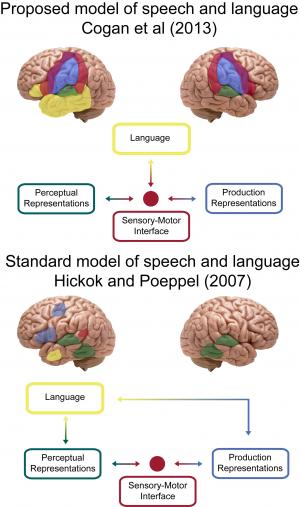
A new study by Cogan et al proposes that speech processes occur on both sides of the brain and are distinct from language, which occurs on one side, typically on the left. This suggests a revision to the standard model of how speech is linked to language with some processes going through a "bilateral sensory-motor interface". Credit: Greg Cogan and Bijan Pesaran

A new study by Cogan et al proposes that speech processes occur on both sides of the brain and are distinct from language, which occurs on one side, typically on the left. This suggests a revision to the standard model of how speech is linked to language with some processes going through a “bilateral sensory-motor interface”. Credit: Greg Cogan and Bijan Pesaran

A new study has found that we use both sides of our brain for speech, a finding that alters previous conceptions about neurological activity. The results, which appear in the journal Nature, also offer insights into addressing speech-related inhibitions caused by stroke or injury and lay the groundwork for better rehabilitation methods.

The study’s senior author, Bijan Pesaran, an associate professor in New York University’s Center for Neural Science, said:

Our findings upend what has been universally accepted in the scientific community—that we use only one side of our brains for speech. With this greater understanding of the speech process, we can retool rehabilitation methods in ways that isolate speech recovery and that don’t involve language.

Read more: Sensory–motor transformations for speech occur bilaterally


Weekly Neuroscience Update

scientists develop video game for stroke

Scientists have developed a therapeutic at-home 3D gaming programme to help stroke patients overcome motor weakness, which affects 80 per cent of survivors.

Using a video game in which people navigate through a virtual town delivering objects to specific locations, a team of neuroscientists has discovered how brain cells that encode spatial information form “geotags” for specific memories and are activated immediately before those memories are recalled.

Establishing links between genes, the brain and human behavior is a central issue in cognitive neuroscience research, but studying how genes influence cognitive abilities and behavior as the brain develops from childhood to adulthood has proven difficult. Now, an international team of scientists has made inroads to understanding how genes influence brain structure and cognitive abilities and how neural circuits produce language.

Stanford University School of Medicine neuroscientists have discovered a new role played by a common but mysterious class of brain cells.

A new study using brain imaging has shown the effect of the chronic pain drug pregalbin on the brain, giving researchers new insight on the treatment of fibromyalgia and other chronic pain disorders.

A study published recently in the Journal of Neuroscience points, for the first time, to the gene trkC as a factor in susceptibility to panic disorder. The researchers define the specific mechanism for the formation of fear memories which will help in the development of new pharmacological and cognitive treatments.

Finally, in the largest study on the topic to date, research shows that speaking a second language may delay the onset of three types of dementias.  The study found that people who spoke two languages developed dementia four and a half years later than people who only spoke one language.


Weekly Neuroscience Update

Childhood poverty impacted how much the two regions of the prefrontal cortex (as shown in orange circles) were engaged during emotion regulation. (Credit: University of Illinois at Chicago College of Medicine)

Childhood poverty impacted how much the two regions of the prefrontal cortex (as shown in orange circles) were engaged during emotion regulation. (Credit: University of Illinois at Chicago College of Medicine)

Childhood poverty and chronic stress may lead to problems regulating emotions as an adult, according to research published online in the Proceedings of the National Academy of Sciences.

New research shows that one of the brain’s fundamental self-protection mechanisms depends on coordinated, finely calibrated teamwork among neurons and non-neural cells knows as glial cells, which until fairly recently were thought to be mere support cells for neurons. The study, which has implications for understanding neurodegenerative diseases, stroke, and other nervous system disorders, adds to a growing body of evidence that glial cells are integral to brain function.

Researchers at higher education institutions have identified six proteins in spinal fluid that can be used as markers for Alzheimer’s disease. And another study suggests that older adults who don’t sleep well have more of the brain plaques that are hallmarks of Alzheimer’s.

Researchers from the Centre for Functional Resonance Imaging of the Brain (FMRIB) at the University of Oxford in the UK, say through monitoring patients’ brain waves while under anesthetic, they were able to pinpoint degrees of consciousness dependent on the doses of anesthetic administered.

Finally, this week, a new study from the UCLA School of Nursing shows that the body’s autonomic responses — the controls that impact such functions as blood pressure, heart rate and sweating — are weaker in people with obstructive sleep apnea but are even more diminished in women.

Weekly Neuroscience Update

Feeling happy or sad? Researchers have measured brain signals to accurately read emotions in individuals. (Credit: Karim S. Kassam et al PLOS ONE 10.1371/journal.pone.0066032)

For the first time, scientists at Carnegie Mellon University have identified which emotion a person is experiencing based on brain activity.

Pre-treatment scans of brain activity predicted whether depressed patients would best achieve remission with an antidepressant medication or psychotherapy, in a new study.

People who experience any stroke symptoms—but do not have a stroke—may also be more likely to develop problems with memory and thinking, according to new research published in the June 19, 2013, online issue of Neurology®, the medical journal of the American Academy of Neurology.

And finally this week, a study, led by Royal Holloway University researcher Carolyn McGettigan, has identified the brain regions and interactions involved in impersonations and accents.

Weekly Neuroscience Update

A boxer utilizing the new concussion-detecting test A new tablet-based test is able to detect whether or not someone has sustained a concussion by analyzing their voice.

An international team of neuroscientists has described for the first time in exhaustive detail the underlying neurobiology of an amnesiac who suffered from profound memory loss after damage to key portions of his brain.

A fitness device created by Glasgow academics and designers helps stroke patients during their long road to recovery.

For anyone who has been affected by depression  it is no secret how devastating the disease can be for them and their families. But if the results from a small study published by a group at Germany’s Bonn University Hospital hold up, there could be a radical transformation in the treatment of depression.

An excess of the brain neurotransmitter glutamate may cause a transition to psychosis in people who are at risk for schizophrenia, reports a study from investigators at Columbia University Medical Center (CUMC) published in the current issue of Neuron.

New research finds that prisoners who are psychopaths lack the basic neurophysiological “hardwiring” that enables them to care for others.

The area of the brain that’s activated when people look at numerals such as “7” and “60” has been pinpointed by researchers. This spot is only about one-fifth of an inch across and consists of 1 million to 2 million nerve cells in the inferior temporal gyrus, the researchers said. The inferior temporal gyrus is known to be involved in the processing of visual information.

And finally this week, habitual liars’ brains differ from those of honest people, a study says. A University of Southern California team studied 49 people and found those known to be pathological liars had up to 26% more white matter than others

Weekly Neuroscience Update

Researchers at the University of Southern California (USC) are developing SimSensei, a Kinect-driven avatar system capable of tracking and analyzing telltale signs of psychological distress. The avatar psychologist uses facial recognition technology and a depth-sensing camera to read a person’s facial movements, body movements, posture, linguistic patterns and acoustics to screen for depression.

A new functional magnetic resonance imaging (fMRI) technique may provide neurosurgeons with a non-invasive tool to help in mapping critical areas of the brain before surgery, reports a study in the April issue of Neurosurgery, official journal of the Congress of Neurological Surgeons.

For the first time, scientists have been able to predict how much pain people are feeling by looking at images of their brains, according to a new study led by the University of Colorado Boulder.The findings, published today in the New England Journal of Medicine, may lead to the development of reliable methods doctors can use to objectively quantify a patient’s pain

New research has shown that the way our minds react to and process emotions such as fear can vary according to what is happening in other parts of our bodies.

UCLA researchers have used a brain-imaging tool and stroke risk assessment to identify signs of cognitive decline early on in individuals who don’t yet show symptoms of dementia.

People with mental illnesses are more than seven times more likely to use cannabis weekly compared to people without a mental illness, according to researchers from the Centre for Addiction and Mental Health (CAMH) who studied U.S. data.

Weekly Neuroscience Update

The phrase “practice makes perfect” has a neural basis in the brain. Researchers have discovered a set of common changes in the brain upon learning a new skill. They have essentially detected a neural marker for the reorganization the brain undergoes when a person practices and become proficient at a task.

Researchers at the University of East Anglia have made a discovery in neuroscience that could offer a long-lasting solution to eating disorders such as obesity.

A new study conducted by The Mind Research Network , shows that neuroimaging data can predict the likelihood of whether a criminal will reoffend following release from prison.

The ability to communicate in multiple languages not only provides doorways to new cultural and social experiences but also apparently promotes brain growth and staves off the onset of dementia and Alzheimer’s disease.

Researchers have discovered a potential way to decode your dreams, predicting the content of the visual imagery you’ve experienced on the basis of neural activity recorded during sleep.

Brain researchers at Barrow Neurological Institute have discovered that we explore the world with our eyes in a different way than previously thought. Their results advance our understanding of how healthy observers and neurological patients interact and glean critical information from the world around them.

In a study designed to differentiate why some stroke patients recover from aphasia and others do not, investigators have found that a compensatory reorganization of language function to right hemispheric brain regions bodes poorly for language recovery. Patients who recovered from aphasia showed a return to normal left-hemispheric language activation patterns. These results, which may open up new rehabilitation strategies, are available in the current issue of Restorative Neurology and Neuroscience.


Weekly Neuroscience Update

A run of poor sleep can have a potentially profound effect on the internal workings of the human body, say UK researchers.

As a bird sings, some neurons in its brain prepare to make the next sounds while others are synchronized with the current notes—a coordination of physical actions and brain activity that is needed to produce complex movements, new research at the University of Chicago shows. In an article in the current issue of Nature, neuroscientist Daniel Margoliash and colleagues show, for the first time, how the brain is organized to govern skilled performance—a finding that may lead to new ways of understanding human speech production.

Deep brain stimulation has helped people with severe obsessive-compulsive disorder, and new research begins to explain why. A Dutch study appearing in the Feb. 24 online issue of the journal Nature Neuroscience found the procedure essentially restored normal function in a part of the brain called the nucleus accumbens.

Researchers have identified a possible treatment window of several years for plaques in the brain that are thought to cause memory loss in diseases such as Alzheimer’s. The Mayo Clinic study is published in the Feb. 27 online issue of Neurology.

Though it’s most often associated with disorders like diabetes, Harvard researchers have shown how the signaling pathway of insulin and insulin-like peptides plays another critical role in the body – helping to regulate learning and memory.

Researchers in Scotland and Germany have discovered a molecular mechanism that shows promise for developing a cure for Huntington’s Disease (HD).

Some people do not learn from their mistakes because of the way their brain works, according to research led by an academic at Goldsmiths, University of London. The research examined what it is about the brain that defines someone as a ‘good learner’ from those who do not learn from their mistakes.

Scientists from the University of Oxford say they have discovered how the brain protects itself from damage that occurs in stroke.

A team of French researchers has discovered that the human brain is capable of distinguishing between different types of syllables as early as three months prior to full term birth. 

Weekly Neuroscience Update

xbox

When selecting a video game to play, opting to turn on your Wii may provide a different experience than playing your Xbox, according to a study from Mississippi State University.

Excessive alcohol use accounts for 4% of the global burden of disease, and binge drinking particularly is becoming an increasing health issue. A new review article published Cortex highlights the significant changes in brain function and structure that can be caused by alcohol misuse in young people.

Working with patients with electrodes implanted in their brains, researchers have shown for the first time that areas of the brain work together at the same time to recall memories. The unique approach promises new insights into how we remember details of time and place.

Researchers at the University of Glasgow are hoping to help victims of stroke to overcome physical disabilities by helping their brains to ‘rewire’ themselves.

Keeping active can slow down the progression of memory loss in people with Alzheimer’s disease, a study has shown.

Neuroscientists have released the results of a new study that examines how fear responses are learned, controlled, and memorized. They show that a particular class of neurons in a subdivision of the amygdala plays an active role in these processes.

Neuroscience researchers from Tufts University have found that our star-shaped brain cells, called astrocytes, may be responsible for the rapid improvement in mood in depressed patients after acute sleep deprivation. This in vivo study, published in the current issue ofTranslational Psychiatry, identified how astrocytes regulate a neurotransmitter involved in sleep. The researchers report that the findings may help lead to the development of effective and fast-acting drugs to treat depression, particularly in psychiatric emergencies.

UC Berkeley neuroscientists have found that the slow brain waves generated during the deep, restorative sleep we typically experience in youth play a key role in transporting memories from the hippocampus – which provides short-term storage for memories – to the prefrontal cortex’s longer term “hard drive.”

Researchers have found altered connectivity in the brain network for body perception in people with anorexia: The weaker the connection, the greater the misjudgement of body shape.

A group of scientists planning to map all the major connections in the human brain began studying their first test subjects in August. The $30 million Human Connectome Project will trace the main neural pathways that link the roughly 500 major regions in the brain, illuminating how biological circuitry underlies our mental functions. MRI scans of 1,200 people, including 300 pairs of twins, will be used to compile an atlas of communication routes throughout the brain. The resulting blueprint will also reveal how brain connectivity varies from person to person.
Weekly Neuroscience Update

Mind wandering may increase creative thinking, according to a new international study.

Simple mental activity such as reading, writing, playing games and doing puzzles may protect brain health in old age, according to a new study.

Reduced production of myelin, a type of protective nerve fiber that is lost in diseases like multiple sclerosis, may also play a role in the development of mental illness, according to researchers at the Graduate School of Biomedical Sciences at Mount Sinai School of Medicine.

A small molecule known to regulate white blood cells has a surprising second role in protecting brain cells from the deleterious effects of stroke, Johns Hopkins researchers report.

Scientists have revealed the minutely detailed pain map of the hand that is contained within our brains, shedding light on how the brain makes us feel discomfort and potentially increasing our understanding of the processes involved in chronic pain.

People with Parkinson’s disease benefit from exercise programs on stationary bicycles, with the greatest effect for those who pedal faster, according to a study presented at the annual meeting of the Radiological Society of North America (RSNA).

A new method to study widespread networks of neurons responsible for our memory has been discovered by scientists from the Max Planck Institute for Biological Cybernetics.

The first study to estimate rates of traumatic brain injury (TBI), without relying on official figures, suggests the worldwide incidence of TBI could be six times higher than previously estimated.

MRI shows changes in the brains of people with post-concussion syndrome (PCS), according to a new study published online in the journal Radiology. Researchers hope the results point the way to improved detection and treatment for the disorder.

photo credit: pamlau.com via photopin cc