Weekly Neuroscience Update

Granule cells connect with other cells via long projections (dendrites). The actual junctions (synapses) are located on thorn-like protuberances called “spines”. Spines are shown in green in the computer reconstruction Credit DZNE/Michaela Müller.

Granule cells connect with other cells via long projections (dendrites). The actual junctions (synapses) are located on thorn-like protuberances called “spines”. Spines are shown in green in the computer reconstruction Credit DZNE/Michaela Müller.

New findings on the link between nerve cells at the interface to the hippocampus may have an influence on learning and memory.

People choosing between two or more equally positive outcomes experience paradoxical feelings of pleasure and anxiety, feelings associated with activity in different regions of the brain, according to research at the Princeton Neuroscience Institute at Princeton University.

Latest findings on how stress hormones promote the brain’s building of negative memories.

Researchers have studied the changes in the brain that are associated with impulsiveness, a personality trait that causes difficulties in inhibiting a response in the face of a stimulus and leads to unplanned actions without considering the negative consequences. These patterns can serve as an indicator for predicting the risk of behavioural problems.

People taking dopamine for Parkinson’s disease sometimes begin to generate a lot of artwork. New research differentiates their expressiveness from obsessive or impulsive tendencies.

Researchers have uncovered more than 100 genetic markers linked to developing schizophrenia.

A type of immune cell widely believed to exacerbate chronic adult brain diseases, such as Alzheimer’s disease and multiple sclerosis (MS), can actually protect the brain from traumatic brain injury (TBI) and may slow the progression of neurodegenerative diseases, according to research published in the online journal Nature Communications.

Weekly Neuroscience Update

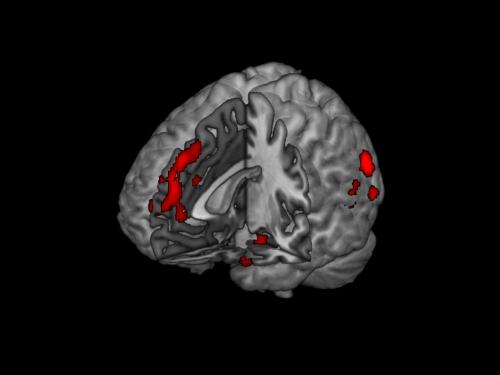
Neuroscience research demonstrates that the brain regions underpinning moral judgment share resources with circuits controlling other capacities such as emotional saliency, mental state understanding and decision-making. Credit: Jean Decety

Neuroscience research demonstrates that the brain regions underpinning moral judgment share resources with circuits controlling other capacities such as emotional saliency, mental state understanding and decision-making. Credit: Jean Decety

People who care about justice are swayed more by reason than emotion, according to new brain scan research from the Department of Psychology and Center for Cognitive and Social Neuroscience. Researchers have discovered a gene that is likely to play a role in the risk of psychosis in bipolar disorders.

A new way to artificially control muscles using light, with the potential to restore function to muscles paralysed by conditions such as motor neuron disease and spinal cord injury, has been developed by scientists at UCL and King’s College London.

Researchers at the University of California, San Diego School of Medicine and the Allen Institute for Brain Science have published a study that gives clear and direct new evidence that autism begins during pregnancy.

A new study is the first documented study that shows cognitive behavioral therapy in a group setting is capable of changing the brain structure in patients with chronic pain.

By examining the sense of touch in stroke patients, a University of Delaware cognitive psychologist has found evidence that the brains of these individuals may be highly plastic even years after being damaged.

A new chemical messenger that is critical in protecting the brain against Parkinson’s disease has been identified by scientists.

Scents and smells can form the basis of some of the most significant memories humans form in their lives, a new study suggests

In the first study of its kind, two researchers have used popular music to help severely brain-injured patients recall personal memories.

Weekly Neuroscience Update

painThe problem with diagnosing and treating pain is that it’s so subjective. But a new paper in Pain says that brain structure may hold some answers.

Adding cognitive-behavioral therapy (CBT) to the treatment of migraines in children and adolescents resulted in greater reductions in headache frequency and migraine-related disability compared with headache education, according to a new study.

Scientists have discovered how salt acts as a key regulator for drugs used to treat a variety of brain diseases including chronic pain, Parkinson’s disease, and depression.

Research focused on the amygdala can help identify children at risk for anxiety disorders and depression.

Whales, bats, and even praying mantises use ultrasound as a sensory guidance system – and now a new study has found that ultrasound can modulate brain activity to heighten sensory perception in humans.

Scientists have shown that there are widespread differences in how genes, the basic building blocks of the human body, are expressed in men and women’s brains.

A new study shows a leftward asymmetry of the choroid plexus in two-thirds of first-trimester human fetuses. This is the earliest brain asymmetry so far identified and may be a precursor to other asymmetries, including that of the temporal planum, which is evident from the 31st week of gestation.

Researchers have discovered the mechanism in the brain responsible for the motor and vocal tics found in Tourette Syndrome.  The study, published in the British Psychological Society’s Journal of Neuropsychology, could at some point lead to new non-drug therapies.

A new study by neuroscientists is the first to directly compare brain responses to faces and objects with responses to colors.

A study begun in Mexico with the collaboration of university students has analysed the effect of weekend alcohol consumption on the lipids comprising cell membrane and its genetic material, i.e. DNA.

Weekly Neuroscience Update

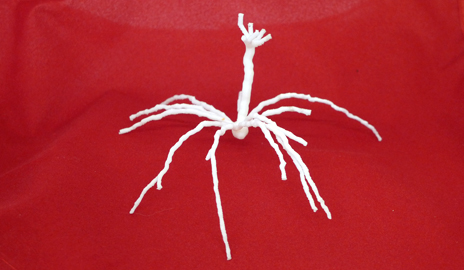
3D-printed model of a neuron (credit: Yale University)

3D-printed model of a neuron (credit: Yale University)

A Yale neuroscientist  has created the first 3D-printed neuron.

Studies released today suggest promising new treatments for nicotine and heroin addiction, and further our understanding of pathological gambling and heroin abuse in those suffering chronic pain. This new knowledge, released at Neuroscience 2013, the annual meeting of the Society for Neuroscience (SFN) and the world’s largest source of emerging news about brain science and health, may one day lead to non-pharmaceutical interventions and therapies to treat addiction. Also presented at SFN, new studies revealing links between social status and specific brain structures and activity, particularly in the context of social stress.

A new study has found that people experiencing a depressive episode process information about themselves differently than people who are not depressed.

To flexibly deal with our ever-changing world, we need to learn from both the negative and positive consequences of our behaviour. In other words, from punishment and reward. Hanneke den Ouden from the Donders Institute in Nijmegen demonstrated that serotonin and dopamine related genes influence how we base our choices on past punishments or rewards. This influence depends on which gene variant you inherited from your parents. These results were published in Neuron on November 20.

Brain scans reveal that people with fibromyalgia are not as able to prepare for pain as healthy people, and they are less likely to respond to the promise of pain relief.

Scientists have used RNA interference (RNAi) technology to reveal dozens of genes which may represent new therapeutic targets for treating Parkinson’s disease. The findings also may be relevant to several diseases caused by damage to mitochondria, the biological power plants found in cells throughout the body.

Playing a fast-paced strategy video games can help the brain to become more agile and improve strategic thinking, according to new research.

While young children sleep, connections between the left and the right hemispheres of their brain strengthen, which may help brain functions mature, according to a new study by the University of Colorado Boulder.  And in another sleep study, a team of sleep researchers  has confirmed the mechanism that enables the brain to consolidate memory and found that a commonly prescribed sleep aid enhances the process. Those discoveries could lead to new sleep therapies that will improve memory for aging adults and those with dementia, Alzheimer’s and schizophrenia.

Weekly Neuroscience Update

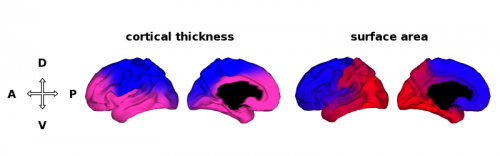
Maps of the brain based on genetic correlation clusters, when only two clusters are specified. This approach solution identified a dorsal-ventral (D-V, i.e., top to bottom) division as the most distinct partition in the genetic patterning of cortical thickness. By contrast, for surface area the two genetic clusters form an anterior-posterior (A-P, i.e., front to back) division. Abbreviations: D, dorsal; V, ventral; A, anterior; P, posterior. Credit: Chi-Hua Chen, Ph.D., UCSD

Maps of the brain based on genetic correlation clusters, when only two clusters are specified. This approach solution identified a dorsal-ventral (D-V, i.e., top to bottom) division as the most distinct partition in the genetic patterning of cortical thickness. By contrast, for surface area the two genetic clusters form an anterior-posterior (A-P, i.e., front to back) division. Abbreviations: D, dorsal; V, ventral; A, anterior; P, posterior. Credit: Chi-Hua Chen, Ph.D., UCSD

An international research team studying the structure and organization of the brain has found that different genetic factors may affect the thickness of different parts of the cortex of the brain.

Johns Hopkins researchers say they have pinpointed a site in a highly developed area of the human brain that plays an important role in the subconscious recognition of which way is straight up and which way is down. The finding, described online in the journal Cerebral Cortex, may help account for some causes of spatial disorientation and dizziness, and offer targets for treating the feelings of unsteadiness and “floating” people experience when the brain fails to properly integrate input from the body’s senses.

The discovery of the first chemical to prevent the death of brain tissue in a neurodegenerative disease has been hailed as the “turning point” in the fight against Alzheimer’s disease.

A bedside scan could reveal an active mind hidden inside an unresponsive body. The method provides another tool for recognising consciousness in people who have been wrongly diagnosed as being in a vegetative state. Tests are also under way to use it to monitor people under general anaesthetic, to make sure they do not regain consciousness during an operation.

The more you want to use your brain – and the more you enjoy doing it – the more likely you are to stay sharp as you age. This is according to findings recently published in the Journals of Gerontology: Psychological Sciences.

A team of scientists have identified neural circuits that modulate REM sleep. 

People who are depressed may have triple the risk of developing Parkinson’s disease, according to a study published in the October 2, 2013, online issue of Neurology

Scientists have discovered a process by which the “power plants” of the brain – tiny mitochondria found inside cells – signal that they are damaged and need to be eliminated. This is according to a study published in the journal Nature Cell Biology.

The hormone vasopressin may play a key role in jet lag, new research suggests.

Researchers have gained new insight into how localized hearing works in the brain. Their research is published in the Oct. 2, 2013 issue of the Journal of Neuroscience.

Weekly Neuroscience Update

Drumming

People who are better able to move to a beat show more consistent brain responses to speech than those with less rhythm, according to a study published in the September 18 issue of The Journal of Neuroscience. The findings suggest that musical training could possibly sharpen the brain’s response to language.

Concussions are connected with substance abuse and suicidal thoughts in adolescents, according to new research presented at a conference on sports-related brain injuries.

The structure of the brain may predict whether a person will suffer chronic low back pain, according to researchers who used brain scans. The results, published in the journal Pain, support the growing idea that the brain plays a critical role in chronic pain, a concept that may lead to changes in the way doctors treat patients.

A drug commonly used for treating diabetes may reverse symptoms of late-stage Alzheimer’s disease and is now in the process of entering a major clinical trial.

Scientists have found a new link between early-onset Parkinson’s disease and a piece of DNA missing from chromosome 22. The findings help shed new light on the molecular changes that lead to Parkinson’s disease.

The pain and itching associated with shingles and herpes may be due to the virus causing a “short circuit” in the nerve cells that reach the skin, researchers have found.

In a new study looking at toddlers and preschoolers with autism, researchers have found that children with better motor skills were more adept at socializing and communicating. This study adds to growing evidence of the important link between autism and motor skill deficits. Motor skills and muscle memory are held in the cerebellum.

Scientists have discovered differences in the brain structure of ballet dancers that may help them avoid feeling dizzy when they perform pirouettes.

New research could offer solutions into slowing down the progression of motor neurone disease (MND).

Playing first person action games can enhance your perception of movement – but only when you’re walking backwards. This is one of the findings of a new paper by University of Leicester psychologists, published in the journal Perception, which examines the effect of playing video games on motion perception.

Two new studies investigate the relationship between self-control and reward processing for chronic dieters and people who would like to control their food intake.

Scientists say they have discovered the specific brain circuitry that causes overeating, according to a study published in the journal Science.

Bad experiences enhance memory formation about places, scientists at The University of Queensland have found.

Finally this week, a new study from MIT reveals a gene that is critical to the process of memory extinction. Enhancing the activity of this gene, known as Tet1, might benefit people with posttraumatic stress disorder (PTSD) by making it easier to replace fearful memories with more positive associations,

Weekly Neuroscience Update

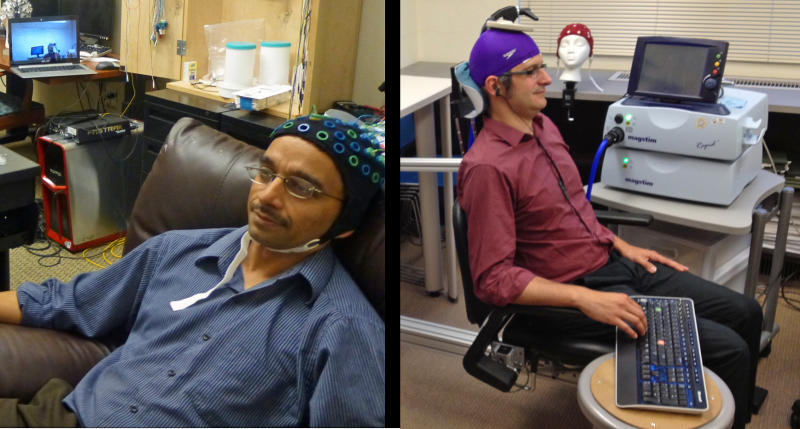
University of Washington University of Washington researcher Rajesh Rao, left, plays a computer game with his mind. Across campus, researcher Andrea Stocco, right, wears a magnetic stimulation coil over the left motor cortex region of his brain. Stocco’s right index finger moved involuntarily to hit the “fire” button as part of the first human brain-to-brain interface demonstration. (Credit: Image courtesy of University of Washington)

University of Washington University of Washington researcher Rajesh Rao, left, plays a computer game with his mind. Across campus, researcher Andrea Stocco, right, wears a magnetic stimulation coil over the left motor cortex region of his brain. Stocco’s right index finger moved involuntarily to hit the “fire” button as part of the first human brain-to-brain interface demonstration. (Credit: Image courtesy of University of Washington)

University of Washington researchers have performed what they believe is the first noninvasive human-to-human brain interface, with one researcher able to send a brain signal via the Internet to control the hand motions of a fellow researcher.

A new study strengthens the link between amyotrophic lateral sclerosis (ALS) and problems in protein production machinery of cells and identifies a possible treatment strategy.

A team of neuroscientists has found a key to the reduction of forgetting. Their findings, which appear in the journal Neuron, show that the better the coordination between two regions of the brain, the less likely we are to forget newly obtained information.

Sleep is well-known to help us better understand what we have learned. But now, researchers believe they have discovered exactly how sleep helps our brains to better learn specific motor tasks, such as typing or playing the piano.

With Magnetic Resonance Imaging (MRI), researchers have identified specific markers in the brain which could help predict whether people with psychosis will respond to antipsychotic medications.

New findings published in the journal Nature show how one component of the brain’s circuitry – inhibitory neurons – behave during critical periods of learning.

Researchers report the first biomarker results reported from the Parkinson’s Progression Markers Initiative (PPMI), showing that a comprehensive test of protein biomarkers in spinal fluid have prognostic and diagnostic value in early stages of Parkinson’s disease. The study is reported in JAMA Neurology.

Why Parkinson’s Disease Has Robbed Linda Ronstadt Of Her Singing Voice

Singer Linda Rondstadt has recently been diagnosed with Parkinson's disease.

Singer Linda Rondstadt has recently been diagnosed with Parkinson’s disease.

The news that Linda Ronstadt has lost her powerful voice after a four-decade singing career as a result of Parkinson’s disease shocked not just the singer, but her many fans.

The 67-year-old Grammy-winning singer revealed last week that she struggled with symptoms of the disease for nearly eight years before getting her diagnosis just months ago. The neurological degenerative condition robs sufferers of their speech, mobility and their cognitive abilities.

During my career, I have spent almost 30 years investigating the effects of Parkinson’s disease on the brain and  I have seen great strides in our understanding and treatment of this illness.

What is Parkinson’s disease?

Over 4 million people worldwide suffer from Parkinson’s disease – a so-called hypokinetic disorder (hypo = lack of; kinetic = movement). Parkinson’s disease can be genetic but it can also be triggered by brain injury – as observed in boxers such as Muhammad Ali – and by environment – e.g. prolonged exposure to chemicals such as insecticides, weed killers and some drugs.  However in most cases Parkinson’s disease arises ‘out of the blue’ – i.e. idiopathic Parkinson’s disease. It is a progressive disease the symptoms start out small and get progressively worse but it is rarely fatal.

Three major symptoms

The disease is associated with three major symptoms (i) akinesia – an inability to start a movement – for instance when starting to brush your teeth, (ii) bradykinesia – an excessive braking or slowing of movement – when the brush strokes become shorter and eventually freeze and (iii) tremor – starting out as a trembling finger movements as if rolling a coin or pill – sometimes called ‘pill-rolling’ – which can progress to the whole body. With Parkinson’s disease one minute you are working away in the garden and the next you are literally stuck to the spot – totally unable to move. In these situations daily life can become a challenge that can be difficult to endure.

History

The disease is named after a British surgeon and political activist James Parkinson (1755-1824) who was born in London’s east end. In October 1794 he was questioned under oath before a council of state in connection with a plot to kill the King. He was exonerated but remained a strong advocate for the under-privileged. In 1817 he published An Essay on the Shaking Palsy reporting 6 cases. Although his publication was later considered the seminal work on the disease, it received little attention until a lot more cases came to light.

Where in the brain does Parkinson’s disease occur?

The Nobel Prize was awarded in 2000 to Professor Arvid Carlsson for his research over the past 50 years which confirmed that the ‘core defect’ in Parkinson’s disease is a loss of a chemical called dopamine in two tiny brain regions  – no bigger than a wart – called the substantia nigra. These two regions deep in the back of the brain – one on the left side and one on the right side – contain nerves that make a lot of dopamine and release it at their tips about 4 inches forward in the basal ganglia – located deep in the center of the brain where it helps to convert the intention/motivation needed to perform a movement into actual movement.

The core defect is a loss of dopamine

Dopamine belongs to a family of neurotransmitters called amines that help nerve cells to stay in touch with each other- sometimes called neurotransmitters. Dopamine acts like hydraulic oil which lubricates the basal ganglia nerve network involved in executing a movement. One only needed to go to watch Linda perform on stage at the height of her career to see dopamine in action as her brain effortlessly converted her thoughts and moods into the mesmerizing tonality, rhythm and range that made her so loved by a generation. In Parkinson’s disease the substantia nigra progressively dies, the supply of dopamine to the basal ganglia dries-up and like a car out of oil the engine seizes-up and movement grinds to a halt.

Trapped and disconnected

We need dopamine to survive. Dopamine allows us to talk, sing, socialize, improvise and take risks. When dopamine flows we don’t see things as being limited by circumstance. We have boundless energy and literally anything is possible!  Without dopamine we feel trapped and disconnected. It is not surprising therefore that mood can become low and depression is often associated with this illness.

Medication is expensive

Over the past 40 years neuroscientists been working hard to develop drugs that can safely raise dopamine levels in the Parkinsonian brain – the so-called antiparkinsonian drugs – and better, more effective treatments come on the market every decade.  Drug treatments are effective in managing symptoms but frequent changes are needed as the disease progresses. In the end many combinations of drugs at higher and higher doses may be needed and unpleasant side-effects may become an issue. Medication costs on average €100,000 per year.  Interestingly, the inexpensive anti-inflammatory drug ibuprofen has recently been shown to help stave off Parkinson’s disease possibly by protecting the substantia nigra but ibuprofen can itself produce unwanted side effects, including stomach bleeding.

Alternatives to drug-treatment?

deep  brain stimulation

Neuroscientists believe that the loss of the dopamine-rich nerves in the substantia nigra results is an over-activity of a ‘brake’ mechanism in the basal ganglia which in turn inappropriately shuts down movement.  Deep brain stimulation (DBS) takes advantage of our knowledge of this brain wiring by applying a small electric current into a target area called the subthalamic nucleus located deep within the basal ganglia to switch off the brake and free-up movement. It is an expensive and risky procedure but it can provide a new lease of life particularly to those patients for whom conventional drug treatment no longer seem to work.

The politics of brain research

Probably the most important lesson to be taken from Linda’s illness is that we need to open up a debate on how we as a society fund research into brain illness and highlight the realization that a deeper understanding of the brain IS the difference between a good and a bad quality of life for the sufferers of brain illnesses such as Parkinson’s disease.

I hope that Linda and her loved ones will take hope from the on-going research into Parkinson’s disease by teams of dedicated scientists worldwide.

Click on the link below to hear Professor Billy O’Connor talk about Parkinson’s disease on Mind Matters – a science programme on RTE radio.

http://www.podcastdirectory.com/episodes/mind-matters-on-parkinson-s-disease-3465171.html

Weekly Neuroscience Update

sad music

Sad music might actually evoke positive emotions reveals a new study by Japanese researchers. The findings help to explain why people enjoy listening to sad music, say Ai Kawakami and colleagues from Tokyo University of the Arts and the RIKEN Brain Science Institute, Japan.

Extroverts may be more outgoing and cheerful in part because of their brain chemistry, reports a study by Cornell neuroscientists.

Researchers at Neuroscience Research Australia (NeuRA) have discovered that the region of the brain called the orbitofrontal cortex plays a key role in linking emotion and memories. The finding comes from a new study, which demonstrates that patients with frontotemporal dementia (FTD) lose the “emotional content” of their memories.

Researchers in Oxford have demonstrated a significant improvement in the treatment of advanced Parkinson’s disease with deep brain stimulation.

In a study examining how bilingual children learn the two different sound systems of languages they are acquiring simultaneously, researchers have discovered insights that indicate children can learn two native languages as easily as they can learn one.

Scientists have developed a method with which the chances of success of a surgical procedure for temporal lobe epilepsy can be accurately predicted.

Patient Plays Guitar During Brain Surgery To Treat Parkinson’s

Brad Carter Plays Guitar During Brain Surgery To Treat Parkinson’s

To mark Ronald Reagan UCLA Medical Center’s 500th deep brain stimulation operation last Thursday, surgeons performed the world’s first live-Vined brain surgery.

The operation, which lead neurologist Dr. Nader Pouratian described as “textbook” brain pacemaker implant surgery, was documented with Vine, a six-second video medium, and with Instagram photos on the hospital’s Twitter account in real time on patient Brad Carter, an actor diagnosed with the progressive neurological disorder essential tremor in 2006.

“Not everyone gets to experience a surgery, and more specifically an awake brain surgery,” Pouratian said in a phone interview with The Huffington Post. “I thought it was a great opportunity to share with the world.”

Deep brain stimulation is a therapy for people with Parkinson’s disease, that  involves inserting a pacemaker that emits electronic impulses to affected areas of the brain, lessening tremor symptoms. At UCLA, the patient is conscious during the surgery and is asked to perform tests so that doctors can ensure the pacemaker is properly placed.

Carter’s disease made his hands shake and his eyes twitch, affecting his ability to play the guitar. He had asked that he be allowed to strum his guitar during the operation to see if the pacemaker improved his playing ability.
Vine videos from the surgery show Carter’s guitar skills get stronger as physicians located the best place to leave the pacemaker.