Weekly Neuroscience Update

neuronal-heat-maps-in-brain

Scientists at CSHL have developed a new mathematical model that makes predictions about where different types are neurons are located throughout the brain. Here are “heat maps” of the brain, made using the mathematical model to predict the distribution of different neurons. Each row represents one neuronal type, and different sections of the brain are shown in each column. Color indicates the likelihood of a particular neuronal type appearing in that area of the brain (white, most likely; black, least). Credit Mitra et al.

A new mathematical model uses gene expression data to predict where neurons are located throughout the brain.

Researchers have studied the acquisition and development of language in babies on the basis of the temporary coordination of gestures and speech. The results are the first in showing how and when they acquire the pattern of coordination between the two elements which allows them to communicate very early on.

The problems people with autism have with memory formation, higher-level thinking and social interactions may be partially attributable to the activity of receptors inside brain cells, researchers have learned.

A new study documents the brain activity underlying our strong tendency to infer a structure of context and rules when learning new tasks (even when a structure isn’t valid). The findings, which revealed individual differences, shows how we try to apply task knowledge to similar situations and could inform future research on learning disabilities.

Researchers have discovered impaired neuronal activity in the parts of the brain associated with anticipatory functioning among occasional 18- to 24-year-old users of stimulant drugs, such as cocaine, amphetamines and prescription drugs such as Adderall.

Why do some teenagers start smoking or experimenting with drugs — while others don’t? In the largest imaging study of the human brain ever conducted — involving 1,896 14-year-olds — scientists have discovered a number of previously unknown networks that go a long way toward an answer.

New research shows that, contrary to what was previously assumed, suppressing unwanted memories reduces their influence on behaviour, and sheds light on how this process happens in the brain.

For our brain, animate and inanimate objects belong to different categories and any information about them is stored and processed by different networks. A study shows that there is also another category that is functionally distinct from the others, namely, the category of “social” groups.

A new technique provides a method to noninvasively measure human neural networks in order to characterize how they form.

Education significantly improves mental functioning in seniors even four decades after finishing school, shows a new study. The study shows that people who attended school for longer periods performed better in terms of cognitive functioning than those who did not.


Weekly Neuroscience Update

Embed from Getty Images

Johns Hopkins researchers report that people with chronic insomnia show more plasticity and activity than good sleepers in the part of the brain that controls movement.

Researchers at The Scripps Research Institute (TSRI) and Vanderbilt University have created the most detailed 3-D picture yet of a membrane protein that is linked to learning, memory, anxiety, pain and brain disorders such as schizophrenia, Parkinson’s, Alzheimer’s and autism.

New research has revealed the dramatic effect the immune system has on the brain development of young children. The findings suggest new and better ways to prevent developmental impairment in children in developing countries, helping to free them from a cycle of poverty and disease, and to attain their full potential.

Rate of change in the thickness of the brain’s cortex is an important factor associated with a person’s change in IQ, according to a collaborative study by scientists in five countries.

Researchers have found that decision-making accuracy can be improved by postponing the onset of a decision by a mere fraction of a second. The results could further our understanding of neuropsychiatric conditions characterized by abnormalities in cognitive function and lead to new training strategies to improve decision-making in high-stake environments. The study was published in the March 5 online issue of the journal PLoS One.

A study has revealed how the fatal neurodegenerative disease amyotrophic lateral sclerosis (ALS), also known as Lou Gehrig’s disease, is transmitted from cell to cell, and suggests the spread of the disease could be blocked.

Research from Karolinska Institutet in Sweden suggests that the expression of the so called MYC gene is important and necessary for neurogenesis in the spinal cord. The findings are being published in the journal  EMBO Reports .

Our memories are inaccurate, more than we’d like to believe. And now a study demonstrates one reason: we apparently add current experiences onto memories.

Damage to the brain may still occur even if symptoms of traumatic brain injury are not present, scientists suggest.

The brain processes read and heard language differently. This is the key and new finding of a study published in Frontiers in Human Neuroscience.

Weekly Neuroscience Update

brain

Researchers have pinpointed an area of the brain that serves as an arbitrator between our two decision-making systems, one devoted to habitual behaviors and the other devoted to actions we take only after careful consideration.

Scientists who discovered a gene that links the thickness of the brain’s gray matter to intelligence say their finding might help improve understanding of brain disorders such as autism and schizophrenia.

People who appreciate the beauty of mathematics activate the same part of their brain when they look at aesthetically pleasing formula as others do when appreciating art or music, suggesting that there is a neurobiological basis to beauty.

Researchers at the University of California, San Francisco, are looking at ways video game technology can be used to improve or heal the brain.

For the first time, scientists have identified a gene linking the thickness of the grey matter in the brain to intelligence. The study is published today in Molecular Psychiatry and may help scientists understand biological mechanisms behind some forms of intellectual impairment.

People with dyslexia have greater difficulty than others in shifting attention between the senses – from seeing something to hearing something – according to an Oxford University study. The researchers suggest that action video games, where attention is constantly shifting focus, may be able to boost literacy skills – though they have yet to test this. The findings are reported in the journal Current Biology.

A new study published in Social Neuroscience says that the brain has begun processing a typed emoticon with the same signals that previously only accompanied processing a real, emoting human face.

A specific type of neuron in the amygdala performs differently in individuals with autism spectrum disorder than in those without the disorder, according to a new study by researchers at Cedars-Sinai Medical Center in New York.

Finally, this Valentine’s weekend, new research reveals that  a region deep inside the brain controls how quickly people make decisions about love.

Weekly Neuroscience Update

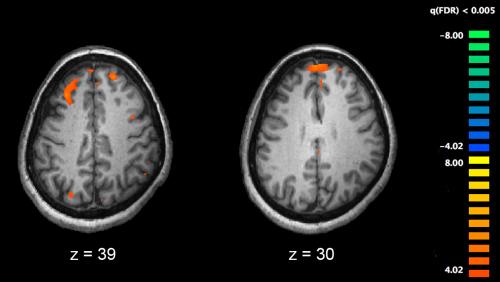
Functional magnetic resonance imaging (fMRI) and other brain imaging technologies allow for the study of differences in brain activity in people diagnosed with schizophrenia. The image shows two levels of the brain, with areas that were more active in healthy controls than in schizophrenia patients shown in orange, during an fMRI study of working memory. Credit: Kim J, Matthews NL, Park S./PLoS One.

Functional magnetic resonance imaging (fMRI) and other brain imaging technologies allow for the study of differences in brain activity in people diagnosed with schizophrenia. The image shows two levels of the brain, with areas that were more active in healthy controls than in schizophrenia patients shown in orange, during an fMRI study of working memory. Credit: Kim J, Matthews NL, Park S./PLoS One.

Researchers from the Broad Institute and several partnering institutions have taken a closer look at the human genome to learn more about the genetic underpinnings of schizophrenia. In two studies published in Nature, scientists analyzed the exomes, or protein-coding regions, of people with schizophrenia and their healthy counterparts, pinpointing the sites of mutations and identifying patterns that reveal clues about the biology underlying the disorder.

A new brain region that appears to help humans identify whether they have made bad decisions has been discovered by researchers.

New research finds that the brains of autistic children generate more information at rest – a 42% increase on average. The study offers a scientific explanation for the most typical characteristic of autism – withdrawal into one’s own inner world. The excess production of information may explain a child’s detachment from their environment.

The brain appears to synchronize the activity of different brain regions to make it possible for a person to pay attention or concentrate on a task, scientists have learned.

Researchers at the Albert Einstein College of Medicine are investigating the effects of repeated combat-related blast exposures on the brains of veterans. Mild traumatic brain injuries can cause problems with cognition, concentration, memory and emotional control. Scientists are using advanced MRI technology and psychological tests to investigate the structural and biological impact of repeated head injury and to assess how these injuries affect cognitive functions. Final results of the study have not yet been published, but researchers hope it will lead to more scientifically valid diagnostic techniques that could potentially allow for detection of both the underlying brain injury and its severity.

Study reveals senses of sight and sound separated in children with autism

Like watching a foreign movie that was badly dubbed, children with autism spectrum disorders (ASD) have trouble integrating simultaneous information from their eyes and their ears, according to a Vanderbilt study. The study, led by Mark Wallace, Ph.D., director of the Vanderbilt Brain Institute, is the first to illustrate the link and strongly suggests that deficits in the sensory building blocks for language and communication can ultimately hamper social and communication skills in children with autism.

To learn more about this research visit:

http://news.vanderbilt.edu/2014/01/senses-of-sight-and-sound-separated-in-children-with-autism/

Weekly Neuroscience Update

Brain scans show a correlation between how well participants could make a connection between a new word and a sound, and the gray matter volume in the hippocampus and cerebellum. (Credit: Photo/Qinghua He)

A combination of brain scans and reading tests has revealed that several regions in the brain are responsible for allowing humans to read. The findings open up the possibility that individuals who have difficulty reading may only need additional training for specific parts of the brain — targeted therapies that could more directly address their individual weaknesses.

Children with Asperger’s syndrome show patterns of brain connectivity distinct from those of children with autism, according to a new study. 

Scientists have discovered that the brain circuits we engage when we think about social matters, such as considering other people’s views, or moral issues, inhibit the circuits that we use when we think about inanimate, analytical things, such as working on a physics problem or making sure the numbers add up when we balance our budget. And they say, the same happens the other way around: the analytic brain network inhibits the social network.

Using direct human brain recordings, a research team has identified a new type of cell in the brain that helps people to keep track of their relative location while navigating an unfamiliar environment.

A collaborative team of researchers has uncovered evidence that a specific genetic alteration appears to contribute to disorders of brain development, including schizophrenia. They also found that schizophrenia shares a common biological pathway with Fragile X mental syndrome, a disorder associated with both intellectual impairment and autism.
A team of researchers has identified 18 new genes responsible for driving glioblastoma multiforme, the most common—and most aggressive—form of brain cancer in adults. The study was published August 5, 2013, in Nature Genetics.

Johns Hopkins biophysicists have discovered that full activation of a protein ensemble essential for communication between nerve cells in the brain and spinal cord requires a lot of organized back-and-forth motion of some of the ensemble’s segments. Their research, they say, may reveal multiple sites within the protein ensemble that could be used as drug targets to normalize its activity in such neurological disorders as epilepsy, schizophrenia, Parkinson’s and Alzheimer’s disease.

A sleepless night makes us more likely to reach for doughnuts or pizza than for whole grains and leafy green vegetables, suggests a new study from UC Berkeley that examines the brain regions that control food choices. The findings shed new light on the link between poor sleep and obesity

Weekly Neuroscience Update

A novel screening method makes it easier to diagnose and treat children with autism

A child with autism discovers how to evoke the onscreen video he likes best. Credit: Rutgers Sensory-Motor Integration Lab

Researchers have developed a new screening method to diagnose autism, which unlike current methods does not rely on subjective criteria. These results are published in a series of studies in the open-access journal Frontiers in Neuroscience.

Going to bed at different times every night throughout early childhood seems to curb children’s brain power, according to a large, long term study.

A computational vision scientist at the University of South Australia has just published new research describing a key advance in our understanding of how the brain perceives the physical world.

Oxytocin has long been known as the warm, fuzzy hormone that promotes feelings of love, social bonding and well-being. It’s even being tested as an anti-anxiety drug. But new research shows oxytocin also can cause emotional pain, an entirely new, darker identity for the hormone.

Ultrasound waves sent to specific brain regions can alter a person’s mood, according to a new study published in the journal Brain Stimulation.

A gene related to neural tube defects in dogs has for the first time been identified by researchers.

UCLA chemists and molecular biologists have for the first time used a “structure-based” approach to drug design to identify compounds with the potential to delay or treat Alzheimer’s disease, and possibly Parkinson’s, Lou Gehrig’s disease and other degenerative disorders.

Weekly Neuroscience Update

Brain and eye combined monitoring breakthrough could lead to fewer road accidents

An eye-tracking, brain monitoring experiment in progress. The infra-red camera is on the small black console on the desk in front of the main PC screen.

Latest advances in capturing data on brain activity and eye movement are being combined to open up a host of ‘mindreading’ possibilities for the future. These include the potential development of a system that can detect when drivers are in danger of falling asleep at the wheel.

Multimodal neuroimaging has confirmed that major depressive disorder is associated with a deregulation of brain regions.

Sensory processing disorders (SPD) are more prevalent in children than autism and as common as attention deficit hyperactivity disorder, yet it receives far less attention partly because it’s never been recognized as a distinct disease. In a groundbreaking new study from UC San Francisco, researchers have found that children affected with SPD have quantifiable differences in brain structure, for the first time showing a biological basis for the disease that sets it apart from other neurodevelopmental disorders.

Neuroscientists have discovered that spontaneously emerging brain activity patterns preserve traces of previous cognitive activity.

When people sing in a choir their heart beats are synchronised, so that the pulse of choir members tends to increase and decrease in unison. This has been shown by a recent study from that examined the health effects for choir members.

Weekly Neuroscience Update

reading

Keeping mentally active by reading books or writing letters helps protect the brain in old age, a study suggests.

The rate and extent of damage to the spinal cord and brain following spinal cord injury have long been a mystery. Now new research has found evidence that patients already have irreversible tissue loss in the spinal cord within 40 days of injury. The study, published in the journal Lancet Neurology, used a new imaging , developed at the Wellcome Trust Centre for Neuroimaging (UCL). This enables the impact of therapeutic treatments and rehabilitative interventions to be determined more quickly and directly.

UCSF neuroscientists have found that by training on attention tests, people young and old can improve brain performance and multitasking skills.

Researchers are striving to understand the different genetic structures that underlie at least a subset of autism spectrum disorders. In cases where the genetic code is in error, did that happen anew in the patient, perhaps through mutation or copying error, or was it inherited? A new study in the American Journal of Human Genetics finds evidence that there may often be a recessive, inherited genetic contribution in autism with significant intellectual disability.

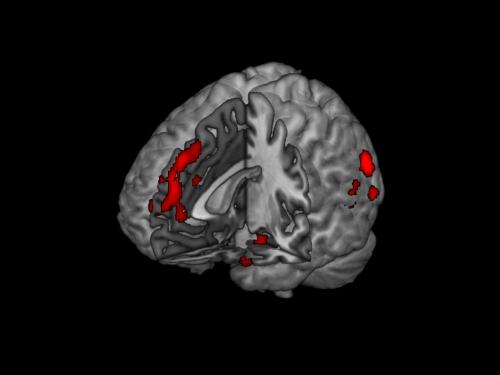
A specific brain disruption is present both in individuals diagnosed with schizophrenia and those with bipolar disorder, adding to evidence that many mental illnesses have biological similarities.

Weekly Neuroscience Update

Research from the University of Southampton, which examines how dolphins might process their sonar signals, could provide a new system for man-made sonar to detect targets, such as sea mines, in bubbly water.

Evidence is mounting that exercise provides some protection from memory loss and Alzheimer’s disease, with three new studies showing that a variety of physical activities are associated with healthier brains in older adults.

Researchers  have discovered an important clue to how the human brain —important clue to how the human brain — which is constantly bombarded with millions of pieces of visual information, can filter out what’s unimportant and focus on what’s most useful.

Scientists at the California Institute of Technology (Caltech) pioneered the study of the link between irregularities in the immune system and neurodevelopmental disorders such as autism a decade ago. Since then, studies of postmortem brains and of individuals with autism, as well as epidemiological studies, have supported the correlation between alterations in the immune system and autism spectrum disorder.

Researchers at Aalto University in Finland have developed the world’s first device designed for mapping the human brain that combines whole-head magnetoencephalography (MEG) and magnetic resonance imaging (MRI) technology. MEG measures the electrical function and MRI visualizes the structure of the brain. The merging of these two technologies will produce unprecedented accuracy in locating brain electrical activity non-invasively. 

Cognition psychologists have discovered why stressed persons are more likely to lapse back into habits than to behave goal-directed. The researchers have now reported in the Journal of Neuroscience that the interaction of the stress hormones hydrocortisone and noradrenaline shut down the activity of brain regions for goal-directed behaviour. The brain regions responsible for habitual behaviour remained unaffected.

Raising levels of the neurotransmitter dopamine in the frontal cortex of the brain significantly decreased impulsivity in healthy adults, in a study conducted by researchers at the Ernest Gallo Clinic and Research Center at the University of California, San Francisco