Weekly Neuroscience Update

Percentage of known neuron-, astrocyte- and oligodendrocyte-enriched genes in 32 modules, ordered by proportion of neuron-enriched gene membership. (credit: Michael Hawrylycz et al./Nature Neuroscience)

Percentage of known neuron-, astrocyte- and oligodendrocyte-enriched genes in 32 modules, ordered by proportion of neuron-enriched gene membership. (credit: Michael Hawrylycz et al./Nature Neuroscience)

Allen Institute researchers have identified a surprisingly small set of just 32 gene-expression patterns for all 20,000 genes across 132 functionally distinct human brain regions, and these patterns appear to be common to all individuals.

Evidence is mounting that gratitude makes a powerful impact on our bodies, including our immune and cardiovascular health. But how does gratitude work in the brain? A team at the University of Southern California has shed light on the neural nuts and bolts of gratitude in a new study, offering insights into the complexity of this social emotion and how it relates to other cognitive processes.

Subjective memory complaints (SMCs) are associated with cognitive impairment nearly two decades later among older women, a prospective study of aging has demonstrated.

Older adults that improved their fitness through a moderate intensity exercise program increased the thickness of their brain’s cortex, the outer layer of the brain that typically atrophies with Alzheimer’s disease, according to a new study. These effects were found in both healthy older adults and those diagnosed with mild cognitive impairment (MCI), an early stage of Alzheimer’s disease.

When it comes to the brain, “more is better” seems like an obvious assumption. But in the case of synapses, which are the connections between brain cells, too many or too few can both disrupt brain function. Research, recently published in the Journal of Neuroscience, reports  that an immune-system protein called MHCI, or major histocompatibility complex class I, moonlights in the nervous system to help regulate the number of synapses, which transmit chemical and electrical signals between neurons. MHCI could play an unexpected role in conditions such as Alzheimer’s disease, type II diabetes and autism.

Researchers have developed a simple technique to measure an individual’s visual processing speed–the speed at which an individual can comprehend visual information–in order to identify whether or not they may have cognitive issues.

Sleep is usually considered an all-or-nothing state: The brain is either entirely awake or entirely asleep. However, MIT neuroscientists have discovered a brain circuit that can trigger small regions of the brain to fall asleep or become less alert, while the rest of the brain remains awake.

Weekly Neuroscience Update

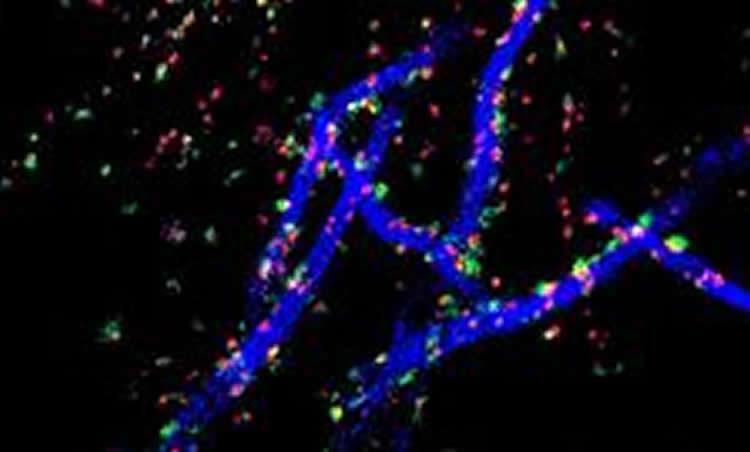
Axon initial segments (blue) and the synapses that form along them (red and green) are shown. Image credit: Winnie Wefelmeyer/MRC Centre for Developmental Neurobiology.

Axon initial segments (blue) and the synapses that form along them (red and green) are shown. Image credit: Winnie Wefelmeyer/MRC Centre for Developmental Neurobiology.

A new study characterises a novel way in which neurons remain electrically stable when confronted with chronic increases in neuronal activity.

Lithium chloride which is used as a mood stabiliser in the treatment of mental health problems, mainly bipolar disorder, could be used to treat arthritis according to a new study.

New research indicates that adults born very premature are more likely to be socially withdrawn and display signs of autism.

Scientists have found that existing anti-malaria drugs could be a potential treatment for Parkinson’s disease.

A number of studies presented at the Alzheimer’s Association International Conference, showed that regular supervised exercise sessions could help to improve symptoms in people with memory problems and dementia.

Brain scans of war veterans with posttraumatic stress disorder have led researchers to an area of the prefrontal cortex that appears to be a good predictor of response to treatment with SSRIs–the first-line drug treatment for PTSD.

New research findings show that body fat can send a signal that affects the way the brain deals with stress and metabolism.

Increasing the levels of a signaling molecule found in the brain can positively alter response to stress, revealing a potential new therapeutic target for treatment of depression.

Music training, begun as late as high school, may help improve the teenage brain’s responses to sound and sharpen hearing and language skills, suggests a new study.

Researchers have, for the first time, determined the rate at which the developing brain eliminates unneeded connections between neurons during early childhood.

Scientists have identified a critical function of what they believe to be schizophrenia’s “Rosetta Stone” gene that could hold the key to decoding the function of all genes involved in the disease.

Researchers have discovered a link between autism and genetic changes in some segments of DNA that are responsible for switching on genes in the brain.

Infants can use their expectations about the world to rapidly shape their developing brains, researchers have found.

Finally this week, there’s new evidence suggesting that women’s brains are especially vulnerable to Alzheimer’s disease and other problems with memory and thinking.

Weekly Neuroscience Update

The human brain using colors and shapes to show neurological differences between two people. Credit Arthur Toga, University of California, Los Angeles via NIGMS.

The human brain using colors and shapes to show neurological differences between two people. Credit Arthur Toga, University of California, Los Angeles via NIGMS.

While many different combinations of genetic traits can cause autism, brains affected by autism share a pattern of ramped-up immune responses, an analysis of data from autopsied human brains reveals. The study, published online in the journal Nature Communications, included data from 72 autism and control brains.

Teenagers who have suffered a traumatic brain injury are twice as likely to drink alcohol or use drugs when compared with whose who have never experienced a similar blow or trauma to the head.

Activating the brain’s amygdala, an almond-shaped mass that processes emotions, can create an addictive, intense desire for sugary foods, a new study found. Rewards such as sweet, tasty food or even addictive drugs like alcohol or cocaine can be extremely attractive when this brain structure is triggered. And another study, led by researchers at University of California, San Diego School of Medicine, revealed that the brains of obese children literally light up differently when tasting sugar.

Scientists have discovered a link between sleep loss and cell injury. Results of a new study find sleep deprivation causes the damage to cells, especially in the liver, lung, and small intestine. Recovery sleep following deprivation heals the damage.

Neural circuits that activate when we daydream run in the opposite direction to how we process reality, a new study finds.

Yale researchers using a new brain imaging analysis method have confirmed that smoking cigarettes activates a dopamine-driven pleasure and satisfaction response differently in men compared to women.

Whether we’re paying attention to something we see can be discerned by monitoring the firings of specific groups of brain cells. Now, new work from Johns Hopkins shows that the same holds true for the sense of touch.

Serious, long-term stress can have dire consequences for your brain. That’s because the immune system and the brain are intimately related, say researchers at the Ruhr University Bochum, Germany.

In the current issue of Psychotherapy and Psychosomatics a new study identifies biological characteristics who may predict who is going to respond to psychotherapy.

Some high school football players exhibit measurable brain changes after a single season of play even in the absence of concussion, according to a study presented at the annual meeting of the Radiological Society of North America. Meanwhile, as debate increases about whether female lacrosse players should wear headgear, a new study reports measurements of the accelerations that stick blows deliver to the head. The study also measured the dampening effect of various kinds of headgear.

Quitting smoking sets off a series of changes in the brain that researchers say may better identify smokers who will start smoking again.

Everyday events are easy to forget, but unpleasant ones can remain engraved in the brain. A new study published in the Proceedings of the National Academy of Sciences identifies a neural mechanism through which unpleasant experiences are translated into signals that trigger fear memories by changing neural connections in a part of the brain called the amygdala. The findings show that a long-standing theory on how the brain forms memories, called Hebbian plasticity, is partially correct, but not as simple as was originally proposed.

Inside The See-Through Brain


Scientists have come up with a way to make whole brains transparent, so they can be labelled with molecular markers and imaged using a light microscope. The technique, called CLARITY, enabled its creators to produce the detailed 3D visualisations you see in this video which takes a look into the brain of a 7-year-old boy who had autism.

Weekly Neuroscience Update

Nerve cells communicate with each other via intricate projections. In brain diseases such as Alzheimer’s and Parkinson’s these extensions atrophy, thereby causing connectivity problems. Credit DZNE/Detlef Friedrichs.

Nerve cells communicate with each other via intricate projections. In brain diseases such as Alzheimer’s and Parkinson’s these extensions atrophy, thereby causing connectivity problems. Credit DZNE/Detlef Friedrichs.

A new study shows the interdependency between the structure and function of neurons.

Neuroscientists have discovered an unexpected benefit of getting older – a more nuanced understanding of social signals, such as the age of others.

Children with autism show different patterns of brain activity during everyday gestures and movements than controls do, suggest unpublished results presented at the 2014 Society for Neuroscience annual meeting.

Researchers have gained fresh insights into how ‘local’ body clocks control waking and sleeping.

People with bipolar disorder who are being treated with the drug lithium are at risk of acute kidney damage and need careful monitoring, according to new research.

Age-related Macular Degeneration (AMD) is the major cause of blindness in the western world, affecting around 50 million people. Now scientists at The University of Manchester have identified an important new factor behind its causes, which they hope could lead to new treatments.

A team of researchers has identified an enzyme key to the survival and spread of glioblastoma cancer cells that is not present in healthy brain cells, making the enzyme a promising therapeutic target.

It is claimed one in five students have taken the ‘smart’ drug Modafinil to boost their ability to study and improve their chances of exam success. But new research into the effects of Modafinil has shown that healthy students could find their performance impaired by the drug.

Researchers have developed new insight into a rare but deadly brain infection, called progressive multifocal leukoencephalopathy (PML). This disease – which is caused by the JC virus – is most frequently found in people with suppressed immune systems and, until now, scientists have had no effective way to study it or test new treatments.

New research offers insight into short-term effects of maternal caregiving on a developing brain.

A team of researchers  has now been able to demonstrate in a study that the bonding hormone oxytocin inhibits the fear center in the brain and allows fear stimuli to subside more easily. This basic research could also usher in a new era in the treatment of anxiety disorders.

Blocking a key receptor in brain cells that is used by oxygen free radicals could play a major role in neutralizing the biological consequences of Alzheimer’s disease, according to new research.

Finally this week, brain scientists have long believed that older people have less of the neural flexibility (plasticity) required to learn new things. A new study shows that older people learned a visual task just as well as younger ones, but the seniors who showed a strong degree of learning exhibited plasticity in a different part of the brain than younger learners did.


Weekly Neuroscience Update

Reviewing MRI data, researchers found the brain anatomy of people with autism above the age of six was mostly indistinguishable from that of typically developing individuals. This image is for illustrative purposes only. Credit McZusatz.

Reviewing MRI data, researchers found the brain anatomy of people with autism above the age of six was mostly indistinguishable from that of typically developing individuals. This image is for illustrative purposes only. Credit McZusatz.

Brain anatomy in MRI scans of people with autism above age six is mostly indistinguishable from that of typically developing individuals and, therefore, of little clinical or scientific value.

Some types of dementia are actually a result of many tiny, unnoticed strokes damaging the brain over time, researchers at the Krembil Neuroscience Centre in Toronto, Canada, have found. This suggests that this type of dementia could be treatable — probably through lifestyle changes.

Therapists could pick up signs of depression just be listening to how their patients talk, after a study found that unhappy people speak in a different tone.

Why do we remember some things and not others? In a unique imaging study researchers have discovered how neurons in the brain might allow some experiences to be remembered while others are forgotten. It turns out, if you want to remember something about your environment, you better involve your dendrites.

Looking at the brain as a highly interactive network of nodes, rather than a collection of individual areas of activity, could offer a new way to diagnose the memory disorders that tend to affect older people.

An international study has identified genetic markers that may help in identifying individuals who could benefit from the alcoholism treatment drug acamprosate. The findings, published in the journal Translational Psychiatry, show that patients carrying these genetic variants have longer periods of abstinence during the first three months of acamprosate treatment.

New research on how the brain leads us to believe we have sharp vision.

Disturbances in the early stages of brain growth, such as preterm birth – when many of the brain’s structures have not yet fully developed – appears to affect the brain’s neuro-circuitry, which may explain premature babies’ higher risk of neurodevelopmental disorders including ADHD and autism spectrum disorder.

Data from 50 laboratories around the world has found that rare mutations in dozens of genes may be responsible for 30% or more cases of autism.

Researchers have been tracking the traces of implicit and explicit memories of fear in human. The study was published in the journal Neurobiology of Learning and Memory; it describes how, in a context of fear, our brain differently encodes contextual memory of a negative event and the emotional response associated.

A major breakthrough in the development of stem cell-derived brain cells has put researchers on a firm path towards the first ever stem cell transplantations in people with Parkinson’s disease. A new study presents the next generation of transplantable dopamine neurons produced from stem cells. These cells carry the same properties as the dopamine neurons found in the human brain.

The brain’s plasticity and its adaptability to new situations do not function the way researchers previously thought, according to a new study published in the journal Cell.

Finally this week, researchers have shown how a single neuron can perform multiple functions in a model organism, illuminating for the first time this fundamental biological mechanism and shedding light on the human brain.


Weekly Neuroscience Update


brain-white-matter-child-fitness (1)

The team used diffusion tensor imaging (DTI, also called diffusion MRI) to look at five white-matter tracts in the brains of the 24 participants. This method analyzes water diffusion into tissues. For white matter, less water diffusion means the tissue is more fibrous and compact, both desirable traits. This image shows an MRI of white matter in the human brain. The image is for illustrative purposes only, and is not connected to the research. Credit Kubicki et al.

A new study of 9 and 10-year-olds finds that those who are more aerobically fit have more fibrous and compact white-matter tracts in the brain than their peers who are less fit. “White matter” describes the bundles of axons that carry nerve signals from one brain region to another. More compact white matter is associated with faster and more efficient nerve activity. The team reports its findings in the open-access journal Frontiers in Human Neuroscience.

In a new study published in The Journal of Neuroscience, researchers report that the amygdala — a part of the brain associated with decision making, memory and emotion — plays a part in telling us who to trust almost instantly.

The latest research on sports concussions in teens has been the focus of recent study.

Depression is known to be a common symptom of Parkinson’s disease, but remains untreated for many patients, according to a new study.

Following another person’s gaze can reveal a wealth of information critical to social interactions and also to safety. Gaze following typically emerges in infancy, and new research looking at preterm infants suggests that its visual experience, not maturational age, that underlies this critical ability.

fMRI scans reveal brain differences in risk-taking teens

Children and adolescents with autism have a surplus of synapses in the brain, and this excess is due to a slowdown in a normal brain “pruning” process during development, according to a study by neuroscientists at Columbia University Medical Center (CUMC).

While much attention has focused on the link between violent video game playing and aggression among youths, a new study finds significantly increased signs of depression among preteens with high daily exposure to violent video games.

An imaging study of chronic users of codeine-containing cough syrups (CCS) has found deficits in specific regions of brain white matter and associates these changes with increased impulsivity in CCS users.

New treatments for multiple sclerosis (MS) using common anti-psychotic agents have been discovered by Victoria University of Wellington researchers.

People with schizophrenia struggle to turn goals into actions because brain structures governing desire and emotion are less active and fail to pass goal-directed messages to cortical regions affecting human decision-making, new research reveals.

Weekly Neuroscience Update

By using a novel technique to test brain waves, researchers are discovering how the brain processes external stimuli that do and don’t reach our awareness. Credit Beckman Institute.

By using a novel technique to test brain waves, researchers are discovering how the brain processes external stimuli that do and don’t reach our awareness. Credit Beckman Institute.

Researchers at the Beckman Institute are using a novel technique to test brain waves to see how the brain processes external stimuli that do and don’t reach our awareness. A group of international scientists has for the first time identified genetic mutations that suggest that schizophrenia and autism share underlying mechanisms. The research could help with future understanding of both conditions and may contribute to the development of treatments. Two psychologists have made a discovery that could revolutionize doctors’ perception and treatment of attention-deficit disorders. A newly identified disorder affecting the human nervous system is caused by a mutation in a gene never before implicated in human disease, according to two studies published in the journal Cell. By performing DNA sequencing of children affected by neurological problems, two research teams independently discovered that a disease marked by reduced brain size, as well as sensory and motor defects, is caused by a mutation in a gene called CLP1. Insights into this rare disorder may have important implications for the treatment of common disorders.

Scientists at the Salk Institute have created a new model of memory that explains how neurons retain select memories a few hours after an event. This new framework provides a more complete picture of how memory works, which can inform research into disorders liked Parkinson’s, Alzheimer’s, post-traumatic stress and learning disabilities.

Stanford scientists have developed faster, more energy-efficient microchips based on the human brain – 9,000 times faster and using significantly less power than a typical PC. This offers greater possibilities for advances in robotics and a new way of understanding the brain. For instance, a chip as fast and efficient as the human brain could drive prosthetic limbs with the speed and complexity of our own actions.

Finally this week, laughter triggers brain waves similar to those associated with meditation, according to a small new studyThe study included 31 people whose brain waves were monitored while they watched humorous, spiritual or distressing video clips. While watching the humorous videos, the volunteers’ brains had high levels of gamma waves, which are the same ones produced during meditation, researchers found.


Weekly Neuroscience Update

Neuroscience research demonstrates that the brain regions underpinning moral judgment share resources with circuits controlling other capacities such as emotional saliency, mental state understanding and decision-making. Credit: Jean Decety

Neuroscience research demonstrates that the brain regions underpinning moral judgment share resources with circuits controlling other capacities such as emotional saliency, mental state understanding and decision-making. Credit: Jean Decety

People who care about justice are swayed more by reason than emotion, according to new brain scan research from the Department of Psychology and Center for Cognitive and Social Neuroscience. Researchers have discovered a gene that is likely to play a role in the risk of psychosis in bipolar disorders.

A new way to artificially control muscles using light, with the potential to restore function to muscles paralysed by conditions such as motor neuron disease and spinal cord injury, has been developed by scientists at UCL and King’s College London.

Researchers at the University of California, San Diego School of Medicine and the Allen Institute for Brain Science have published a study that gives clear and direct new evidence that autism begins during pregnancy.

A new study is the first documented study that shows cognitive behavioral therapy in a group setting is capable of changing the brain structure in patients with chronic pain.

By examining the sense of touch in stroke patients, a University of Delaware cognitive psychologist has found evidence that the brains of these individuals may be highly plastic even years after being damaged.

A new chemical messenger that is critical in protecting the brain against Parkinson’s disease has been identified by scientists.

Scents and smells can form the basis of some of the most significant memories humans form in their lives, a new study suggests

In the first study of its kind, two researchers have used popular music to help severely brain-injured patients recall personal memories.

Inside The Developing Brain: Clues To Schizophrenia and Autism

Images of the developing fetal brain show connections among brain regions.  Allen Institute for Brain Science and Bruce Fischl, Massachusetts General Hospital

Images of the developing fetal brain show connections among brain regions.
Allen Institute for Brain Science and Bruce Fischl, Massachusetts General Hospital

A high-resolution map of the human brain in utero is providing hints about the origins of brain disorders including schizophrenia and autism.

The map shows where genes are turned on and off throughout the entire brain at about the midpoint of pregnancy, a time when critical structures are taking shape. The human brain is often called the most complex object in the universe. Yet its basic architecture is created in just nine months, when it grows from a single cell to more than 80 billion cells organized in a way that will eventually let us think and feel and remember.

Having a map like this is important because many psychiatric and behavioral problems appear to begin before birth, even though they may not manifest until teenage years or even the early 20s.

The resulting map, which is available to anyone who wants to use it, has already led to at least two important findings. The first is that many genes that are associated with brain disorders are turned on early in development, which suggests that these disorders may have their origin from these very early time points.

And the map tells researchers who study these disorders where in the brain they should be looking for signs of trouble. For example, the map shows that genes associated with autism appear to be acting on a specific type of brain cell in a part of the brain called the neocortex. That suggests we should be looking at this particular type of cell in the neocortex, and furthermore that we should probably be looking very early in the prenatal stages for the origin of autism.

Source: NPR