Inside The Developing Brain: Clues To Schizophrenia and Autism

Images of the developing fetal brain show connections among brain regions.  Allen Institute for Brain Science and Bruce Fischl, Massachusetts General Hospital

Images of the developing fetal brain show connections among brain regions.
Allen Institute for Brain Science and Bruce Fischl, Massachusetts General Hospital

A high-resolution map of the human brain in utero is providing hints about the origins of brain disorders including schizophrenia and autism.

The map shows where genes are turned on and off throughout the entire brain at about the midpoint of pregnancy, a time when critical structures are taking shape. The human brain is often called the most complex object in the universe. Yet its basic architecture is created in just nine months, when it grows from a single cell to more than 80 billion cells organized in a way that will eventually let us think and feel and remember.

Having a map like this is important because many psychiatric and behavioral problems appear to begin before birth, even though they may not manifest until teenage years or even the early 20s.

The resulting map, which is available to anyone who wants to use it, has already led to at least two important findings. The first is that many genes that are associated with brain disorders are turned on early in development, which suggests that these disorders may have their origin from these very early time points.

And the map tells researchers who study these disorders where in the brain they should be looking for signs of trouble. For example, the map shows that genes associated with autism appear to be acting on a specific type of brain cell in a part of the brain called the neocortex. That suggests we should be looking at this particular type of cell in the neocortex, and furthermore that we should probably be looking very early in the prenatal stages for the origin of autism.

Source: NPR

How the Brain Recognises Speech Sounds

UC San Francisco researchers are reporting a detailed account of how speech sounds are identified by the human brain, offering an unprecedented insight into the basis of human language. The finding, they said, may add to our understanding of language disorders, including dyslexia.

Weekly Neuroscience Update

neuronal-heat-maps-in-brain

Scientists at CSHL have developed a new mathematical model that makes predictions about where different types are neurons are located throughout the brain. Here are “heat maps” of the brain, made using the mathematical model to predict the distribution of different neurons. Each row represents one neuronal type, and different sections of the brain are shown in each column. Color indicates the likelihood of a particular neuronal type appearing in that area of the brain (white, most likely; black, least). Credit Mitra et al.

A new mathematical model uses gene expression data to predict where neurons are located throughout the brain.

Researchers have studied the acquisition and development of language in babies on the basis of the temporary coordination of gestures and speech. The results are the first in showing how and when they acquire the pattern of coordination between the two elements which allows them to communicate very early on.

The problems people with autism have with memory formation, higher-level thinking and social interactions may be partially attributable to the activity of receptors inside brain cells, researchers have learned.

A new study documents the brain activity underlying our strong tendency to infer a structure of context and rules when learning new tasks (even when a structure isn’t valid). The findings, which revealed individual differences, shows how we try to apply task knowledge to similar situations and could inform future research on learning disabilities.

Researchers have discovered impaired neuronal activity in the parts of the brain associated with anticipatory functioning among occasional 18- to 24-year-old users of stimulant drugs, such as cocaine, amphetamines and prescription drugs such as Adderall.

Why do some teenagers start smoking or experimenting with drugs — while others don’t? In the largest imaging study of the human brain ever conducted — involving 1,896 14-year-olds — scientists have discovered a number of previously unknown networks that go a long way toward an answer.

New research shows that, contrary to what was previously assumed, suppressing unwanted memories reduces their influence on behaviour, and sheds light on how this process happens in the brain.

For our brain, animate and inanimate objects belong to different categories and any information about them is stored and processed by different networks. A study shows that there is also another category that is functionally distinct from the others, namely, the category of “social” groups.

A new technique provides a method to noninvasively measure human neural networks in order to characterize how they form.

Education significantly improves mental functioning in seniors even four decades after finishing school, shows a new study. The study shows that people who attended school for longer periods performed better in terms of cognitive functioning than those who did not.


Neurosurgeons successfully implant 3D printed skull

3D printed skull implant Photo Credit: UMC Utrecht

3D printed skull implant Photo Credit: UMC Utrecht

A 22-year-old woman from the Netherlands who suffers from a chronic bone disorder — which has increased the thickness of her skull from 1.5cm to 5cm, causing reduced eyesight and severe headaches — has had the top section of her skull removed and replaced with a 3D printed implant.

The skull was made specifically for the patient using an unspecified durable plastic. Since the operation, the patient has gained her sight back entirely, is symptom-free and back to work. It is not known whether the plastic will require replacing at a later date or if it will last a lifetime.

The operation was performed by a team of neurosurgeons at the University Medical Centre Utrecht and the university claims this is this first instance of a successful 3D printed cranium that has not been rejected by the patient.

It is hoped this technique can also be used for patients with other bone disorders or to repair severely damaged skulls after an accident or tumour.

Source: Wired UK

Patients with schizophrenia have impaired ability to imitate

This is an illustration of the mirror neuron system in the human brain which has been implicated in the impaired ability to imitate experienced by many patients with schizophrenia. Credit: Jan Brascamp

This is an illustration of the mirror neuron system in the human brain which has been implicated in the impaired ability to imitate experienced by many patients with schizophrenia.
Credit: Jan Brascamp

A brain-mapping study of patients with schizophrenia has found that areas associated with the ability to imitate are impaired, providing new support for the theory that deficits in this basic cognitive skill may underlie the profound difficulty with social interactions that characterize the disorder. In a paper published online on Mar. 14 by the American Journal of Psychiatry, the researchers report that when patients with schizophrenia were asked to imitate simple hand movements, their brains exhibited abnormal brain activity in areas associated with the ability to imitate.

The new study is the first to use functional magnetic resonance imaging, which maps levels of brain activity by measuring associated changes in blood flow, to examine the brain activity of schizophrenia patients while performing basic imitation tasks. It was performed on 16 medicated schizophrenia patients and 16 healthy participants. While lying in the scanner, participants watched a computer display that showed either a video of a hand pressing buttons on a button box or an animation of an ‘X’ that moved to different fingers on a still image of a hand. Participants were given three different instructions: push the same button as the hand in the video; push the button under the finger marked with the ‘X;’ or simply observe the display. As a result, the experimenters could look at brain activation associated with imitation (pressing buttons while watching a video of a moving hand) and non-imitative action (pressing buttons while watching the moving ‘X’).

The researchers found that the individuals with schizophrenia showed altered brain activity levels in regions of the brain that prior studies in primates have identified as crucial for imitation. During imitation, the patients had less activation than healthy individuals in brain regions involved in detecting biological movement — the special way in which living things move — and also in regions involved in transforming this visual information into a plan for movement. At the same time, patients with schizophrenia had more activation than the healthy participants in these same regions when they performed non-imitative actions.

The specific areas of the brain that become over-active and under-active are associated with the “mirror neuron” system. Mirror neurons are networks of neurons that fire both when an animal acts and when it observes the same action performed by another. They have been directly observed in the brains of primates. In humans, neuroscientists have located areas using brain-mapping techniques that appear to act in a similar fashion.

Source: Science Daily

Inside A Glass Brain

Philip Rosedale, creator of Second Life, and Adam Gazzaley, a neuroscientist at the University of California San Francisco, have developed a way for people to see each thought as it flies through the mind.  Entitled “The Glass Brain,” the project was on display at SXSW 2014 and provided attendees the opportunity to see how their brains react to assorted stimuli.

This is an anatomically-realistic 3D brain visualization depicting real-time source-localized activity (power and “effective” connectivity) from EEG (electroencephalographic) signals. Each color represents source power and connectivity in a different frequency band (theta, alpha, beta, gamma) and the golden lines are white matter anatomical fiber tracts. Estimated information transfer between brain regions is visualized as pulses of light flowing along the fiber tracts connecting the regions.

Weekly Neuroscience Update

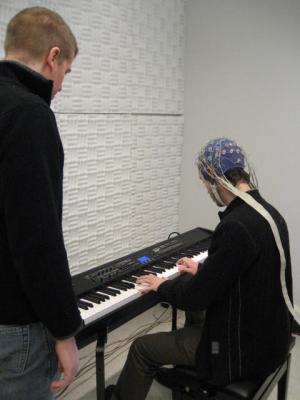
For the study, researchers recruited twenty skilled pianists from Lyon, France. The group was asked to learn simple melodies by either hearing them several times or performing them several times on a piano. Pianists then heard all of the melodies they had learned, some of which contained wrong notes, while their brain electric signals were measured using electroencephalography (EEG). Credit: Caroline Palmer/Brian Mathias

For the study, researchers recruited twenty skilled pianists from Lyon, France. The group was asked to learn simple melodies by either hearing them several times or performing them several times on a piano. Pianists then heard all of the melodies they had learned, some of which contained wrong notes, while their brain electric signals were measured using electroencephalography (EEG). Credit: Caroline Palmer/Brian Mathias

Research from McGill University reveals that the brain’s motor network helps people remember and recognize music that they have performed in the past better than music they have only heard. 

Veterans who have been exposed to nearby explosions, but who lack clear symptoms of traumatic brain injury (TBI) may still have damage to the brain’s white matter similar to veterans with TBI, according to new research at Duke Medicine and the U.S. Department of Veterans Affairs.

University of Adelaide researchers say new insights into how the human brain responds to chronic pain could eventually lead to improved treatments for patients. And also at the University of Adelaide, studies show that a gene linked to intellectual disability is critical to the earliest stages of the development of human brains. Known as USP9X, the gene has been investigated by Adelaide researchers for more than a decade, but in recent years scientists have begun to understand its particular importance to brain development.

In order to function properly, the human brain requires the ability not only to store but also to forget. Through memory loss, unnecessary information is deleted and the nervous system retains its plasticity. A disruption of this process can lead to serious mental disorders. Scientists have now discovered a molecular mechanism that actively regulates the process of forgetting. The journal Cell has published their results.

Brain imaging using radioactive dye can detect early evidence of Alzheimer’s disease that may predict future cognitive decline.

Scientists have identified a new group of compounds that may protect brain cells from inflammation linked to seizures and neurodegenerative diseases.

Your brain’s ability to instantly link what you see with what you do is down to a dedicated information ‘highway’, suggests new research.

There has been a great deal of research on changes among different brain states during sleep, but  new findings, reported in the March 13 issue of Cell, provide a compelling example of a change in state in the awake brain.

Finally, this week, using a new method to determine whether individuals met the criteria for a clinical diagnosis of bipolar disorder, researchers from UCLA tried a new approach by combining results from brain imaging, cognitive tests, and an array of temperament and behavioral measures. In an attempt to better understand the genes that cause the disorder, a collaborative research team identified about 50 brain and behavioral measures that are both under strong genetic control and associated with bipolar disorder, creating the potential to pinpoint the specific genes that contribute to the illness.

Inside The Decision-Making Brain

anterior_ insula

The anterior insula was sensitive to escalating alcohol costs especially when the costs of drinking outweighed the benefits, indicating this could be the region of the brain at the intersection of how our rational and irrational systems work with one another.

Although choosing to do something because the perceived benefit outweighs the financial cost is something people do daily, little is known about what happens in the brain when a person makes these kinds of decisions. Studying how these cost-benefit decisions are made when choosing to consume alcohol, University of Georgia associate professor of psychology James MacKillop identified distinct profiles of brain activity that are present when making these decisions.*

The study combined functional magnetic resonance imaging and a bar laboratory alcohol procedure to see how the cost of alcohol affected people’s preferences. The study group included 24 men, age 21-31, who were heavy drinkers. Participants were given a $15 bar tab and then were asked to make decisions in the fMRI scanner about how many drinks they would choose at varying prices, from very low to very high. Their choices translated into real drinks, at most eight that they received in the bar immediately after the scan. Any money not spent on drinks was theirs to keep.

The study applied a neuroeconomic approach, which integrates concepts and methods from psychology, economics and cognitive neuroscience to understand how the brain makes decisions. In this study, participants’ cost-benefit decisions were categorized into those in which drinking was perceived to have all benefit and no cost, to have both benefits and costs, and to have all costs and no benefits. In doing so, MacKillop could dissect the neural mechanisms responsible for different types of cost-benefit decision-making.

When participants decided to drink in general, activation was seen in several areas of the cerebral cortex, such as the prefrontal and parietal cortices. However, when the decision to drink was affected by the cost of alcohol, activation involved frontostriatal regions, which are important for the interplay between deliberation and reward value, suggesting suppression resulting from greater cognitive load. This is the first study of its kind to examine cost-benefit decision-making for alcohol and was the first to apply a framework from economics, called demand curve analysis, to understanding cost-benefit decision making.

The brain activity was most differentially active during the suppressed consumption choices, suggesting that participants were experiencing the most conflict. We had speculated during the design of the study that the choices not to drink at all might require the most cognitive effort, but that didn’t seem to be the case. Once people decided that the cost of drinking was too high, they didn’t appear to experience a great deal of conflict in terms of the associated brain activity. McKillop

These conflicted decisions appeared to be represented by activity in the anterior insula, which has been linked in previous addiction studies to the motivational circuitry of the brain. Not only encoding how much people crave or value drugs, this portion of the brain is believed to be responsible for processing interceptive experiences, a person’s visceral physiological responses.

It was interesting that the insula was sensitive to escalating alcohol costs especially when the costs of drinking outweighed the benefits. That means this could be the region of the brain at the intersection of how our rational and irrational systems work with one another. In general, we saw the choices associated with differential brain activity were those choices in the middle, where people were making choices that reflect the ambivalence between cost and benefits. Where we saw that tension, we saw the most brain activity. McKillop

While MacKillop acknowledges the impact this research could have on neuromarketing–or understanding how the brain makes decisions about what to buy–he is more interested in how this research can help people with alcohol addictions.

“These findings reveal the distinct neural signatures associated with different kinds of consumption preferences. Now that we have established a way of studying these choices, we can apply this approach to better understanding substance use disorders and improving treatment,” he said, adding that comparing fMRI scans from alcoholics with those of people with normal drinking habits could potentially tease out brain patterns that show what is different between healthy and unhealthy drinkers. “In the past, we have found that behavioral indices of alcohol value predict poor treatment prognosis, but this would permit us to understand the neural basis for negative outcomes.”

*The research was published in the journal Neuropsychopharmacology March 3.

Weekly Neuroscience Update

Embed from Getty Images

Johns Hopkins researchers report that people with chronic insomnia show more plasticity and activity than good sleepers in the part of the brain that controls movement.

Researchers at The Scripps Research Institute (TSRI) and Vanderbilt University have created the most detailed 3-D picture yet of a membrane protein that is linked to learning, memory, anxiety, pain and brain disorders such as schizophrenia, Parkinson’s, Alzheimer’s and autism.

New research has revealed the dramatic effect the immune system has on the brain development of young children. The findings suggest new and better ways to prevent developmental impairment in children in developing countries, helping to free them from a cycle of poverty and disease, and to attain their full potential.

Rate of change in the thickness of the brain’s cortex is an important factor associated with a person’s change in IQ, according to a collaborative study by scientists in five countries.

Researchers have found that decision-making accuracy can be improved by postponing the onset of a decision by a mere fraction of a second. The results could further our understanding of neuropsychiatric conditions characterized by abnormalities in cognitive function and lead to new training strategies to improve decision-making in high-stake environments. The study was published in the March 5 online issue of the journal PLoS One.

A study has revealed how the fatal neurodegenerative disease amyotrophic lateral sclerosis (ALS), also known as Lou Gehrig’s disease, is transmitted from cell to cell, and suggests the spread of the disease could be blocked.

Research from Karolinska Institutet in Sweden suggests that the expression of the so called MYC gene is important and necessary for neurogenesis in the spinal cord. The findings are being published in the journal  EMBO Reports .

Our memories are inaccurate, more than we’d like to believe. And now a study demonstrates one reason: we apparently add current experiences onto memories.

Damage to the brain may still occur even if symptoms of traumatic brain injury are not present, scientists suggest.

The brain processes read and heard language differently. This is the key and new finding of a study published in Frontiers in Human Neuroscience.