Weekly Neuroscience Update

art.jpg

Being told an image is a work of art changes people’s responses on both a neural and behavioural level, a new study reports.

Loneliness is linked to poor physical and mental health, and is an even more accurate predictor of early death than obesity. To better understand who is at risk, researchers conducted the first genome-wide association study for loneliness — as a life-long trait, not a temporary state. They discovered that risk for feeling lonely is partially due to genetics, but environment plays a bigger role. The study of more than 10,000 people, published September 15 by Neuropsychopharmacology, also found that genetic risk for loneliness is associated with neuroticism and depressive symptoms.

Researchers report that better education and standards of living may lower the risk of developing dementia than previously thought.

By applying an algorithm to functional magnetic resonance imaging, scientists have been able to see emotions at work in the human brain. The findings – recently published in the journal PLOS Biology – could enable better assessment of emotional states, which may help individuals who struggle to convey their feelings.

Bilingual people may have a cognitive advantage when it comes to maintaining attention and focus, a new study reports.

Both heredity and environmental factors influence our risk of cardiovascular disease. A new study shows now that the memory of a heart attack can be stored in our genes through epigenetic changes.

Researchers have developed a new theory that outlines how the brain separates relevant from irrelevant information.

Scientists are developing an early diagnosis system, based on virtual reality,  for neurodegenerative disorders. The system is intended to such diseases as multiple sclerosis, Parkinson’s disease and others.

A new study supports the role of intrinsic reward in maintaining exercise as a long-term habit.

Recent advances in imaging have revealed that false memories can be held by the very same cells that hold accurate ones, but we don’t have much information about how false memories get there in the first place. A recent study published in PNAS provides some insight into this issue, finding that false memories may arise from similarities among the items being remembered.

Researchers have discovered a unique epigenetic footprint in specific immune cells that can identify people with HIV who have impaired cognitive function.

Engaging in fantasy play could benefit creative thinking in children suggests a study presented at the British Psychological Society’s Developmental Psychology Section annual conference.

A new study looks at the role glutamate plays in neuromuscular development.

People who suffer from synethesia are also more sensitive to the association between the sound of words and visual shapes, researchers report.

A pioneering new study shows that life story work has the potential to help people with dementia.

A study published in Biological Psychiatry found that training the brain using auditory or visual signals could guide people to regulate their brain activity after traumatic stress.

Researchers have identified the specific synaptic and post-synaptic characteristics that allow auditory neurons to compute with temporal precision.

Finally this week, a news study shows the anxiety response is not only seen in areas associated with emotion, but also in brain areas associated with movement.

 

Weekly Neuroscience Update

man-798989_960_720.jpg

A new study sheds light on how some older people retain youthful thinking abilities and the brain circuits that support those abilities.

Relying on clinical symptoms of memory loss to diagnose Alzheimer’s disease may miss other forms of dementia caused by Alzheimer’s that don’t initially affect memory, reports a new Northwestern Medicine study.

Bilingual people may have a cognitive advantage when it comes to maintaining attention and focus, a new study reports.

An EU-funded project is getting close to building combined brain and neuromuscular computer models to predict the progression of Parkinson’s and ensure the prescription of the correct medication.

A new study investigates what happens when we multitask and why it’s not such a good idea to drive and use a phone at the same time.

Researchers have found a switch that redirects helper cells in the peripheral nervous system into “repair” mode, a form that restores damaged axons.

A new study offers insight into the neurological processes involved in fear and anxiety.

According to researchers, a simple MRI brain scan could help diagnose people with a common cognitive disorder.

A new mathematical model could improve understanding of memory consolidation during deep sleep.

High stress between the ages of  5 and 8 is biologically embedded, posing mental health risks decades later into adult life, suggests US brain scans study.

Finally this week, a new paper reports on how understanding brain function has become more than a brain science.


Weekly Neuroscience Update

taste.jpg

Researchers report the gustatory cortex relies on all the senses to anticipate taste.

A research group has identified an enzyme whose production is turned off in nerve cells of the frontal lobe when alcohol dependence develops. The deficiency in this enzyme leads to continued use of alcohol despite adverse consequences.

Scientists have identified a brain circuit that’s indispensable to the sleep-wake cycle.

Studying brain electrical activity of volunteers, researchers found that language acquisition enhances brain plasticity and capacity for learning. In particular, they note that early language learning plays a significant role in the rapid formation of memory circuits for coding new information.

A new study reports that relaxing flexed muscles in your foot can reduce the ability of your hands to respond to stimulation.

We all know that we can quickly lose cardiovascular endurance if we stop exercising for a few weeks, but what impact does the cessation of exercise have on our brains? New research examined cerebral blood flow in healthy, physically fit older adults (ages 50-80 years) before and after a 10-day period during which they stopped all exercise. Using MRI brain imaging techniques, they found a significant decrease in blood flow to several brain regions, including the hippocampus, after they stopped their exercise routines.

Brain cells grow faster in children with some forms of autism due to distinct changes in core cell signaling patterns, according to new research.

Researchers have identified a brain mechanism that could be a drug target to help prevent tolerance and addiction to opioid pain medication, such as morphine, according to a study by Georgia State University and Emory University. The findings, published in the Nature journal Neuropsychopharmacology in August, show for the first time that morphine tolerance is due to an inflammatory response produced in the brain. This brain inflammation is caused by the release of cytokines, chemical messengers in the body that trigger an immune response, similar to a viral infection.

A new study reports researchers discover a signaling pathway that enables cells to reach their destinations through repulsion.

To remember events in the order they occur, the brain’s neurons function in a coordinated way that is akin to a symphony, a team of New York University scientists has found. Their findings offer new insights into how we recall information and point to factors that may disrupt certain types of memories.

Researchers have mapped out a serotonin-driven anxiety circuit that may explain the side effects of anxiety and fear experienced by some patients taking SSRIs. 

A new study published in the journal Neuron, delves into the anatomy and function of the striatum by employing cutting-edge strategies to comprehensively map one of the brain’s lesser-known forms of organization.

Finally this week, a new paper looks at why some of us are extreme thrill seekers, and others don’t even enjoy a gentle roller coaster ride.


Weekly Neuroscience Update

desk-1148994_960_720

Getting some sleep in between study sessions may make it easier to recall what you studied and relearn what you’ve forgotten, even 6 months later, according to new findings.

Metabolic syndrome, a cluster of cardiometabolic conditions, may be a biological mechanism linking posttraumatic stress disorder (PTSD) to structural brain abnormalities, according to a new study in Biological Psychiatry. The findings highlight the need to develop effective interventions for PTSD to treat not only the symptoms associated with the disorder, but also potential ensuing metabolic and neurodegenerative consequences, which may be suggestive of premature aging.

A new study strengthens previous research that claims performing cognitive tasks later in life may reduce the risk of developing dementia.

Your brain activity differs depending on whether you’re working on a task, or at rest — and just how much that activity differs may be linked to how smart you are, a new study finds.

Researchers have developed a new, non-invasive technique that could be used to treat patients with consciousness disorders.

New research published in the New Journal of Physics tries to decompose the structural layers of the cortical network to different hierarchies enabling to identify the network’s nucleus, from which our consciousness could emerge.

A new neuroimaging study links alcohol cravings to the right ventral striatum.

According to researchers, age related changes in the organisation of neural networks when performing short term memory tasks may help to compensate for other aspects of brain ageing.

Researchers have identified a circuit that seems to be related to serotonin-driven anxiety.

A test of how sticky a protein molecule is could help diagnose the early stages of Parkinson’s disease, a study from the University of Edinburgh suggests.

Finally, this week a new study reports dogs have the ability to understand human speech intonation and vocabulary by using similar brain areas to humans.


A Visual Nudge Can Disrupt Recall of What Things Look Like

Interfering with your vision makes it harder to describe what you know about the appearance of even common objects, according to new research.

Study participants were asked recall bits of visual information they know about specific objects. Half the time, they saw a blast of coloured static meant to disrupt the parts of the brain that process visual information. The static made a significant difference in their ability to recall the correct information, showing a connection between visual memory and the visual perception systems in the brain.

Visual interference selectively interrupted their ability to answer questions about the visual properties of objects. They had trouble trying to recall that kind of information. But it didn’t change how good they were at accessing what they knew about the nonvisual properties of the same objects.

For more on this study click here

Weekly Neuroscience Update

EPNorth

A virtual reality world called EVA Park can improve the communication of those who have impaired speech and language following a stroke, according to research by academics at City University London. The study, which is published in PLOS ONE, is the first exploration of multi-user virtual reality in aphasia therapy and shows the potential for technology to play an important role in improving the everyday lives of people with the condition.

A new study will look at how brain connections mature and develop from childhood to adulthood.

Neurons communicate by sending chemical signals called neurotransmitters across synapses, specialized connections between two individual cells. This communication requires a delicate and intricate molecular architecture. A recent paper published in Nature has now shown that the structure of this intercellular space is more complicated than previously thought, and it probably helps boost the efficiency of the signaling.

A new long term study of young marijuana users tracks the brain’s response to reward over time. The findings indicate a lower response to reward in marijuana users.

Neuroscientists at the University of Pittsburgh have identified the neural networks that connect the cerebral cortex to the adrenal medulla, which is responsible for the body’s rapid response in stressful situations. These findings, reported in the online Early Edition of the journal Proceedings of the National Academy of Sciences (PNAS), provide evidence for the neural basis of a mind-body connection.

A new study provides insight into how overconfidence can lead to poor decision making.

Scientists have identified part of our brain that helps us learn to be good to other people. The discovery could help understanding of conditions like psychopathy where people’s behaviour is extremely antisocial.

Finally this week, researchers have developed a neurodevelopmental model of a rare genetic disorder that could help shed light on the workings of the human social brain.


Weekly Neuroscience Update

reading-1156865_960_720

According to researchers, a brain area dedicated to reading skills has connections for the ability before children learn to read.

Researchers at the US Army Research Laboratory (ARL) have conducted studies to build a database on brain patterns that could help to predict how soldiers will react in  proactive and reactive states.

A new study reports vision relies on patterns of brain activity.

Eight people who have spent years paralyzed from spinal cord injuries have regained partial sensation and muscle control in their lower limbs after training with brain-controlled robotics, according to a study published Aug. 11 in Scientific Reports.

Contrary to an earlier study, researchers have discovered new hippocampal neurons formed as a result of exercise do not cause certain old memories to be forgotten.

Researchers report our gut bacteria is sensitive to melatonin and expresses its own circadian rhythm.

Researchers report the brain’s ‘physic engine’ helps predict how the world behaves.

A new study published in the journal Neurobiology of Aging revealed that middle-aged adults who were overweight had reduced white matter volume in the brain, compared with their lean counterparts.

A new study reports transcranial magnetic stimulation can significantly reduce phantom limb pain.

MIT engineers have developed a new device that replicates the neuromuscular junction — the vital connection where nerve meets muscle –  that could help test new treatments for ALS and other neuromuscular disorders.

Finally this week, researchers have identified two areas involved in a neural network that helps interpret situations as positive or negative.


Weekly Neuroscience Update

hearing-loss-frontal-cortex-neurosciencenews

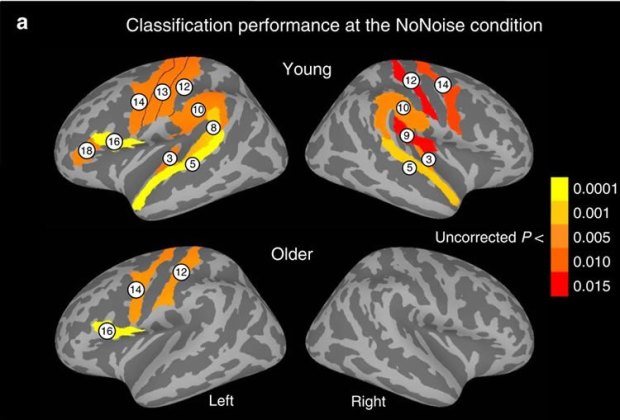
Regions with significant phoneme classification at the NoNoise condition for each group. NeuroscienceNews.com image is credited to the researchers/Nature Communications.

Researchers have pinpointed the specific part of the brain that older adults rely on to differentiate speech sounds in background noise, which could revolutionise the treatment of hearing loss.

New research has identified how cells protect themselves against ‘protein clumps’ known to be the cause of neurodegenerative diseases including Alzheimer’s, Parkinson’s and Huntington’s disease.

Transcranial alternating current stimulation may help to improve memory when targeted to a specific kind of brain activity achieved during sleep.

Researchers in the US and Australia have made a breakthrough discovery in the international quest to discover a new and potentially effective vaccine targeting the pathological proteins associated with Alzheimer’s disease.

A new study identifies different brain regions that become active when a strategy of categorisation is applied.

Researchers have developed a new machine learning system that analyses the entire human genome to predict which genes may cause autism spectrum disorder, raising the number of genes that could be linked to the disorder from 65 to 2,500.

Results from a study published in the online publication Nature Genetics finds 15 genomic regions that are significantly associated with a diagnosis of depression.

According to researchers, age related changes in the organization of neural networks when performing short term memory tasks may help to compensate for other aspects of brain aging.

Researchers report smoking related deficits in dopamine return to normal three months after quitting.

Genetic changes associated with Parkinson’s disease have been found in liver, fat, immune and developmental cells, a new study reports.

Brain imaging, twin studies and transcriptome data reveal genetic relationships between lobes.

Finally this week, a new study suggests regular physical activity may lead to greater hippocampal volume and could stave off dementia, especially in older people.