How Does Your Brain Work? #BrainAwarenessWeek

To mark Brain Awareness Week, a global campaign to increase public awareness of the progress and benefits of brain research, which runs from 11-17 March 2019, I will be posting a series of articles on the nature of the brain.

Your brain is a multilayered web of billions of nerve cells arranged in patterns that coordinate thought, emotion, behaviour, movement and sensation.

A complicated highway system of nerves connects your brain to the rest of your body so communication can occur in split seconds. Think about how fast you pull your hand back from a hot stove.

The outermost layer, the cerebral cortex (the “gray matter” of the brain), is a fraction of an inch thick but contains 70 percent of all neurons. Deep folds and wrinkles in the brain increase the surface area of the gray matter, so more information can be processed.

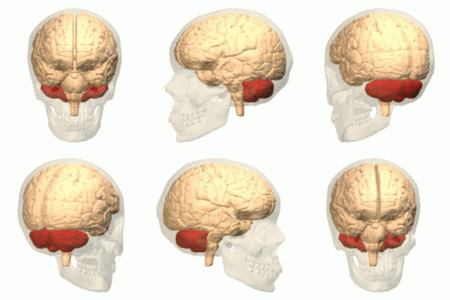
Your brain’s hemispheres are divided into four lobes.

bn00033-lobes-of-the-brain

  • The frontal lobes control thinking, planning, organizing, problem-solving, short-term memory and movement.
  • The parietal lobes interpret sensory information, such as taste, temperature and touch.
  • The occipital lobes process images from your eyes and link that information with images stored in memory.
  • The temporal lobes process information from your senses of smell, taste and sound. They also play a role in memory storage.

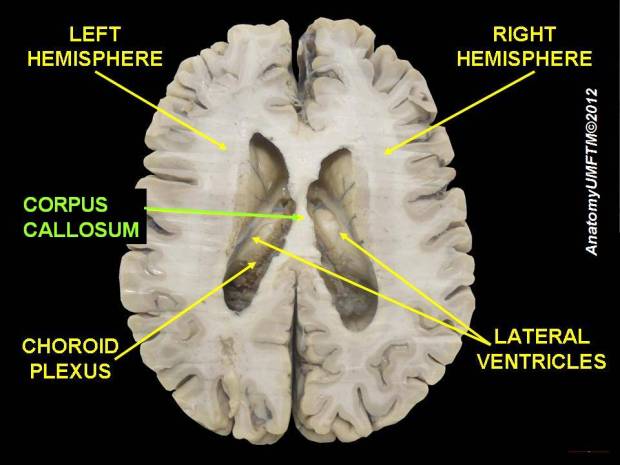
The cerebrum is divided into two halves (hemispheres) by a deep fissure. The hemispheres communicate with each other through a thick tract of nerves, called the corpus callosum, at the base of the fissure. In fact, messages to and from one side of the body are usually handled by the opposite side of the brain.
Slide1oo.jpg

Beneath the cortex are areas such as the basal ganglia, which controls movement; the limbic system, central to emotion; and the hippocampus, a keystone of memory.
The primitive brainstem regulates balance, coordination and life-sustaining processes such as breathing and heartbeat.

Throughout the brain, nerve cells (neurons) communicate with one another through interlocking circuits. Neurons have two main types of branches coming off their cell bodies. Dendrites receive incoming messages from other nerve cells. Axons carry outgoing signals from the cell body to other cells — such as a nearby neuron or muscle cell.

Complete_neuron_cell_diagram_en.svg

Interconnected with each other, neurons are able to provide efficient, lightning-fast communication. When a neuron is stimulated, it generates a tiny electrical current, which passes down a fiber, or axon. The end of the axon releases neurotransmitters —chemicals that cross a microscopic gap, or synapse — to stimulate other neurons nearby.

what-are-neurotransmitters-QBI.jpg

Neurotransmitters: Queensland Brain Inst.

Neurotransmitters pass through the synapse, the gap between two nerve cells, and attach to receptors on the receiving cell. This process repeats from neuron to neuron, as the impulse travels to its destination — a web of communication that allows you to move, think, feel and communicate.

While all the parts of your brain work together, each part is responsible for a specific function — controlling everything from your heart rate to your mood.


Sources

Dana Alliance for Brain Initiatives

Mayo Clinic

Weekly Neuroscience Update

arm_16x9.jpg

A new prosthetic hand enables amputees to regain a subtle, close to natural, sense of touch.

Researchers at MIT have developed a new neuroimaging technique that can track signaling processes inside neurons. The MRI sensor will enable researchers to identify the roles neurons play in different types of behavior.

Estrogen in the brain is important to keep neurons communicating and memories being made, scientists report.

A new study shows that there is a very limited regeneration of cells in the brain of patients diagnosed with multiple sclerosis (MS). These findings underline the importance of treating MS at an early stage of the disease progression, when the affected cells can repair the damage as they are not replaced by new ones.

Researchers report alterations in RNA editing play a vital role in autism spectrum disorder.

Older adults who engage in short bursts of physical activity can experience a boost in brain health even if the activity is carried out at a reasonably low intensity, according to a new study.

In children with autism, the sound of their mom’s voice creates a weaker brain response than in their peers not on the autism spectrum, a new study reports.

Researchers report they have identified biomarkers of Alzheimer’s disease in spinal fluid samples of a significant number of older patients hospitalized as a result of hip fractures. The study suggests neural alterations that lead to poor balance in older people may signify an increased risk of falls that result in hip fractures, and Alzheimer’s disease.

A new study reveals how male sex steroids impact brain development

Finally this week, scientists have found the first common genetic risk variants for autism and uncovered genetic differences in clinical subgroups of autism. The discovery means that we will in future be able to determine the genes which separate the diagnostic groups, make more precise diagnoses, and provide better counselling for the individual person suffering from autism disorders.

Weekly Neuroscience Update

autism-body-clock-neurosciencnews.jpg

Image Source: RIKEN

Researchers report the hierarchy of intrinsic neural timescales appears to be disrupted in adults on the autism spectrum. 

A new study reveals teenage binge drinking can result in lasting epigenetic changes that alter the expression of BDNF-AS, a protein vital for the formation of neural connection in the amygdala.

Researchers shed light on the neural networks that appear to govern human consciousness.

Scientists report the popular bodybuilding protein supplement, L-norvaline, can have a negative impact on brain health. Researchers found that in low concentrations, the supplement causes damage to neurons which eventually leads to cell death.

A new study finds cannabis use in teens is associated with a higher risk of developing depression and anxiety as adults.

According to researchers, there is an optimum amount of dopamine that should be present within the brain. This optimum amount can help improve cognitive performance on tasks, researchers report.

A new study reveals the somatosensory cortex plays a complex role in memory and reward learning.

Scientists report EEG technology can help to predict the onset of epileptic seizures up to four minutes in advance. Additionally, acetate, an edible acid, may help to prevent seizures if they are detected with enough notice.

Teenagers suffering with depression may struggle with recalling specific memories, according to new research from the University of Reading.

A new study reveals women’s brains tend to appear three years younger than males of the same age. Researchers report this could be a reason why women tend to remain mentally sharp longer than men.

A new prosthetic hand enables amputees to regain a subtle, close to natural, sense of touch.

Finally this week, new research reports that older adults who exercise by using electric bicycles experience comparable cognitive and mental health benefits to those who use a standard, pedal-powered bike.

Weekly Neuroscience Update

sleep-infection-neuroscinenews (1)

This diagram shows how the effects of Gαs-coupled agonists on T cells can be influenced by sleep or disease. NeuroscienceNews.com image is credited to Dimitrov et al., 2019.

A new study reports sleep can help immune cells attach to targets and help fight infection. The study reveals how sleep assists the body in fighting infections, whereas conditions like chronic stress can make the body more susceptible to illness.

Researchers have demonstrated that physical coordination is more beneficial in larger groups.

Scientists have identified a small set of molecules that can convert glial cells into new neurons. The finding could help develop new treatments for Alzheimer’s disease and brain injuries.

New therapeutic molecules show promise in reversing the memory loss linked to depression and aging.

The first population-level study on the link between gut bacteria and mental health identifies specific gut bacteria linked to depression and provides evidence that a wide range of gut bacteria can produce neuroactive compounds. Jeroen Raes (VIB-KU Leuven) and his team published these results today in the scientific journal Nature Microbiology.

A new study reports unexpected changes in music activates the nucleus accumbens, providing reward and helping us to learn about the music as we listen. 

Researchers reveal the different cognitive styles of creative and analytical thinkers are a result of fundamental differences in neural activity that can be observed when people are not working on a problem.

Finally this week, a new study reports fluvoxamine, an antidepressant used to treat OCD appears to be effective in stopping sepsis.

Weekly Neuroscience Update

sleep-pain-neuroscinenews.jpg

Activity in the brain’s somatosensory cortex, which receives pain signals, increased 126 percent following a sleepless night vs. a full night of sleep. 

Researchers report sleep deprivation intensifies and prolongs pain.

A new study reports a causal link between dopamine, musical pleasure and motivation. Phamacologically manipulating dopamine levels, researchers found increasing dopamine increased the hedonic experience and motivational response to listening to a piece of music.

Scientists have developed a protein sensor which allows for the observation of nicotine’s movement in cells.

Patients with psychosis have accelerated aging of two brain networks important for general cognition–the frontoparietal network (FPN) and cingulo-opercular network (CON)–according to a new study in Biological Psychiatry.

A new international study has identified 269 new genes linked to depression.

Researchers have identified the 3D structure of a brain receptor that causes nausea as a result of chemotherapy treatments for cancer. The same receptor also plays a critical role in pain perception, migraines and chronic itching.

There is growing evidence that at least in some patients with Parkinson’s disease (PD), the disease may begin in the gut. 

New science uncovers how an unlikely culprit, Porphyromonas gingivalis (Pg) – the bacterium commonly associated with chronic gum disease – appears to drive Alzheimer’s disease (AD) pathology.

Researchers have identified a genetic link between impulsivity and a predisposition to engage in risky behaviors.

Differences in cognitive development between hearing and deaf children start in infancy, according to new research by The Ohio State University College of Medicine published today in the journal PLOS ONE.

A new study reveals blood cell DNA remains steady, even after transplant. The findings shed new light on human aging.

Finally this week, researchers have shed new light on why some people may not respond to antidepressants for major depressive disorder. The study reports neurons in the brains of some with MDD may become hyperactive in the presence of SSRIs.

Is The Internet Changing Your Brain? #SaferInternetDay

Today, on #SaferInternetDay, I thought it a good time to return to a topic I’ve spoken about over the years. The question of whether our brains are being altered due to our increasing reliance on search engines, social networking sites, and other digital technologies, is always a timely one.

The Internet can be a force for positive change (as with new ‘cybertherapies’ to help patients with addiction and post-traumatic stress disorders), but equally, it can have a negative effect on mental health – especially with young people.

Today, I’m giving a talk to parents on the pros and cons of gaming and why gaming is so attractive to young people. I want to offer parents an opportunity to create a balance in their child’s world through understanding what is going on inside their child’s brain.

The talk takes place at Nenagh Arts Centre, Co Tipperary.  If you can’t attend in person, I’ll be sharing my slides later this week on SlideShare so check back in again.

This event is FREE but it is essential to book a seat with the Arts Centre on 067 34400 or through Eventbrite. 

Weekly Neuroscience Update

brain-20424_960_720.jpg

A new study reveals taking a short daytime nap can help to consolidate learning and memory of new foreign words.

Astrocytes, ‘caretaker’ cells that surround and support neurons in the brain, may lead the tempo of the body’s internal clock and control patterns of daily behavior, a new study reports.

Pre-teens who use a mobile phone or watch TV in the dark an hour before bed are at risk of not getting enough sleep, a new study reveals.

In a scientific first, neuroengineers have created a system that translates thought into intelligible, recognizable speech. This breakthrough, which harnesses the power of speech synthesizers and artificial intelligence, could lead to new ways for computers to communicate directly with the brain.

Scientists report brain connectivity appears to be dictated by the spatial architecture of neurons, rather than the cell type-specific cues.

A new study reports sleep deprivation increases the levels of tau, and accelerates the spread of the protein, in the brain. The findings reveal a lack of sleep alone may help drive the development of Alzheimer’s disease.

Researchers report alterations in RNA editing play a vital role in autism spectrum disorder.

According to a new study, the consequence of daily stress is linked to an increase in REM sleep. Researchers report the increase is associated with genes involved in apoptosis and cell survival. The findings shed light on how stress leads to mood disorders, and how changes in sleep contribute to this.

You can hack your brain to form good habits – like going to the gym and eating healthily – simply by repeating actions until they stick, according to new research.

Machine learning technology is helping researchers to detect the early signs of Alzheimer’s, by identifying potential blood based biomarkers of the disease. Researchers say the technology has found hidden factors associated with Alzheimer’s through medical data, and could help improve disease prediction.

A new study reveals the molecular switch that helps control the function of satiety neurons and body weight.

When we’re in pain, we have a hard time sleeping. But how does poor sleep affect pain? For the first time, scientists have answered that question by identifying neural glitches in the sleep-deprived brain that can intensify and prolong the agony of sickness and injury.

People with sleep apnea struggle to remember details of memories from their own lives, potentially making them vulnerable to depression, new research has shown.

Finally this week, using CRISPR gene editing, researchers mapped important genes for helping T helper cells. The findings could help generate new treatments to activate the immune system against infection and to attack tumor cells.


Weekly Neuroscience Update

visual-cortex-face-recognition-neurosciencenews.jpg

 Image credited to Dr. Vadim Axelrod

Researchers have identified neurons in the visual cortex that respond to different faces.

Leading a unique, collaborative research study with scientists across the globe, investigators have pinpointed a set of molecules that wire the body weight center of the brain.

A large-scale international study has discovered new genetic risk loci for Alzheimer’s disease, and researchers published their work in Nature Genetics.

A new study reports experiencing vital exhaustion, a symptom of psychological distress, during mid life may be associated with a higher risk of developing dementia later in life.

Researchers have identified over 500 genetic variants which affect the use of, and addiction to, alcohol and tobacco.

A new neuroimaging study has helped researchers capture the processes by which the brain stores information related to when events happen. The findings could help further the understanding of age-related dementia.

Researchers report using rhythmic movements while speaking helps to improve speech skills in children.

A new study uses an epigenetic approach to correct synaptic dysfunction in the brain associated with memory loss. The findings could help to restore memory function in those with Alzheimer’s and other neurodegenerative diseases.

Scientists say they can predict whether a person can expect to live longer or die sooner than average, by looking at their DNA.

Yale researchers have discovered several genetic variants that signal the risk of serious suicide attempts and noted some variants have also been linked to major depressive disorder.

Scientists report signs of memory problems in old age may be a result of hearing loss and not a neurodegenerative disease.

Using sophisticated computational tools, researchers have discovered biomarkers that may explain why symptoms of post-traumatic stress disorder (PTSD) can be so severe for some people and not for others.

Researchers have discovered how the body is able to initiate repair mechanisms which can limit the extent of damage to the myelin sheath. The findings could help with the development of new therapies for multiple sclerosis.

A new EEG study reveals how the brain utilizes more cognitive resources to hold memory and process previous information.

Chaos in bodily regulation can optimize our immune system according to a recent discovery made by researchers. The discovery may prove to be of great significance for avoiding serious diseases such as cancer and diabetes.

A new neuroimaging study reveals brain activity is reduced when we experience self touch, as opposed to the touch of another person. The findings shed light on how the brain is able to distinguish between tactile sensations generated by the touch of another and personal touch.

A new study shows an association between excessive social media use and impaired risky decision making, a common deficient in substance addiction.

Researchers report children who experience deprivation early in life have impaired memory and executive function between the ages of 8 and 16 compared to peers who were placed in quality foster homes.

New research reveals frequency plays a key role in neural activation from electrical stimulation.

A new study reports amyloid precursor proteins modulate neural signal transmission by binding to a specific receptor. Researchers say modulating the receptor could help treat Alzheimer’s disease.

Researchers report a genetic mutation that causes structural abnormalities in the adolescent brain may predict an increased risk of schizophrenia later in life.

A new neuroimaging study reveals tasks that require audiovisual processing are extremely difficult for children with dyslexia. The findings could lead to new tests that help identify the disorder before children fall behind their peers.

Finally this week, a new study reveals differences in genes in four areas of the brain that contribute to psychiatric disorders.

Weekly Neuroscience Update

glial-cells-parkinsoins-neurosciencnewes (1).jpg

Image: di Domenico/Stem Cell Reports

A new study reveals a defective version of astrocytes may be linked to the build up of alpha synuclein and could spur Parkinson’s disease. The findings show the important role glial cells play in Parkinson’s and offers insights into new targets for therapies to fight the neurodegenerative disease.

A genome-wide analysis of nearly 45,000 people has identified 16 regions of DNA associated with epilepsy, 11 of which are newly identified.

Scientists at the Max Planck Institute for Metabolism Research in Cologne found when people crave specific foods, the brain releases more dopamine when they finally consume the item. The study reports the gastrointestinal tract is in constant contact with the brain and uses reward stimuli to control our desire for food.

Researchers have developed a method to determine the length of mutated genes associated with Huntington’s disease quickly and easily.

Men with dyslexia have altered structural connections between the thalamus and auditory cortex on the left side of the brain, new research published in Journal of Neuroscience reveals.

A new study reports when we retrieve information about visual objects, the brain first focuses on the core meaning and afterwards recalls specific details.

Researchers report that neuron loss in Alzheimer’s disease may not be such a bad thing. The study reveals the loss of neurons may be the result of a cell quality control mechanism attempting to protect the brain from the accumulation of malfunctioning neurons.

Neurofeedback training stimulates the cortical learning process and can help improve the sense of touch, a new study reveals.

Research led by stem cell scientists at Harvard University points to a potential new biomarker and drug target for amyotrophic lateral sclerosis (ALS), a neurological disease that is extremely difficult to diagnose and treat.

Finally this week, researchers have identified over 500 genetic variants which affect the use of, and addiction to, alcohol and tobacco.


Weekly Neuroscience Update

baby-2598005_960_720.jpg

Parents and carers who regularly read with small children are giving them a language advantage of eight months, a study shows.

Smartphone and internet addiction appears to have an impact on brain chemistry. A new study reports the ratio of GABA to Glx is significantly increased in the anterior cingulate cortex of teens who are addicted to their smartphones.

Researchers report neurons from people on the autism spectrum exhibit different growth patterns and develop at a faster rate.

A new study reports obesity and excessive body fat around the middle is associated with lower grey matter volume in the brain. The study also found a link between obesity and shrinkage in specific brain areas.

Researchers have shed light on the epidemiological factors that help shape our gut bacteria from social relationships, socioeconomic status and health related behaviors.

Scientists used EEG to investigate how the brain processes stimuli to determine whether an image or word is positive or negative. The study found words associated with loss causes neural reactions in the visual cortex after 100 milliseconds.

A new study identifies a direct dopamine neuron link to circadian rhythm.

A noninvasive hearing test may assist with early detection and diagnosis of autism spectrum disorders, according to research published in the Journal of the American Osteopathic Association.

Scripps researchers have uncovered the process that helps control neuron growth.

A new study has identified racial disparities between African Americans and Caucasians in the level of a key biomarker used to identify Alzheimer’s disease.

Neuroscientists have identified exactly how breathing changes the brain.

A new study, published in Proceedings of the National Academy of Sciences (PNAS), sheds light on a mechanism underlying Parkinson’s disease and suggests that Tacrolimus — an existing drug that targets the toxic protein interaction explored in the study — could be used as a novel treatment.

Researchers have identified a mechanism that may explain what is known as the Mozart Effect, where sound input is linked to developing cognitive function.

Neuroscientists have identified a neural population in the human auditory cortex that responds selectively to sounds that people typically categorize as music, but not to speech or other environmental sounds.

Finally this week, researchers at the Netherlands Institute for Neuroscience revealed that there are five types of insomnia