Weekly Neuroscience Update

Glioma cells tend to congregate at blood vessel junctions, almost as if camping alongside a stream where it joins a river. The ready supply of nutrients would allow the cell to grow into a larger tumor mass. Credit University of Alabama at Birmingham.

Glioma cells tend to congregate at blood vessel junctions, almost as if camping alongside a stream where it joins a river. The ready supply of nutrients would allow the cell to grow into a larger tumor mass. Credit University of Alabama at Birmingham.

Researchers have shed new light on how cells called gliomas migrate in the brain and cause devastating tumors. The findings, published in Nature Communications, show that gliomas — malignant glial cells — disrupt normal neural connections and hijack control of blood vessels.

New details on the NMDA receptor could aid development of drugs for Alzheimer’s, Parkinson’s, depression, other neurological disorders.

In a new study, scientists took a molecular-level journey into microtubules, the hollow cylinders inside brain cells that act as skeletons and internal highways. They watched how a protein called tubulin acetyltransferase (TAT) labels the inside of microtubules. The results, published in Cell, answer long-standing questions about how TAT tagging works and offer clues as to why it is important for brain health.

Patients with persistent ringing in the ears – a condition known as tinnitus – process emotions differently in the brain from those with normal hearing, researchers report in the journal Brain Research.

Pornography triggers brain activity in people with compulsive sexual behaviour – known commonly as sex addiction – similar to that triggered by drugs in the brains of drug addicts, according to a University of Cambridge study published in the journal PLOS ONE. However, the researchers caution that this does not necessarily mean that pornography itself is addictive.

Around half of the genes that influence how well a child can read also play a role in their mathematics ability, say scientists from UCL, the University of Oxford and King’s College London who led a study into the genetic basis of cognitive traits.

Psychologists at Stony Brook University, NY, suggest that about 20% of the population are genetically predisposed to be more aware and empathic. Now, in a new study, they explore which regions of the brain are implicated in this. They publish their findings in the journal Brain and Behavior.

Learning a second language may help improve brain function regardless of when you start, according to a new study.
 

Weekly Neuroscience Update

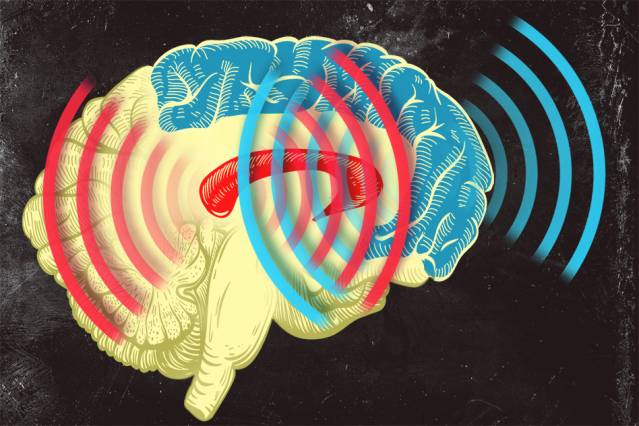
MIT neuroscientists found that brain waves originating from the striatum (red) and from the prefrontal cortex (blue) become synchronized when an animal learns to categorize different patterns of dots.  Illustration: Jose-Luis Olivares/MIT

MIT neuroscientists found that brain waves originating from the striatum (red) and from the prefrontal cortex (blue) become synchronized when an animal learns to categorize different patterns of dots.
Illustration: Jose-Luis Olivares/MIT

The human mind can rapidly absorb and analyze new information as it flits from thought to thought. These quickly changing brain states may be encoded by synchronization of brain waves across different brain regions, according to a new study from MIT neuroscientists.

Research published in the Proceedings of the National Academy of Sciences examines what happens to the brain when it recovers from the effects of anesthetic.

A new study finds that meditation strongly stimulates parts of the brain that help with memory and emotion processing, which in turn lowers stress. A team of researchers from the Norwegian University of Science and Technology, the University of Oslo, and the University of Sydney found that “nondirective” meditation, in which someone achieves a relaxed focus of attention by repeating a mantra or sound and lets his or her mind wander, is the most effective kind of meditation.

New research touts the ability of PET (Positron Emission Tomography) scans to identify patients in a minimally conscious state (MCS) far more accurately than other imaging technologies.

Weekly Neuroscience Update

human-brain-120329

MRIs work by aligning the magnetic spin of the hydrogen molecules in the body. Credit: Image courtesy of MGH-UCLA Human Connectome Project.

Brain scans are now starting to peer down to the molecular level, revealing what brain cells are telling one another, researchers say.

A new study has provided insight into the behavioral damage caused by repeated blows to the head. The research provides a foundation for scientists to better understand and potentially develop new ways to detect and prevent the repetitive sports injuries that can lead to the condition known as chronic traumatic encephalopathy (CTE).

Sufferers of a common sleep-breathing disorder have diminished activity among neurons responsible for keeping heart rate low, reveals a new study published in The Journal of Physiology. The research discovered that in obstructive sleep apnoea (OSA), neurons in the brainstem that control heart rate experience a blunting of their activity. The reduction of neuronal activity likely contributes to the increased heart rate,blood pressure and risk of adverse cardiovascular events that occur in patients with OSA.

A variant of the gene KLOTHO is known for its anti-aging effects in people fortunate enough to carry a copy. Now researchers have found that it also has benefits when it comes to brain function.

Humans who lack the corpus callosum, a bundle of 200 million fibers that connect the left and right hemispheres of the brain, have long fascinated physicians, neuroscientists and other curious minds. Now, a group of researchers puts an end to the Sperry’s paradox, which describes major differences between individuals born with reduced or absent brain connections and those who acquire this condition later in life.

A study has shown that a long-overlooked form of neuron-to-neuron communication called miniature neurotransmission plays an essential role in the development of synapses, the regions where nerve impulses are transmitted and received.

The way that your heart rate increases in response to alertness in the brain has been recently discovered by researchers. Specifically, this study looked at the interactions between neurons that fire upon increased attention and anxiety and neurons that control heart rate to discover the “why,” “how,” and “where to next” behind this phenomenon. The results may have important implications for how certain conditions are treated in the future, such as post-traumatic stress disorder, chronic anxiety, or even stress.

A growing body of evidence suggests nonhuman animals can group living and inanimate things based on less than obvious shared traits, raising questions about how creatures accomplish this task.

Researchers at the University of Liverpool found musical training can increase blood flow in the left hemisphere of the brain, suggesting the area of the brain responsible for music and language share common pathways.

Weekly Neuroscience Update

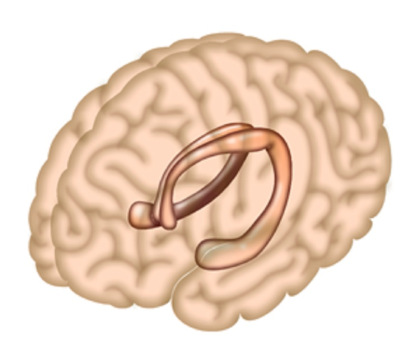
The hippocampus is a region of the brain largely responsible for memory formation. Credit Salk Institute.

The hippocampus is a region of the brain largely responsible for memory formation. Credit Salk Institute.

Scientists have created a new model of memory that explains how neurons retain select memories a few hours after an event. This new framework provides a more complete picture of how memory works, which can inform research into disorders liked Parkinson’s, Alzheimer’s, post-traumatic stress and learning disabilities.

A switch in the brain of people with epilepsy dictates whether their seizures will be relatively mild or lead to a dangerous and debilitating loss of consciousness, Yale researchers have found.

By predicting our eye movements, our brain creates a stable world for us. Researchers used to think that those predictions had so much influence that they could cause us to make errors in estimating the position of objects. Neuroscientists at Radboud University have shown this to be incorrect. The Journal of Neuroscience published their findings – which challenge fundamental knowledge regarding coordination between brain and eyes.

Extreme and traumatic events can change a person — and often, years later, even affect their children. Researchers have now unmasked a piece in the puzzle of how the inheritance of traumas may be mediated.

Artists have structurally different brains compared with non-artists, a study has found. Participants’ brain scans revealed that artists had increased neural matter in areas relating to fine motor movements and visual imagery. The research, published in NeuroImage, suggests that an artist’s talent could be innate. But training and environmental upbringing also play crucial roles in their ability, the authors report.

Certain errors in visual perception in people with schizophrenia are consistent with interference or ‘noise’ in a brain signal known as a corollary discharge, a new study shows.

Finally this week,  a recent study has shown that use of abstract gestures is a powerful tool for helping children understand and generalize mathematical concepts.


Weekly Neuroscience Update

Neuroscience research demonstrates that the brain regions underpinning moral judgment share resources with circuits controlling other capacities such as emotional saliency, mental state understanding and decision-making. Credit: Jean Decety

Neuroscience research demonstrates that the brain regions underpinning moral judgment share resources with circuits controlling other capacities such as emotional saliency, mental state understanding and decision-making. Credit: Jean Decety

People who care about justice are swayed more by reason than emotion, according to new brain scan research from the Department of Psychology and Center for Cognitive and Social Neuroscience. Researchers have discovered a gene that is likely to play a role in the risk of psychosis in bipolar disorders.

A new way to artificially control muscles using light, with the potential to restore function to muscles paralysed by conditions such as motor neuron disease and spinal cord injury, has been developed by scientists at UCL and King’s College London.

Researchers at the University of California, San Diego School of Medicine and the Allen Institute for Brain Science have published a study that gives clear and direct new evidence that autism begins during pregnancy.

A new study is the first documented study that shows cognitive behavioral therapy in a group setting is capable of changing the brain structure in patients with chronic pain.

By examining the sense of touch in stroke patients, a University of Delaware cognitive psychologist has found evidence that the brains of these individuals may be highly plastic even years after being damaged.

A new chemical messenger that is critical in protecting the brain against Parkinson’s disease has been identified by scientists.

Scents and smells can form the basis of some of the most significant memories humans form in their lives, a new study suggests

In the first study of its kind, two researchers have used popular music to help severely brain-injured patients recall personal memories.

Weekly Neuroscience Update

Embed from Getty Images

Johns Hopkins researchers report that people with chronic insomnia show more plasticity and activity than good sleepers in the part of the brain that controls movement.

Researchers at The Scripps Research Institute (TSRI) and Vanderbilt University have created the most detailed 3-D picture yet of a membrane protein that is linked to learning, memory, anxiety, pain and brain disorders such as schizophrenia, Parkinson’s, Alzheimer’s and autism.

New research has revealed the dramatic effect the immune system has on the brain development of young children. The findings suggest new and better ways to prevent developmental impairment in children in developing countries, helping to free them from a cycle of poverty and disease, and to attain their full potential.

Rate of change in the thickness of the brain’s cortex is an important factor associated with a person’s change in IQ, according to a collaborative study by scientists in five countries.

Researchers have found that decision-making accuracy can be improved by postponing the onset of a decision by a mere fraction of a second. The results could further our understanding of neuropsychiatric conditions characterized by abnormalities in cognitive function and lead to new training strategies to improve decision-making in high-stake environments. The study was published in the March 5 online issue of the journal PLoS One.

A study has revealed how the fatal neurodegenerative disease amyotrophic lateral sclerosis (ALS), also known as Lou Gehrig’s disease, is transmitted from cell to cell, and suggests the spread of the disease could be blocked.

Research from Karolinska Institutet in Sweden suggests that the expression of the so called MYC gene is important and necessary for neurogenesis in the spinal cord. The findings are being published in the journal  EMBO Reports .

Our memories are inaccurate, more than we’d like to believe. And now a study demonstrates one reason: we apparently add current experiences onto memories.

Damage to the brain may still occur even if symptoms of traumatic brain injury are not present, scientists suggest.

The brain processes read and heard language differently. This is the key and new finding of a study published in Frontiers in Human Neuroscience.

Weekly Neuroscience Update

Lesion overlap map illustrating common and distinctive brain regions for Val/Val (blue) and Val/Met (yellow) genotype patients. Overlap between Val/Val and Val/Met genotype patients is illustrated in green. In each axial slice, the right hemisphere is on the reader’s left. Credit Barbey et al./PLOS ONE.

Lesion overlap map illustrating common and distinctive brain regions for Val/Val (blue) and Val/Met (yellow) genotype patients. Overlap between Val/Val and Val/Met genotype patients is illustrated in green. In each axial slice, the right hemisphere is on the reader’s left – this is because the view is from the bottom i.e. as if one were in the neck looking up at the brain. Credit Barbey et al./PLOS ONE.

Researchers report that one tiny variation in the sequence of a gene may cause some people to be more impaired by traumatic brain injury (TBI) than others with comparable wounds.

A recent study conducted by a multicenter-research team led by Cedars-Sinai Medical Center used a new, automated imaging system to identify shrinkage of a mood-regulating brain structure in a large sample of women with multiple sclerosis (MS), who also have a certain type of depression. The research supports earlier studies suggesting that the hippocampus may contribute to the high frequency of depression seen in those who suffer from MS.

Max Ortiz Catalan, researcher at Chalmers University of Technology, has developed a new method for the treatment of phantom limb pain (PLP) after an amputation. 

University of Sydney study is looking into the effectiveness of omega-3 supplements and the antidepressant, sertraline, in reducing depressive symptoms and cognitive decline in older people, in a bid to prevent the onset of depression and dementia in later life.

Certain neurons in the human striatum—a brain region involved in movement and cognition—are renewed throughout life, according to a study published in Cell.

Researchers at the University of Oxford have discovered the molecular switch in the brain that sends us to sleep.

Weekly Neuroscience Update

Temporo-parietal jonction (TPJ) © Perrine Ruby / Inserm

Temporo-parietal jonction (TPJ) © Perrine Ruby / Inserm

Some people recall a dream every morning, whereas others rarely recall one. A research team has studied the brain activity of these two types of dreamers in order to understand the differences between them. In a study published in the journal Neuropsychopharmacology, the researchers show that the temporo-parietal junction, an information-processing hub in the brain, is more active in high dream recallers. Increased activity in this brain region might facilitate attention orienting toward external stimuli and promote intrasleep wakefulness, thereby facilitating the encoding of dreams in memory.

Many psychiatric disorders are accompanied by memory deficits. Basel scientists have now identified a network of genes that controls fundamental properties of neurons and is important for human brain activity, memory and the development of schizophrenia. 

Researchers have taken a major step toward identifying the specific genes that contribute to bipolar disorder.

A recent study conducted by Johns Hopkins University and the National Institute of Aging found that aging adults with hearing loss are at higher risk for accelerated brain-tissue loss.

Brain cell regeneration has been discovered in a new location in human brains. The finding raises hopes that these cells could be used to help people recover after a stroke, or to treat other brain diseases.

Finally this week, researchers are hoping that the world’s largest simulated brain — known as Spaun — will be used to test new drugs that lead to breakthrough treatments for neurological disorders such as Parkinson’s, Huntington’s, and Alzheimer’s disease.

Weekly Neuroscience Update

brain

Researchers have pinpointed an area of the brain that serves as an arbitrator between our two decision-making systems, one devoted to habitual behaviors and the other devoted to actions we take only after careful consideration.

Scientists who discovered a gene that links the thickness of the brain’s gray matter to intelligence say their finding might help improve understanding of brain disorders such as autism and schizophrenia.

People who appreciate the beauty of mathematics activate the same part of their brain when they look at aesthetically pleasing formula as others do when appreciating art or music, suggesting that there is a neurobiological basis to beauty.

Researchers at the University of California, San Francisco, are looking at ways video game technology can be used to improve or heal the brain.

For the first time, scientists have identified a gene linking the thickness of the grey matter in the brain to intelligence. The study is published today in Molecular Psychiatry and may help scientists understand biological mechanisms behind some forms of intellectual impairment.

People with dyslexia have greater difficulty than others in shifting attention between the senses – from seeing something to hearing something – according to an Oxford University study. The researchers suggest that action video games, where attention is constantly shifting focus, may be able to boost literacy skills – though they have yet to test this. The findings are reported in the journal Current Biology.

A new study published in Social Neuroscience says that the brain has begun processing a typed emoticon with the same signals that previously only accompanied processing a real, emoting human face.

A specific type of neuron in the amygdala performs differently in individuals with autism spectrum disorder than in those without the disorder, according to a new study by researchers at Cedars-Sinai Medical Center in New York.

Finally, this Valentine’s weekend, new research reveals that  a region deep inside the brain controls how quickly people make decisions about love.

Weekly Neuroscience Update

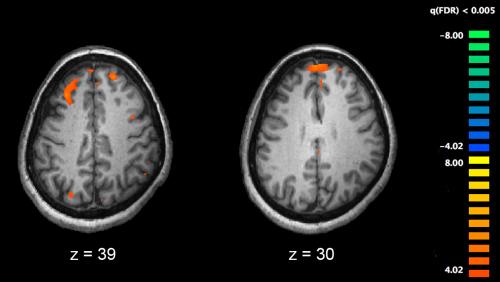
Functional magnetic resonance imaging (fMRI) and other brain imaging technologies allow for the study of differences in brain activity in people diagnosed with schizophrenia. The image shows two levels of the brain, with areas that were more active in healthy controls than in schizophrenia patients shown in orange, during an fMRI study of working memory. Credit: Kim J, Matthews NL, Park S./PLoS One.

Functional magnetic resonance imaging (fMRI) and other brain imaging technologies allow for the study of differences in brain activity in people diagnosed with schizophrenia. The image shows two levels of the brain, with areas that were more active in healthy controls than in schizophrenia patients shown in orange, during an fMRI study of working memory. Credit: Kim J, Matthews NL, Park S./PLoS One.

Researchers from the Broad Institute and several partnering institutions have taken a closer look at the human genome to learn more about the genetic underpinnings of schizophrenia. In two studies published in Nature, scientists analyzed the exomes, or protein-coding regions, of people with schizophrenia and their healthy counterparts, pinpointing the sites of mutations and identifying patterns that reveal clues about the biology underlying the disorder.

A new brain region that appears to help humans identify whether they have made bad decisions has been discovered by researchers.

New research finds that the brains of autistic children generate more information at rest – a 42% increase on average. The study offers a scientific explanation for the most typical characteristic of autism – withdrawal into one’s own inner world. The excess production of information may explain a child’s detachment from their environment.

The brain appears to synchronize the activity of different brain regions to make it possible for a person to pay attention or concentrate on a task, scientists have learned.

Researchers at the Albert Einstein College of Medicine are investigating the effects of repeated combat-related blast exposures on the brains of veterans. Mild traumatic brain injuries can cause problems with cognition, concentration, memory and emotional control. Scientists are using advanced MRI technology and psychological tests to investigate the structural and biological impact of repeated head injury and to assess how these injuries affect cognitive functions. Final results of the study have not yet been published, but researchers hope it will lead to more scientifically valid diagnostic techniques that could potentially allow for detection of both the underlying brain injury and its severity.