Weekly Neuroscience Update

hearing-loss-frontal-cortex-neurosciencenews

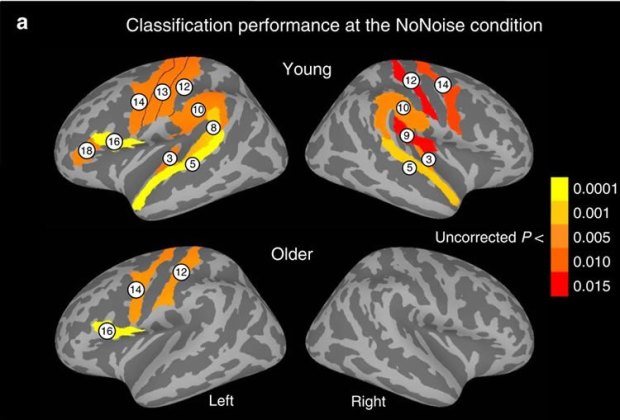
Regions with significant phoneme classification at the NoNoise condition for each group. NeuroscienceNews.com image is credited to the researchers/Nature Communications.

Researchers have pinpointed the specific part of the brain that older adults rely on to differentiate speech sounds in background noise, which could revolutionise the treatment of hearing loss.

New research has identified how cells protect themselves against ‘protein clumps’ known to be the cause of neurodegenerative diseases including Alzheimer’s, Parkinson’s and Huntington’s disease.

Transcranial alternating current stimulation may help to improve memory when targeted to a specific kind of brain activity achieved during sleep.

Researchers in the US and Australia have made a breakthrough discovery in the international quest to discover a new and potentially effective vaccine targeting the pathological proteins associated with Alzheimer’s disease.

A new study identifies different brain regions that become active when a strategy of categorisation is applied.

Researchers have developed a new machine learning system that analyses the entire human genome to predict which genes may cause autism spectrum disorder, raising the number of genes that could be linked to the disorder from 65 to 2,500.

Results from a study published in the online publication Nature Genetics finds 15 genomic regions that are significantly associated with a diagnosis of depression.

According to researchers, age related changes in the organization of neural networks when performing short term memory tasks may help to compensate for other aspects of brain aging.

Researchers report smoking related deficits in dopamine return to normal three months after quitting.

Genetic changes associated with Parkinson’s disease have been found in liver, fat, immune and developmental cells, a new study reports.

Brain imaging, twin studies and transcriptome data reveal genetic relationships between lobes.

Finally this week, a new study suggests regular physical activity may lead to greater hippocampal volume and could stave off dementia, especially in older people.


Brain Imaging at Multiple Size Scales

MIT researchers have developed a new technique for imaging brain tissue at multiple scales, allowing them to peer at molecules within cells or take a wider view of the long-range connections between neurons.

This technique, known as magnified analysis of proteome (MAP), should help scientists in their ongoing efforts to chart the connectivity and functions of neurons in the human brain.

Learn more at http://news.mit.edu/2016/imaging-brain-multiple-size-scales-0725

Was dopamine the secret to Muhammad Ali’s greatness?

Ali

I was saddened this week to read of the death of Muhammad Ali. The 74 year old whose outrageous talent in the ring was matched by his political significance and cultural impact, struggled with Parkinson’s disease which began during his boxing career in the late 1970’s. He was hospitalised several times in recent years and died of respiratory problems related to his disease. I have spent over 30 years investigating the effects of Parkinson’s disease on the brain and I am happy to report that during this period I have seen great strides in our understanding and treatment of this illness.

What is Parkinson’s disease?

Over 4 million people worldwide suffer from Parkinson’s disease; a so-called hypokinetic disorder (Greek; hypo = lack of; kinetic = movement). It is a progressive disease – the symptoms start out small and get progressively worse but it is rarely fatal. With Parkinson’s disease one minute you are working away in the garden and the next you are literally stuck to the spot – totally unable to move. In these situations daily life can become a challenge that can be difficult to endure.

Causes of Parkinson’s disease

Parkinson’s disease can be genetic but it can also be triggered by what happens to you as you live your life such as prolonged exposure to chemicals like insecticides, weed killers and some drugs. Significantly in the case of Muhammad Ali, the disease can also be triggered by brain injury. However in most cases Parkinson’s disease arises ‘out of the blue’ as the so-called idiopathic Parkinson’s disease.

The core defect

The ‘core defect’ in Parkinson’s disease is a loss of a chemical in the brain called dopamine. Dopamine acts like hydraulic oil which lubricates those nerve circuits in the brain that are involved in executing a movement. In Parkinson’s disease the supply of dopamine dries-up and, like a car out of oil the engine seizes-up and movement grinds to a halt.

The Muhammad Ali we all remember was dopamine in action

We need dopamine to survive. Dopamine allows us to talk, socialise, be brave, improvise and take risks. When dopamine flows we don’t see things as being limited by circumstance. We have boundless energy and literally anything is possible! One only needed to watch Muhammad Ali’s awesome talent at the height of his career to see dopamine in action as his brain effortlessly converted his thoughts into the mesmerising performances inside and outside the ring that made him so loved by a generation. Ali’s ability to ‘float like a butterfly, sting like a bee’ was all down to the dopamine in his brain.

Superman

As a child in the 1960s I thought this 6’ 3’’ giant was the closest thing to Superman. Later I watched him take on the establishment over the political and cultural discrimination against his African American heritage knowing full-well that they were going to make him pay for it. It was then that I realised that Muhammad Ali was not just a gifted athlete but also a courageous human being – that he was in fact, a real, live Superman. Again, Ali’s deeply-held convictions and his bravery in standing by them was another expression of the dopamine in his brain.

Was boxing to blame?

Since Muhammad Ali’s death some media have reported that it is a pity that his illness had to overshadow what he achieved during his amazing life. Without dopamine Ali must have felt trapped and disconnected at times. While neurologists cannot definitively say whether Ali’s symptoms were a result of his boxing career, what is known for certain is that head trauma increases the risk of getting Parkinson’s disease.

Boxing and brain injury – a potentially lethal mix

Probably the most important lesson to be taken from Ali’s illness is that we need to open up a debate on how we as a society deal with traumatic brain injury and its causes. Even a minor concussion is dangerous because repeat concussions have cumulative effects on the brain, resulting in brain swelling, permanent brain injury, and long-term disability including Parkinson’s disease, personality change, epilepsy or even death.

By its very nature, a concussion is unexpected, so it is difficult to prevent. Here are three common-sense precautions you can take to lessen the possibility of traumatic brain injury.

1. Wear protective head gear. Participation in high-contact, high-risk sports such as all types of boxing, football, hurling and hockey can increase the likelihood of a concussion. Skateboarding, snowboarding, horseback riding, cycling and roller-blading are also a threat to your brain health. Wearing headgear, padding, and mouth and eye guards can help safeguard against traumatic head injuries. Wearing a bike helmet can lower the risk of traumatic head injury by 85%. Ensure that the equipment is properly fitted, well maintained, and worn consistently.

2. Drive smart. Always wear a seatbelt even as a passenger in a back seat, obey posted speed limits, and don’t use drugs or alcohol when driving, because they can impair reaction time.

3. Don’t fight. Concussions are often sustained during a punch-up, and more males than females report traumatic head injuries.

Funding for research into illness of mind and brain

We also need to highlight the realisation that a deeper understanding of the brain IS the difference between a good and a bad quality of life for the sufferers of brain illnesses such as Parkinson’s disease.

I hope that Muhammad Ali’s loved ones will take hope from the on-going research into Parkinson’s disease by teams of dedicated scientists worldwide.

Click on this link to hear Professor Billy O’Connor talk about Parkinson’s disease on Mind Matters – a science program on Irish National radio (RTE).


You might also like to read:

Emotions are habits so pick a good one

World Mental Health Day

Why Parkinson’s Disease robbed Linda Ronstadt of her singing voice


Weekly Neursocience Update

vegetative-1024x576

Brain glucose metabolism shows a dramatic drop from full consciousness to the minimal conscious and persistent vegetative states.

Brain scans strongly predict return of consciousness in vegetative patients.

Researchers report a surgically implanted neuroprosthetic devices that coordinates the activity hip, knee and ankle muscles led to improved walking speed and distance for a patient with limited mobility following a stroke.

According to new research, dopamine signalling within the cerebral cortex can predict changes between neural networks during working memory tasks.

A region of the brain that responds to bad experiences has the opposite reaction to expectations of aversive events in people with depression compared to healthy adults. The study, published in Molecular Psychiatry, found that the habenula, a pea-sized region of the brain, functions abnormally in depression. The same team previously showed that the habenula was activated in healthy volunteers when they expected to receive an electric shock.

Researchers have identified a mechanism that keeps the brain clean during neurodegenerative diseases.

Older people are less willing to take risks for potential rewards and this may be due to declining levels of dopamine in the brain, finds a new UCL study of over 25,000 people funded by Wellcome.

Neuroscience researchers have identified a gene critical for human brain development.

According to a new study, the brains of people with schizophrenia may be able to reorganize and fight the illness.

Researchers report we recognize patterns in music automatically, even with no musical training.

Finally this week, a new study has identified a neural pathway involved in switching between habitual behavior and deliberate decision making.


Weekly Neuroscience News

virtual-partner-emotion-NeuroscienceNews

Researchers have created a ‘virtual partner’ that is able to elicit emotional response from humans in real time.

New research, presented this week at the European Society of Human Genetics conference in Barcelona, Spain, demonstrates that men whose red blood cells lack Y chromosomes are more susceptible to Alzheimer’s disease. The team hopes that, in the future, these findings might help develop an early warning system for Alzheimer’s.

A new study explores the role microtubles play in neurodevelopment.

According to researchers, people with major depressive disorder could have altered purine metabolism.

Researchers report we recognize patterns in music automatically, even with no musical training.

According to a new study, during sensory stimulation, increases of blood flow are not precisely tuned to local neural activity, and this can have implications for fMRI neuroimaging.

New evidence reveals the powerful role of experience in linking language and cognition in infants.

Researchers report microglia may actually protect the brain against Alzheimer’s disease by containing the spread of amyloid plaques.

A new study reports microglia can diminish the adverse changes to neural circuitry bought on by chronic cocaine use.

Researchers report they have solved the puzzle as to how antibodies enter the nervous system to control viral infections.

A new study from the University of Rochester suggests that human intelligence might have evolved in response to the demands of caring for infants.

Researchers have investigated how the human brain implements hierarchical structures in order to design more clever algorithms for machine learning.

new study reports having high blood pressure can raise the risk of developing vascular dementia.

A new study from MIT neuroscientists reveals that a gene mutation associated with autism plays a critical role in the formation and maturation of synapses—the connections that allow neurons to communicate with each other.

Finally this week, a new study reports a number of different areas of childrens’ brains become activated when they hear their mother’s voice. This response predicts a child’s social communication ability.

Mapping the Brain

Trailblazers in neuroscience Dr. Christof Koch and Dr. John Donoghue reveal mind-blowing insights on how the brain turns thought into voluntary behaviors and how that knowledge is empowering victims of neurological trauma with regained physical abilities.