Weekly Neuroscience Update

Neuroscience research demonstrates that the brain regions underpinning moral judgment share resources with circuits controlling other capacities such as emotional saliency, mental state understanding and decision-making. Credit: Jean Decety

Neuroscience research demonstrates that the brain regions underpinning moral judgment share resources with circuits controlling other capacities such as emotional saliency, mental state understanding and decision-making. Credit: Jean Decety

People who care about justice are swayed more by reason than emotion, according to new brain scan research from the Department of Psychology and Center for Cognitive and Social Neuroscience. Researchers have discovered a gene that is likely to play a role in the risk of psychosis in bipolar disorders.

A new way to artificially control muscles using light, with the potential to restore function to muscles paralysed by conditions such as motor neuron disease and spinal cord injury, has been developed by scientists at UCL and King’s College London.

Researchers at the University of California, San Diego School of Medicine and the Allen Institute for Brain Science have published a study that gives clear and direct new evidence that autism begins during pregnancy.

A new study is the first documented study that shows cognitive behavioral therapy in a group setting is capable of changing the brain structure in patients with chronic pain.

By examining the sense of touch in stroke patients, a University of Delaware cognitive psychologist has found evidence that the brains of these individuals may be highly plastic even years after being damaged.

A new chemical messenger that is critical in protecting the brain against Parkinson’s disease has been identified by scientists.

Scents and smells can form the basis of some of the most significant memories humans form in their lives, a new study suggests

In the first study of its kind, two researchers have used popular music to help severely brain-injured patients recall personal memories.

Weekly Neuroscience Update

Temporo-parietal jonction (TPJ) © Perrine Ruby / Inserm

Temporo-parietal jonction (TPJ) © Perrine Ruby / Inserm

Some people recall a dream every morning, whereas others rarely recall one. A research team has studied the brain activity of these two types of dreamers in order to understand the differences between them. In a study published in the journal Neuropsychopharmacology, the researchers show that the temporo-parietal junction, an information-processing hub in the brain, is more active in high dream recallers. Increased activity in this brain region might facilitate attention orienting toward external stimuli and promote intrasleep wakefulness, thereby facilitating the encoding of dreams in memory.

Many psychiatric disorders are accompanied by memory deficits. Basel scientists have now identified a network of genes that controls fundamental properties of neurons and is important for human brain activity, memory and the development of schizophrenia. 

Researchers have taken a major step toward identifying the specific genes that contribute to bipolar disorder.

A recent study conducted by Johns Hopkins University and the National Institute of Aging found that aging adults with hearing loss are at higher risk for accelerated brain-tissue loss.

Brain cell regeneration has been discovered in a new location in human brains. The finding raises hopes that these cells could be used to help people recover after a stroke, or to treat other brain diseases.

Finally this week, researchers are hoping that the world’s largest simulated brain — known as Spaun — will be used to test new drugs that lead to breakthrough treatments for neurological disorders such as Parkinson’s, Huntington’s, and Alzheimer’s disease.

Speech processing requires both sides of our brain

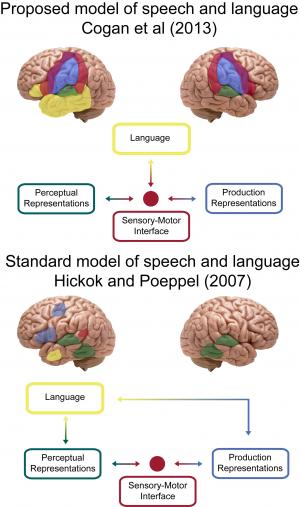
A new study by Cogan et al proposes that speech processes occur on both sides of the brain and are distinct from language, which occurs on one side, typically on the left. This suggests a revision to the standard model of how speech is linked to language with some processes going through a "bilateral sensory-motor interface". Credit: Greg Cogan and Bijan Pesaran

A new study by Cogan et al proposes that speech processes occur on both sides of the brain and are distinct from language, which occurs on one side, typically on the left. This suggests a revision to the standard model of how speech is linked to language with some processes going through a “bilateral sensory-motor interface”. Credit: Greg Cogan and Bijan Pesaran

A new study has found that we use both sides of our brain for speech, a finding that alters previous conceptions about neurological activity. The results, which appear in the journal Nature, also offer insights into addressing speech-related inhibitions caused by stroke or injury and lay the groundwork for better rehabilitation methods.

The study’s senior author, Bijan Pesaran, an associate professor in New York University’s Center for Neural Science, said:

Our findings upend what has been universally accepted in the scientific community—that we use only one side of our brains for speech. With this greater understanding of the speech process, we can retool rehabilitation methods in ways that isolate speech recovery and that don’t involve language.

Read more: Sensory–motor transformations for speech occur bilaterally


Study highlights an increase in young and middle age stroke

Actor Frankie Muniz reveals he suffered a mini-stroke

Actor Frankie Muniz reveals he suffered a mini-stroke

Stroke rates among young and middle-aged people worldwide are increasing and these groups now account for nearly one-third of all strokes, according to a new study. The analysis of data gathered between 1990 and 2010 found that the number of strokes among people aged 20 to 64 rose 25 percent during that time, and that this age group now accounts for 31 percent of the total number of strokes, compared with 25 percent before 1990.

The news that former Malcolm In The Middle actor,  Frankie Muniz,  has recently suffered his second mini-stroke at the age of 27, seems to bear out the study findings. He revealed the news on Twitter.

Almost a year to the day, I experienced another mini stroke. Hopefully that will be the last. Miserable.


What Is A Mini Stroke?

A mini stroke is medically known as a transient ischemic attack (TIA). A TIA is a sign that part of the brain isn’t getting enough blood.One in ten people who suffer a TIA go on to have a stroke within a week if they remain untreated.

Weekly Neuroscience Update

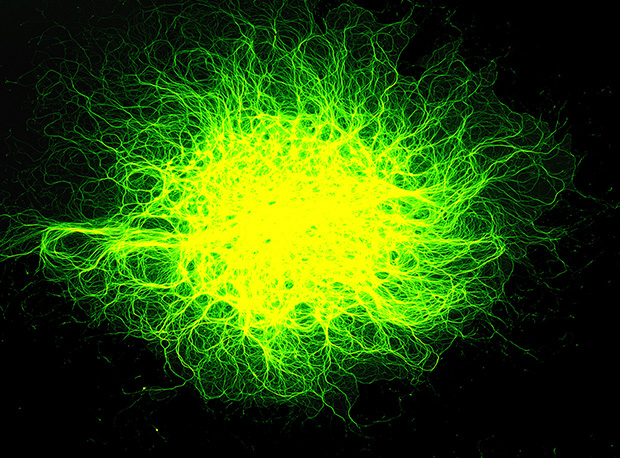
To study how nerve cells respond to injuries in their branches, Washington University researcher Valeria Cavalli grows them in “spots” like the one shown above. Cavalli recently identified a chain reaction that enables repair of these branches when they are cut. Credit Yongcheol Cho/Washington University at St. Louis.

To study how nerve cells respond to injuries in their branches, Washington University researcher Valeria Cavalli grows them in “spots” like the one shown above. Cavalli recently identified a chain reaction that enables repair of these branches when they are cut. Credit Yongcheol Cho/Washington University at St. Louis.

Researchers have identified a chain reaction that triggers the regrowth of some damaged nerve cell branches, a discovery that one day may help improve treatments for nerve injuries that can cause loss of sensation or paralysis.

Groundbreaking research nearly two decades ago linking a mother’s educational background to her children’s literacy and cognitive abilities stands out among decades of social science studies demonstrating the adverse effects of poverty. Now new research has taken that finding in a neuroscientific direction: linking poor processing of auditory information in the adolescent brain to a lower maternal educational background.

A review of new research says there is growing evidence to support the idea that the brain plays a key role in normal glucose regulation and the development of type 2 diabetes.

University of Queensland (UQ) scientists have made a fundamental breakthrough into how the brain decodes the visual world.

Cocaine addicts may become trapped in drug binges not because they are always seeking euphoric highs but rather to avoid emotional lows, says a study in Psychopharmacology.

Researchers have developed a therapeutic at-home gaming program for stroke patients who experience motor weakness affecting 80 percent of survivors.

Learning a musical instrument as a child gives the brain a boost that lasts long into adult life, say scientists.

The birth of new neurons depend upon activation of an important molecular pathway in stem cells, a new Yale School of Medicine study shows.

Researchers have taken a major step towards understanding the causes of Alzheimer’s disease with the largest study yet into the genetics of the disorder.

Light enhances brain activity during a cognitive task even in some people who are totally blind, according to a new study.

Scientists have discovered biological mechanisms that may link Parkinson’s disease to Alzheimer’s disease, according to a study published in the journal Acta Neuropathologica.


Weekly Neuroscience Update

Childhood poverty impacted how much the two regions of the prefrontal cortex (as shown in orange circles) were engaged during emotion regulation. (Credit: University of Illinois at Chicago College of Medicine)

Childhood poverty impacted how much the two regions of the prefrontal cortex (as shown in orange circles) were engaged during emotion regulation. (Credit: University of Illinois at Chicago College of Medicine)

Childhood poverty and chronic stress may lead to problems regulating emotions as an adult, according to research published online in the Proceedings of the National Academy of Sciences.

New research shows that one of the brain’s fundamental self-protection mechanisms depends on coordinated, finely calibrated teamwork among neurons and non-neural cells knows as glial cells, which until fairly recently were thought to be mere support cells for neurons. The study, which has implications for understanding neurodegenerative diseases, stroke, and other nervous system disorders, adds to a growing body of evidence that glial cells are integral to brain function.

Researchers at higher education institutions have identified six proteins in spinal fluid that can be used as markers for Alzheimer’s disease. And another study suggests that older adults who don’t sleep well have more of the brain plaques that are hallmarks of Alzheimer’s.

Researchers from the Centre for Functional Resonance Imaging of the Brain (FMRIB) at the University of Oxford in the UK, say through monitoring patients’ brain waves while under anesthetic, they were able to pinpoint degrees of consciousness dependent on the doses of anesthetic administered.

Finally, this week, a new study from the UCLA School of Nursing shows that the body’s autonomic responses — the controls that impact such functions as blood pressure, heart rate and sweating — are weaker in people with obstructive sleep apnea but are even more diminished in women.

Weekly Neuroscience Update

Feeling happy or sad? Researchers have measured brain signals to accurately read emotions in individuals. (Credit: Karim S. Kassam et al PLOS ONE 10.1371/journal.pone.0066032)

For the first time, scientists at Carnegie Mellon University have identified which emotion a person is experiencing based on brain activity.

Pre-treatment scans of brain activity predicted whether depressed patients would best achieve remission with an antidepressant medication or psychotherapy, in a new study.

People who experience any stroke symptoms—but do not have a stroke—may also be more likely to develop problems with memory and thinking, according to new research published in the June 19, 2013, online issue of Neurology®, the medical journal of the American Academy of Neurology.

And finally this week, a study, led by Royal Holloway University researcher Carolyn McGettigan, has identified the brain regions and interactions involved in impersonations and accents.

Weekly Neuroscience Update

A boxer utilizing the new concussion-detecting test A new tablet-based test is able to detect whether or not someone has sustained a concussion by analyzing their voice.

An international team of neuroscientists has described for the first time in exhaustive detail the underlying neurobiology of an amnesiac who suffered from profound memory loss after damage to key portions of his brain.

A fitness device created by Glasgow academics and designers helps stroke patients during their long road to recovery.

For anyone who has been affected by depression  it is no secret how devastating the disease can be for them and their families. But if the results from a small study published by a group at Germany’s Bonn University Hospital hold up, there could be a radical transformation in the treatment of depression.

An excess of the brain neurotransmitter glutamate may cause a transition to psychosis in people who are at risk for schizophrenia, reports a study from investigators at Columbia University Medical Center (CUMC) published in the current issue of Neuron.

New research finds that prisoners who are psychopaths lack the basic neurophysiological “hardwiring” that enables them to care for others.

The area of the brain that’s activated when people look at numerals such as “7” and “60” has been pinpointed by researchers. This spot is only about one-fifth of an inch across and consists of 1 million to 2 million nerve cells in the inferior temporal gyrus, the researchers said. The inferior temporal gyrus is known to be involved in the processing of visual information.

And finally this week, habitual liars’ brains differ from those of honest people, a study says. A University of Southern California team studied 49 people and found those known to be pathological liars had up to 26% more white matter than others

Weekly Neuroscience Update

Conceptual scheme of controlled release of ODN from a hydrogel composed of a CyD-containing molecular network by mechanical compression. (Credit: Image courtesy of National Institute for Materials Science)

A research group has succeeded in developing a gel material which is capable of releasing drugs in response to pressure applied by the patient.

New findings about how the brain functions to suppress pain have been published in the leading journal in the field Pain, by National University of Ireland Galway (NUI Galway) researchers. For the first time, it has been shown that suppression of pain during times of fear involves complex interplay between marijuana-like chemicals and other neurotransmitters in a brain region called the amygdala.

Researchers report that they have found a biological mechanism that appears to play a vital role in learning to read. This finding provides significant clues into the workings behind dyslexia — a collection of impairments unrelated to intelligence, hearing or vision that makes learning to read a struggle.

A new study suggests neural ‘synchrony’ may be key to understanding how the human brain perceives.

Sleep plays an important role in the brain’s ability to consolidate learning when two new potentially competing tasks are learned in the same day, research at the University of Chicago demonstrates.

New research for the first time explains exactly how two brain regions interact to promote emotionally motivated behaviors associated with anxiety and reward. The findings could lead to new mental health therapies for disorders such as addiction, anxiety, and depression.

Researchers have designed a decoded functional MRI neurofeedback method that induces a pre-recorded activation pattern in targeted early visual brain areas that could also produce the pattern through regular learning.

A new study conducted by monitoring the brain waves of sleeping adolescents has found that remarkable changes occur in the brain as it prunes away neuronal connections and makes the major transition from childhood to adulthood.

New research suggests that depression, even in children, can increase the risk of heart problems later in life. Teens who were depressed as children are far more likely than their peers to be obese, smoke cigarettes and lead sedentary lives, even if they no longer suffer from depression.

Alcohol consumption affects the brain in multiple ways, ranging from acute changes in behavior to permanent molecular and functional alterations. The general consensus is that in the brain, alcohol targets mainly neurons. However, recent research suggests that other cells of the brain known as astrocytic glial cells or astrocytes are necessary for the rewarding effects of alcohol and the development of alcohol tolerance.

New research published in The Journal of Neuroscience suggests that modifying signals sent by astrocytes, our star-shaped brain cells, may help to limit the spread of damage after an ischemic brain stroke.

The prefrontal cortex is a region of the brain that acts like a filter, keeping any irrelevant thoughts, memories and perceptions from interfering with the task-at-hand. In a new study, researchers have shown that inhibiting this filter can enhance unfiltered, creative thinking.

A new study suggests that depression results from a disturbance in the ability of brain cells to communicate with each other. The study indicates a major shift in our understanding of how depression is caused and how it should be treated.


Weekly Neuroscience Update

A run of poor sleep can have a potentially profound effect on the internal workings of the human body, say UK researchers.

As a bird sings, some neurons in its brain prepare to make the next sounds while others are synchronized with the current notes—a coordination of physical actions and brain activity that is needed to produce complex movements, new research at the University of Chicago shows. In an article in the current issue of Nature, neuroscientist Daniel Margoliash and colleagues show, for the first time, how the brain is organized to govern skilled performance—a finding that may lead to new ways of understanding human speech production.

Deep brain stimulation has helped people with severe obsessive-compulsive disorder, and new research begins to explain why. A Dutch study appearing in the Feb. 24 online issue of the journal Nature Neuroscience found the procedure essentially restored normal function in a part of the brain called the nucleus accumbens.

Researchers have identified a possible treatment window of several years for plaques in the brain that are thought to cause memory loss in diseases such as Alzheimer’s. The Mayo Clinic study is published in the Feb. 27 online issue of Neurology.

Though it’s most often associated with disorders like diabetes, Harvard researchers have shown how the signaling pathway of insulin and insulin-like peptides plays another critical role in the body – helping to regulate learning and memory.

Researchers in Scotland and Germany have discovered a molecular mechanism that shows promise for developing a cure for Huntington’s Disease (HD).

Some people do not learn from their mistakes because of the way their brain works, according to research led by an academic at Goldsmiths, University of London. The research examined what it is about the brain that defines someone as a ‘good learner’ from those who do not learn from their mistakes.

Scientists from the University of Oxford say they have discovered how the brain protects itself from damage that occurs in stroke.

A team of French researchers has discovered that the human brain is capable of distinguishing between different types of syllables as early as three months prior to full term birth.