Early genetic markers of Alzheimer’s risk identified

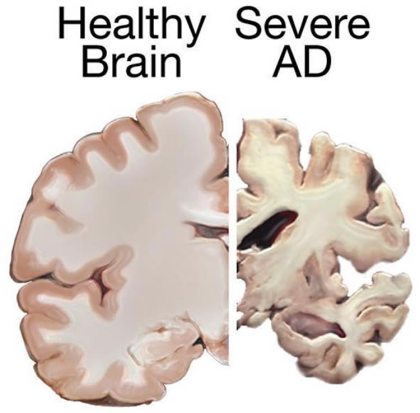
Alzheimer's brain on the left, normal brain on the right

The brains of Alzheimer’s patients – like the one on the left – are more shrunken than normal ones

Genetic markers that could help highlight who is at risk of developing Alzheimer’s disease have been identified by US scientists.

The research in Neuron identifies mutations that affect the build-up of certain proteins in the brain.

Tangles of a kind of tau called phosphorylated tau (ptau) are a hallmark of the disease. High levels of these tau proteins increase the chance of having the disease.

One of the new gene variants identified by the Washington University School of Medicine team was also shown to be linked to a small increased risk of developing Alzheimer’s and a greater risk of cognitive decline.

The team used genetic information from more than 1,200 people, significantly larger than previous studies in this area.


Weekly Neuroscience Update

UCL Medical staff discussing an image of a human brain

Researchers at University College London have made a breakthrough in the way that drugs could be delivered to the brain, tackling the difficult problem of constructing drugs which are able to pass through the blood-brain barrier – a mechanism which prevents many chemicals in the bloodstream from passing into the brain, including synthetic compounds administered as medication as well as harmful environmental toxins.

For older adults looking to sharpen their mental abilities, it might be time to log on to Facebook. Preliminary research findings from the University of Arizona suggest that men and women older than 65 who learn to use Facebook could see a boost in cognitive function.

A single concussion may cause lasting structural damage to the brain, according to a new study published online in the journal Radiology.

In an effort to better evaluate and prevent concussions and head traumas, researchers at Johns Hopkins University have developed a computer model to identify what types of jarring movements to the body can cause injury to the brain

A team of sleep researchers has confirmed the mechanism that enables the brain to consolidate memory and found that a commonly prescribed sleep aid enhances the process. Those discoveries could lead to new sleep therapies that will improve memory for aging adults and those with dementia, Alzheimer’s and schizophrenia.

How do neurons store information about past events? In the Nencki Institute of Experimental Biology of the Polish Academy of Sciences in Warsaw, a previously unknown mechanism of memory trace formation has been discovered. It appears that at least some events are remembered thanks to geometry.

It is possible to tell who a person is thinking about by analyzing images of his or her brain. Our mental models of people produce unique patterns of brain activation, which can be detected using advanced imaging techniques according to a study by Cornell University neuroscientist Nathan Spreng and his colleagues.

Columbia University Medical Center (CUMC) researchers have found the first evidence that selective activation of the dentate gyrus, a portion of the hippocampus, can reduce anxiety without affecting learning.

Weekly Neuroscience Update

medium_46044113Advice to “sleep on it” before making a big decision may be wise, according to new brain-imaging research.

Scientists from the University of Southampton have identified the molecular system that contributes to the harmful inflammatory reaction in the brain during neurodegenerative diseases.An important aspect of chronic neurodegenerative diseases, such as Alzheimer’s, Parkinson’s, Huntington’s or prion disease, is the generation of an innate within the brain. Results from the study open new avenues for the regulation of the inflammatory reaction and provide new insights into the understanding of the biology of , which play a leading role in the development and maintenance of this reaction.

A study conducted at the University of Granada and the University of York in Toronto, Canada, has revealed that bilingual children develop a better working memory –which holds, processes and updates information over short periods of time– than monolingual children.

Good mental health and clear thinking depend upon our ability to store and manipulate thoughts on a sort of “mental sketch pad.” In a new study, Yale School of Medicine researchers describe the molecular basis of this ability — the hallmark of human cognition — and describe how a breakdown of the system contributes to diseases such as schizophrenia and Alzheimer’s disease.

Your eyes aren’t just advanced visual systems capturing images of what’s around you. New research published in the Journal of Neuroscience shows that when our eyes perceive visual stimuli, it gets encoded in our brains in ways that change our emotional reactions.

In a pair of new papers, researchers at the University of California, San Diego School of Medicine and the Royal Netherlands Academy of Arts and Sciences upend a long-held view about the basic functioning of a key receptor molecule involved in signaling between neurons, and describe how a compound linked to Alzheimer’s disease impacts that receptor and weakens synaptic connections between brain cells.

Fear responses can only be erased when people learn something new while retrieving the fear memory. This is the conclusion of a study conducted by scientists from the University of Amsterdam (UvA) and published in the leading journal Science.

Injuries that result in chronic pain, such as limb injuries, and those unrelated to the brain are associated with epigenetic changes in the brain which persist months after the injury, according to researchers at McGill University.

Montreal researchers find that music lessons before age seven create stronger connections in the brain.

A team of political scientists and neuroscientists has shown that liberals and conservatives use different parts of the brain when they make risky decisions, and these regions can be used to predict which political party a person prefers.

Weekly Neuroscience Update

xbox

When selecting a video game to play, opting to turn on your Wii may provide a different experience than playing your Xbox, according to a study from Mississippi State University.

Excessive alcohol use accounts for 4% of the global burden of disease, and binge drinking particularly is becoming an increasing health issue. A new review article published Cortex highlights the significant changes in brain function and structure that can be caused by alcohol misuse in young people.

Working with patients with electrodes implanted in their brains, researchers have shown for the first time that areas of the brain work together at the same time to recall memories. The unique approach promises new insights into how we remember details of time and place.

Researchers at the University of Glasgow are hoping to help victims of stroke to overcome physical disabilities by helping their brains to ‘rewire’ themselves.

Keeping active can slow down the progression of memory loss in people with Alzheimer’s disease, a study has shown.

Neuroscientists have released the results of a new study that examines how fear responses are learned, controlled, and memorized. They show that a particular class of neurons in a subdivision of the amygdala plays an active role in these processes.

Neuroscience researchers from Tufts University have found that our star-shaped brain cells, called astrocytes, may be responsible for the rapid improvement in mood in depressed patients after acute sleep deprivation. This in vivo study, published in the current issue ofTranslational Psychiatry, identified how astrocytes regulate a neurotransmitter involved in sleep. The researchers report that the findings may help lead to the development of effective and fast-acting drugs to treat depression, particularly in psychiatric emergencies.

UC Berkeley neuroscientists have found that the slow brain waves generated during the deep, restorative sleep we typically experience in youth play a key role in transporting memories from the hippocampus – which provides short-term storage for memories – to the prefrontal cortex’s longer term “hard drive.”

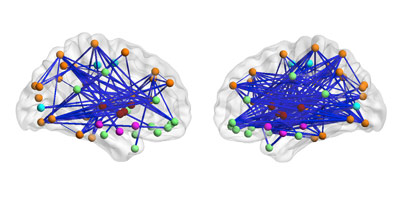
Researchers have found altered connectivity in the brain network for body perception in people with anorexia: The weaker the connection, the greater the misjudgement of body shape.

A group of scientists planning to map all the major connections in the human brain began studying their first test subjects in August. The $30 million Human Connectome Project will trace the main neural pathways that link the roughly 500 major regions in the brain, illuminating how biological circuitry underlies our mental functions. MRI scans of 1,200 people, including 300 pairs of twins, will be used to compile an atlas of communication routes throughout the brain. The resulting blueprint will also reveal how brain connectivity varies from person to person.

Weekly Neuroscience Update

medium_3550062627
A new clinical study in the journal Brain and Behavior, has been undertaken to decide whether a non-invasive method, using musical tones to regulate brain activity, can actually reprogram the brain, resulting in insomnia prevention.

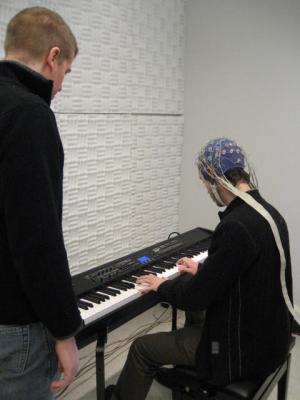
Researchers have shown that synchronization emerges between brains when making music together, and even when musicians play different voices.

People are able to detect, within a split second, if a hurtful action they are witnessing is intentional or accidental, new research on the brain at the University of Chicago shows.

Everyone knows that men and women tend to hold different views on certain things. However, new research by scientists from the University of Bristol and published in PLoS ONE indicates that this may literally be the case.

All patients with Alzheimer’s disease (AD) lose brain cells, which leads to a shrinking, or atrophy, of the brain. But the pattern of gray matter loss is significantly different in men and women, according to a study presented recently at the annual meeting of the Radiological Society of North America.

Weekly Neuroscience Update

Image: Pixmac.com

Gym-style exercise may improve not only general health in middle age, but also brain function, according to new research.

Researchers at Oregon Health & Science University have discovered that blocking a certain enzyme in the brain can help repair the brain damage associated with multiple sclerosis and a range of other neurological disorders.

Researchers at the University of Minnesota’s Center for Magnetic Resonance Research (CMRR) have found a small population of neurons that is involved in measuring time.

Two proteins have a unique bond that enables brain receptors essential to learning and memory to not only get and stay where they’re needed, but to be hauled off when they aren’t, researchers say.

Scientists have discovered that the brain circuits we engage when we think about social matters, such as considering other people’s views, or moral issues, inhibit the circuits that we use when we think about inanimate, analytical
things, such as working on a physics problem or making sure the numbers add up when we balance our budget. And they say, the same happens the other way around: the analytic brain network inhibits the social network.

Lund University researchers plan to use optogenetics to stimulate neurons to release more dopamine to combat Parkinson’s disease.

A new finding could lead to strategies for treating speech loss after a stroke and helping children with dyslexia. New research links motor skills and perception, specifically as it relates to a second finding – a new understanding of what the left and right brain hemispheres “hear.”

UCLA researchers have for the first time measured the activity of a brain region known to be involved in learning, memory and Alzheimer’s disease during sleep. They discovered that this region, called the entorhinal cortex, behaves as if it’s remembering something, even during anesthesia–induced sleep — a finding that counters conventional theories about sleep-time memory consolidation.

Weekly Neuroscience Update

Neuroscientists have announced a longitudinal research collaboration to investigate the emotional, social and cognitive effects of musical training on childhood brain development. The five-year research project, Effects of Early Childhood Musical Training on Brain and Cognitive Development, will offer USC researchers an important opportunity to provide new insights and add rigorous data to an emerging discussion about the role of early music engagement in learning and brain function.

UCLA researchers have for the first time measured the activity of a brain region known to be involved in learning, memory and Alzheimer’s disease during sleep. They discovered that this part of the brain behaves as if it’s remembering something, even under anesthesia, a finding that counters conventional theories about memory consolidation during sleep.

New research reveals that stroke may be affecting people at a younger age. The study is published in the October 10, 2012, online issue of Neurology, the medical journal of the American Academy of Neurology.

Scientists studying a rare genetic disorder have identified a molecular pathway that may play a role in schizophrenia, according to new research in the October 10 issue of The Journal of Neuroscience. The findings may one day guide researchers to new treatment options for people with schizophrenia — a devastating disease that affects approximately 1 percent of the world’s population.

Researchers from the University of Exeter Medical School have for the first time identified the mechanism that protects us from developing uncontrollable fear.

Small amounts of the drug ketamine can immediately relieve the symptoms of chronic depression, as well as those of treatment-resistant patients within a few hours, say Yale scientists.

Scientists find that competition between two brain regions influences the ability to make healthy choices.

A compassion-based meditation program can significantly improve a person’s ability to read the facial expressions of others, finds a study published by Social Cognitive and Affective Neuroscience. This boost in empathic accuracy was detected through both behavioral testing of the study participants and through functional magnetic resonance imaging (fMRI) scans of their brain activity.

A study in PLOS ONE shows that whether or not you like the person you’re watching can actually have an effect on brain activity related to motor actions and lead to “differential processing” – for example, thinking the person you dislike is moving more slowly than they actually are.

Weekly Neuroscience Update

Newly formed emotional memories can be erased from the human brain. This is shown by researchers from Uppsala University in a new study now being published by the academic journal Science. The findings may represent a breakthrough in research on memory and fear.

A growing body of research shows that children who suffer severe neglect and social isolation have cognitive and social impairments as adults. A study from Boston Children’s Hospital shows, for the first time, how these functional impairments arise: Social isolation during early life prevents the cells that make up the brain’s white matter from maturing and producing the right amount of myelin, the fatty “insulation” on nerve fibers that helps them transmit long-distance messages within the brain.

People with psychopathic tendencies have an impaired sense of smell, which points to inefficient processing in the front part of the brain [orbitofrontal cortex]. These findings by Mehmet Mahmut and Richard Stevenson, from Macquarie University in Australia, are published online in Springer’s journal Chemosensory Perception.

According to new research of MRI scans of children’s appetite and pleasure centers in their brains, the logos of such fast-food giants as McDonald’s, Pizza Hut, and Burger King causes those areas to “light up”.

New signs of future Alzheimer’s disease have been identified by researchers at Lund University and Skane University in Sweden. Dr. Peder Buchhave and his team explain that disease-modifying treatments are more beneficial if started early, so it is essential identify Alzheimer’s disease patients as quickly as possible.

A new study from MIT neuroscientists sheds light on a neural circuit that makes us likelier to remember what we’re seeing when our brains are in a more attentive state.

Weekly Neuroscience Update

Have you ever wondered why some people find it so much easier to stop smoking than others? New research shows that vulnerability to smoking addiction is shaped by our genes. A study from the Montreal Neurological Institute and Hospital — The Neuro, McGill University shows that people with genetically fast nicotine metabolism have a significantly greater brain response to smoking cues than those with slow nicotine metabolism.

When children learn to play a musical instrument, they strengthen a range of auditory skills. Recent studies suggest that these benefits extend all through life, at least for those who continue to be engaged with music. But a study published last month is the first to show that music lessons in childhood may lead to changes in the brain that persist years after the lessons stop.

A team of Australian researchers, led by University of Melbourne has developed a genetic test that is able to predict the risk of developing autism spectrum disorder (ASD).

Recent findings by an international collaboration including IRCM researchers hold new implications for the pathogenesis of myotonic dystrophy.

Researchers at Newcastle University have revealed the mechanism by which neurons, the nerve cells in the brain and other parts of the body, age. The research opens up new avenues of understanding for conditions where the ageing of neurons are known to be responsible, such as dementia and Parkinson’s disease.
Finally, this week…a new study has shown that it’s possible to predict how well people will remember information by monitoring their brain activity while they study.

Weekly Neuroscience Update

Research from the University of Southampton, which examines how dolphins might process their sonar signals, could provide a new system for man-made sonar to detect targets, such as sea mines, in bubbly water.

Evidence is mounting that exercise provides some protection from memory loss and Alzheimer’s disease, with three new studies showing that a variety of physical activities are associated with healthier brains in older adults.

Researchers  have discovered an important clue to how the human brain —important clue to how the human brain — which is constantly bombarded with millions of pieces of visual information, can filter out what’s unimportant and focus on what’s most useful.

Scientists at the California Institute of Technology (Caltech) pioneered the study of the link between irregularities in the immune system and neurodevelopmental disorders such as autism a decade ago. Since then, studies of postmortem brains and of individuals with autism, as well as epidemiological studies, have supported the correlation between alterations in the immune system and autism spectrum disorder.

Researchers at Aalto University in Finland have developed the world’s first device designed for mapping the human brain that combines whole-head magnetoencephalography (MEG) and magnetic resonance imaging (MRI) technology. MEG measures the electrical function and MRI visualizes the structure of the brain. The merging of these two technologies will produce unprecedented accuracy in locating brain electrical activity non-invasively. 

Cognition psychologists have discovered why stressed persons are more likely to lapse back into habits than to behave goal-directed. The researchers have now reported in the Journal of Neuroscience that the interaction of the stress hormones hydrocortisone and noradrenaline shut down the activity of brain regions for goal-directed behaviour. The brain regions responsible for habitual behaviour remained unaffected.

Raising levels of the neurotransmitter dopamine in the frontal cortex of the brain significantly decreased impulsivity in healthy adults, in a study conducted by researchers at the Ernest Gallo Clinic and Research Center at the University of California, San Francisco