Understand the facts of dementia with this quick video overview.
Category: Alzheimers Disease
Weekly Neuroscience Update
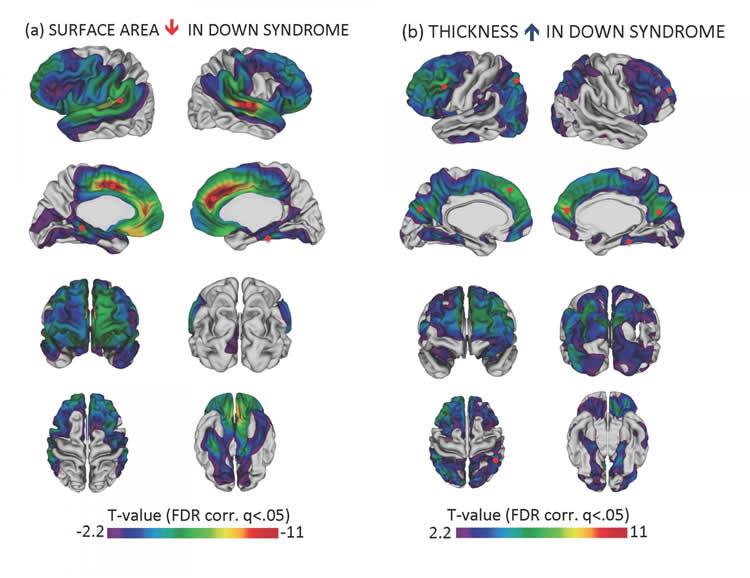
Reductions in cortical surface area and increases in cortical thickness in Down syndrome relative to typical controls. Panel A shows that the cortex surface area is lower in Down syndrome; panel B shows that the cortex is thicker in Down syndrome brains. Small red circles indicate the approximate locations where cortical surface area and thickness were most different between brains of participants with Down syndrome and brains of typically developing participants. Image credit: Lee et al., National Institute of Mental Health
The thickness of the brain’s cerebral cortex could be a key to unlocking answers about intellectual development in youth with Down Syndrome. It could also provide new insights to why individuals with this genetic neurodevelopmental disorder are highly susceptible to early onset Alzheimer’s Disease later in life.
In a study published in The Journal of Experimental Medicine, researchers report a surprising finding that challenges current anatomy and histology textbook knowledge: Lymphatic vessels are found in the central nervous system where they were not known to exist.
Changes in the vaginal microbiome are associated with effects on offspring gut microbiota and on the developing brain, according to a new study published in Endocrinology, a journal of the Endocrine Society.
Researchers discover that a protein called Taranis could hold the key to a good night’s sleep.
A team of researchers has now been able to demonstrate in a study that the bonding hormone oxytocin inhibits the fear center in the brain and allows fear stimuli to subside more easily. This basic research could also usher in a new era in the treatment of anxiety disorders.
Early life stress affects cognitive functioning in low-income children.
Researchers at Monash University have found physical differences in the brains of people who respond emotionally to others’ feelings, compared to those who respond more rationally, in a study published in the journal NeuroImage.
Having a stroke ages a person’s brain function by almost eight years, new research finds — robbing them of memory and thinking speed as measured on cognitive tests. In another pilot study, women who experience more hot flashes, particularly while sleeping, during the menopause transition are more likely to have brain changes reflecting a higher risk for cerebrovascular disease, such as stroke and other brain blood flow problems.
Researchers discover the anatomic reasons for the persistence of musical memory in Alzheimer patients.
A new study on successful ageing has linked better memory performance in older age with patterns of neural compensation. The research sheds light on how memory can remain efficient in spite of common age-related neural decline.
There are more boys than girls diagnosed with autism spectrum disorder (ASD). Now, a study shows that behaviors relevant to autism are more frequently observed in boys than in girls, whether they’re at risk of autism or not. Meanwhile an early intervention program for toddlers with autism spectrum disorder improves their intellectual abilities and reduces autism symptoms – and those results persist years after the children originally received treatment, according to a recent study. And in another study, using functional magnetic resonance imaging, a team of researchers has shown for the first time that children with autism spectrum disorder who are overly sensitive to sensory stimuli have brains that react differently than those with the disorder who don’t respond so severely to noises, visual stimulation and physical contact.
The stress hormone cortisol strengthens memories of scary experiences.
Finally, this week, researchers have found that people who speak more than one language have twice as much brain damage as unilingual people before they exhibit symptoms of Alzheimer’s disease. It’s the first physical evidence that bilingualism delays the onset of the disease.
Weekly Neuroscience Update

Brain cell density remains constant with age among cognitively normal adults. (Courtesy of Dr. Keith Thulborn)
New, ultra-high-field magnetic resonance images (MRI) of the brain provide the most detailed images to date to show that while the brain shrinks with age, brain cell density remains constant.
In a stunning discovery that overturns decades of textbook teaching, researchers have determined that the brain is directly connected to the immune system by vessels previously thought not to exist. That such vessels could have escaped detection when the lymphatic system has been so thoroughly mapped throughout the body is surprising on its own, but the true significance of the discovery lies in the effects it could have on the study and treatment of neurological diseases ranging from autism to Alzheimer’s disease to multiple sclerosis.
A new MRI study has found distinct injury patterns in the brains of people with concussion-related depression and anxiety, according to a new study published online in the journal Radiology.
Children and adolescents who received deep brain stimulation for generalized dystonia maintained significant symptom relief for up to eight years, according to a study presented at the 12th World Congress of the International Neuromodulation Society.
An international team of researchers is using data mapping methods created to track the spread of information on social networks to trace its dissemination across a surprisingly different system: the human brain.
A previously unknown link between the immune system and the death of motor neurons in Amyotrophic lateral sclerosis (ALS), also known as Lou Gehrig’s disease, has been discovered. The finding paves the way to a whole new approach for finding a drug that can cure or at least slow the progression of such neurodegenerative diseases as ALS, Alzheimer’s, Parkinson’s and Huntington’s diseases.
Spoken sentences can be reconstructed from activity patterns of human brain surface. “Brain to Text” combines knowledge from neuroscience, medicine and informatics.
Finally this week, scientists have figured out how newly learned concepts form in the human brain by visualizing how new information gets filed. They say this is the first time science visually witnessed how and where specific objects are coded in the brain.
Could your brain repair itself?
Imagine the brain could reboot, updating its damaged cells with new, improved units. That may sound like science fiction — but it’s a potential reality scientists are investigating right now. Ralitsa Petrova details the science behind neurogenesis and explains how we might harness it to reverse diseases like Alzheimer’s and Parkinson’s.
Weekly Neuroscience Update

A neural network is like a social network: The strongest bonds exist between like-minded partners.
Credit: Biozentrum, University of Basel
Neurons in the brain are wired like a social network, report researchers from Biozentrum, University of Basel. Each nerve cell has links with many others, but the strongest bonds form between the few cells most similar to each other. The results are published in the journal Nature.
Stroke survivors can have “significant” improvement in arm movements after using the Nintendo Wii as physiotherapy according to researchers.
Grasping an object involves a complex network of brain functions. First, visual cues are processed in specialized areas of the brain. Then, other areas of the brain use these signals to control the hands to reach for and manipulate the desired object. New findings suggest that the cerebellum, a region of the brain that has changed very little over time, may play a critical role. Findings could lead to advancements in assistive technologies benefiting the disabled.
A process previously thought to be mere background noise in the brain has been found to shape the growth of neurons as the brain develops, according to research published in Cell Reports.
Applying lessons learned from autism to brain cancer, researchers at The Johns Hopkins University have discovered why elevated levels of the protein NHE9 add to the lethality of the most common and aggressive form of brain cancer, glioblastoma. Their discovery suggests that drugs designed to target NHE9 could help to successfully fight the deadly disease.
Scientists at the Hebrew University of Jerusalem in Israel claim to have overturned standard thinking on how the brain is able to perform different tasks by studying brain activity in blind people.
Previously, it was thought ability to repair DNA was the same throughout the body, but new research overturns this idea and shows organs vary in the extent to which they carry out a type of DNA repair called nucleotide excision repair.
Finally this week, a major study by an international team shows new evidence that long-term smoking could cause thinning of the brain’s cortex. The cortex is the outer layer of the brain in which critical cognitive functions such as memory, language and perception take place. Interestingly, the findings also suggest that stopping smoking helps to restore at least part of the cortex’s thickness.
Weekly Neuroscience Update

Nerve cells communicate with each other via intricate projections. In brain diseases such as Alzheimer’s and Parkinson’s these extensions atrophy, thereby causing connectivity problems. Credit DZNE/Detlef Friedrichs.
A new study shows the interdependency between the structure and function of neurons.
Neuroscientists have discovered an unexpected benefit of getting older – a more nuanced understanding of social signals, such as the age of others.
Children with autism show different patterns of brain activity during everyday gestures and movements than controls do, suggest unpublished results presented at the 2014 Society for Neuroscience annual meeting.
Researchers have gained fresh insights into how ‘local’ body clocks control waking and sleeping.
People with bipolar disorder who are being treated with the drug lithium are at risk of acute kidney damage and need careful monitoring, according to new research.
Age-related Macular Degeneration (AMD) is the major cause of blindness in the western world, affecting around 50 million people. Now scientists at The University of Manchester have identified an important new factor behind its causes, which they hope could lead to new treatments.
A team of researchers has identified an enzyme key to the survival and spread of glioblastoma cancer cells that is not present in healthy brain cells, making the enzyme a promising therapeutic target.
It is claimed one in five students have taken the ‘smart’ drug Modafinil to boost their ability to study and improve their chances of exam success. But new research into the effects of Modafinil has shown that healthy students could find their performance impaired by the drug.
Researchers have developed new insight into a rare but deadly brain infection, called progressive multifocal leukoencephalopathy (PML). This disease – which is caused by the JC virus – is most frequently found in people with suppressed immune systems and, until now, scientists have had no effective way to study it or test new treatments.
New research offers insight into short-term effects of maternal caregiving on a developing brain.
A team of researchers has now been able to demonstrate in a study that the bonding hormone oxytocin inhibits the fear center in the brain and allows fear stimuli to subside more easily. This basic research could also usher in a new era in the treatment of anxiety disorders.
Blocking a key receptor in brain cells that is used by oxygen free radicals could play a major role in neutralizing the biological consequences of Alzheimer’s disease, according to new research.
Finally this week, brain scientists have long believed that older people have less of the neural flexibility (plasticity) required to learn new things. A new study shows that older people learned a visual task just as well as younger ones, but the seniors who showed a strong degree of learning exhibited plasticity in a different part of the brain than younger learners did.
Weekly Neuroscience Update
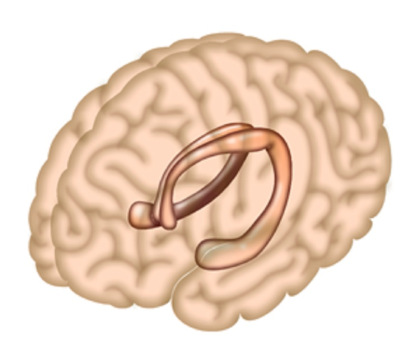
The hippocampus is a region of the brain largely responsible for memory formation. Credit Salk Institute.
Scientists have created a new model of memory that explains how neurons retain select memories a few hours after an event. This new framework provides a more complete picture of how memory works, which can inform research into disorders liked Parkinson’s, Alzheimer’s, post-traumatic stress and learning disabilities.
A switch in the brain of people with epilepsy dictates whether their seizures will be relatively mild or lead to a dangerous and debilitating loss of consciousness, Yale researchers have found.
By predicting our eye movements, our brain creates a stable world for us. Researchers used to think that those predictions had so much influence that they could cause us to make errors in estimating the position of objects. Neuroscientists at Radboud University have shown this to be incorrect. The Journal of Neuroscience published their findings – which challenge fundamental knowledge regarding coordination between brain and eyes.
Extreme and traumatic events can change a person — and often, years later, even affect their children. Researchers have now unmasked a piece in the puzzle of how the inheritance of traumas may be mediated.
Artists have structurally different brains compared with non-artists, a study has found. Participants’ brain scans revealed that artists had increased neural matter in areas relating to fine motor movements and visual imagery. The research, published in NeuroImage, suggests that an artist’s talent could be innate. But training and environmental upbringing also play crucial roles in their ability, the authors report.
Certain errors in visual perception in people with schizophrenia are consistent with interference or ‘noise’ in a brain signal known as a corollary discharge, a new study shows.
Finally this week, a recent study has shown that use of abstract gestures is a powerful tool for helping children understand and generalize mathematical concepts.
Weekly Neuroscience Update
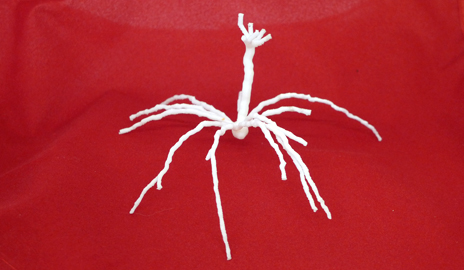
3D-printed model of a neuron (credit: Yale University)
A Yale neuroscientist has created the first 3D-printed neuron.
Studies released today suggest promising new treatments for nicotine and heroin addiction, and further our understanding of pathological gambling and heroin abuse in those suffering chronic pain. This new knowledge, released at Neuroscience 2013, the annual meeting of the Society for Neuroscience (SFN) and the world’s largest source of emerging news about brain science and health, may one day lead to non-pharmaceutical interventions and therapies to treat addiction. Also presented at SFN, new studies revealing links between social status and specific brain structures and activity, particularly in the context of social stress.
A new study has found that people experiencing a depressive episode process information about themselves differently than people who are not depressed.
To flexibly deal with our ever-changing world, we need to learn from both the negative and positive consequences of our behaviour. In other words, from punishment and reward. Hanneke den Ouden from the Donders Institute in Nijmegen demonstrated that serotonin and dopamine related genes influence how we base our choices on past punishments or rewards. This influence depends on which gene variant you inherited from your parents. These results were published in Neuron on November 20.
Brain scans reveal that people with fibromyalgia are not as able to prepare for pain as healthy people, and they are less likely to respond to the promise of pain relief.
Scientists have used RNA interference (RNAi) technology to reveal dozens of genes which may represent new therapeutic targets for treating Parkinson’s disease. The findings also may be relevant to several diseases caused by damage to mitochondria, the biological power plants found in cells throughout the body.
Playing a fast-paced strategy video games can help the brain to become more agile and improve strategic thinking, according to new research.
While young children sleep, connections between the left and the right hemispheres of their brain strengthen, which may help brain functions mature, according to a new study by the University of Colorado Boulder. And in another sleep study, a team of sleep researchers has confirmed the mechanism that enables the brain to consolidate memory and found that a commonly prescribed sleep aid enhances the process. Those discoveries could lead to new sleep therapies that will improve memory for aging adults and those with dementia, Alzheimer’s and schizophrenia.
Weekly Neuroscience Update
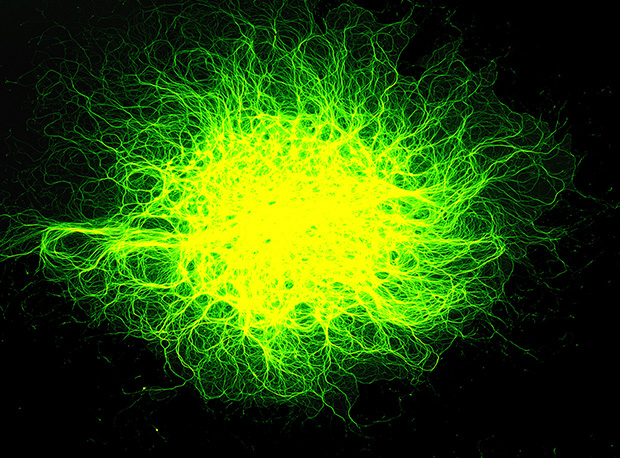
To study how nerve cells respond to injuries in their branches, Washington University researcher Valeria Cavalli grows them in “spots” like the one shown above. Cavalli recently identified a chain reaction that enables repair of these branches when they are cut. Credit Yongcheol Cho/Washington University at St. Louis.
Researchers have identified a chain reaction that triggers the regrowth of some damaged nerve cell branches, a discovery that one day may help improve treatments for nerve injuries that can cause loss of sensation or paralysis.
Groundbreaking research nearly two decades ago linking a mother’s educational background to her children’s literacy and cognitive abilities stands out among decades of social science studies demonstrating the adverse effects of poverty. Now new research has taken that finding in a neuroscientific direction: linking poor processing of auditory information in the adolescent brain to a lower maternal educational background.
A review of new research says there is growing evidence to support the idea that the brain plays a key role in normal glucose regulation and the development of type 2 diabetes.
University of Queensland (UQ) scientists have made a fundamental breakthrough into how the brain decodes the visual world.
Cocaine addicts may become trapped in drug binges not because they are always seeking euphoric highs but rather to avoid emotional lows, says a study in Psychopharmacology.
Researchers have developed a therapeutic at-home gaming program for stroke patients who experience motor weakness affecting 80 percent of survivors.
Learning a musical instrument as a child gives the brain a boost that lasts long into adult life, say scientists.
The birth of new neurons depend upon activation of an important molecular pathway in stem cells, a new Yale School of Medicine study shows.
Researchers have taken a major step towards understanding the causes of Alzheimer’s disease with the largest study yet into the genetics of the disorder.
Light enhances brain activity during a cognitive task even in some people who are totally blind, according to a new study.
Scientists have discovered biological mechanisms that may link Parkinson’s disease to Alzheimer’s disease, according to a study published in the journal Acta Neuropathologica.
Weekly Neuroscience Update

Childhood poverty impacted how much the two regions of the prefrontal cortex (as shown in orange circles) were engaged during emotion regulation. (Credit: University of Illinois at Chicago College of Medicine)
Childhood poverty and chronic stress may lead to problems regulating emotions as an adult, according to research published online in the Proceedings of the National Academy of Sciences.
New research shows that one of the brain’s fundamental self-protection mechanisms depends on coordinated, finely calibrated teamwork among neurons and non-neural cells knows as glial cells, which until fairly recently were thought to be mere support cells for neurons. The study, which has implications for understanding neurodegenerative diseases, stroke, and other nervous system disorders, adds to a growing body of evidence that glial cells are integral to brain function.
Researchers at higher education institutions have identified six proteins in spinal fluid that can be used as markers for Alzheimer’s disease. And another study suggests that older adults who don’t sleep well have more of the brain plaques that are hallmarks of Alzheimer’s.
Researchers from the Centre for Functional Resonance Imaging of the Brain (FMRIB) at the University of Oxford in the UK, say through monitoring patients’ brain waves while under anesthetic, they were able to pinpoint degrees of consciousness dependent on the doses of anesthetic administered.
Finally, this week, a new study from the UCLA School of Nursing shows that the body’s autonomic responses — the controls that impact such functions as blood pressure, heart rate and sweating — are weaker in people with obstructive sleep apnea but are even more diminished in women.
 inside-the-brain.com