Weekly Neuroscience Update

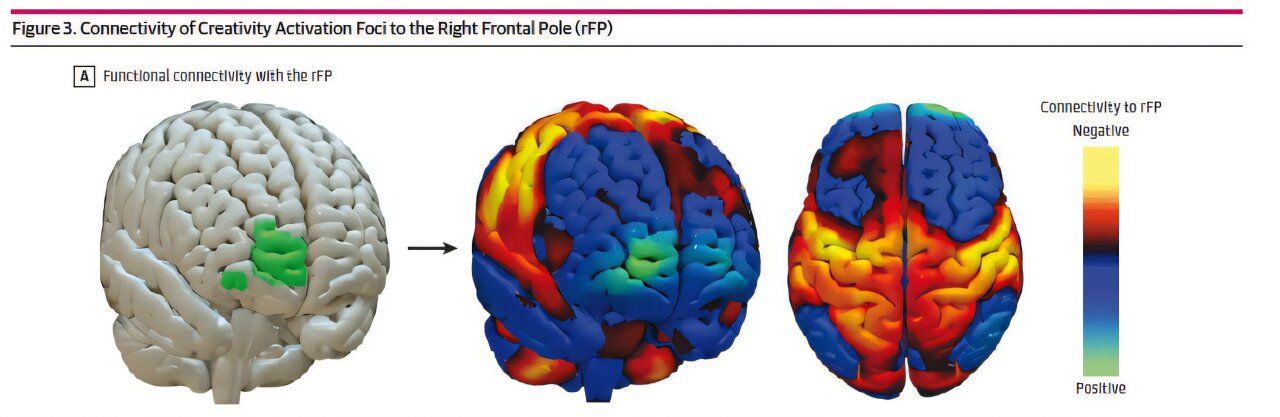
Functional connectivity with the rFP (green, left) defines a distributed brain circuit (right) that will encompass coordinates activated by creativity tasks. Credit: Brigham and Women’s Hospital

A new study suggests that different brain regions activated by creative tasks are part of one common brain circuit. By evaluating data from 857 participants across 36 fMRI studies, researchers identified a brain circuit for creativity and found people with brain injuries or neurodegenerative diseases that affect this circuit may have increased creativity.

New research has uncovered why males and females may experience stress differently, providing insights into how the brain’s molecular mechanisms adapt to acute challenges.

How can nerve pathways in the brain be visualized to improve the planning of complex surgeries? A research team has investigated an AI-powered method that makes these reconstructions more precise. The study, recently published in NeuroImage: Clinical, could ultimately help make neurosurgical procedures safer.

Three studies at the University of Zurich demonstrate that hypnosis alters activity in the large-scale functional networks of the brain. It also affects the neurochemical milieu of specific brain areas.

New research reveals that brain cells use a muscle-like signaling mechanism to relay information over long distances. Scientists discovered that dendrites, the branch-like extensions of neurons, contain a structured network of contact sites that amplify calcium signals—similar to how muscles contract. These contact sites regulate calcium release, activating key proteins involved in learning and memory.

Researchers have made a major breakthrough in understanding the link between genetics and cognition.

A recent large-scale study published in Science Advances has revealed a connection between genetic variations associated with dyslexia and structural differences in the brain. These differences were found in areas involved in motor coordination, vision, and language. This provides new insights into the neurological underpinnings of this common learning difficulty.

According to a recent study, a diet low in vegetables and fruits and high in red meat, fast food, and sugar-sweetened soft drinks was associated with accelerated biological aging.

A new mathematical model sheds light on how the brain processes different cues, such as sights and sounds, during decision making. The findings may one day improve how brain circuits go awry in neurological disorders, such as Alzheimer’s, and could help artificial brains, like Alexa or self-driving car technology, more helpful.

New research has shown just one 20-minute session of moderate intensity aerobic exercise can improve an athlete’s executive function and concussion symptoms in the early stages of recovery.

A recent study using brain imaging technology discovered that experiencing beauty in music involves increased communication between brain areas associated with reward and visual processing, while listening to music considered less beautiful is linked to more activity in brain regions responsible for basic sensory processing. 

Finally this week, women with epilepsy may have offspring with decreased bone metabolism and lower birth weight, according to a study published in the Annals of Clinical and Translational Neurology.
Weekly Neuroscience Update

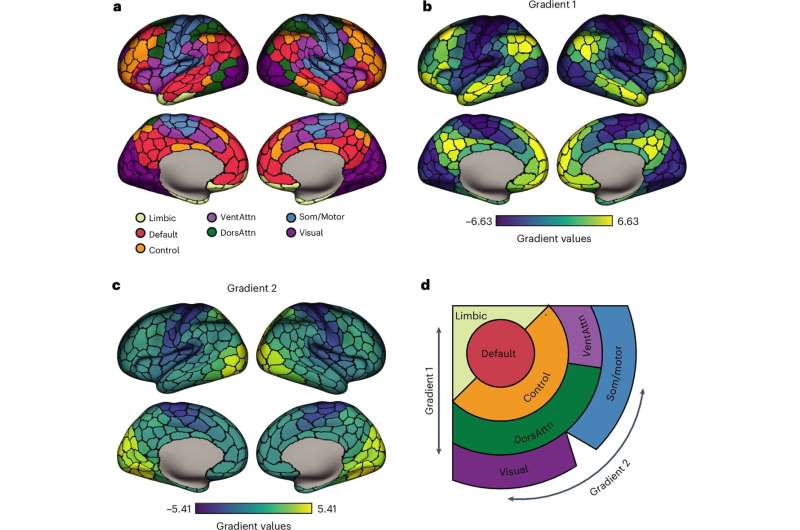
Large-scale functional networks are embedded along two principal gradients. Credit: Nature Neuroscience (2024).

Scientists have uncovered how different types of brain cells work together to form large-scale functional networks in the human brain—interconnected systems that support everything from sensory processing to complex decision-making—paving the way for new insights into brain health and disease.

A new neuroimaging marker of cerebral small vessel disease is related to general cognition and may serve to identify persons at risk of dementia in future clinical trials, a landmark study has found.

A recent study reveals that the genetic mutation causing Huntington’s disease (HD) enhances brain development and intelligence in early life, but leads to degeneration in adulthood. Children with the HD gene exhibit larger brains and higher IQs than those without the mutation.

In what could one day become a new treatment for epilepsy, researchers have used pulses of light to prevent seizure-like activity in neurons.

A team of researchers has found that certain factors are linked to faster brain shrinkage and quicker progression from normal thinking abilities to mild cognitive impairment (MCI). People with type 2 diabetes and low levels of specific proteins in their cerebrospinal fluid showed more rapid brain changes and developed MCI sooner than others.

A new study explores how brain waves reflect melody predictions while listening to music.

Neuroscientists have identified the binding site of low-dose ketamine, providing critical insight into how the medication, often described as a wonder drug, alleviates symptoms of major depression in as little as a few hours with effects lasting for several days.

New research indicates that cannabis use causes cellular damage that increases the risk of highly cancerous tumors by disrupting mitochondria and damaging DNA. 

Fampridine, used for improving walking in multiple sclerosis, may also enhance working memory in individuals with schizophrenia or depression. A study found that the drug significantly improved working memory in participants with initially poor performance, but had no effect on those with strong baseline memory.

A recent study links satellite and brain imaging data to identify how environmental factors can impact mental health, cognition and brain development in young people.

A new Alzheimer’s test collects just a few drops of blood from a finger prick, which can be mailed to a lab for analysis. The test measures biomarkers like pTau217 and has shown similar accuracy to traditional venous blood sampling.

Children born to mothers who take antiseizure medications during pregnancy may face increased risks of neurodevelopmental conditions, according to new data.

Researchers have shed light on the puzzling relationship between dopamine and rest tremor in Parkinson’s disease, finding that preserved dopamine in certain brain regions may actually contribute to tremor symptoms, challenging common beliefs.

New research has revealed the diverse assembly and regulation of Type-A GABA receptors (GABAARs), which are crucial for balancing brain activity. 

A recent study has found fascinating similarities in how the human brain and artificial intelligence models process language. The research, published in Nature Communications, suggests that the brain, like AI systems such as GPT-2, may use a continuous, context-sensitive embedding space to derive meaning from language, a breakthrough that could reshape our understanding of neural language processing.

A team of researchers has investigated the composition and communication of cells in so-called subcortical lesions, tissue damage to deep brain structures at different stages of multiple sclerosis.

Care for stroke survivors urgently needs to focus on non-motor skill outcomes such as fatigue, anxiety and reduced social participation to improve survivors’ quality of life and minimize care needs, according to a new study.

An international research collaboration has discovered how unusual spherical structures form in the brains of people with a mutation that causes a form of inherited Alzheimer’s disease. 

A new study identifies previously hidden brain network patterns in schizophrenia by focusing on nonlinear connectivity, offering potential biomarkers for early diagnosis. Traditional imaging methods often overlook these patterns, but researchers developed advanced statistical tools to uncover this new dimension of brain organization.

Finally this week, research published in the Journal of the American Geriatrics Society has identified several community-level factors that may increase people’s risk of experiencing cognitive impairment.

Weekly Neuroscience Update

recognition-id-neuroscinews

Image showing a map of the brain surface showing regions that preferentially activate during face (blue) and scene (red) identification. Image is credited to Oscar Woolnough, PhD, postdoctoral research fellow in the Department of Neurosurgery at McGovern Medical School at UTHealth in Houston.

A new study reveals areas of brain where recognition and identification occur.

Researchers have identified a hippocampal neural network that activates during stress. Activity in a hippocampal-hypothalamus network predicts greater feelings of stress, while connectivity between the hippocampus and dorsolateral prefrontal cortex predicts less stress.

Researchers have identified27 protein biomarkers that can predict whether a patient with COVID-19 is likely to develop severe coronavirus symptoms.

While the amount of antibodies generated varies widely in patients who have recovered from coronavirus, most people generate at least some antibodies which are intrinsically capable of neutralizing the SARS-CoV-2 virus according to a new study.

Twenty-nine genes have now been identified as being linked to problematic alcohol use. 

Toxic versions of the protein tau are believed to cause death of neurons of the brain in Alzheimer’s disease. A new study published in Nature Communications shows that the spread of toxic tau in the human brain in elderly individuals may occur via connected neurons. The researchers could see that beta-amyloid facilitates the spread of toxic tau.

Certain personality traits could increase the risk of developing mild cognitive impairment, a new study reports.

The anesthetic drug ketamine has been shown, in low doses, to have a rapid effect on difficult-to-treat depression. Researchers at Karolinska Institutet now report that they have identified a key target for the drug: specific serotonin receptors in the brain. Their findings, which are published in Translational Psychiatry, give hope of new, effective antidepressants.

Finally this week, a new study shows some infants can identify differences in musical tones at six months.


How Stress Affects The Brain #StressAwarenessDay

Stress isn’t always a bad thing; it can be handy for a burst of extra energy and focus, like when you’re playing a competitive sport or have to speak in public. But when it’s continuous, it actually begins to change your brain. In this video, Madhumita Murgia shows how chronic stress can affect brain size, its structure, and how it functions, right down to the level of your genes

Weekly Neuroscience Update

brain-structure-language-neurosciencenews.jpg

Image:  Bansal et al., PLOS Computational Biology, October 2018.

Scientists are using computational models of the brain to simulate how the structure of the brain may impact brain activity and, ultimately, human behavior. The research focuses on interconnectivity, looking at how different regions are linked to and interact with one another.

Using a green filter helps to increase reading speed for children with dyslexia, researchers report.

Using three different training models, researchers report mental training, mindfulness and meditation can induce structural brain plasticity and reduce social stress.

A new study reports sleep helps improve learning performance in predictable processes.

A new brain imaging study reveals how the midbrain and striatum, two key areas of the dopamine system, become more active when a person updates their beliefs about the world around them.

Researchers report deep brain stimulation has little benefit for those suffering from early onset Alzheimer’s disease.

Finally this week, a decade worth of data reveals people who multitask with different forms of media at once are worse at completing simple memory tasks.

Weekly Neuroscience Update

dog-2751115_960_720.jpgThe tendency of dogs to seek contact with their owners is associated with genetic variations in sensitivity for the hormone oxytocin, according to a new study from Linköping University, Sweden.

A new study reveals schizophrenia is up to 79% hereditary.

Metacognition of a tactile working memory task has been demonstrated by researchers for the first time. Understanding this brain function might help in the development of new treatments for neuropsychiatric illnesses in the future.

Researchers have shed light on how motor signals help sharpen our ability to decipher complex sound flows.

Increased communication between distant brain regions helps older adults compensate for the negative aspects of ageing, reports a new study published this week in Human Brain Mapping.

Scientists report brain network organization changes can influence executive function in young adults.

A news study has found that brain functions in young men and women are changed by long-term alcohol use, but that these changes are significantly different in men and women.

Mindfulness and meditation can affect brain plasticity, resulting in the ability for adults to acquire new social skills, researchers report.

A new study has found that chronic tinnitus (ringing or buzzing in the ears) is associated with changes in certain networks in the brain, and furthermore, those changes cause the brain to stay more at attention and less at rest.

Finnish researchers have revealed how eating stimulates brain’s endogenous opioid system to signal pleasure and satiety.

Finally this week, sleep deprivation — typically administered in controlled, inpatient settings — rapidly reduces symptoms of depression in roughly half of depression patients, according to the first meta-analysis on the subject in nearly 30 years.


Weekly Neuroscience Update

sleep-55792_960_720.jpg

Researchers report people with poor sleep quality were less likely to experience symptoms of depression if they had higher activity in the ventral striatum.

A new study, published in the open-access journal Frontiers in Human Neuroscience, has uncovered a simple, measurable explanation that can determine your preference for one song over another.

Almost a quarter of girls and one-tenth of boys show signs of depression at age 14, say researchers from the University College London.

Excessive neurogenesis following brain injury may lead to neurological problems and cognitive decline researchers report. The findings challenge common assumptions that excessive brain cell growth following injury is advantageous.

Whether we are consciously aware of seeing a familiar face and object or not, our brains actively notice

A new study has investigated which neurons react to different vocal pitches, discerning between different voices and reacting to emphasis. The findings help us to understand how the brain gains meaning from the sound of speech.

A new report examines the effect stress can have on our bodies and general health.

Finnish researchers have revealed that exercise-induced endorphin release in the brain depends on the intensity of the exercise. Endorphin release induced by exercise may be an important mechanism which affects exercise motivation and maintenance of regular physical activity.

Researchers reveal people who report higher levels of moral reasoning show increased activity in brain areas associated with reward. 

Finally this week, for most people, laughter is highly contagious. But researchers reporting in Current Biology on September 28 have new evidence to show that boys at risk of developing psychopathy when they become adults don’t have that same urge.


Weekly Neuroscience Update

dog-624951_960_720.jpg

People have a remarkable ability to remember and recall events from the past, even when those events didn’t hold any particular importance at the time they occurred. Now, researchers reporting in the journal Current Biology on November 23 have evidence that dogs have this kind of “episodic memory” too.

PET imaging of new neurons in the brain promises to advance our understanding and treatment of depression.

Research from Mayo Clinic included in the November issue of JAMA Neurology identifies a new biomarker for brain and spinal cord inflammation, allowing for faster diagnosis and treatment of patients.

The amount of GABA in person’s dorsolateral prefrontal cortex is linked the ability to keep several things in mind simultaneously. to new research.

A new study offers important insight into how Alzheimer’s disease begins within the brain. The researchers found a relationship between inflammation, a toxic protein and the onset of the disease. The study also identified a way that doctors can detect early signs of Alzheimer’s by looking at the back of patients’ eyes.

An international research team has found that when the brain “reads” or decodes a sentence in English or Portuguese, its neural activation patterns are the same.

In a cross-domain study, researchers have discovered unexpected cells in the protective membranes that enclose the brain, the so called meninges. These ‘neural progenitors’ – or stem cells that differentiate into different kinds of neurons – are produced during embryonic development. These findings show that the neural progenitors found in the meninges produce new neurons after birth – highlighting the importance of meningeal tissue as well as these cells’ potential in the development of new therapies for brain damage or neurodegeneration. A paper highlighting the results was published in the leading scientific journal Cell Stem Cell.

A new study reports that a single stressful event may cause long term consequences in the brain.

Researchers have identified previously unknown neural circuitry that plays a role in promoting satiety, the feeling of having had enough to eat. The discovery revises the current models for homeostatic control — the mechanisms by which the brain maintains the body’s status quo — of feeding behaviour. Published online today in Nature Neuroscience, the findings offer new insight into the regulation of hunger and satiety and could help researchers find solutions to the ongoing obesity epidemic.

Finally this week, learning by taking practice tests, a strategy known as retrieval practice, can protect memory against the negative effects of stress, according to new research.


Weekly Neuroscience Update

The human brain using colors and shapes to show neurological differences between two people. Credit Arthur Toga, University of California, Los Angeles via NIGMS.

The human brain using colors and shapes to show neurological differences between two people. Credit Arthur Toga, University of California, Los Angeles via NIGMS.

While many different combinations of genetic traits can cause autism, brains affected by autism share a pattern of ramped-up immune responses, an analysis of data from autopsied human brains reveals. The study, published online in the journal Nature Communications, included data from 72 autism and control brains.

Teenagers who have suffered a traumatic brain injury are twice as likely to drink alcohol or use drugs when compared with whose who have never experienced a similar blow or trauma to the head.

Activating the brain’s amygdala, an almond-shaped mass that processes emotions, can create an addictive, intense desire for sugary foods, a new study found. Rewards such as sweet, tasty food or even addictive drugs like alcohol or cocaine can be extremely attractive when this brain structure is triggered. And another study, led by researchers at University of California, San Diego School of Medicine, revealed that the brains of obese children literally light up differently when tasting sugar.

Scientists have discovered a link between sleep loss and cell injury. Results of a new study find sleep deprivation causes the damage to cells, especially in the liver, lung, and small intestine. Recovery sleep following deprivation heals the damage.

Neural circuits that activate when we daydream run in the opposite direction to how we process reality, a new study finds.

Yale researchers using a new brain imaging analysis method have confirmed that smoking cigarettes activates a dopamine-driven pleasure and satisfaction response differently in men compared to women.

Whether we’re paying attention to something we see can be discerned by monitoring the firings of specific groups of brain cells. Now, new work from Johns Hopkins shows that the same holds true for the sense of touch.

Serious, long-term stress can have dire consequences for your brain. That’s because the immune system and the brain are intimately related, say researchers at the Ruhr University Bochum, Germany.

In the current issue of Psychotherapy and Psychosomatics a new study identifies biological characteristics who may predict who is going to respond to psychotherapy.

Some high school football players exhibit measurable brain changes after a single season of play even in the absence of concussion, according to a study presented at the annual meeting of the Radiological Society of North America. Meanwhile, as debate increases about whether female lacrosse players should wear headgear, a new study reports measurements of the accelerations that stick blows deliver to the head. The study also measured the dampening effect of various kinds of headgear.

Quitting smoking sets off a series of changes in the brain that researchers say may better identify smokers who will start smoking again.

Everyday events are easy to forget, but unpleasant ones can remain engraved in the brain. A new study published in the Proceedings of the National Academy of Sciences identifies a neural mechanism through which unpleasant experiences are translated into signals that trigger fear memories by changing neural connections in a part of the brain called the amygdala. The findings show that a long-standing theory on how the brain forms memories, called Hebbian plasticity, is partially correct, but not as simple as was originally proposed.