Weekly Neuroscience Update

Artificial Intelligence (AI), specifically GPT-4, was found to match the top 1% of human thinkers on a standard creativity test. The AI application ChatGPT, developed using GPT-4, excelled in fluency and originality in the Torrance Tests of Creative Thinking, a widely recognized tool for assessing creativity. This breakthrough finding indicates that AI may be developing creative ability on par with or even surpassing human capabilities. 

Researchers have identified a small structure in the brain, the anterior precuneus or aPCu, as a crucial component in establishing our physical self or “I”.

Taking good care of your teeth may be linked to better brain health, according to a study published in Neurology. The study found that gum disease and tooth loss were linked to brain shrinkage in the hippocampus, which plays a role in memory and Alzheimer’s disease. The study does not prove that gum disease or tooth loss causes Alzheimer’s disease; it only shows an association.

A new study has demonstrated for the first time that the diagnosis of multiple sclerosis (MS) can be significantly improved by additionally measuring the thickness of retinal layers in the eye.

Distinct, though neighbouring, areas of the brain are activated when processing music and language, with specific sub-regions engaged for simple melodies versus complex melodies, and for simple versus complex sentences, according to researchers.

New findings suggest that depression after traumatic brain injury (TBI) could be a clinically distinct disorder rather than traditional major depressive disorder, with implications for patient treatment.

If you’re sleep deprived, you will likely have a harder time remembering things than if you’re well-rested. But if you have good cardiorespiratory fitness, your memory may be less affected by the effects of sleep deprivation than others, according to a recent McGill study published in the journal Medicine & Science in Sports & Exercise.

Finally this week, even during sleep, the sounds that infants are exposed to can play a big role in language development, especially for babies at risk of language delays.

Weekly Neuroscience Update

Encouraging children to indulge in reading for pleasure can enhance their cognitive and mental health during adolescence, a recent study reveals. The study, involving over 10,000 young adolescents from the US, discovered that an optimal reading duration of 12 hours per week contributed to improved brain structure and mental health.

New research has investigated associations of adverse childhood experiences with changes in epigenetic age acceleration.

Researchers have discovered a new depression subtype, the ‘cognitive biotype,’ affecting 27% of patients who respond poorly to typically prescribed antidepressants. These patients struggle with planning, self-control, sustained focus, and suppressing inappropriate behavior, with brain scans revealing reduced activity in the regions responsible for these tasks.

A team of researchers has developed a predictive model to recognize patterns of persistent negative thinking, or rumination, using machine learning.

A new study involving over 22,000 people with Multiple Sclerosis (MS) has identified a genetic variant associated with the disease’s faster progression. The research discovered a genetic variant that significantly affects disease severity. This development brings us closer to understanding and combatting the progressive form of MS. The identified genetic variant accelerates disability, undermining patient mobility and independence over time.

Regularly finding time for a little snooze is good for our brain and helps keep it bigger for longer, say researchers.

Do intelligent people think faster? Researchers made the surprising finding that participants with higher intelligence scores were only quicker when tackling simple tasks, while they took longer to solve difficult problems than subjects with lower IQ scores. 

Finally this week, new research provides the first physiological evidence supporting the scientific theory of how the brain consolidates memory during sleep. 

Weekly Neuroscience Update

A new study sheds light on gender differences in risk-taking behavior. The research reveals women are more averse to risk than men due to heightened sensitivity to potential losses. Conversely, men, exhibiting greater optimism, are more willing to engage in risk-taking.

Researchers have identified specific brain network connections associated with anosognosia, a condition where patients are unaware of their neurological or psychiatric deficits.

Scientists have discovered children’s ability to process emotional cues is largely established by the time they start school. Analyzing brain scans from children aged five to 15, the study revealed that such brain activity becomes increasingly similar to their peers as they reach adolescence. The research emphasizes the importance of early intervention to address issues related to understanding emotional cues.

Recent neuroscience studies underscore the profound impact of sleep and sleep disorders on memory.

In a paper published in Science Advances, an international team reveal the discovery of sequence variants in the gene ABCC9 that influence the pitch of voices. The scientists found that ABCC9 variants associate with higher voice pitch in both men and women. The same sequence variants are also linked to higher pulse pressure, a cardiovascular risk factor, highlighting links between voice pitch and health-related traits.

Researchers have discovered a promising new avenue for treating glioblastoma, a deadly brain cancer.

Research led by the University of Texas Health Science Center, San Antonio, Texas, has looked into premature brain aging in individuals with type 1 diabetes. The findings of this study show an increase in brain aging among individuals with type 1 diabetes without any early signs of AD-related neurodegeneration. These increases were associated with reduced cognitive performance, but according to the authors, the abnormal patterns observed in the samples were modest.

Finally this week, intricate links between breathing and memory recall have been unraveled by recent scientific research, painting a more complex picture of our cognitive processes.

Weekly Neuroscience Update

A new study explores the use of music-listening to relieve acute pain, finding that people who were given the impression that they had control over the music they heard experienced more pain relief than people who were not given such control.

Better diagnosis and treatment of the incurable eye disease age-related macular degeneration is a step closer, thanks to the discovery of new genetic signatures of the disease.

Research continues to demonstrate the many ways the gut microbiome can influence human health, and an active area within this field centres on its role in Alzheimer’s disease. A new study has furthered our knowledge of this relationship by demonstrating what’s described as a clear genetic link between the two, while also pointing to the potential for new treatments.

Neuroscientists have confirmed that the exact same network is activated in speakers of 45 different languages representing 12 distinct language families.   

Pollution is widely known to be a risk to individual’s physical health, but can it have adverse effects on mental health as well? A study published in Developmental Psychology suggests that exposure to ozone can be a risk factor for depression in adolescents.

Researchers have developed a comprehensive “toolbox” to establish that the mobility of receptors exists in intact brain tissue, and this mobility is critical for certain types of memory.

People challenged with chronic back pain have been given hope with a new treatment that focuses on retraining how the back and the brain communicate, a randomised controlled trial run by researchers at UNSW Sydney and Neuroscience Research Australia (NeuRA) and several other Australian and European universities has shown.

A group of hippocampal neurons show rhythmic activity at different frequencies in the desynchronized state, but can align their rhythmic frequency to produce a synchronized brain rhythm upon activation.

A new hypothesis suggests when people are awake during the biological circadian night there are neurophysiological changes in the brain that alters the way in which we interact with the world, especially when it comes to impulse control, information processing, and reward processing.

Finally this week, you’re fast asleep. But some regions of your brain tasked with hearing sound aren’t taking the night off, according to new research.

Weekly Neuroscience Update

A new study underscores the importance of healthy sleep to prevent the Alzheimer’s related amyloid-beta 42 protein from forming clumps in the brain.

It has long been known that there is an association between food and pain, as people with chronic pain often struggle with their weight. Researchers at the Del Monte Institute for Neuroscience may have found an explanation in a new study that suggests that circuitry in the brain responsible for motivation and pleasure is impacted when someone experiences pain.

Researchers have found 90 minutes of mild- to moderate-intensity exercise directly after a flu or COVID-19 vaccine may provide an extra immune boost.

When a person tries to access a memory, their brain quickly sifts through everything stored in it to find the relevant information. But as we age, many of us have difficulty retrieving memories. In a review published in the journal Trends in Cognitive Sciences researchers propose an explanation for why this might be happening: the brains of older adults allocate more space to accumulated knowledge and have more material to navigate when attempting to access memories.

Researchers have discovered a critical role the dorsal precentral gyrus plays in how people use the sound of their voices to control how they want the words they speak to sound.

Finally this week, a new study has uncovered new evidence linking higher levels of neuroticism and anxiety with the ability to experience a deeply relaxing sensation known as the Autonomous Sensory Meridian Response (ASMR).

Weekly Neuroscience Update

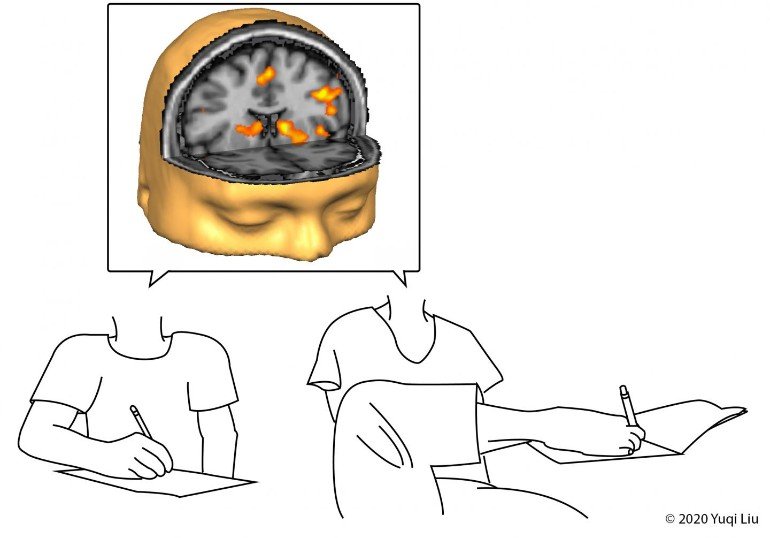
Illustration of a hand action in typically developed individuals and a foot action in individuals with dysplasia. A network in frontal and parietal areas, shown in yellow-orange, prefer a specific action type, regardless of the acting body part. Credit: Yuqi Liu, PhD


A new study of reaching and grasping with hand or food reveals novel brain insights. 

Researchers have discovered a new mechanism by which clumps of tau protein are created in the brain, killing brain cells and causing Alzheimer’s disease.

New research reveals a single brain region links depression and anxiety, heart disease and treatment sensitivity. 

A Danish study shows that people doing hard physical work have a 55-percent higher risk of developing dementia than those doing sedentary work.

A new theory suggests electromagnetic energy in the brain enables neurons and brain regions to create consciousness and our ability to critically think.

Brain cell dysfunction in low oxygen is, caused by the very same responder system that is intended to be protective, according to a new published study.

A new study reveals a correlation between multimedia multitasking, memory loss, and difficulties in maintaining attention.

A recent study reveals how gene control mechanisms define the identity of developing neurons in the brainstem. The researchers also showed that a failure in differentiation of the brainstem neurons leads to behavioural abnormalities, including hyperactivity and attention deficit.

The decline of striosomal activity in the brain may explain why people lose the motivation to learn as they age.

Finally this week, researchers have shown how a genetic mutation throws off the timing of the biological clock, causing a common sleep syndrome called delayed sleep phase disorder.


Weekly Neuroscience Update

alzheimers-iron-cognition-neurosnceews.jpg

Researchers using MRI have found that iron accumulation in the outer layer of the brain is associated with cognitive deterioration in people with Alzheimer’s disease, according to a study published in the journal Radiology.

Examining the brains of frequent cannabis users, researchers have identified a pattern of connectivity related to craving the substance.

Auditory hallucinations, a common feature of psychosis and schizophrenia, may be the result of increased connectivity between sensory and language processing areas in the brain.

Nitrous oxide may provide temporary relief to veterans suffering from PTSD, a new study reports.

Light to moderate weekly alcohol consumption during middle age could help preserve brain function as we get older. Compared to non-drinkers, those who had a drink or two a day tended to have better performance on cognitive tests over time.

Low levels of the stress hormone cortisol and the GLIZ protein can trigger chronic inflammatory responses in the body, contributing to the aging process.

The placentas of sixteen women who contracted COVID-19 during pregnancy showed evidence of significant injury, a new study reports. The placental injuries were consistent with abnormal blood flow between mother and baby in-utero, suggesting another complication of coronavirus infection in pregnant women.

Finally this week, a new study highlights the most common neurological and psychological complications that arise as a result of coronavirus infection.

Weekly Neuroscience Update

chef-939436_640.jpg

New findings suggest humans have a stereo sense of smell that subconsciously guides navigation.

The study of a man with a neurodegenerative disease that has robbed his ability to see certain numbers sheds light on how the brain processes information without any visual awareness of the stimuli.

Young adults who acquire fewer genetic mutations over time lived five years longer than those who acquired them more rapidly.

96% of patients hospitalized for coronavirus infections report experiencing PTSD as a result of their illness. Researchers also found an increased risk of depression, anxiety, and other mental health disorders in those hospitalized for COVID-19.

Genetic deletions associated with neurodevelopmental disorders may also be linked to dysfunctional organ development, a new study reports.

A new study reveals the relationship between attentional state and emotions from pupillary reactions. Visual perception elicits emotions in all attentional state, while auditory perception elicits emotions only when attention is paid to sounds.

Statins lowered the death rate and decreased the need for mechanical ventilation in patients hospitalized for severe COVID-19.

A new study has identified a different set of individual neurons in the medial frontal cortex that is responsible for memory-based decision making. The findings have implications for the treatment of Alzheimer’s disease, schizophrenia, and other disorders associated with problems in cognitive flexibility.

Elevated pulse pressure in blood traveling to the brain causes inflammation, oxidative stress, and apoptosis in the blood-brain barrier that leads to brain damage.

Researchers have found an unexpected set of mental illnesses in patients with a spectrum of a rare genetic disorder. Their study revealed the need for clinicians to consider the complexities of co-existing conditions in patients with both psychological and fragile X associated disorders.

Finally this week, people experience a flattening of emotions following a single night of poor sleep. Researchers also found a link between sleep deprivation, learning, and reaction time.

Weekly Neuroscience Update

artificial-membrane-brain-tisuse-neurosciencenews

A newly developed microfluidic device microfluidic device allowed researchers to keep tissue from the suprachiasmatic nucleus alive for over 25 days.

Neuroscientists have proved how different parts of the human brain work together to create and retrieve episodic memory.  Models suggested that, during formation of a memory, information is routed from cortex to hippocampus whilst retrieving a memory should see this information flow in reverse.

A collaborative study published today in the journal Cell Reports provides evidence for a new molecular cause for neurodegeneration in Alzheimer’s disease.

Researchers have identified brain circuitry differences that might be associated with suicidal behavior in individuals with mood disorders. The study, published in Psychological Medicine, provides a promising lead toward tools that can predict which individuals are at the highest risk for suicide.

A period of wakeful rest can help reduce memory intrusions associated with PTSD.

Does dementia spread gradually and evenly in all directions across the brain, or can it “jump” from one brain area to another? New research helps to settle the question by examining the progression of frontotemporal dementia.

Examining postmortem brains of autism spectrum disorder patients, researchers discover an accumulation of immune cells surrounding blood vessels in the brain.

Your personality type may influence addiction to certain drugs, a new study reveals. Those whose personalities rank higher for impulsivity are more likely to use ecstasy, while those who score higher for neurotic traits are more likely to use opioid like heroin, researchers report.

Finally this week, researchers have mapped out some of the mechanisms that may affect women’s fertility from the teenage years to menopause.


Weekly Neuroscience Update

D56BDDNUwAAxsUD.jpg

Music and mindful music listening may help people who have suffered strokes recover their impaired cognitive abilities more effectively, new research suggests.

The loss of memory and cognitive function known to afflict survivors of septic shock is the result of a sugar that is released into the bloodstream and enters the brain during the life-threatening condition. This finding, published in the Proceedings of the National Academy of Sciences, explains the premature mental aging that follows septic shock and may shed light on memory loss in other diseases.

Researchers have identified a new autoimmune disease that causes muscle pain and weakness.

Scientists used brain signals recorded from epilepsy patients to program a computer to mimic natural speech–an advancement that could one day have a profound effect on the ability of certain patients to communicate.

Scientists have created a “neural decoder” that translates brain activity into speech.

Autism diagnosis becomes stable starting at 14 months of age, researchers report. The accurate diagnosis of ASD, four months earlier than previously believed, leads to more opportunities for early interventions.

A new two-tier diagnostic blood test which evaluates both amyloid beta and tau, can help detect Alzheimer’s disease in presymptomatic patients.

Researchers are officially defining a new brain disorder that mimics Alzheimer’s disease. The disorder will be known as LATE, which stands for limbic-predominant age-related TDP-43 encephalopathy.

Finally this week, a new deep learning algorithm can reliably determine what visual stimuli neurons in the visual cortex respond best to.