http://www.youtube.com/watch?v=BKVv6v-Hd0A
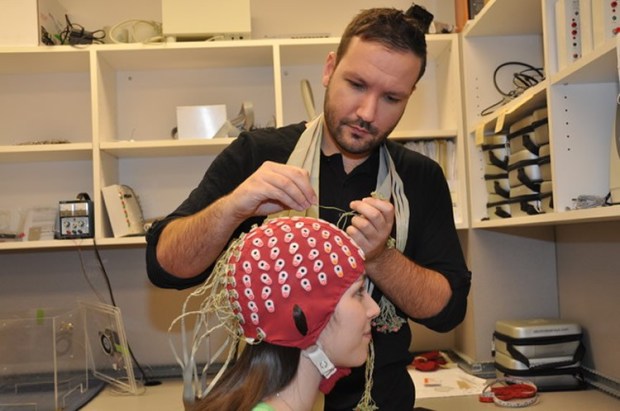
This video attempts to explain the working of the brain through mapping out the electrical activity of the brain – Electro-encephalogram (EEG)
http://www.youtube.com/watch?v=BKVv6v-Hd0A
This video attempts to explain the working of the brain through mapping out the electrical activity of the brain – Electro-encephalogram (EEG)

Scientists have located a specific set of neurons that indicate how time passes, confirming that the brain plays an essential role in how we experience the passage of time.
Neuroscientists have found that by training on attention tests, people young and old can improve brain performance and multitasking skills.
A gene that is associated with regeneration of injured nerve cells has been identified by scientists at Penn State University and Duke University.
When given early treatment, children with autism spectrum disorders (ASD) made significant improvements in behavior, communication, and most strikingly, brain function, Yale School of Medicine researchers report in a new study.
Researchers have found some of the earliest signs of Alzheimer’s disease, more than two decades before the first symptoms usually appear.
The Sentis Brain Animation Series takes you on a tour of the brain through a series of short and sharp animations. In this video, the three regions of the brain are described and how they interact as we experience the world.

Neuroscientists have announced a longitudinal research collaboration to investigate the emotional, social and cognitive effects of musical training on childhood brain development. The five-year research project, Effects of Early Childhood Musical Training on Brain and Cognitive Development, will offer USC researchers an important opportunity to provide new insights and add rigorous data to an emerging discussion about the role of early music engagement in learning and brain function.
UCLA researchers have for the first time measured the activity of a brain region known to be involved in learning, memory and Alzheimer’s disease during sleep. They discovered that this part of the brain behaves as if it’s remembering something, even under anesthesia, a finding that counters conventional theories about memory consolidation during sleep.
New research reveals that stroke may be affecting people at a younger age. The study is published in the October 10, 2012, online issue of Neurology, the medical journal of the American Academy of Neurology.
Scientists studying a rare genetic disorder have identified a molecular pathway that may play a role in schizophrenia, according to new research in the October 10 issue of The Journal of Neuroscience. The findings may one day guide researchers to new treatment options for people with schizophrenia — a devastating disease that affects approximately 1 percent of the world’s population.
Researchers from the University of Exeter Medical School have for the first time identified the mechanism that protects us from developing uncontrollable fear.
Small amounts of the drug ketamine can immediately relieve the symptoms of chronic depression, as well as those of treatment-resistant patients within a few hours, say Yale scientists.
Scientists find that competition between two brain regions influences the ability to make healthy choices.
A compassion-based meditation program can significantly improve a person’s ability to read the facial expressions of others, finds a study published by Social Cognitive and Affective Neuroscience. This boost in empathic accuracy was detected through both behavioral testing of the study participants and through functional magnetic resonance imaging (fMRI) scans of their brain activity.
A study in PLOS ONE shows that whether or not you like the person you’re watching can actually have an effect on brain activity related to motor actions and lead to “differential processing” – for example, thinking the person you dislike is moving more slowly than they actually are.

Picture: shelbyasteward, flickr.com
Scientists from Newcastle University have drawn up a league table of the least pleasant sounds we may encounter as part of everyday life – albeit a slightly old-fashioned life as the top five include the rasp of chalk on a blackboard.
Working with 13 volunteers, they tested reactions to 74 different noises both in outward response and more closely via small changes in the brain.
The results are published in the latest issue of the Journal of Neuroscience and show, among other things, that acoustically anything in the frequency range of around 2,000 to 5,000 Hz was found to be unpleasant.
An aspirin a day may slow brain decline in elderly women at high risk of cardiovascular disease, research finds.
The hippocampus represents an important brain structure for learning. Scientists at the Max Planck Institute of Psychiatry in Munich discovered how it filters electrical neuronal signals through an input and output control, thus regulating learning and memory processes.
Scientists performing experimental brain surgery on a man aged 50 have stumbled across a mechanism that could unlock how memory works. The accidental breakthrough came during an experiment originally intended to suppress the obese man’s appetite, using the increasingly successful technique of deep-brain stimulation. Electrodes were pushed into the man’s brain and stimulated with an electric current. Instead of losing appetite, the patient instead had an intense experience of déjà vu. He recalled, in intricate detail, a scene from 30 years earlier. More tests showed his ability to learn was dramatically improved when the current was switched on and his brain stimulated.
Brain metastases are common secondary complications of other types of cancer, particularly lung, breast and skin cancer. The body’s own immune response in the brain is rendered powerless in the fight against these metastases by inflammatory reactions. Researchers in Vienna have now, for the first time, precisely characterised the brain’s immune response to infiltrating metastases. This could pave the way to the development of new, less aggressive treatment options.
Newly formed emotional memories can be erased from the human brain. This is shown by researchers from Uppsala University in a new study now being published by the academic journal Science. The findings may represent a breakthrough in research on memory and fear.
A growing body of research shows that children who suffer severe neglect and social isolation have cognitive and social impairments as adults. A study from Boston Children’s Hospital shows, for the first time, how these functional impairments arise: Social isolation during early life prevents the cells that make up the brain’s white matter from maturing and producing the right amount of myelin, the fatty “insulation” on nerve fibers that helps them transmit long-distance messages within the brain.
People with psychopathic tendencies have an impaired sense of smell, which points to inefficient processing in the front part of the brain [orbitofrontal cortex]. These findings by Mehmet Mahmut and Richard Stevenson, from Macquarie University in Australia, are published online in Springer’s journal Chemosensory Perception.
According to new research of MRI scans of children’s appetite and pleasure centers in their brains, the logos of such fast-food giants as McDonald’s, Pizza Hut, and Burger King causes those areas to “light up”.
New signs of future Alzheimer’s disease have been identified by researchers at Lund University and Skane University in Sweden. Dr. Peder Buchhave and his team explain that disease-modifying treatments are more beneficial if started early, so it is essential identify Alzheimer’s disease patients as quickly as possible.
A new study from MIT neuroscientists sheds light on a neural circuit that makes us likelier to remember what we’re seeing when our brains are in a more attentive state.
Have you ever wondered why some people find it so much easier to stop smoking than others? New research shows that vulnerability to smoking addiction is shaped by our genes. A study from the Montreal Neurological Institute and Hospital — The Neuro, McGill University shows that people with genetically fast nicotine metabolism have a significantly greater brain response to smoking cues than those with slow nicotine metabolism.
When children learn to play a musical instrument, they strengthen a range of auditory skills. Recent studies suggest that these benefits extend all through life, at least for those who continue to be engaged with music. But a study published last month is the first to show that music lessons in childhood may lead to changes in the brain that persist years after the lessons stop.
A team of Australian researchers, led by University of Melbourne has developed a genetic test that is able to predict the risk of developing autism spectrum disorder (ASD).
Recent findings by an international collaboration including IRCM researchers hold new implications for the pathogenesis of myotonic dystrophy.
In my latest presentation, I explore what neuroscience can teach us about creativity.

Researchers have found that neurons in a specific region of the frontal cortex, called the anterior cingulate cortex, become active during decisions involving competitive effort.
In a major breakthrough, an international team of scientists has proven that addiction to morphine and heroin can be blocked, while at the same time increasing pain relief.
Researchers have shown that activity in a certain region of the brain changes as children learn to reason about what other people might be thinking.
The human brain contains billions of neurons that are arranged in complex circuits, which enable people to function with regard to controlling movements, perceiving the world and making decisions. In order to understand how the brain works and what malfunctions occur in neurological disorders it is crucial to decipher these brain circuits. A new study, which is featured in the August 9 edition of Nature reveals that MIT neuroscientists have now come closer towards this goal, by discovering that two major classes of brain cells repress neural activity in specific mathematical ways by which one type subtracting from overall activation, whilst the other type divides it.
That fact that heavy drinking impacts the brain of developing youths is a well-known fact. However, now researchers from the University of California, San Diego School of Medicine and VA San Diego Healthcare System have discovered that certain patterns of brain activity could also help to predict which youths are at risk of becoming problem drinkers. The study is featured online in the August edition of the Journal of Studies on Alcohol and Drugs. The study involved functional magnetic resonance imaging (fMRI) of 12 to 16 year old teenagers’ brains before they started drinking and who had an fMRI three years later. About half of the teenagers started drinking heavily over the 3-year period but the researchers noted that the fMRI scans taken before these group of teenagers started drinking, they already showed less fMRI response in areas of the brain that were associated earlier with heavy drinking.
Major depression or chronic stress can cause the loss of brain volume, a condition that contributes to both emotional and cognitive impairment. Now a team of researchers led by Yale scientists has discovered one reason why this occurs — a single genetic switch that triggers loss of brain connections in humans and depression in animal models.
Neuroscientists from The Scripps Institute have identified a specialized population of stem cells that have an impressive vocational calling: higher brain functioning. It’s an important finding that holds promise for the treatments of serious cognitive disorders — including those that impact on conscious function. And it also reveals how humans and other mammals are able to have such big brains.
Neuroscientists have discovered that the universal saying of “living in the moment” may be impossible. A study published in the journal Neuron reveals that neuroscientists have identified an area in the brain, which is responsible for using past decisions and outcomes to guide future behavior. The study is the first of its kind to analyze signals linked to metacognition, known as a person’s ability to monitor and control cognition, which researchers describe as “thinking about thinking.”