Weekly Neuroscience Update

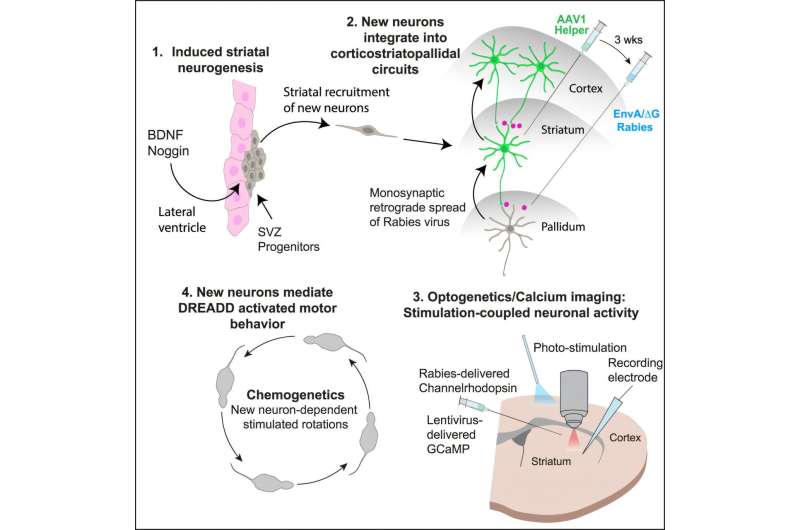
Credit: Cell Reports (2025).

New research shows that the adult brain can generate new neurons that integrate into key motor circuits. The findings demonstrate that stimulating natural brain processes may help repair damaged neural networks in Huntington’s and other diseases.

A study published in Brain Communications highlights a new approach to treating drug-resistant epilepsy.

A novel human study with intracranial recordings demonstrates the thalamus’s pivotal role, especially its higher-order regions, in the onset of conscious perception, with activation preceding that of the prefrontal cortex.

New findings reveal that long-term obesity patterns have distinct impacts on brain structure, function, and cognition. 

Researchers have discovered new potential therapeutic targets for multiple sclerosis (MS). While current treatments prevent further damage, the current findings may form the starting point for the development of new treatments for tissue recovery in MS. The research is published in the journal Brain.

Research published in the Journal of Magnetic Resonance Imaging has uncovered changes in brain connectivity during chemotherapy in patients with breast cancer.

Mass General Brigham investigators have linked difficult early life experiences with reduced quality and quantity of the white matter communication highways throughout the adolescent brain. This reduced connectivity is also associated with lower performance on cognitive tasks.

A team of engineers has developed a microscale brain–computer interface that is small enough to be placed between hair follicles on a user’s head.

Researchers have identified specific high-order thalamic nuclei that drive human conscious perception by activating the prefrontal cortex. Their findings enhance understanding of how the brain forms conscious experience, offering new empirical support for theories that assign a central role to thalamic structures rather than cortical areas alone.

A natural compound found in everyday fruits and vegetables may hold the key to protecting nerve cells—and it’s showing promise as a potential treatment for ALS and dementia.

New research highlights how smartphones are transforming memory science by capturing real-world data on sleep, emotion, and daily experiences. Studies show that replaying memories before sleep, experiencing novel events, and feeling positive emotions can all strengthen autobiographical memory.

An artificial intelligence tool that can help interpret and assess how well treatments are working for patients with multiple sclerosis has been developed by UCL researchers.

A recent study indicates that brain cells possess a higher degree of plasticity than previously understood. This suggests that the brain’s ability to adapt and change throughout life is more extensive than earlier scientific models suggested.

Researchers have discovered that increased blood flow leads to stiffness in the hippocampus, a region of the brain that plays important roles in learning and memory. 

By mapping the presynaptic inputs to single neurons within the primary somatosensory cortex researchers have shown how these neurons integrate brain-wide signals related to behavior, offering a more nuanced understanding of cortical activity.

Seventeen modifiable risk factors are shared by stroke, dementia, and late-life depression, according to a review published in the Journal of Neurology, Neurosurgery & Psychiatry.

A recent study has shown how aspects of brain function change with age, revealing that excitatory processes in the brain decrease, while inhibitory processes increase as children get older. The findings are an important step in understanding disorders like autism.

Finally this week, research shows that a blow to the head can significantly impact a child’s or adolescent’s future education. Even a mild concussion can have far-reaching consequences.

Weekly Neuroscience Update

Illustration of the wearable rTMS device. Credit: Nature Communications (2025).

A new wearable brain stimulation device is being developed, aiming to make therapeutic brain stimulation portable and accessible. This technology could potentially allow for on-the-go treatment of various neurological and psychiatric conditions, moving brain stimulation therapy out of clinical settings and into everyday life.

A recent study provides the first detailed cellular insights into how psilocin, the active ingredient in magic mushrooms, promotes the growth and networking of human nerve cells.

Scientists have developed tiny, magnetically controlled robots designed for minimally invasive brain surgery. These robots can perform precise actions like gripping and cutting tissue, guided by external magnetic fields, potentially eliminating the need for large skull openings. The technology aims to significantly reduce patient recovery time and risks associated with traditional neurosurgery.

Marking a breakthrough in the field of brain-computer interfaces (BCIs), a team of researchers has unlocked a way to restore naturalistic speech for people with severe paralysis.

For the first time, scientists have confirmed a neurobiochemical link between dopamine and cognitive flexibility, according to new research published in The Journal of Nuclear Medicine. PET imaging shows that the brain increases dopamine production when completing cognitively demanding tasks, and that the more dopamine released, the more efficiently the tasks are completed. Armed with this information, physicians may soon be able to develop more precise treatment strategies for neurological and psychiatric disorders.

The risk of a full-blown stroke will remain high for at least a decade after a person has a slight brush with stroke, in the form of a transient ischemic attack or minor stroke, a new study says.

By analyzing DNA and proteins in the blood of people with and without acute spinal cord injuries (SCIs), researchers have developed a novel blood test that has the potential to rapidly predict the severity and likelihood of sensory and motor recovery within six months in a cost-effective manner.

A new study has demonstrated that the brains of people who experience migraines and other types of headaches cannot modulate visual stimulation in the same way a person without these conditions can.

Scientists have developed a way to map how individual connections between neurons change across the entire brain during learning, giving scientists a new view into how changes in behaviour show up in the brain. The new imaging method, DELTA, provides scientists with a brain-wide map of how individual synaptic proteins change over time. Proteins important for synaptic plasticity are known to be degraded or synthesized as synaptic connections change.

Research has found that metal particles from artificial joint implants can enter the central nervous system and accumulate in cerebrospinal fluid, raising concerns about potential neurological effects.

Though Alzheimer’s disease is often described as a buildup of proteins in the brain in the form of plaques and tangles, a new study has shown that blood vessels in the brain might hold another important clue to the disease.

Finally this week, virtual reality reveals that curiosity is key in shaping our spatial memory and mental map formation, according to new research.

Weekly Neuroscience Update

This illustration depicts a single cell RNA-sequencing study of PTSD, major depression and normal controls. In this plot, more than 363,000 nuclei are represented and categorized into eight broad cell types, allowing researchers to visualize the cellular and molecular changes associated with these conditions. Credit: Dell Medical School

In a new study, investigators have uncovered both shared and distinct molecular changes across brain regions, genomic layers, cell types, and blood in individuals with post-traumatic stress disorder (PTSD) and major depressive disorder (MDD).

New research has revealed that areas of age-related damage in the brain relate to motor outcomes after a stroke—a phenomenon that may be under-recognized in stroke research.

A large study using pre-pandemic brain scans of adolescents reveals that brain wiring before COVID-19 predicted mental health outcomes during the pandemic. Adolescents with stronger connections within the brain’s “salience network,” responsible for emotion and reward processing, demonstrated greater resilience to stress and negative emotions. Conversely, weaker connections in the prefrontal cortex and other areas linked to emotional processing were associated with higher levels of stress and sadness.These findings highlight the importance of understanding individual brain differences in predicting and addressing mental health vulnerabilities during challenging times.

A team of medical researchers at the National Children’s Medical Center, Children’s Hospital, Fudan University, China, has developed a technique to freeze and thaw brain tissue without causing damage.

Singing can improve language recovery in stroke patients by repairing the brain’s language network. This positive effect is attributed to increased grey matter volume in language regions and improved connectivity within the network.

A new AI tool to more quickly and accurately classify brain tumours has been developed by researchers at The Australian National University.

An international research collaboration investigated how highly organised patterns of neural activity emerge during development and found the cortex of the brain can transform unorganised inputs into highly organized patterns of activity.

Results from a new study suggest that long-term exposure to air pollution leads to increased risk in dementia in Denmark.

A recent study published in Health Data Science reveals the significant impact of high cumulative body mass index (BMI) on brain health. The research found that high BMI is associated with smaller brain volume, larger white matter lesions, and abnormal microstructural integrity.

A team of neurosurgeons and AI specialists has found some success in restoring speech to a patient who lost the ability after a stroke.

A study published in iScience from researchers from the Ivcher Institute for Brain, Cognition, and Technology at Reichman University offers a new perspective towards the plasticity of the brain, and integration of the senses, paving the way for the enhancement of prosthetics and assistive technologies, and even our interactions with virtual and augmented realities.

Finally this week, research addresses a gap in understanding how ketamine’s impact on individual neurons leads to pervasive and profound changes in brain network function.

Weekly Neuroscience Update

Variant definition, splitting and classification as border or ectopic. Credit: Nature Neuroscience (2024)

A new study has revealed brain differences that may explain why humans demonstrate a variety of cognitive abilities and behaviors. The research shows that two forms of individual differences may predict cognitive abilities, explain behavioral differences and even pinpoint biomarkers of brain disease.

A team of neuroscientists has found that so-called superagers maintain memory as they grow older because they do not experience a decline in the integrity of their white brain matter.

Researchers have developed an artificial intelligence technique that can effectively estimate an individual’s brain age based on electroencephalogram (EEG) brain scans. The technology could help to make early, regular screening for degenerative brain diseases more accessible.

A simple blood test could allow doctors to determine whether a person may be at higher risk for stroke or cognitive decline during their lifetime, according to a new study.

A brief episode of anger triggered by remembering past experiences may negatively impact the blood vessels’ ability to relax, which is essential for proper blood flow, according to new research published in the Journal of the American Heart Association.

Using neuroimaging, researchers have identified a brain network crucial to human consciousness. 

An individual’s experience of pain from medical treatment can be heightened by witnessing other people’s responses to the same treatment, with this negative experience subsequently spreading to others, scientists have discovered.

Listening to music benefits older adults’ cognitive health, even if it’s music they haven’t heard before or don’t enjoy very much, according to a new study.

Researchers have found a way to better control the preclinical generation of key neurons depleted in Parkinson’s disease, pointing toward a new approach for a disease with no cure and few effective treatments.

An international research team led by Karolinska Institutet has mapped the early genetic development of the brain and can now present an atlas of embryonic development between weeks 6 and 13.

Researchers have identified a key mechanism in brain stem cells that prevents identity conflicts during gene expression. This mechanism allows the cells to retain stemness while being primed for neuronal differentiation. The discovery includes finding that keeping neuronal gene messengers within the nucleus, while allowing stem cell gene messengers to be translated, avoids premature differentiation.

A new study demonstrates the potential of virtual reality in treating major depressive disorder.

Exercise prompts muscles to release molecular cargo that boosts brain cell function and connection, but the process is not well understood. Now new research has found that the nerves that tell muscles to move also prompt them to release more of the brain-boosting factors.

A pattern of brain activity that helps prevent us from getting lost has been identified in a new study, published in Nature Human Behaviour.

A new study highlights a novel mechanism of brain plasticity involving chondroitin sulfate clusters outside nerve cells. Researchers identified these cartilage-like structures as crucial for the brain’s ability to adapt and store information.

Finally this week, a new computer model may have cracked the code on helpful memory cues.

Weekly Neuroscience Update

Credit: Biological Psychiatry: Cognitive Neuroscience and Neuroimaging (2023). DOI: 10.1016/j.bpsc.2023.07.003

Researchers have recently been exploring the potential of psychedelic drugs, such as psilocybin and lysergic acid diethylamide (LSD) for treating depression and other mental disorders. Recent research compared the brains of those who had taken psychedelics to those who meditated or were hypnotized. The researchers found that while some may report similar experiences or feelings under these different states of consciousness, what is happening in their brains is very different. Despite the similarities in brain activity between psilocybin and LSD, the changes they induced were markedly different. It suggests that psychedelics, meditation, and hypnosis operate differently and possess distinct underlying mechanisms.

A new study has used multi-omics profiling to track the markers of aging in women.

In a recent review published in the journal Trends in Cognitive Science on August 3rd, a group of social scientists describe how the functions of social media algorithms are misaligned with human social instincts meant to foster cooperation, which can lead to large-scale polarization and misinformation.

Researchers have proposed a strategy to stratify risk of progression from mild cognitive impairment to Alzheimer’s disease.

Research from the Max Planck Florida Institute for Neuroscience has identified a mechanism through which insulin-like growth factors facilitate brain plasticity. The insulin superfamily of hormones, including insulin, insulin-like growth factor 1 (IGF1), and insulin-like growth factor 2 (IGF2), play a crucial role not only in regulating blood sugar, metabolism, and growth, but also in healthy brain development and function, including learning and memory.

Finally this week, how people feel about their sleep has a greater impact on their well-being than what sleep-tracking technology says about their sleep quality, new research has found.

Weekly Neuroscience Update

brain-structure-language-neurosciencenews.jpg

Image:  Bansal et al., PLOS Computational Biology, October 2018.

Scientists are using computational models of the brain to simulate how the structure of the brain may impact brain activity and, ultimately, human behavior. The research focuses on interconnectivity, looking at how different regions are linked to and interact with one another.

Using a green filter helps to increase reading speed for children with dyslexia, researchers report.

Using three different training models, researchers report mental training, mindfulness and meditation can induce structural brain plasticity and reduce social stress.

A new study reports sleep helps improve learning performance in predictable processes.

A new brain imaging study reveals how the midbrain and striatum, two key areas of the dopamine system, become more active when a person updates their beliefs about the world around them.

Researchers report deep brain stimulation has little benefit for those suffering from early onset Alzheimer’s disease.

Finally this week, a decade worth of data reveals people who multitask with different forms of media at once are worse at completing simple memory tasks.

Weekly Neuroscience Update

speech-pitch-neurosceincneews.jpg

Chang Lab’s research reveals what area of the human brain controls the pitch of our speech.

Researchers have revealed the area of the brain that controls our voice box, allowing us to alter the pitch of our speech. The insight could pave the way for advancing neuroprosthetics to allow people who can’t speak, to express themselves in a naturalistic way.

A new study reports the brain mechanisms responsible for triggering memory are identical, whether a person is awake or asleep.

While the effects of sleep deprivation are well known, researchers discover sleeping too much could have a detrimental effect on your brain. A new study reports sleeping more than eight hours per night can reduce cognitive ability and reasoning skills.

Researchers have discovered the thalamus plays a crucial role in the development of normal sleep and waking states.

A new study reports T cells are activated in the intestines and migrate to the brain, causing an inflammatory cascade that may lead to multiple sclerosis. Researchers say the gut microbiome may play a more significant role in the development and progression of MS than previously believed.

A new study reports an afternoon nap can help us to process unconscious information and enhance cognition.

Utilizing lesion network mapping, a recently developed technique for analyzing how the brain works, researchers have studied free will perception related to movement decisions.

A new study reports a protein made by astrocytes plays a critical role in brain plasticity by assisting with neural maturation and flexibility.

Only a small proportion of cases of dementia are thought to be inherited – the cause of the vast majority is unknown. Now, in a study published today in the journal Nature Communications, a team of scientists led by researchers at the University of Cambridge believe they may have found an explanation: spontaneous errors in our DNA that arise as cells divide and reproduces.

An international team of researchers has demonstrated, with electrophysiological evidence, the existence of grid-like activity in the human brain.

Finally, this week, a new study reports people may be able to avoid depression, even if they have a genetic predisposition to SAD, by maintaining or boosting serotonin levels throughout the year.


Weekly Neuroscience Update

girl-1990347_960_720.jpgA new report reveals how the development of music is so closely tied to our own evolution.

Even a single bout of physical activity can have significant positive effects on people’s mood and cognitive functions, according to a new study in Brain Plasticity.

A new study reports on the complex brain connections employed during word retrieval.

New research provides an unprecedented level of resolution and insight into disturbances in cortical GABAergic microcircuits, which are thought to underlie cognitive impairments in schizophrenia.

A sign language study helps researchers better understand how the brain processes language.

Researchers say the goal of memory is not to transmit the most accurate information over time, but to optimize intelligent decision making by holding on to valuable information.

A new study reports microglia may play a role in a diverse array of neurodegenerative and psychiatric illnesses.

A new brain imaging study shows for the first time that brain inflammation is significantly elevated – more than 30 per cent higher – in people with obsessive-compulsive disorder (OCD) than in people without the condition.

A research team has studied two structurally-similar proteins in the adult brain and have found that they play distinct roles in the development of dementia. 

Neurons found to be abnormal in psychosis play an important role in our ability to distinguish between what is real and what is perceived, researchers say.

A new study sheds light on the neural mechanism behind why some people with autism are unable to make eye contact with others.

While researchers report the risk of developing psychosis from cannabis use is relatively small, those who use the drug and already suffer from schizophrenia may notice their condition worsen.

Finally this week, researchers have discovered a mechanism of glucose sensing by muscles that contribute to the regulation of blood sugar levels in the body.

Weekly Neuroscience Update

4121A56E00000578-4574260-image-a-57_1496767085907.jpgElectrically stimulating the dorsolateral prefrontal cortex can enhance our ability to ‘think outside the box’, a new study reports.

An international team of researchers has found, for the first time, seven risk genes for insomnia. With this finding the researchers have taken an important step towards the unravelling of the biological mechanisms that cause insomnia. In addition, the finding proves that insomnia is not, as is often claimed, a purely psychological condition.

Researchers have developed a neural network based AI system that can decode and predict what a person is seeing or imagining.

A new study reports artificial intelligence used by the military to help shoot down fighter planes can accurately predict treatment outcomes for people with bipolar disorder.

New research sheds light on how the brain codes navigation behaviour at larger scales.

The visual cortex, the human brain’s vision-processing center that was previously thought to mature and stabilize in the first few years of life, actually continues to develop until sometime in the late 30s or early 40s, a neuroscientist and her colleagues have found.

Clusters of a sticky protein — amyloid plaque — found in the brain signal mental decline years before symptoms appear, a new study finds.

According to researchers, brain signals in specific brain areas change during a lifespan in ways that could be vital for maintaining flexibility.

Two new studies shed light on how the brain encodes and recalls memories.

People with voice disorders may have a problem with correctly utilizing auditory feedback to control their voices.

A new study reveals the role the motor system plays in the perception of language. 

According to researchers, bilingual children perform better at voice recognition and processing than monolingual children.

Fascination with faces is nature, not nurture, suggests a new study of third-trimester fetuses.

Finally this week, the mystery of how human eyes compute the direction of moving light has been made clearer by scientists at The University of Queensland.

Weekly Neuroscience Update

dog-624951_960_720.jpg

People have a remarkable ability to remember and recall events from the past, even when those events didn’t hold any particular importance at the time they occurred. Now, researchers reporting in the journal Current Biology on November 23 have evidence that dogs have this kind of “episodic memory” too.

PET imaging of new neurons in the brain promises to advance our understanding and treatment of depression.

Research from Mayo Clinic included in the November issue of JAMA Neurology identifies a new biomarker for brain and spinal cord inflammation, allowing for faster diagnosis and treatment of patients.

The amount of GABA in person’s dorsolateral prefrontal cortex is linked the ability to keep several things in mind simultaneously. to new research.

A new study offers important insight into how Alzheimer’s disease begins within the brain. The researchers found a relationship between inflammation, a toxic protein and the onset of the disease. The study also identified a way that doctors can detect early signs of Alzheimer’s by looking at the back of patients’ eyes.

An international research team has found that when the brain “reads” or decodes a sentence in English or Portuguese, its neural activation patterns are the same.

In a cross-domain study, researchers have discovered unexpected cells in the protective membranes that enclose the brain, the so called meninges. These ‘neural progenitors’ – or stem cells that differentiate into different kinds of neurons – are produced during embryonic development. These findings show that the neural progenitors found in the meninges produce new neurons after birth – highlighting the importance of meningeal tissue as well as these cells’ potential in the development of new therapies for brain damage or neurodegeneration. A paper highlighting the results was published in the leading scientific journal Cell Stem Cell.

A new study reports that a single stressful event may cause long term consequences in the brain.

Researchers have identified previously unknown neural circuitry that plays a role in promoting satiety, the feeling of having had enough to eat. The discovery revises the current models for homeostatic control — the mechanisms by which the brain maintains the body’s status quo — of feeding behaviour. Published online today in Nature Neuroscience, the findings offer new insight into the regulation of hunger and satiety and could help researchers find solutions to the ongoing obesity epidemic.

Finally this week, learning by taking practice tests, a strategy known as retrieval practice, can protect memory against the negative effects of stress, according to new research.