Weekly Round-Up

Peer pressure is hard-wired into our brains
A new study explains why people take stupid chances when all of their friends are watching that they would never take by themselves. According to the study,the human brain places more value on winning in a social setting than it does on winning when you’re alone. Scientists have identified the part of the brain responsible for controlling whether we conform to expectations and group pressure.
Does a blind person reading Braille process words in the brain differently than a person who reads by sight? Mainstream neuroscience thinking implies that the answer is yes because different senses take in the information. But a recent study in Current Biology finds that the processing is the same, adding to mounting evidence that using sensory inputs as the basis for understanding the brain may paint an incomplete picture.
New research sheds light on how and why we remember dreams–and what purpose they are likely to serve.
Child neurologist and neuroscientist Dr. Tallie Z. Baram has found that maternal care and other sensory input triggers activity in a baby’s developing brain that improves cognitive function and builds resilience to stress.
University of British Columbia scientists may have uncovered a new explanation for how Alzheimer’s disease destroys the brain.
The brains of people who relapse into depression differ from those of people who maintain a recovery, a new study shows. The results may provide insight into why some people relapse and why certain therapies may help, the researchers said.
Researchers using scanning technology say they discovered physical differences in the brains of older children with autism compared to those of kids without autism.
And finally, in an effort to understand what happens in the brain when a person reads or considers such abstract ideas as love or justice, Princeton researchers have for the first time matched images of brain activity with categories of words related to the concepts a person is thinking about. The results could lead to a better understanding of how people consider meaning and context when reading or thinking.
Money Troubles? Blame your Brain!

What can neuroscience teach us about financial risk?
Neuroscientists at the California Institute of Technology report that the amygdalae – two almond-shaped clusters of tissue located deep in the brain and which register rapid emotional reactions – are responsible for the fear of losing money.
In a previous blog post I described how the size of your amygdala (plural; amygdalae) is related to the size of your social network. Well it gets a lot more interesting! A recent study of amygdala-damaged patients – described in a paper entitled Amygdala damage eliminates monetary loss aversion in the prestigious scientific journal Proceedings of the National Academy of Sciences (PNAS) – may also offer insight into the state of your monthly bank balance.
The study involved an examination of two patients whose amygdalae had been destroyed due to a very rare genetic disease; those patients, along with individuals without amygdala damage, volunteered to participate in a simple gambling task.
In the task, all individuals were asked whether or not they were willing to accept a variety of gambles, each with a different possible gain or loss.
For example, all individuals were asked to choose from the following three gambles.
- Take a gamble to win $20 or lose $5 (a risk most people will choose to accept).
- Take a gamble to win $20 or lose $20 (a risk most people will not choose to accept).
- Take a gamble to win $20 or lose $15 (a risk most people will reject even though the net expected outcome here is positive).
It turns out that both of the amygdala-damaged patients took risky gambles much more often and showed no aversion to monetary loss whatsoever, in sharp contrast to those individuals of the same age and education who had no amygdala damage.
The findings suggest that the amygdala is critical for triggering a sense of caution toward making gambles in which you might lose – similar to its role in fear and anxiety. Your brain’s very own Fort Knox!
Who knows but sometime in the future we may be required to undergo a brain scan to check the size of our amygdalae in order to qualify for a credit card, enrol for a business degree or manage a bank!
Maybe the next ten years of brain research should be dedicated – the decade of the amygdala – to help us relearn a healthy sense of respect for money and get us back into the black?
The Human Brain: How We Decide
Take a virtual tour of the human brain as it makes decisions
Death of scientist who discovered serotonin
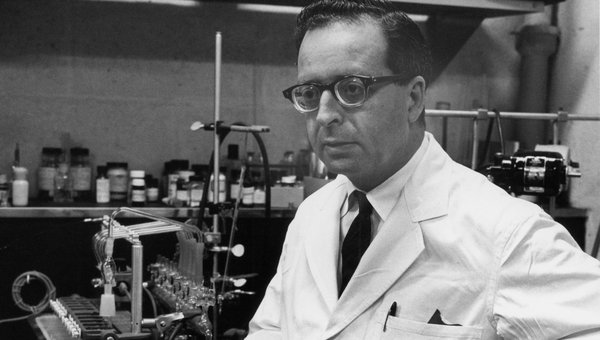
Maurice M. Rapport pictured at the Albert Einstein College of Medicine.
The death has taken place of Maurice Rapport, a biochemist who helped isolate and name the neurotransmitter serotonin in the late 1940s. Rapport’s work isolating this chemical which plays a key role in regulating mood, was revolutionary at a time when little was known about the way the brain functioned, and led to the creation of a wide variety of psychiatric and other drugs.
The New York Times, reporting on his death, outlined the background to his discovery.
Scientists had known since the 1860s of a substance in the serum released during clotting that constricts blood vessels by acting on the smooth muscles of the blood-vessel walls. In the 20th century, researchers pinpointed its source in blood platelets, but its identity remained a mystery.
Dr. Rapport, working with Dr. Page and Arda A. Green, isolated the substance and, in a paper published in 1948, gave it a name: serotonin, derived from “serum” and “tonic.”
On his own, Dr. Rapport identified the structure of serotonin as 5-hydroxytryptamine, or 5-HT, as it is called by pharmacologists. His findings, published in 1949, made it possible for commercial laboratories to synthesize serotonin and study its properties as a neurotransmitter.
More than 90,000 scientific papers have been published on 5-HT, and the Serotonin Club, a professional organization, regularly holds conferences to report on research in the field.
Maurice Rapport died on Aug. 18 in Durham, N.C. He was 91.
Weekly Round Up

A part of the human brain that’s involved in emotion gets particularly excited at the sight of animals, a new study has shown. The brain structure in question is the amygdala: that almond-shaped, sub-cortical bundle of nuclei that used to be considered the brain’s fear centre, but which is now known to be involved in many aspects of emotional learning.
Studies have shown that meditating regularly can help relieve chronic pain, but the neural mechanisms underlying the relief were unclear. Now, researchers from MIT, Harvard, and Massachusetts General Hospital have found a possible explanation.
Men and women differ in the way they anticipate an unpleasant emotional experience, which influences the effectiveness with which that experience is committed to memory according to new research.
New research has contradicted a 40-year-old theory of how the brain controls impulsive behavior
Head trauma may increase the risk of developing schizophrenia, a new study says. The results show people who have suffered from a traumatic brain injury (TBI) are 1.6 times more likely to develop schizophrenia compared with those who have not suffered such an injury.
Researchers from the Royal College of Surgeons in Ireland (RCSI) and Beaumont Hospital have conducted a study which has found striking brain similarities in bipolar disorder and schizophrenia.
The brains of older people are not slower but rather wiser than young brains, which allows older adults to achieve an equivalent level of performance, according to research undertaken at the University Geriatrics Institute of Montreal by Dr. Oury Monchi and Dr. Ruben Martins of the University of Montreal.
A new study testing alcohol’s effects on brain activity finds that alcohol dulls the brain “signal” that warns people when they are making a mistake, ultimately reducing self control.
Researchers in the Netherlands have been able to shed more light on how combat experiences change the brains of soldiers.
And finally, new research from MIT suggests that there are parts of our brain dedicated to language and only language, a finding that marks a major advance in the search for brain regions specialized for sophisticated mental functions. And this week,new research makes the case that language is not a key part of thinking about numbers, but the key part, overriding other influences like cultural ones.
Want to see what a real brain looks like?
Want to see what a real brain looks like? This video is a demonstration of parts of the cerebral cortex by Dr Sanjoy Sanyal, Associate Professor and Course Director of Neuroscience, Medical University of the Americas, Nevis.
Weekly Update
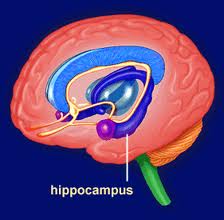
The formation of new memories and the retrieval of older memories are both evidenced in the hippocampus region of the brain
The hippocampus is a brain structure that plays a major role in the process of memory formation. It is not entirely clear how the hippocampus manages to string together events that are part of the same experience but are separated by “empty” periods of time. Now, new research published in the latest issue of the journal Neuron finds that there are neurons in the hippocampus that encode every sequential moment in a series of events that compose a discrete experience.
Sad people are apparently better than happy people at face recognition, an upside to being down in the dumps that is yielding insights into how mood can affect the brain. The findings, based on experiments involving college students, could help lead to better treatments for depression, psychologists say.
Our memories work better when our brains are prepared to absorb new information, according to a new study by MIT researchers.
A fundamental new discovery about how nerve cells in the brain store and release tiny sacs filled with chemicals may radically alter the way scientists think about neurotransmission – the electrical signaling in the brain that enables everything from the way we move, to how we remember and sense the world.
Can neuroscience explain consciousness?
Consciousness – n. the quality or state of being aware especially of something within oneself.
Some philosophers are convinced that there are phenomena that science can never explain. One example of this is consciousness – a distinguishing feature of thinking, feeling creatures such as ourselves and other higher mammals. Much research into the nature of consciousness has been done by neuroscientists, psychologists and others. But despite all the new scientific findings, a number of recent philosophers claim that there is something intrinsically mysterious about the phenomena of consciousness that no amount of scientific investigation can eliminate.
Is consciousness scientifically inexplicable?
What are the grounds for this view? Their basic argument is that conscious experiences are fundamentally unlike anything else in the world in that they have a ‘subjective’ aspect. Consider for example the experience of watching a sad movie. This is an experience that will have a distinctive ‘feel’ to it and while neuroscience may one day explain the complex goings-on in the brain that produce our feeling of sadness – it cannot explain why watching a sad move feels the way it does. These philosophers argue that the scientific study of the brain can at most tell us which brain processes are correlated with which consciousness experiences and while scientific information is interesting and valuable it does not tell us why experience with a distinctive subjective feel (such as sadness) should result from the purely physical going on in the brain. Many people believe this to be the case also.
Science – the art of the possible
This argument is compelling but it is controversial and is not endorsed by all philosophers, let alone neuroscientists. Indeed, in response to this argument the philosopher Daniel Dennett published a book in 1991 defiantly titled Consciousness Explained. Most neuroscientists would sometimes accuse those philosophers who argue that consciousness must always elude scientific explanation of being dogmatic and having a lack of imagination and predict that in the not-too-distant future neuroscience will deliver a radically different type of brain science, with radically different explanatory techniques what will explain why our experiences feel the way they do.
Science is a tribute to what we can know although we are fallible
Unfortunately there is a 2000-year-long tradition of philosophers trying to tell scientists what is and is not possible and later scientific development have often proved the philosophers wrong. Only time will tell whether the same fate awaits those who argue that consciousness must always elude scientific explanation.
My money is on the neuroscientists with this one!
Weekly Round Up

What can neuroscience teach us about making predictions?
Every day we make thousands of tiny predictions — when the bus will arrive, who is knocking on the door, whether the dropped glass will break. Now, in one of the first studies of its kind, researchers at Washington University in St. Louis are beginning to unravel the process by which the brain makes these everyday prognostications.
Imitation may be the sincerest form of flattery but how do our brains decide when and who we should copy? Researchers from The University of Nottingham have found that the key may lie in an unspoken invitation communicated through eye contact.
Cognitive training can enhance working memory and the release of the neurotransmitter dopamine, according to a study published recently in the journal Science.
The American Society of Addiction Medicine (ASAM) just released this new definition of addiction after a four-year process involving more than 80 experts: “Addiction is a chronic brain disorder and not simply a behavior problem involving alcohol, drugs, gambling or sex, experts contend in a new definition of addiction, one that is not solely related to problematic substance abuse.”
Finally, IBM has been shipping computers for more than 65 years, and it is finally on the verge of creating a true electronic brain. It has just announced that along with four universities and the Defense Advanced Research Projects Agency (DARPA), it has created the basic design of an experimental computer chip that emulates the way the brain processes information.
 inside-the-brain.com