In this recent lecture, I translate cutting-edge neuroscience to answer such questions as how a gamers brain is ‘formed’ and illuminate the brain processes involved in generating creative games and using them to get the best from the brain.
Why do we have brains?
Neuroscientist Daniel Wolpert starts from a surprising premise: the brain evolved, not to think or feel, but to control movement. In this entertaining, data-rich talk he gives us a glimpse into how the brain creates the grace and agility of human motion.
How social and emotional learning can affect the brain
Neuroscientist Richard Davidson‘s research is focused on cortical and subcortical substrates of emotion and affective disorders, including depression and anxiety.
Using quantitative electrophysiology, positron emission tomography and functional magnetic resonance imaging to make inferences about patterns of regional brain function, his lab studies normal adults and young children, and those with, or at risk for, affective and anxiety disorders.
A major focus of his current work is on interactions between prefrontal cortex and the amygdala in the regulation of emotion in both normal subjects and patients with affective and anxiety disorders.
In this video Professor Davidson presents his research on how social and emotional learning can affect the brain.
Weekly Round Up

In an attempt to put matter over mind, researchers are beginning to decipher what exactly is happening in our brains when we are making decisions.
Historically, the dyslexia label has been assigned to children who whose high IQs mismatch their low reading scores, but a new brain-imaging study challenges this understanding of dyslexia.
Twin studies have shown that people with schizophrenia and bipolar disorder have changes in gene activity caused by their environment. The finding provides the strongest evidence yet that such gene changes might cause the conditions.
The famous dictum of Henry Ford “Whether you think you can or think you can’t – you’re right,” has been put to the test in new study, which finds that people who think they can learn from their mistakes have a different brain reaction to mistakes than people who think intelligence is fixed.
Everybody has experienced a sense of “losing oneself” in an activity and now researchers have caught the brain in the act.
The brains of autistic children have a distinctive topography that a team of Stanford University scientists was able to capture using new imaging techniques, with the hope of someday creating a template for the autistic brain that could be used to diagnose children at an early age.
Finally, modern society’s increasing dependency on online tools for both work and recreation opens up unique opportunities for the study of social interactions. With this in mind, scientists at Indiana University have put Dunbar’s Number (a theoretical cognitive limit to the number of people with whom one can maintain stable social relationships) to the test by analyzing the Twitter activity of 1.7 million individuals. Their research offers support to Dunbar’s hypothesis of a biological limit to the number of relationships than can be simultaneously maintained by a single individual.
What is dopamine?
Dopamine is a neurotransmitter that helps control the brain’s reward and pleasure centers. Dopamine also helps regulate movement and emotional responses, and it enables us not only to see rewards, but to take action to move toward them.
Dopamine deficiency results in Parkinson’s Disease, and people with low dopamine activity may be more prone to addiction. Most abused drugs cause the release of dopamine and this is thought to contribute to their addictive properties.
This video describes some of the cognitive functions of dopamine in your brain.
Opening a window into the movies in our minds
In research, that brings to mind the movie Minority Report, a group of neuroscientists have found a way to see through another person’s eyes.
By reconstructing YouTube videos from viewers’ brain activity, researchers from UC Berkeley, have, in the words of Professor Jack Gallant, opened ” a window into the movies in our minds.”
Gallant’s coauthors of the study, published in Current Biology, watched YouTube videos inside a magnetic resonance imaging machine for several hours at a time. The team then used the brain imaging data to develop a computer model that matched features of the videos — like colors, shapes and movements — with patterns of brain activity. Subtle changes in blood flow to visual areas of the brain, measured by functional MRI, predicted what was on the screen at the time.
Lead author, Shinji Nishimoto, said the results of the study shed light on how the brain understands and processes visual experiences. The next line of research is to investigate if the technology could one day allow people who are paralyzed to control their environment by imagining sequences of movements.
Weekly Round Up
 The Guardian newspaper reports on a new study on how video games can persist in our perception as fleeting hallucinations in an effect labelled ‘game transfer phenomena’.
Responding to faces is a critical tool for social interactions between humans. Without the ability to read faces and their expressions, it would be hard to tell friends from strangers upon first glance, let alone a sad person from a happy one. Now, neuroscientists from the California Institute of Technology (Caltech), with the help of collaborators at Huntington Memorial Hospital and Cedars-Sinai Medical Center, have discovered a novel response to human faces by looking at recordings from brain cells in neurosurgical patients.
New medical research tends to confirm that the human brain does not stop developing in adolescence, but continues well into our 20s, according to investigators at the University of Alberta.
A review of the evidence to date suggests that music therapy can help patients recover their movements after experiencing brain damage.
Frontotemporal dementia—triggered by cell death in the front and sides of the brain—accounts for about one-fourth of all cases of early-onset dementia. Now, scientists at UCLA have discovered that a certain signaling pathway plays a key role in the brain disorder and may offer a potential target for treatment.
Finally, the latest research shows that your learning can continue even while you sleep, so those adverts for products that help you learn while you sleep may be true after all!
Is the mind modular?
Mind – n. the human consciousness that originates in the brain and is manifested especially in thought, perception, emotion, will, memory, and imagination.
Architecture of the human mind
No robot can solve a crossword, or engage in a conversation, with anything like the facility the average human being can. Somehow or other we humans are capable of performing complex cognitive tasks with minimal effort. Trying to understand how this could be is the central explanatory problem of the discipline known as cognitive psychology. There is an old but ongoing debate among cognitive psychologists concerning the architecture of the human mind.
The ‘general-purpose problem-solver’ mind
According to one view the human mind is a’ general-purpose problem-solver’. This means that the mind contains a general set of problem-solving skills or ‘general intelligence’ which it applies to an infinitely large number of different tasks. So the same set of cognitive capacities is employed, whether you are trying to count marbles, deciding what movie to see, or learning a foreign language – these tasks represent different applications of the human’s general intelligence.
The modular mind
A rival view argues that the human mind contains a number of subsystems or modules – each of which is designed to perform a very limited number of tasks and cannot do anything else. This is known as the modularity of mind hypothesis. So for example it is widely believed that there is special module for learning a language – a view deriving from the linguist Noam Chomsky. Chomsky insisted that a child does not learn to speak by overhearing adult conversation and then using ‘general intelligence’ to figure out the rules of the language being spoken; rather there is a distinct neuronal circuit – a module – which specialises in language acquisition in every human child which operates automatically and whose sole function is to enable that child to learn a language, given appropriate prompting. The fact that even those with very low ‘general intelligence’ can often learn to speak perfectly well strengthens this view.
Clues from the broken brain
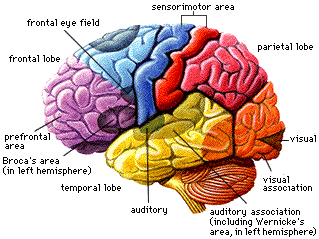
Some of the most compelling evidence for the modularity of mind hypothesis comes from studies of patients with brain damage. If the human mind were a general all-purpose problem-solver we would expect damage to the brain to affect all cognitive capacities more or less equally. But this is not what we find. On the contrary, brain damage often impairs some cognitive capacities but leaves other untouched. A good example of this is damage to a part of the brain known as Wernicke’s area – following injury or viral infection – which leaves a patient unable to understand speech although they are still able to produce fluent, grammatical sentences. This strongly suggests that there are separate modules for sentence production and comprehension. Other brain-damaged patients lose their long-term memory (amnesia) but their short-term memory and their ability to speak and understand are entirely unimpaired.
Modular or ‘general purpose problem-solver’ …or both?
The evidence for a modular mind is compelling and the philosopher Jerry Fodor published a book in 1983 titled The Modularity of Mind which explained exactly what a module is. However the modular view is controversial and is not endorsed by all philosophers. Opponents argue that even in a general purpose problem-solver brain it is still possible that distinct cognitive capacities might be differently affected by brain damage. Fodor himself even admits that the answer may not be all that clear cut and suggests that while perception and language are modular, thinking and reasoning are almost certainly not – we solve some cognitive tasks using specialised modules and others using our ‘general intelligence’. However not all psychologists agree with this.
Is the mind scientifically inexplicable?
Exactly how many modules there are and precisely what they do, are questions that cannot be answered given the current state of brain research. Most neuroscientists equate mind and brain as one and the same thing and predict that in the not-too-distant future neuroscience will deliver a radically different type of brain science, with radically different explanatory techniques what will explain the architecture of the human mind.
What neuroscience can teach us about teaching
 Recent brain research shows that different circuits are called upon in the brain for different activities such as math, music and reading.
In addition, learning and practicing particular skills can cause corresponding areas in the brain to grow or change by adding a tiny fraction of the brain’s neural circuitry and eliminating old ones.
Imaging technologies are helping map the circuits and study variability among children with learning difficulties. Moreover, recent research is providing insight into attention systems in the brain and is shedding light on how we plan, initiate, organize, and most importantly, inhibit certain behaviours.
On Friday, 23rd September, I will be giving a workshop at the Institute of Technology Sligo on what neuroscience can teach us about teaching. This workshop contributes to this dialogue by summarising what we already know about the learning process in the brain and suggests how it might inform the teaching/learning process in the classroom using approaches such as problem-based learning.
I will be touching on the following areas:
1. An overview of how problem-based learning is implemented and assessed in University of Limerick on the Graduate Medical School programme.
2. A review of how the brain learns and memorizes new information
3. An examination of the different brain circuits involved in processing science and maths concepts, music and reading or laboratory skills
4. Recommendations on how we can facilitate and support appropriate learning environments.
If you cannot attend in person, you can still take part in this workshop online.
Book online at http://www.eventbrite.com/event/2174273310
This webinar was recorded. Click here to access recording.
Weekly Round Up

Laughter with friends releases endorphins, the brain's "feel-good" chemicals
Laughing with friends releases feel-good brain chemicals, which also relieve pain, new research indicates.
The Wellcome Trust has published a report providing reflections on the field of human functional brain imaging (fMRI).
UCLA life scientists have identified for the first time a particular gene’s link to optimism, self-esteem and “mastery,” the belief that one has control over one’s own life — three critical psychological resources for coping well with stress and depression.
Managing other people at work triggers structural changes in the brain, protecting its memory and learning centre well into old age, according to research from the University of New South Wales.
How the brain controls impulsive behavior may be significantly different from psychologists have thought for the last 40 years. That is the unexpected conclusion of a study by an international team of neuroscientists published in the Aug. 31 issue of the Journal of Neuroscience.
And finally this week, research conducted by Boston College neuroscientist Sean MacEvoy and colleague Russell Epstein of the University of Pennsylvania finds evidence of a new way of considering how the brain processes and recognizes a person’s surroundings, according to a paper published in the latest issue of Nature Neuroscience.
 inside-the-brain.com