The Sentis Brain Animation Series takes you on a tour of the brain through a series of short and sharp animations. In this video, the three regions of the brain are described and how they interact as we experience the world.
Weekly Neuroscience Update

Loneliness? It’s All a State of Mind
Researchers have found that lonely people have less grey matter in a part of the brain associated with decoding eye gaze and other social cues.
While studying the sense of touch, scientists at Duke Medicine have pinpointed specific neurons that appear to regulate perception.
An international team of researchers has for the first time shown that one area of the brain, called the anterior insular cortex, is the activity center of human empathy, whereas other areas of the brain are not.
Early surgery for patients with slow-growing, low-grade glioma brain tumours may result in better survival than a wait-and-see approach, according to Norwegian research.
Books and educational toys can make a child smarter, but they also influence how the brain grows, according to new research. The findings point to a “sensitive period” early in life during which the developing brain is strongly influenced by environmental factors.
Exercising in your 70s may stop your brain from shrinking and showing the signs of ageing linked to dementia, say experts from Edinburgh University.
A patient’s genetic makeup may explain the “placebo effect,” in which people perceive that a fake treatment makes them feel better, according to a study that may help researchers design better clinical trials. Patients with a certain variation on a gene linked to release of dopamine, a brain chemical that affects emotions and sensations of pleasure and pain, were more likely to respond to a placebo version of acupuncture than patients with a different variation, a study in the journal PLoS One found.
UCLA researchers have for the first time measured the activity of a brain region known to be involved in learning, memory and Alzheimer’s disease during sleep. They discovered that this part of the brain behaves as if it’s remembering something, even under anesthesia, a finding that counters conventional theories about memory consolidation during sleep.
The brains of teenage girls with behavioural disorders are different to those of their peers, UK researchers have found. The Journal of Child Psychology and Psychiatry study of 40 girls revealed differences in the structure of areas linked to empathy and emotions. Previous work has found similar results in boys.
There are two ways we can forget a memory that causes unpleasant sensations, be they a humiliating gaffe at some dinner party or an extremely frightening event, say researchers from the University of Cambridge in the October 17th edition of Neuron.
This is your brain on music
Aniruddh Patel, of the Neurosciences Institute, discusses what music can teach us about the brain, and what brain science, in turn, can reveal about music.
Introducing the Mindfulness and Relaxation Centre at Beaumont Hospital

Beaumont Hospital is offering a new online resource with audio tracks to help people relax and reduce stress. The new online Mindfulness and Relaxation Centre is a place to learn about how and why to practice relaxation and mindfulness exercises. Relaxation and mindfulness training are helpful for managing stress as well as helping people cope with physical illness and ongoing medical treatment.
Weekly Neuroscience News

An early childhood surrounded by books and educational toys will leave positive fingerprints on a person’s brain well into their late teens, a two-decade-long research study has shown.
Dopamine is a neurotransmitter that is associated with emotions, movement, and the brain’s pleasure and reward system. In the current issue of Advances in Neuroimmune Biology, investigators provide a broad overview of the direct and indirect role of dopamine in modulating the immune system and discuss how recent research has opened up new possibilities for treating diseases such as Parkinson’s and Alzheimer’s disease, schizophrenia, multiple sclerosis or even the autoimmune disorders.
Studies released this week explore the neurological component of dietary disorders, uncovering evidence that the brain’s biological mechanisms may contribute to significant public health challenges — obesity, diabetes, binge eating, and the allure of the high-calorie meal.
By peering into students’ brains, a recent study, published in the journal NeuroImage, found that learning languages can help bulk up the brain.
Research is helping reveal how human and primate brains process and interpret facial expressions, and the role of facial mimicry in everything from deciphering an unclear smile to establishing relationships of power and status.
Neuroscientists from New York University and the University of California, Irvine have isolated the “when” and “where” of molecular activity that occurs in the formation of short-, intermediate-, and long-term memories. Their findings, which appear in the journal the Proceedings of the National Academy of Sciences, offer new insights into the molecular architecture of memory formation and, with it, a better roadmap for developing therapeutic interventions for related afflictions.
An inexpensive, five-minute eye scan can accurately assess the amount of brain damage in people with the debilitating autoimmune disorder multiple sclerosis (MS), and offer clues about how quickly the disease is progressing, according to results of two Johns Hopkins studies.
Brain scanner may help “locked in” people communicate
People unable to speak through paralysis may one day be able to spell out their thoughts with technology being developed by Dutch scientists. The brain-scanner measures different levels of brain activity and associates each level with a letter of the alphabet.
New Links Between Stress And Depression Discovered
 Researchers report new insights into how the brain responds to extreme stress, whether from combat, natural disasters, or repeated violent competition. The insights offer hope for detecting and treating several widespread and debilitating neuropsychiatric disorders, and were presented at Neuroscience 2012, the annual meeting of the Society for Neuroscience and the world’s largest source of emerging news about brain science and health.
Researchers reveal first brain study of Temple Grandin
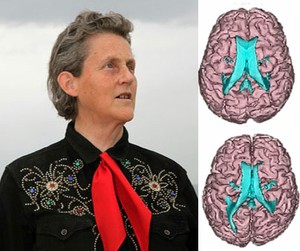
Left-leaning: Unlike controls (top), Temple Grandin has lateral ventricles (bottom) that are significantly larger on the left side of her brain than on the right.
This time of year usually sees me travelling to the US for the Society for Neuroscience annual meeting. This year for the first time in many years I am missing it, but thanks to the wonders of the internet, I am keeping abreast of the proceedings.
A presentation at the meeting in New Orleans this past weekend revealed the first study to take a close look at Temple Grandin, perhaps the world’s most famous person with autism, and one of the first to look at the brains of savants. Grandin, professor of animal sciences at Colorado State University, is an outspoken advocate for autism research and awareness. She is known as a ‘savant,’ or a person who shows characteristic social deficits of autism and yet also has some exceptional abilities.
Click here to read Virginia Hughes report for Simons Foundation Autism Research Initiative
Weekly Neuroscience Update

Neuroscientists have announced a longitudinal research collaboration to investigate the emotional, social and cognitive effects of musical training on childhood brain development. The five-year research project, Effects of Early Childhood Musical Training on Brain and Cognitive Development, will offer USC researchers an important opportunity to provide new insights and add rigorous data to an emerging discussion about the role of early music engagement in learning and brain function.
UCLA researchers have for the first time measured the activity of a brain region known to be involved in learning, memory and Alzheimer’s disease during sleep. They discovered that this part of the brain behaves as if it’s remembering something, even under anesthesia, a finding that counters conventional theories about memory consolidation during sleep.
New research reveals that stroke may be affecting people at a younger age. The study is published in the October 10, 2012, online issue of Neurology, the medical journal of the American Academy of Neurology.
Scientists studying a rare genetic disorder have identified a molecular pathway that may play a role in schizophrenia, according to new research in the October 10 issue of The Journal of Neuroscience. The findings may one day guide researchers to new treatment options for people with schizophrenia — a devastating disease that affects approximately 1 percent of the world’s population.
Researchers from the University of Exeter Medical School have for the first time identified the mechanism that protects us from developing uncontrollable fear.
Small amounts of the drug ketamine can immediately relieve the symptoms of chronic depression, as well as those of treatment-resistant patients within a few hours, say Yale scientists.
Scientists find that competition between two brain regions influences the ability to make healthy choices.
A compassion-based meditation program can significantly improve a person’s ability to read the facial expressions of others, finds a study published by Social Cognitive and Affective Neuroscience. This boost in empathic accuracy was detected through both behavioral testing of the study participants and through functional magnetic resonance imaging (fMRI) scans of their brain activity.
A study in PLOS ONE shows that whether or not you like the person you’re watching can actually have an effect on brain activity related to motor actions and lead to “differential processing” – for example, thinking the person you dislike is moving more slowly than they actually are.
Which sound does our brain most hate to hear?

Picture: shelbyasteward, flickr.com
Scientists from Newcastle University have drawn up a league table of the least pleasant sounds we may encounter as part of everyday life – albeit a slightly old-fashioned life as the top five include the rasp of chalk on a blackboard.
Working with 13 volunteers, they tested reactions to 74 different noises both in outward response and more closely via small changes in the brain.
The results are published in the latest issue of the Journal of Neuroscience and show, among other things, that acoustically anything in the frequency range of around 2,000 to 5,000 Hz was found to be unpleasant.
 inside-the-brain.com