Weekly Neuroscience Update

sad music

Sad music might actually evoke positive emotions reveals a new study by Japanese researchers. The findings help to explain why people enjoy listening to sad music, say Ai Kawakami and colleagues from Tokyo University of the Arts and the RIKEN Brain Science Institute, Japan.

Extroverts may be more outgoing and cheerful in part because of their brain chemistry, reports a study by Cornell neuroscientists.

Researchers at Neuroscience Research Australia (NeuRA) have discovered that the region of the brain called the orbitofrontal cortex plays a key role in linking emotion and memories. The finding comes from a new study, which demonstrates that patients with frontotemporal dementia (FTD) lose the “emotional content” of their memories.

Researchers in Oxford have demonstrated a significant improvement in the treatment of advanced Parkinson’s disease with deep brain stimulation.

In a study examining how bilingual children learn the two different sound systems of languages they are acquiring simultaneously, researchers have discovered insights that indicate children can learn two native languages as easily as they can learn one.

Scientists have developed a method with which the chances of success of a surgical procedure for temporal lobe epilepsy can be accurately predicted.

How Did Tolerance Kill Cory Monteith?

Corey M

I was saddened this week to read of the coroner’s verdict on the death of Cory Monteith.  The 31-year-old talented actor and performer had been plagued by substance abuse problems long before his Hollywood days and had voluntarily checked himself into rehab in March where he completed a 30-day program.

Heroin and alcohol – a potentially lethal mix

Over the past two decades I have visited high schools and colleges to talk on how addictive drugs including heroin and alcohol affect the brain and it still amazes me how little the general public understand how these potentially lethal drugs work.

The post mortem showed the Cory’s death was due to a combination of heroin and alcohol intake. Both heroin and alcohol have similar effects on the brain. They both elevate mood, lower heart rate and put your brain into a sleepy inattentive state.  Heroin and alcohol are what’s called narcotics (i.e. sleep inducers) and sometimes called nervous system depressants – not to be confused with a depressed mood but relating as to how these drugs act to silence (i.e. depress) activity in the nervous system.  It is no coincidence then that a street name for heroin is dope. Once in the brain, heroin is converted to morphine by enzymes and the morphine binds to opiate receptors in certain areas of the brain. Alcohol in contrast, acts in a less specific way by making neurons ‘leaky’.  Both drugs are highly addictive and to make matters worse, at high enough doses they  both can act as anaesthetics – drugs that switch off important nervous functions in the brain stem – like for instance, respiration (breathing) and it was the combined effect of both of these drugs  in slowing and eventually stopping breathing which was why Cory died.

Many addiction experts were not surprised

It is clear from reading newspaper reports that although Cory Monteith’s friends and loved ones are deeply shocked by the revelations of the inquest many addiction experts were not surprised.  Corey struggled with drugs since he was 13 – so long in fact that his chronic addiction was hardwired into his brain. Thus, 30 days in rehab was not enough time to get to the root cause of the addiction especially if there were any underlying psychiatric issues. Brain rewiring for chronic addiction usually takes between 90 and 120 days to be effective.  Alarm bells should also have rung after he was released from rehab when he went on vacation to Mexico.  A vacation was a huge post-rehab mistake as a structured, supportive environment is so important to grow, maintain and strengthen the new brain connections.

What is tolerance and how did it kill Cory?

Not everyone who takes heroin and alcohol together dies; so what is so special about Cory’s situation? Cory died because of a brain phenomenon called tolerance. When drugs such as heroin are used repeatedly over time, tolerance may develop.  Tolerance occurs when the person no longer responds to the drug in the way that person initially responded.  Stated another way, it takes a higher dose of the drug to achieve the same level of response achieved initially.  So for example, in the case of heroin, morphine and alcohol tolerance develops rapidly to the effects of the drug.  The development of tolerance is not addiction, although many drugs that produce tolerance also have addictive potential.  Tolerance to drugs can be produced by several different mechanisms, but in the case of heroin, morphine and alcohol tolerance develops at the level of biochemical reactions mainly within the liver whereby  enzymes adapt so that the drug can no longer cause changes in brain cell firing. Thus, the effect of a given dose of heroin, morphine and/or alcohol is diminished.

A decrease in tolerance after rehab put Cory’s brain at risk

During the 30 days in rehab Cory’s body gradually rid itself of drugs and tolerance also gradually faded. The reasons why Cory’s death occurred shortly after his release from rehab was because of a large decrease in tolerance that his body experienced after that period of abstinence. Thus, when Cory returned to using, he ran the risk of experiencing a far more extreme reaction to the same drug doses that he was once accustomed to using.

It is particularly sad that our memories of this genuinely loved and popular person may be tarnished by the revelation. I would urge people not to let this be the case, and to remember Corey for his talent and not the sordid nature of his death.

Drug taking as a way of coping

I do think however that Cory’s death might not be in vain if it opens up a debate on how we as a society deal with stress. We have heard that Cory had a history of chronic addiction and we are led to surmise that alcohol and drug taking was his way of coping. In this he is not alone. As the world economy continues on its downward slide, and unemployment and financial worries beset us, are we going to turn more and more to these quick fixes to handle our dis-stress?

Probably the most important lesson to be taken from Cory’s death is the realization that the stresses of life and how we manage them IS the difference between life and death. I look forward to developing this theme in greater detail including drug-free tips on how the avoid worry and stress in future posts, but in the meantime, my deepest sympathy goes to Cory’s loved ones at this difficult time.

The Brain Science Of Learning (Podcast)

orbitEarlier this year I was interviewed by Radio Adelaide’s Ewart Shaw, host of the weekly ORBIT – the ideas in education radio show on what we already know about the learning process in the brain.

During the course of the interview I discussed recent scientific findings linking education with neuroscience around the emerging field of neuroeducation, including the educational relevance of factors such as exercise, motivation and stress and how they are informing the teaching/learning process in the classroom.

You can download a podcast of the interview from this link.

Weekly Neuroscience Update

Brain and eye combined monitoring breakthrough could lead to fewer road accidents

An eye-tracking, brain monitoring experiment in progress. The infra-red camera is on the small black console on the desk in front of the main PC screen.

Latest advances in capturing data on brain activity and eye movement are being combined to open up a host of ‘mindreading’ possibilities for the future. These include the potential development of a system that can detect when drivers are in danger of falling asleep at the wheel.

Multimodal neuroimaging has confirmed that major depressive disorder is associated with a deregulation of brain regions.

Sensory processing disorders (SPD) are more prevalent in children than autism and as common as attention deficit hyperactivity disorder, yet it receives far less attention partly because it’s never been recognized as a distinct disease. In a groundbreaking new study from UC San Francisco, researchers have found that children affected with SPD have quantifiable differences in brain structure, for the first time showing a biological basis for the disease that sets it apart from other neurodevelopmental disorders.

Neuroscientists have discovered that spontaneously emerging brain activity patterns preserve traces of previous cognitive activity.

When people sing in a choir their heart beats are synchronised, so that the pulse of choir members tends to increase and decrease in unison. This has been shown by a recent study from that examined the health effects for choir members.

Your Brain On Buzz. How Do Ideas Spread On The Internet?

Brain regions TPJ and DMPFC (Click for description) Psychologists report for the first time that the temporoparietal junction (TPJ) and dorsomedial prefrontal cortex (DMPFC) brain regions are associated with the successful spread of ideas, often called 'buzz.'

Psychologists report for the first time that the temporoparietal junction (TPJ) and dorsomedial prefrontal cortex (DMPFC) brain regions are associated with the successful spread of ideas, often called ‘buzz.’

How do ideas spread? What messages will go viral on social media, and can this be predicted?

UCLA psychologists have taken a significant step toward answering these questions, identifying for the first time the brain regionsassociated with the successful spread of ideas, often called “buzz.”

The research has a broad range of implications, the study authors say, and could lead to more effective public health campaigns, more persuasive advertisements and better ways for teachers to communicate with students.

“Our study suggests that people are regularly attuned to how the things they’re seeing will be useful and interesting, not just to themselves but to other people,” said the study’s senior author, Matthew Lieberman, a UCLA professor of psychology and of psychiatry and biobehavioral sciences and author of the forthcoming book “Social: Why Our Brains Are Wired to Connect.”

We always seem to be on the lookout for who else will find this helpful, amusing or interesting, and our brain data are showing evidence of that. At the first encounter with information, people are already using the brain network involved in thinking about how this can be interesting to other people. We’re wired to want to share information with other people. I think that is a profound statement about the social nature of our minds.

The study findings are published in the online edition of the journal Psychological Science, with print publication to follow later this summer.
More information on the study can be found on the UCLA website.

Weekly Neuroscience Update

reading

Keeping mentally active by reading books or writing letters helps protect the brain in old age, a study suggests.

The rate and extent of damage to the spinal cord and brain following spinal cord injury have long been a mystery. Now new research has found evidence that patients already have irreversible tissue loss in the spinal cord within 40 days of injury. The study, published in the journal Lancet Neurology, used a new imaging , developed at the Wellcome Trust Centre for Neuroimaging (UCL). This enables the impact of therapeutic treatments and rehabilitative interventions to be determined more quickly and directly.

UCSF neuroscientists have found that by training on attention tests, people young and old can improve brain performance and multitasking skills.

Researchers are striving to understand the different genetic structures that underlie at least a subset of autism spectrum disorders. In cases where the genetic code is in error, did that happen anew in the patient, perhaps through mutation or copying error, or was it inherited? A new study in the American Journal of Human Genetics finds evidence that there may often be a recessive, inherited genetic contribution in autism with significant intellectual disability.

A specific brain disruption is present both in individuals diagnosed with schizophrenia and those with bipolar disorder, adding to evidence that many mental illnesses have biological similarities.

Inside The Emotional Brain

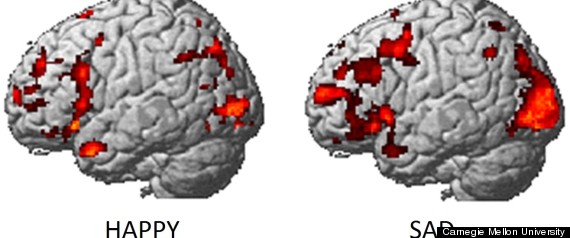
BRAIN-ACTIVITY-EMOTIONS-large570

Scientists have found a way to determine what emotions you’re feeling by looking at brain activity measured by imaging technology.

The findings, published in the journal PLOS ONE, are important to emotion research because they bring “a new method with potential to identify emotions without relying on people’s ability to self-report,” study researcher Karim Kassam, an assistant professor of social and decision sciences at Carnegie Mellon University, said in a statement.

“It could be used to assess an individual’s emotional response to almost any kind of stimulus, for example, a flag, a brand name or a political candidate.”

For the study, researchers used a combination of brain imaging — functional magnetic resonance imaging — and machine learning. They recruited 10 actors from the university’s drama school to act out different emotions, such as anger, happiness, pride and shame, while inside an fMRI scanner, for multiple times in random order.

To make sure that researchers were able to measure the actual emotions and not just the acting out of emotions, they had the study participants also look at emotion-eliciting images while undergoing FMRI brain scans.

“Despite manifest differences between people’s psychology, different people tend to neurally encode emotions in remarkably similar ways,” study researcher Amanda Markey, a graduate student in the Department of Social and Decision Sciences at the university, said in a statement.

Source: Huffington Post

Weekly Neuroscience Update

Feeling happy or sad? Researchers have measured brain signals to accurately read emotions in individuals. (Credit: Karim S. Kassam et al PLOS ONE 10.1371/journal.pone.0066032)

For the first time, scientists at Carnegie Mellon University have identified which emotion a person is experiencing based on brain activity.

Pre-treatment scans of brain activity predicted whether depressed patients would best achieve remission with an antidepressant medication or psychotherapy, in a new study.

People who experience any stroke symptoms—but do not have a stroke—may also be more likely to develop problems with memory and thinking, according to new research published in the June 19, 2013, online issue of Neurology®, the medical journal of the American Academy of Neurology.

And finally this week, a study, led by Royal Holloway University researcher Carolyn McGettigan, has identified the brain regions and interactions involved in impersonations and accents.