Study Suggests Our Brains Have a ‘Sixth Sense’

Scientists may have discovered a “sixth sense” that relates to something called numerosity, which involves the ability to rapidly assimilate the number of objects within one’s field of vision. The team behind the study used fMRI scans to highlight the activity of a key area of the brain, which seemed to alter its response based upon the number of objects perceived.

Dubbed a “number sense,” the phenomenon is believed to manifest in a part of the brain called the posterior parietal cortex, situated around the crown of an individual’s head. The study’s lead researcher, Ben Harvey, who works at the Utrecht University in the Netherlands, explained that most people don’t need to methodically count a small number of objects presented to them, “… we just know how many there are straight away.” This has led many people to maintain that a person’s numerosity powers represent something akin to a “sixth sense.”

Weekly Neuroscience Update

Nucleus accumbens by The Brain from Top to Bottom

Nucleus accumbens by The Brain from Top to Bottom

A person’s intensity of Facebook use can be predicted by activity in a reward-related area of the brain, according to a new study published in the open-access journal Frontiers in Human Neuroscience.

Sleep helps the brain consolidate what we’ve learned, but scientists have struggled to determine what goes on in the brain to make that happen for different kinds of learned tasks. In a new study, researchers pinpoint the brainwave frequencies and brain region associated with sleep-enhanced learning of a sequential finger tapping task akin to typing, or playing piano.

Alcohol intoxication reduces communication between two areas of the brain that work together to properly interpret and respond to social signals, according to researchers at the University of Illinois at Chicago College of Medicine.

Brain scans of people who say they have insomnia have shown differences in brain function compared with people who get a full night’s sleep.

The age at which children learn a second language can have a significant bearing on the structure of their adult brain, according to a new study.

Weekly Neuroscience Update

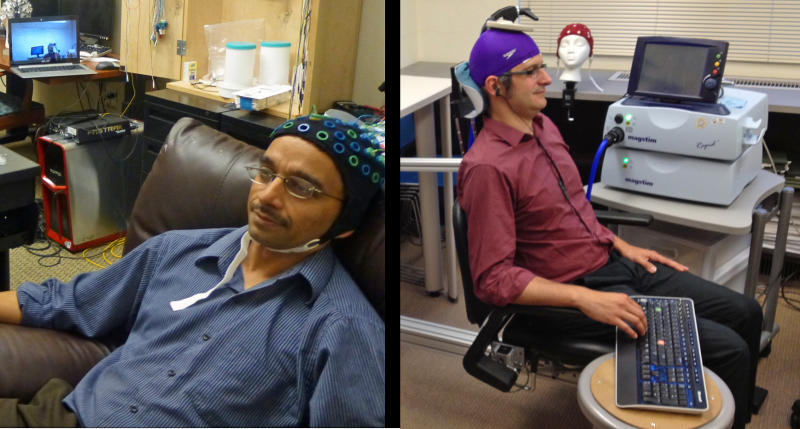
University of Washington University of Washington researcher Rajesh Rao, left, plays a computer game with his mind. Across campus, researcher Andrea Stocco, right, wears a magnetic stimulation coil over the left motor cortex region of his brain. Stocco’s right index finger moved involuntarily to hit the “fire” button as part of the first human brain-to-brain interface demonstration. (Credit: Image courtesy of University of Washington)

University of Washington University of Washington researcher Rajesh Rao, left, plays a computer game with his mind. Across campus, researcher Andrea Stocco, right, wears a magnetic stimulation coil over the left motor cortex region of his brain. Stocco’s right index finger moved involuntarily to hit the “fire” button as part of the first human brain-to-brain interface demonstration. (Credit: Image courtesy of University of Washington)

University of Washington researchers have performed what they believe is the first noninvasive human-to-human brain interface, with one researcher able to send a brain signal via the Internet to control the hand motions of a fellow researcher.

A new study strengthens the link between amyotrophic lateral sclerosis (ALS) and problems in protein production machinery of cells and identifies a possible treatment strategy.

A team of neuroscientists has found a key to the reduction of forgetting. Their findings, which appear in the journal Neuron, show that the better the coordination between two regions of the brain, the less likely we are to forget newly obtained information.

Sleep is well-known to help us better understand what we have learned. But now, researchers believe they have discovered exactly how sleep helps our brains to better learn specific motor tasks, such as typing or playing the piano.

With Magnetic Resonance Imaging (MRI), researchers have identified specific markers in the brain which could help predict whether people with psychosis will respond to antipsychotic medications.

New findings published in the journal Nature show how one component of the brain’s circuitry – inhibitory neurons – behave during critical periods of learning.

Researchers report the first biomarker results reported from the Parkinson’s Progression Markers Initiative (PPMI), showing that a comprehensive test of protein biomarkers in spinal fluid have prognostic and diagnostic value in early stages of Parkinson’s disease. The study is reported in JAMA Neurology.

Why Parkinson’s Disease Has Robbed Linda Ronstadt Of Her Singing Voice

Singer Linda Rondstadt has recently been diagnosed with Parkinson's disease.

Singer Linda Rondstadt has recently been diagnosed with Parkinson’s disease.

The news that Linda Ronstadt has lost her powerful voice after a four-decade singing career as a result of Parkinson’s disease shocked not just the singer, but her many fans.

The 67-year-old Grammy-winning singer revealed last week that she struggled with symptoms of the disease for nearly eight years before getting her diagnosis just months ago. The neurological degenerative condition robs sufferers of their speech, mobility and their cognitive abilities.

During my career, I have spent almost 30 years investigating the effects of Parkinson’s disease on the brain and  I have seen great strides in our understanding and treatment of this illness.

What is Parkinson’s disease?

Over 4 million people worldwide suffer from Parkinson’s disease – a so-called hypokinetic disorder (hypo = lack of; kinetic = movement). Parkinson’s disease can be genetic but it can also be triggered by brain injury – as observed in boxers such as Muhammad Ali – and by environment – e.g. prolonged exposure to chemicals such as insecticides, weed killers and some drugs.  However in most cases Parkinson’s disease arises ‘out of the blue’ – i.e. idiopathic Parkinson’s disease. It is a progressive disease the symptoms start out small and get progressively worse but it is rarely fatal.

Three major symptoms

The disease is associated with three major symptoms (i) akinesia – an inability to start a movement – for instance when starting to brush your teeth, (ii) bradykinesia – an excessive braking or slowing of movement – when the brush strokes become shorter and eventually freeze and (iii) tremor – starting out as a trembling finger movements as if rolling a coin or pill – sometimes called ‘pill-rolling’ – which can progress to the whole body. With Parkinson’s disease one minute you are working away in the garden and the next you are literally stuck to the spot – totally unable to move. In these situations daily life can become a challenge that can be difficult to endure.

History

The disease is named after a British surgeon and political activist James Parkinson (1755-1824) who was born in London’s east end. In October 1794 he was questioned under oath before a council of state in connection with a plot to kill the King. He was exonerated but remained a strong advocate for the under-privileged. In 1817 he published An Essay on the Shaking Palsy reporting 6 cases. Although his publication was later considered the seminal work on the disease, it received little attention until a lot more cases came to light.

Where in the brain does Parkinson’s disease occur?

The Nobel Prize was awarded in 2000 to Professor Arvid Carlsson for his research over the past 50 years which confirmed that the ‘core defect’ in Parkinson’s disease is a loss of a chemical called dopamine in two tiny brain regions  – no bigger than a wart – called the substantia nigra. These two regions deep in the back of the brain – one on the left side and one on the right side – contain nerves that make a lot of dopamine and release it at their tips about 4 inches forward in the basal ganglia – located deep in the center of the brain where it helps to convert the intention/motivation needed to perform a movement into actual movement.

The core defect is a loss of dopamine

Dopamine belongs to a family of neurotransmitters called amines that help nerve cells to stay in touch with each other- sometimes called neurotransmitters. Dopamine acts like hydraulic oil which lubricates the basal ganglia nerve network involved in executing a movement. One only needed to go to watch Linda perform on stage at the height of her career to see dopamine in action as her brain effortlessly converted her thoughts and moods into the mesmerizing tonality, rhythm and range that made her so loved by a generation. In Parkinson’s disease the substantia nigra progressively dies, the supply of dopamine to the basal ganglia dries-up and like a car out of oil the engine seizes-up and movement grinds to a halt.

Trapped and disconnected

We need dopamine to survive. Dopamine allows us to talk, sing, socialize, improvise and take risks. When dopamine flows we don’t see things as being limited by circumstance. We have boundless energy and literally anything is possible!  Without dopamine we feel trapped and disconnected. It is not surprising therefore that mood can become low and depression is often associated with this illness.

Medication is expensive

Over the past 40 years neuroscientists been working hard to develop drugs that can safely raise dopamine levels in the Parkinsonian brain – the so-called antiparkinsonian drugs – and better, more effective treatments come on the market every decade.  Drug treatments are effective in managing symptoms but frequent changes are needed as the disease progresses. In the end many combinations of drugs at higher and higher doses may be needed and unpleasant side-effects may become an issue. Medication costs on average €100,000 per year.  Interestingly, the inexpensive anti-inflammatory drug ibuprofen has recently been shown to help stave off Parkinson’s disease possibly by protecting the substantia nigra but ibuprofen can itself produce unwanted side effects, including stomach bleeding.

Alternatives to drug-treatment?

deep  brain stimulation

Neuroscientists believe that the loss of the dopamine-rich nerves in the substantia nigra results is an over-activity of a ‘brake’ mechanism in the basal ganglia which in turn inappropriately shuts down movement.  Deep brain stimulation (DBS) takes advantage of our knowledge of this brain wiring by applying a small electric current into a target area called the subthalamic nucleus located deep within the basal ganglia to switch off the brake and free-up movement. It is an expensive and risky procedure but it can provide a new lease of life particularly to those patients for whom conventional drug treatment no longer seem to work.

The politics of brain research

Probably the most important lesson to be taken from Linda’s illness is that we need to open up a debate on how we as a society fund research into brain illness and highlight the realization that a deeper understanding of the brain IS the difference between a good and a bad quality of life for the sufferers of brain illnesses such as Parkinson’s disease.

I hope that Linda and her loved ones will take hope from the on-going research into Parkinson’s disease by teams of dedicated scientists worldwide.

Click on the link below to hear Professor Billy O’Connor talk about Parkinson’s disease on Mind Matters – a science programme on RTE radio.

http://www.podcastdirectory.com/episodes/mind-matters-on-parkinson-s-disease-3465171.html

Weekly Neuroscience Update

japanesesupe

Researchers in Japan have used the powerful K computer, the world’s fastest supercomputer, to simulate the complex neural structure of our brain.

Heavy drinking as a teenager is the single biggest risk factor for developing dementia unusually early, according to new research. A study of almost 500,000 Swedish men identified “alcohol intoxication” as a late adolescent as the most serious of nine separate risk factors for young onset dementia (YOD) – that is, dementia before reaching 65.

For the first time, researchers have documented irregular brain activity within the first 24 hours of a concussive injury, as well as an increased level of brain activity weeks later—suggesting that the brain may compensate for the injury during the recovery time. The findings are published in the September issue of the Journal of the International Neuropsychological Society.

New findings may help neuroscientists pinpoint better targets for anti-anxiety treatments.

The synapses in the brain act as key communication points between approximately one hundred billion neurons. They form a complex network connecting various centres in the brain through electrical impulses. New research from Lund University suggests that it is precisely here, in the synapses, that Huntington’s disease might begin.

In patients with early Alzheimer’s disease, disruptions in brain networks emerge about the same time as chemical markers of the disease appear in the spinal fluid, researchers at Washington University School of Medicine in St. Louis have shown.

New research indicates that teens with anorexia nervosa have bigger brains than teens that do not have the eating disorder.

Assessing consciousness in patients with severe brain trauma is a difficult challenge for doctors, as the injury effectively takes away any ability to blink, squeeze a hand or otherwise respond. But scientists have found a way to measure the brain’s response to a magnetic pulse, helping them determine a person’s level of awareness.


Guest Blog for August

Read my guest post today on the Neuroscience Ireland website.

Neuroscience Ireland Guest Blog

THE SECRET TO A HAPPY LIFE – STAY FOCUSSED

Relying on our memories leaves us open to chronic unhappiness – so what can we do about it?

 Image

Each person is actually two ‘selves’

Daniel Kahneman’s 2011 book ‘Thinking, Fast and Slow’ is a brilliant, wide-ranging summary of decades of research into how people make decisions and is well worth a read. Kanehman proves in a series of ‘thought experiments’ conducted on literally millions of individiuals over many years that – odd as it may seem – we are not our moment-to-moment ‘experiencing selves’ who actually do our living but are in fact  our ‘remembering  selves.’ 

Relying on our memories can be a major cause of suffering

Chronic unhappiness is due to what he regards as a deeply unfortunate disjunction between the ‘experiencing self’ and the ‘remembering self.’ He argues that when it comes to it – our ‘experiencing self’…

View original post 755 more words

Inside The Sleeping Brain


In this TED talk,  Russell Foster, a circadian neuroscientist (he studies the sleep cycles of the brain),  shares three popular theories about why we sleep, busts some myths about how much sleep we need at different ages — and hints at some bold new uses of sleep as a predictor of mental health.

Inside The Extrovert Brain

Dopamine Pathways. In the brain, dopamine plays an important role in the regulation of reward and movement. As part of the reward pathway, dopamine is manufactured in nerve cell bodies located within the ventral tegmental area (VTA) and is released in the nucleus accumbens and the prefrontal cortex. Its motor functions are linked to a separate pathway, with cell bodies in the substantia nigra that manufacture and release dopamine into the striatum (Image Source: WIkipedia)

Dopamine Pathways. In the brain, dopamine plays an important role in the regulation of reward and movement. As part of the reward pathway, dopamine is manufactured in nerve cell bodies located within the ventral tegmental area (VTA) and is released in the nucleus accumbens and the prefrontal cortex. Its motor functions are linked to a separate pathway, with cell bodies in the substantia nigra that manufacture and release dopamine into the striatum (Image Source: Wikipedia)

A recent study published in the journal Frontiers in Human Neuroscience focused on the neurotransmitter dopamine  – —the “pleasure chemical” – in the extroverted brain, finding that the reason extroverts seem to experience stronger positive emotions may be all about how their brains process the memory of rewards.

Reference:

Depue R.A. and Fu Y. Front. On the nature of extraversion: variation in conditioned contextual activation of dopamine-facilitated affective, cognitive, and motor processes. Hum. Neurosci. 13 June 2013