Study reveals senses of sight and sound separated in children with autism

Like watching a foreign movie that was badly dubbed, children with autism spectrum disorders (ASD) have trouble integrating simultaneous information from their eyes and their ears, according to a Vanderbilt study. The study, led by Mark Wallace, Ph.D., director of the Vanderbilt Brain Institute, is the first to illustrate the link and strongly suggests that deficits in the sensory building blocks for language and communication can ultimately hamper social and communication skills in children with autism.

To learn more about this research visit:

http://news.vanderbilt.edu/2014/01/senses-of-sight-and-sound-separated-in-children-with-autism/

Understanding how your brain works helps you learn better

Evidence is accumulating that knowledge about the brain empowers learning. This is because understanding how your brain learns and remembers fosters a sense of autonomy (i.e. making your learning independent of someone/something else) and autonomy is recognised as a key factor in effective learning.

This 10 minute video can provide you with insights into how to prime your brain for effective learning and it may help if you are worried about exams and feel that you are not learning optimally.

Comments are welcome.

Inside The Emotional Brain

brain activity emotions

Scientists have found a way to determine what emotions you’re feeling by looking at brain activity measured by imaging technology.

The findings, published in the journal PLOS ONE, are important to emotion research because they bring “a new method with potential to identify emotions without relying on people’s ability to self-report,” study researcher Karim Kassam, an assistant professor of social and decision sciences at Carnegie Mellon University, said in a statement.

“It could be used to assess an individual’s emotional response to almost any kind of stimulus, for example, a flag, a brand name or a political candidate.”

For the study, researchers used a combination of brain imaging — functional magnetic resonance imaging — and machine learning. They recruited 10 actors from the university’s drama school to act out different emotions, such as anger, happiness, pride and shame, while inside an fMRI scanner, for multiple times in random order.

To make sure that researchers were able to measure the actual emotions and not just the acting out of emotions, they had the study participants also look at emotion-eliciting images while undergoing FMRI brain scans.

“Despite manifest differences between people’s psychology, different people tend to neurally encode emotions in remarkably similar ways,” study researcher Amanda Markey, a graduate student in the Department of Social and Decision Sciences at the university, said in a statement.

Source: Huffington Post

Slow brain waves play key role in coordinating complex activity

UCSF neurosurgeons place 64-electrode grids on the surface of the brain's temporal and frontal lobes to locate regions where epileptic seizures originate. These grids allowed UC Berkeley neuroscientists to study the interaction of brain waves during simple tasks, such as word recognition or hand movements. (Images courtesy the Knight Lab)

UCSF neurosurgeons place 64-electrode grids on the surface of the brain’s temporal and frontal lobes to locate regions where epileptic seizures originate. These grids allowed UC Berkeley neuroscientists to study the interaction of brain waves during simple tasks, such as word recognition or hand movements. (Images courtesy the Knight Lab)

While it is widely accepted that the output of nerve cells carries information between regions of the brain, it’s a big mystery how widely separated regions of the cortex involving billions of cells are linked together to coordinate complex activity. Now a new study by neuroscientists at the University of California, Berkeley, and neurosurgeons and neurologists at UC San Francisco (UCSF) is beginning to answer that question.

“One of the most important questions in neuroscience is: How do areas of the brain communicate?” said Dr. Robert Knight, professor of psychology, Evan Rauch Professor of Neuroscience and director of the Helen Wills Neuroscience Institute at UC Berkeley. “A simple activity like responding to a question involves areas all over the brain that hear the sound, analyze it, extract the relevant information, formulate a response, and then coordinate your lips and mouth to speak. We have no idea how information moves between these areas.”

By measuring electrical activity in the brains of pre-surgical epilepsy patients, the researchers have found the first evidence that slow brain oscillations, or theta waves, “tune in” the fast brain oscillations called high-gamma waves that signal the transmission of information between different areas of the brain. In this way, the researchers argue, areas like the auditory cortex and frontal cortex, separated by several inches in the cerebral cortex, can coordinate activity.

“If you are reading something, language areas oscillate in theta frequency allowing high-gamma-related neural activity in individual neurons to transmit information,” said Knight. “When you stop reading and begin to type, theta rhythms oscillate in motor structures, allowing you to plan and execute your motor response by way of high gamma. Simple, but effective.”

The findings are reported in the Sept. 15 issue of Science.

Read more at UC Berkeley News

Top ten blog posts of 2013

Top-10-ListThese were the most popular blog posts on Inside the Brain ranked according to most page views in 2013.

Does Addiction Exist?

What is ‘attention’ and where is it in the brain?

Understanding ADHD and Learning Disability

Understanding ADHD and Learning Disability Part V: Diagnosing ADHD

Could there an evolutionary advantage in having ADHD?

What can mirror neurons teach us about consciousness, mental health and well-being?

Inside The Musical Brain

This Is Your Brain On Poetry

Why Parkinson’s Disease Has Robbed Linda Ronstadt Of Her Singing Voice

How Did Tolerance Kill Cory Monteith?

New Discoveries Inside The Developing Brain

Image shows the neocortex organised into thousands of columns of neurons. Each column has a diameter of 0.5mm and contains 10,000 neurons. The neocortex is also organised into 6 layers. In the background are other neurons making up the neocortical column.

Image shows the neocortex organised into thousands of columns of neurons. Each column has a diameter of 0.5mm and contains 10,000 neurons. The neocortex is also organised into 6 layers. In the background are other neurons making up the neocortical column.

The human brain develops with an exquisitely timed choreography marked by distinct patterns of gene activity at different stages from the womb to adulthood, report Yale researchers. The Yale team conducted a large-scale analysis of gene activity in cerebral neocortex —an area of the brain governing perception, behavior, and cognition — at different stages of development. The neocortex, Latin for “new bark,” is our third, newly human brain in terms of evolution. It is what makes possible our judgments and our knowledge of good and evil. It is also the site from which our creativity emerges and home to our sense of self.

The team found that the human brain is more like a neighbourhood, which is better defined by the community living within its borders than its buildings.“The neighborhoods get built quickly and then everything slows down and the neocortex focuses solely on developing connections, almost like an electrical grid,” said Nenad Sestan, professor of neurobiology at Yale’s Kavli Institute for Neuroscience and senior author of the study.  “Later when these regions are synchronized, the neighborhoods begin to take on distinct functional identities like Little Italy or Chinatown.”

The analysis shows the general architecture of brain regions is largely formed in the first six months after conception by a burst of genetic activity, which is distinct for specific regions of the neocortex. This rush is followed by a sort of intermission beginning in the third trimester of pregnancy. During this period, most genes that are active in specific brain regions are quieted — except for genes that spur connections between all neocortex regions. Then in late childhood and early adolescence, the genetic orchestra begins again and helps subtly shape neocortex regions that progressively perform more specialized tasks, a process that continues into adulthood.

The analysis is the first to show this “hour glass” sketch of human brain development, with a lull in genetic activity sandwiched between highly complex patterns of gene expression, said Sestan. Intriguingly, say the researchers, some of the same patterns of genetic activity that define this human “hour glass” sketch were not observed in developing monkeys, indicating that they may play a role in shaping the features specific to human brain development.

The findings emphasize the importance of the proper interplay between genes and environment in the child’s earliest years after birth when the formation of synaptic connections between brain cells becomes synchronized, which shape how brain structures will be used later in life, said Sestan. For instance, disruptions of in synchronization of synaptic connections during child’s earliest years have been implicated in autism.

Notes:

Mihovil Pletikos, Andre ́ M.M. Sousa, and Goran Sedmak of Yale are co-lead authors of the Yale study. Other Yale authors are Kyle A. Meyer, Ying Zhu, Feng Cheng, Mingfeng Li and Yuka Imamura Kawasawa.

The work was funded by the National Institute of Mental Health, the James S. McDonnell Foundation, and the Kavli Foundation.

Imagae Credit: IBM/EPFL Blue Brain Project

Weekly Neuroscience Update

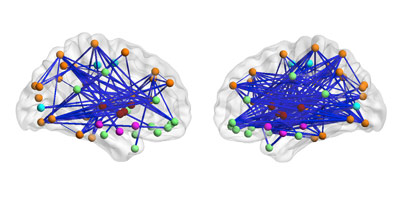
Overly connected: Many pairs of brain regions — including those involved in sensory processing, emotion and motivation — are more tightly synchronized in children with autism (right) than in controls (left).

Overly connected: Many pairs of brain regions — including those involved in sensory processing, emotion and motivation — are more tightly synchronized in children with autism (right) than in controls (left).

Three studies published over the past two months have found significant evidence that children and adolescents with autism have brains that are overly connected compared with the brains of controls. The findings complicate the theory that autism is fundamentally characterized by weakly connected brain regions. Meanwhile new findings suggest the oxytocin receptor, a gene known to influence mother-infant bonding and pair bonding in monogamous species, also plays a special role in the ability to remember faces. This research has important implications for disorders in which social information processing is disrupted, including autism spectrum disorder. In addition, the finding may lead to new strategies for improving social cognition in several psychiatric disorders.

Researchers are gaining a better understanding of the neurochemical basis of addiction with a new technology called optogenetics.

We know that getting even a measly extra hour of sleep a night can have major benefits for us–like more memories, less anxiety, and happier genes. But scientists have tested another hypothesis for why we need to spend so much time horizontal: Sleep cleans our brains.

Scientists have pinpointed a specific part of the brain where Alzheimer’s begins and traced how the disease spreads.

Scientists have zapped an electrical current to people’s brains to erase distressing memories, part of an ambitious quest to better treat ailments such as mental trauma, psychiatric disorders and drug addiction.

Finally this week, many people can recall reading at least one cherished story that they say changed their life. Now researchers at Emory University have detected what may be biological traces related to this feeling: Actual changes in the brain that linger, at least for a few days, after reading a novel.

Does Addiction Exist?

Addiction (1)American actor and addiction-awareness activist Matthew Perry and journalist Peter Hitchens traded blows in a televised interview last week,  with the latter questioning the reality of drug addiction. Hitchens questions how Perry has suffered in his ‘battle with addiction’ and for his motives in supporting special courts for people who buy and use illegal drugs.  Hitchens has gone further to question if in fact ‘addiction’ actually exists at all.  Not surprisingly this has resulted in one hell of a row.

Over the past two decades I have visited high schools and colleges to talk on how addictive drugs affect the brain and to explain the many theories about why certain people become addicted.

What is an addictive drug?

All addictive drugs release the neurotransmitter dopamine in the brain and this is thought to contribute to their addictive properties. Dopamine is carried in a nerve pathway called the reward pathway which controls the brain’s reward and pleasure centers. The reward pathway does this by regulating emotional responses that enable us not only to see rewards but also to take action to move toward them.  Addictive drugs hijack the reward pathway by causing it to release dopamine and this leads to the compulsive behavior including the loss of control in limiting intake found in addiction.

Are some drugs more addictive than others?

Yes. The type of drug taken is important as some drugs are more addictive than others.  This is because drugs differ in their ability to release dopamine in the reward pathway.  How a drug is taken is also very important. Nicotine is very addictive because it is smoked.  Smoking is the quickest way to get a substance into the brain and this makes it more addictive.

Don’t forget the buzz

The initial use of addictive drugs such as cocaine, heroin, alcohol and marijuana is often driven by the immediate euphoria – the buzz – that accompanies it and because their brains are so rich in dopamine this is of great importance to adolescents and young adults.  In this way drug addiction is predominantly a disease of the young.

Why do people take addictive drugs?

People dabble in addictive drugs for all sorts of reasons  – availability, affluence, to rebel, to seek attention, for a sense of adventure, naivety, the pressure to conform  or just plain boredom.

Who becomes an addict?

Addiction is complex and there are as many reasons why someone becomes addicted as there are addicts. This situation is not helped by the fact that we cannot yet predict who will become addicted, or how to cure it.

Addiction is a three-legged stool

The problem is that not everyone who takes addictive drugs becomes addicted. In fact, most drug users can with a little effort, drop their habit.  In order to explain who becomes addicted it is best to think of addiction as a three-legged stool and just as a stool needs all three legs in place- all three legs must also be in place for addiction to take hold. The three legs of addiction are

  • Biological.  For instance, children of alcoholics are four times more likely to become addicted to drink, even if they’re brought up away from their natural parents.
  • Psychological.  For instance, chronic, inescapable stress including the stress of boredom contributes to addictive behavior.
  • Social.  For instance, the availability of a drug is important – it’s harder to become an alcoholic in Saudi Arabia where the sale of alcohol is forbidden.

Hitchens is right – addiction doesn’t exist – that is, until you become an addict.

So, in one way Hitchens is right- addiction doesn’t exist – that is, until you become an addict. Then it controls your every waking and sleeping moment, it can destroy your life and those of your loved ones, shatter talent and ambition, wreck communities and economies.

Drug taking as a way of coping

The row between Perry and Hitchens over the nature of addiction might not be in vain if it opens up a debate on how we as a society deal with stress. We all know of, or have heard of someone suffering from chronic addiction and we are led to surmise that alcohol and drug taking is their way of coping.  In this we are not alone. As the world economy continues on its downward slide, and unemployment and financial worries beset us, are we going to turn more and more to these quick fixes to handle our dis-stress?

Probably the most important lesson to be taken from this row is the realization that the stresses of life and how we manage them IS the difference between life and death. I look forward to developing this theme in greater detail including drug-free tips on how to avoid worry and stress in future posts, but in the meantime, I salute both Perry and Hitchens for bringing addiction back into the spotlight.