How Your Brain Sees Things You Don’t

What do you see in this image?  (Credit: Jay Sanguinetti)

What do you see in this image? (Credit: Jay Sanguinetti)

A new study indicates that our brains perceive objects in everyday life that we may not be consciously aware of.

The finding by University of Arizona doctoral student Jay Sanguinetti challenges currently accepted models, in place for a century, about how the brain processes visual information.

Sanguinetti showed study participants a series of black silhouettes, some of which contained meaningful, real-world objects hidden in the white spaces on the outsides. He monitored subjects’ brainwaves with an electroencephalogram, or EEG, while they viewed the objects.

Study participants’ brainwaves indicated that even if a person never consciously recognized the shapes on the outside of the image, their brains still processed those shapes to the level of understanding their meaning.

N400-reduction

A brainwave that indicates recognition of an object

“There’s a brain signature for meaningful processing,” Sanguinetti said. A peak in the averaged brainwaves called N400 indicates that the brain has recognized an object and associated it with a particular meaning.

“It happens about 400 milliseconds after the image is shown, less than a half a second,” said Peterson. “As one looks at brainwaves, they’re undulating above a baseline axis and below that axis.

The negative ones below the axis are called N and positive ones above the axis are called P, so N400 means it’s a negative waveform that happens approximately 400 milliseconds after the image is shown.”

The presence of the N400 negative peak indicates that subjects’ brains recognize the meaning of the shapes on the outside of the figure.

“The participants in our experiments [in some cases] don’t see those shapes on the outside; nonetheless, the brain signature tells us that they have processed the meaning of those shapes,” said said Sanguinetti adviser Mary Peterson, a professor of psychology and director of the UA’s Cognitive Science Program.

“But the brain rejects them as interpretations, and if it rejects the shapes from conscious perception, then you won’t have any awareness of them.”

“We also have novel silhouettes as experimental controls,” Sanguinetti said. “These are novel black shapes in the middle and nothing meaningful on the outside.”

The N400 waveform does not appear on the EEG of subjects when they are seeing these truly novel silhouettes, without images of any real-world objects, indicating that the brain does not recognize a meaningful object in the image.

“This is huge,” Peterson said. “We have neural evidence that the brain is processing the shape and its meaning of the hidden images in the silhouettes we showed to participants in our study.”

So why does the brain process images that are not perceived?

The finding leads to the question: why would the brain process the meaning of a shape when a person is ultimately not going to perceive it?

“Many, many theorists assume that because it takes a lot of energy for brain processing, that the brain is only going to spend time processing what you’re ultimately going to perceive,” said Peterson.

“But in fact the brain is deciding what you’re going to perceive, and it’s processing all of the information and then it’s determining what’s the best interpretation.

“This is a window into what the brain is doing all the time. It’s always sifting through a variety of possibilities and finding the best interpretation for what’s out there. And the best interpretation may vary with the situation.”

Our brains may have evolved to sift through the barrage of visual input in our eyes and identify those things that are most important for us to consciously perceive, such as a threat or resources such as food, Peterson suggested.

Finding where the processing of meaning occurs

In the future, Peterson and Sanguinetti plan to look for the specific regions in the brain where the processing of meaning occurs to understand where and how this meaning is processed,” said Peterson.

Images were shown to Sanguinetti’s study participants for only 170 milliseconds, yet their brains were able to complete the complex processes necessary to interpret the meaning of the hidden objects.

“There are a lot of processes that happen in the brain to help us interpret all the complexity that hits our eyeballs,” Sanguinetti said. “The brain is able to process and interpret this information very quickly.”

How this relates to the real world

Sanguinetti’s study indicates that in our everyday life, as we walk down the street, for example, our brains may recognize many meaningful objects in the visual scene, but ultimately we are aware of only a handful of those objects, said Sanguinetti.

The brain is working to provide us with the best, most useful possible interpretation of the visual world — an interpretation that does not necessarily include all the information in the visual input.

“The findings in the research also show that our brains are processing potential objects in a visual scene to much higher levels of processing than once thought,” he explained to KurzweilAI. “Our models assume that potential objects compete for visual representation. The one that wins the competition is perceived as the object, the loser is perceived as the shapeless background.

“Since we’ve shown that shapeless backgrounds are processed to the level of semantics (meaning), there might be a way to bias this processing such that hidden objects in a scene might be perceived, by tweaking the image in ways to enunciate certain objects over others. This could be useful in many applications like radiology, product design, and even art.”

Notes:

Silhouette Image: Sanguinetti showed study participants images of what appeared to be an abstract black object. Sometimes, however, there were real-world objects hidden at the borders of the black silhouette. In this image, the outlines of two seahorses can be seen in the white spaces surrounding the black object.

Original source of article  http://www.kurzweilai.net/does-your-brain-see-things-you-dont

REFERENCES:

Joseph L. Sanguinetti, John J. B. Allen, and Mary A. Peterson, The Ground Side of an Object: Perceived as Shapeless yet Processed for Semantics, Psychological Science, 2013, doi: 10.1177/0956797613502814

Weekly Neuroscience Update

Lesion overlap map illustrating common and distinctive brain regions for Val/Val (blue) and Val/Met (yellow) genotype patients. Overlap between Val/Val and Val/Met genotype patients is illustrated in green. In each axial slice, the right hemisphere is on the reader’s left. Credit Barbey et al./PLOS ONE.

Lesion overlap map illustrating common and distinctive brain regions for Val/Val (blue) and Val/Met (yellow) genotype patients. Overlap between Val/Val and Val/Met genotype patients is illustrated in green. In each axial slice, the right hemisphere is on the reader’s left – this is because the view is from the bottom i.e. as if one were in the neck looking up at the brain. Credit Barbey et al./PLOS ONE.

Researchers report that one tiny variation in the sequence of a gene may cause some people to be more impaired by traumatic brain injury (TBI) than others with comparable wounds.

A recent study conducted by a multicenter-research team led by Cedars-Sinai Medical Center used a new, automated imaging system to identify shrinkage of a mood-regulating brain structure in a large sample of women with multiple sclerosis (MS), who also have a certain type of depression. The research supports earlier studies suggesting that the hippocampus may contribute to the high frequency of depression seen in those who suffer from MS.

Max Ortiz Catalan, researcher at Chalmers University of Technology, has developed a new method for the treatment of phantom limb pain (PLP) after an amputation. 

University of Sydney study is looking into the effectiveness of omega-3 supplements and the antidepressant, sertraline, in reducing depressive symptoms and cognitive decline in older people, in a bid to prevent the onset of depression and dementia in later life.

Certain neurons in the human striatum—a brain region involved in movement and cognition—are renewed throughout life, according to a study published in Cell.

Researchers at the University of Oxford have discovered the molecular switch in the brain that sends us to sleep.

Can the damaged brain repair itself?

After a traumatic brain injury, it sometimes happens that the brain can repair itself, building new brain cells to replace damaged ones. But the repair doesn’t happen quickly enough to allow recovery from degenerative conditions like motor neuron disease (also known as Lou Gehrig’s disease or ALS). In this video, regenerative neurologist  Siddharthan Chandran walks through some new techniques using special stem cells that could allow the damaged brain to rebuild faster.


What Songbirds Can Teach Us About Learning and the Brain

All known languages require the following features: 

1.  Sufficient brain space to house the dictionary and grammar.

2. Specific features of the vocal apparatus including the vocal cords, the muscles of the tongue and mouth enabling articulation.

3. An ability to control breathing which allows for long fluent articulate phrases and the ability to modulate intonation subtly over the length of a single breadth.

Our nearest primate relatives (i.e. monkeys and apes) do not have any such control which explains why attempts to train them to speak have been so unsuccessful.

Birds alone can imitate human speech. The birds brain, vocal apparatus, or syrinx (literally, ‘flute’) and their ability to control their breathing explains why.


Weekly Neuroscience Update

Temporo-parietal jonction (TPJ) © Perrine Ruby / Inserm

Temporo-parietal jonction (TPJ) © Perrine Ruby / Inserm

Some people recall a dream every morning, whereas others rarely recall one. A research team has studied the brain activity of these two types of dreamers in order to understand the differences between them. In a study published in the journal Neuropsychopharmacology, the researchers show that the temporo-parietal junction, an information-processing hub in the brain, is more active in high dream recallers. Increased activity in this brain region might facilitate attention orienting toward external stimuli and promote intrasleep wakefulness, thereby facilitating the encoding of dreams in memory.

Many psychiatric disorders are accompanied by memory deficits. Basel scientists have now identified a network of genes that controls fundamental properties of neurons and is important for human brain activity, memory and the development of schizophrenia. 

Researchers have taken a major step toward identifying the specific genes that contribute to bipolar disorder.

A recent study conducted by Johns Hopkins University and the National Institute of Aging found that aging adults with hearing loss are at higher risk for accelerated brain-tissue loss.

Brain cell regeneration has been discovered in a new location in human brains. The finding raises hopes that these cells could be used to help people recover after a stroke, or to treat other brain diseases.

Finally this week, researchers are hoping that the world’s largest simulated brain — known as Spaun — will be used to test new drugs that lead to breakthrough treatments for neurological disorders such as Parkinson’s, Huntington’s, and Alzheimer’s disease.

Why Are Some Brain Injuries Worse Than Others?

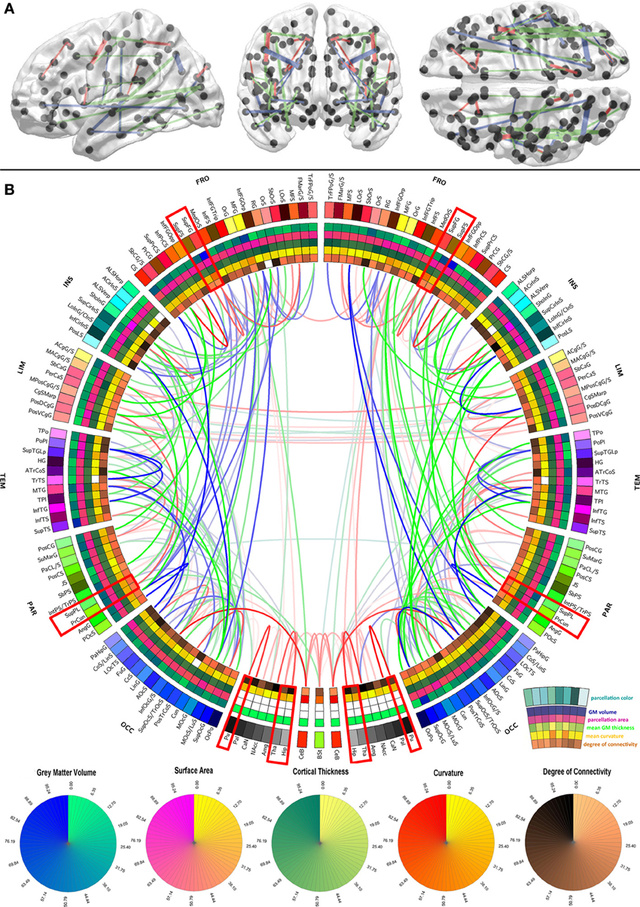
Image A: 3-D models of how the white matter in the brain connects, paired with a "connectogram" visualizing linkages between different areas of the brain / USC

3-D models of how the white matter in the brain connects, paired with a “connectogram” visualizing linkages between different areas of the brain / USC

According to research published in The Lancet, approximately a fifth of adults with a severe traumatic brain injury make a good recovery. But many more die or are left with enduring disability. Although doctors caring for Michael Schumacher, the Formula One World Champion who sustained a severe head injury while skiing, haven’t commented on how he is responding to their latest tests and treatment, Dr Peter Kirkpatrick, a leading British neurosurgeon based at Addenbrooke’s hospital in Cambridge, says that it is “extremely unlikely” that Schumacher will return to his previous level of health, although he insists it is “medically possible”.

The effects of brain injury fall into three main categories:

  • Cognitive – problems with memory, concentration, information processing
  • Emotional and behavioural problems – anxiety, explosive anger and irritability, lack of awareness or empathy
  • Physical – problems with movement, balance and co-ordination, fatigue, epilepsy

Sometimes a head injury which seems severe is followed by a good recovery while a seemingly small head injury can have very serious, long-lasting consequences.  Why is this?

Location, location, location.

The reason is that brain injury operates a bit like the property market in that the three most important things to consider are location, location and location. When nerve pathways are damaged, those brain areas served by those pathways may wither or have their functions taken over by other brain regions. Nerve pathways are also called ‘white’ pathways or ‘white matter’ because they are covered by an insulating sheath of myelin and appear white to the naked eye.

The challenge is to determine the location of key ‘scaffold’ pathways and to understand what makes them so vulnerable and important. This is not an easy task given the total length of nerve pathways in the average 20-year old human brain is 160,000 km. A recent study provides new findings on the brain’s network scaffold that will help inform clinicians about the neurological impacts of brain diseases such as multiple sclerosis, Alzheimer’s disease and brain injury.


Weekly Neuroscience Update

brain

Researchers have pinpointed an area of the brain that serves as an arbitrator between our two decision-making systems, one devoted to habitual behaviors and the other devoted to actions we take only after careful consideration.

Scientists who discovered a gene that links the thickness of the brain’s gray matter to intelligence say their finding might help improve understanding of brain disorders such as autism and schizophrenia.

People who appreciate the beauty of mathematics activate the same part of their brain when they look at aesthetically pleasing formula as others do when appreciating art or music, suggesting that there is a neurobiological basis to beauty.

Researchers at the University of California, San Francisco, are looking at ways video game technology can be used to improve or heal the brain.

For the first time, scientists have identified a gene linking the thickness of the grey matter in the brain to intelligence. The study is published today in Molecular Psychiatry and may help scientists understand biological mechanisms behind some forms of intellectual impairment.

People with dyslexia have greater difficulty than others in shifting attention between the senses – from seeing something to hearing something – according to an Oxford University study. The researchers suggest that action video games, where attention is constantly shifting focus, may be able to boost literacy skills – though they have yet to test this. The findings are reported in the journal Current Biology.

A new study published in Social Neuroscience says that the brain has begun processing a typed emoticon with the same signals that previously only accompanied processing a real, emoting human face.

A specific type of neuron in the amygdala performs differently in individuals with autism spectrum disorder than in those without the disorder, according to a new study by researchers at Cedars-Sinai Medical Center in New York.

Finally, this Valentine’s weekend, new research reveals that  a region deep inside the brain controls how quickly people make decisions about love.

Does the brain rewrite memories?

A multi-colored image of a brain for imaging research. Researchers from Northwestern University released a study showing that the memories can adapt. Scientists used a functional MRI and eye tracking as part of their research.

A multi-colored image of a brain for imaging research. Researchers from Northwestern University released a study showing that the memories can adapt. Scientists used a functional MRI and eye tracking as part of their research.

Memories are not picture perfect. The brain can rewrite old memories to update them with new experiences and information, according to a new study by Northwestern University scientists. The study, published in the Journal of Neuroscience, monitored 17 participants using three different tools: behavioral measures, a functional MRI and eye-movement tracking. Despite the number of participants appearing small, the researchers said it is a statistically robust study.

Read the full story here 

The Influence of Taking Photos on Memory

medium_4786580516

Taking a picture to help you remember something might end up having the opposite effect, according to new research.

A study showed that people who took photographs of items during a museum tour were less likely to remember details than those who merely looked at the objects.

“People so often whip out their cameras almost mindlessly to capture a moment, to the point that they are missing what is happening right in front of them,” says psychological scientist Linda Henkel, author of the study, which was published in the journal Psychological Science.

Henkel set up an experiment in the university’s museum, in which students were led on a tour and were asked to take note of certain objects, either by photographing them or by simply observing them. The next day, their memory for the objects was tested – and participants were less accurate in recognising the items they had photographed compared to those they had only observed. Henkel called this the “photo-taking impairment effect.”

“When people rely on technology to remember for them – counting on the camera to record the event and thus not needing to attend to it fully themselves – it can have a negative impact on how well they remember their experiences,” she says.

A second group offered a slight variation on the findings: those taking a photograph of a specific detail on the object by zooming in on it with the camera seemed to preserve memory for the object, not just for the part that was zoomed in on but also for the part that was out of frame.

“These results show how the ‘mind’s eye’ and the camera’s eye are not the same,” Henkel says, adding that memory research indicates taking pictures can help people remember, but only if they take time to observe and review.

photo credit: Carollainy via photopin cc