Why did the Edge walk off the edge? The answer might surprise you

edge

The music world was shaken briefly this week when lead guitarist with rock band U2, Dave ‘the Edge’ Evans, literally walked off the edge of the stage during a sell-out performance in Vancouver. Fortunately Dave survived the fall intact enough to joke about it later. It got me wondering what may have led to the fall? One possible explanation is a scientific one.

First a definition

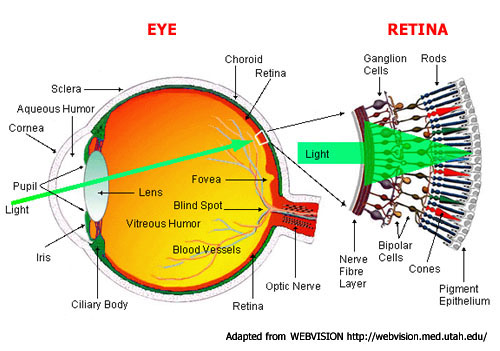
Rod cells (or rods) – photoreceptor cells concentrated at the outer edges of the retina at the back of the eyeball which are sensitive to dim light and are almost entirely responsible for peripheral vision and/or night vision.
eye_anatomy

The human eye is built differently in men and women

The eye is an extension of the brain. The retina at the back of each eyeball contains about ninety million rod-shaped cells to handle vision in dim light including peripheral vision and/or night vision. It may surprise you but most men have less peripheral vision than most women. This is because men have less rod cells than women in the back of their eye balls. In fact, women are so sensitive to dim light that they find strong light stressful –  painful even. That is why more women than men wear sunglasses. In contrast, most men are comfortable in bright light as it eliminates the need for them to rely on their weak peripheral vision.

Do women have eyes in the back of their head?

You’ve no doubt heard that women have eyes in the back of their heads. You may have grown up believing this was true of your Mother who seemed to know what you were doing, even when her back was turned. Most women’s peripheral vision is effective up to almost 180 degrees. It is weak or absent in most men. A man’s eyes are larger than a woman’s and his brain configures them for a type of long distance tunnel vision, which means he can see clearly and accurately directly in front of him and over great distances – almost like binoculars. This allows a man to focus clearly on a distant target while women can monitor everything going on around her. This is part of the reason why women can cook dinner and watch the kids at the same time – a recipe for disaster with many men.

Men stare – women don’t 

The number of men injured or killed on our roads is more than double that of women. Not only will men will take more risks crossing the road than women, but as they get older their poorer peripheral vision increases their injury rate. Men tend to stare i.e. they concentrate on getting somewhere or something across the street and just don’t see the car coming. Car insurance statistics show that female drivers are less likely to be hit on the side than are male drivers. The lack of peripheral vision in men obstructs their ability to see traffic approaching from the side. Socks, shoes, car keys, wallets and even kerbs they’re all there, but men just can’t see them as well as women can – unless of course they stare. In fact, far from being bad manners, staring is a man’s way to compensate for their lack of peripheral vision.

Back to the edge

Chances are that the Edge simply walked off the edge because like most men of his age he just did not see it, due in part to the steady deterioration in a male’s already weak peripheral vision. I am happy to hear that Dave survived with only a few scratches.


Inside The Compassionate Brain

Emiliana R. Simon-Thomas, Ph.D., is the science director of the UC Berkeley Greater Good Science Center. In this video for the Mindfulness and Compassion conference, Dr. Simon-Thomas explains the neurological mechanisms that support compassion – and why mindfulness meditation can help support the growth of compassion.

Those whom we love live on in our memory

billydad

“The life of the dead is placed in the memory of the living” ~  Marcus Tullius Cicero

My father died this week. He was ninety-one years old.

My father was an entrepreneur with an uncanny ability to engage people and was a master of the art of conversation.  He loved his job as a shopkeeper, and it was a job for which he was ideally suited.

During his brief illness I noticed how memories of him suddenly came flooding back and I literally became his child again, re-living my childhood trips with him to football matches, working with him in his shop and listening to his conversations with customers – so much so that sometimes the customers forgot what it was they came into the shop to buy. I could go on and on.

We are our memories

We literally are our memories; they define us and no better man than my father to instil my own childhood memories. In this way he helped to define who I am today and my brain is literally packed full of memories of him. Although the loss of my father is heart breaking, my memories of him are of some consolation and they will be cherished.

Childhood bereavement

While bereavement at any age is difficult, childhood bereavement can be particularly traumatic possibly because of the scarcity of those memories from which to derive any identity or consolation.  Click below for valuable resources in helping children understand bereavement – Consolation for Life’s Darkest Hours: 7 Unusual and Wonderful Books that Help Children Grieve and Make Sense of Death

I will develop this theme of the brain and bereavement in greater detail including coping strategies in future posts. In the meantime my memories, dreams and reflections go to my father at this time.

May his soul be on God’s right hand.

Ar dheas Dé go raibh a anam. (Old Gaelic blessing)

Weekly Neuroscience Update

brain-scan-reveals-out-of-body-illusion-neuroinnovations

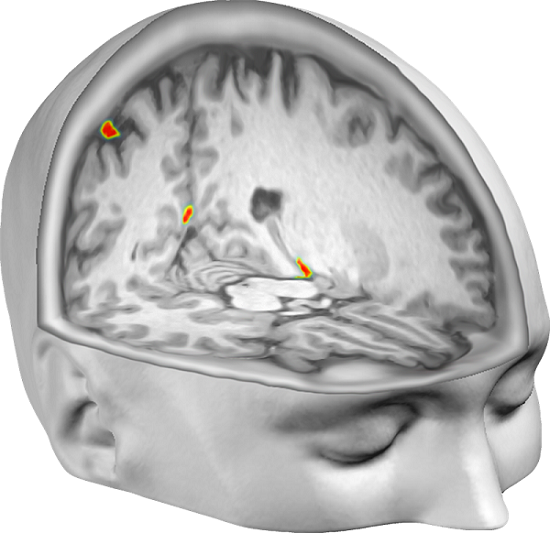
Brain regions in which the scientists could successfully decode the participants’ perceived self-location from patterns of neural activity. Credit: Malin Björnsdotter/Arvid Guterstam. Henrik Ehrsson , Arvid Guterstam , Malin Björnsdotter.

In a new study from Sweden’s Karolinska Institutet, neuroscientists created an out-of-body illusion in participants placed inside a brain scanner. They then used the illusion to perceptually ‘teleport’ the participants to different locations in a room and show that the perceived location of the bodily self can be decoded from activity patterns in specific brain regions.

The brains of people with type 1 diabetes show signs of accelerated ageing that correlate with slower information processing, according to new research.

Researchers studying postpartum depression have found that the hormone oxytocin increased activation in a reward-sensitive area of the brain when women viewed images of crying infants, but not when they viewed images of smiling ones. The researchers say oxytocin might spark the motivation to help an upset baby.

New findings reveal how long term cosmic ray exposure causes lasting cognitive impairment in astronauts.

People with depression or bipolar disorder often feel their thinking ability has gotten “fuzzy”, or less sharp than before their symptoms began. Now, researchers have shown in a very large study that effect is indeed real – and rooted in brain activity differences that show up on advanced brain scans.

Researchers have shown for the first time that a common neurotransmitter acts via a single type of neuron to enable the brain to process information more effectively. 

Finally this week, your genes may influence how sensitive you are to emotional information, according to research recently published in the Journal of Neuroscience. The study found that carriers of a certain genetic variation perceived positive and negative images more vividly, and had heightened activity in certain brain regions.


The (Neuro) Science of Genius

What do originality and invention look like in the brain? In this interview with New York Times columnist Carl Zimmer as part of Big Think’s partnership with 92Y’s Seven Days of Genius series, neuroscientist Heather Berlin explains current research into creative “flow states”, examining what happens in the brain when rappers and jazz musicians improvise.

Weekly Neuroscience Update

researchers have developed a method to map the circuitry of the brain with a “Neuronal Positioning System” (NPS) similar to how a Global Positioning System (GPS) triangulates our location on the planet. Image credit: Dr. Shlomo Tsuriel and Dr. Alex Binshtok, Hebrew University of Jerusalem.

researchers have developed a method to map the circuitry of the brain with a “Neuronal Positioning System” (NPS) similar to how a Global Positioning System (GPS) triangulates our location on the planet. Image credit: Dr. Shlomo Tsuriel and Dr. Alex Binshtok, Hebrew University of Jerusalem.

In new research scientists have announced a “Neuronal Positioning System” (NPS) that maps the circuitry of the brain, similar to how a Global Positioning System (GPS) receiver triangulates one’s location on the planet.

EPFL scientists have developed a new method that can accurately simulate the chemical modification of the protein behind Parkinson’s disease. The technique, has opened a new way of understanding Parkinson’s, and can be expanded to other proteins and diseases as well.

Neuroscientists have found a way to activate opioid receptors with light.

New research shows that chemotherapy can lead to excessive mind wandering and an inability to concentrate. Dubbed ‘chemo-brain,’ the negative cognitive effects of the cancer treatment have long been suspected, but the study is the first to explain why patients have difficulty paying attention.

A study provides new evidence that book sharing in early childhood may promote brain development supporting reading readiness.

An international team of scientists has discovered what amounts to a molecular reset button for our internal body clock. Their findings reveal a potential target to treat a range of disorders, from sleep disturbances to other behavioral, cognitive, and metabolic abnormalities, commonly associated with jet lag, shift work and exposure to light at night, as well as with neuropsychiatric conditions such as depression and autism.

New findings provide potential explanations for the very high percentage of post-traumatic disorders in combat.

Scientists have discovered that neurons are risk takers: They use minor “DNA surgeries” to toggle their activity levels all day, every day. Since these activity levels are important in learning, memory and brain disorders, the researchers think their finding will shed light on a range of important questions.

Women may have a more difficult time than men in recovering from concussion, according to a new study published online in the journal Radiology.

Finally this week, researchers report a previously unappreciated phenomenon in which the location of injury to a neuron’s communication wire in the spinal cord — the axon — determines whether the neuron simply stabilizes or attempts to regenerate. The study, published by Neuron, demonstrates how advances in live-imaging techniques are revealing new insights into the body’s ability to respond to spinal cord injuries.


What actually makes us happy?

fun

Recently, Gallup surveyed people across 158 countries about their happiness and reported that Switzerland came out on top while four of the five least happy countries in the world were Rwanda, Benin, Burundi and Togo.  Gallup also argued that most of the differences in happiness could be explained by just six factors:

  1. Real GDP per capita
  2. Healthy life expectancy
  3. Having someone to count on
  4. Perceived freedom to make life choices
  5. Freedom from corruption,
  6. Generosity

However, I believe that this survey missed something fundamental about the nature of individual human happiness.

Happiness is within you.

As I explained in previous posts, it is an astonishing fact that the recipe for individual human happiness can be summarized into just one sentence and here it is.

Your happiness is determined by an ability to engage and respond appropriately to the people, things and events that surround you.

Notice from this sentence, that your own individual happiness depends on YOU alone and not the people, things and events that surround you.  Ultimately whether you are..

  1. Male or female
  2. Old or young
  3. Able bodied or not
  4. Alone or in company
  5. A local or a stranger
  6. Confident or timid

..each one of us has the power to regulate our own happiness – a fact that the happiest people in the world already know.

Holders of Swiss passports and those living in sub-Saharan Africa take note.

Weekly Neuroscience Update


Brain-scan-images-by-Hospital-Sant-Pau-702x336

A new study published in the American journal with the highest impact factor in worldwide,Molecular Psychiatry, reveals that consumers of cannabis are more prone to experiencing false memories.

Excessive movement common among children with attention-deficit/hyperactivity disorder is actually vital to how they remember information and work out complex cognitive tasks, a new study shows. The findings show the longtime prevailing methods for helping children with ADHD may be misguided.

Brain scans of students from contrasting backgrounds have made visible the legacy of a challenging childhood. Important brain regions are more developed among children raised in a comfortable home environment.

New research published in the journal Nature Communications represents a potentially fundamental shift in our understanding of how nerve cells in the brain generate the energy needed to function. The study shows neurons are more independent than previously believed and this research has implications for a range of neurological disorders.

Every time you make a memory, somewhere in your brain a tiny filament reaches out from one neuron and forms an electrochemical connection to a neighbouring neuron. A team of biologists at Vanderbilt University is studying how these connections are formed at the molecular and cellular level.

Finally this week, among the advice new parents receive is to read to their babies early and often. The hope is that sharing books together will help children’s language development and eventually, turn them into successful readers. Now there is evidence that reading to young children is in fact associated with differences in brain activity supporting early reading skills.