Weekly Neuroscience Update

The researchers conducted an experiment using a brain-machine interface, a device that allows the brain to control a computer cursor using thought alone. By studying the brain’s activity, the researchers could see how the brain thinks an action should be performed. Image is adapted from the Carnegie Mellon University press release.

The researchers conducted an experiment using a brain-machine interface, a device that allows the brain to control a computer cursor using thought alone. By studying the brain’s activity, the researchers could see how the brain thinks an action should be performed. Image is adapted from the Carnegie Mellon University press release.

A study conducted at Carnegie Mellon University investigated the brain’s neural activity during learned behavior and found that the brain makes mistakes because it applies incorrect inner beliefs, or internal models, about how the world works.

People with post-traumatic stress disorder (PTSD) appear to have an imbalance between two of the brain’s signaling systems, a new study suggests.

A study, by researchers from the University of Glasgow’s Institute of Neuroscience and Psychology, has found that our inability to hold onto new memories is essential to the brain’s learning process.

Researchers have identified a Christmas spirit network in the brain – an area that they believe may play a role in the feelings of joy and nostalgia many of us feel during the holiday season.

Scientists have identified a key mechanism in the brain which might be associated with the onset and development of psychosis.

The decision to be generous or not arises from a specific process in the amygdala, a tiny structure deep in the brain long associated with emotions such as fear, according to a new study conducted by researchers at Yale and Duke universities.

Scientists have shed new light on the molecular basis of memory. Their study confirms that the formation of memories is accompanied by an altered activity of specific genes.

Finally this week, a pioneering study has found that the human brain has a dedicated set of nerve cells that respond only to the sound of music, which contradicts the widely accepted view that musical appreciation is merely “piggybacking” on the ability to hear other everyday sounds such as speech.
Scientist Scans His Brain Twice A Week For 18 Months And This Is What He Found

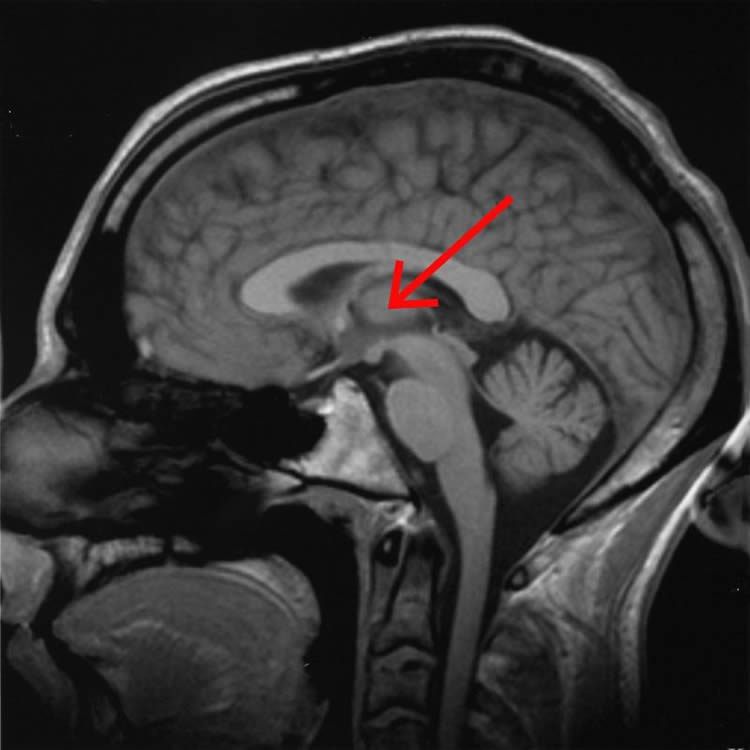
For 18 months, Stanford psychologist Russell Poldrack scanned his brain activity twice a week to understand how functional areas of his brain communicate.

Every Tuesday and Thursday morning, for 18 months, Poldrack scanned his brain, and monitored how his neurological activity changed over time using a magnetic resonance imaging (MRI) scanner, a device that can track the flow of blood in the body.  The main aim of this study was to determine how different parts of the brain speak to each other and modify themselves, from the visual centres to those that control movement. It’s well known that the brain possesses the remarkable ability to reorganize itself. This trait, known as “plasticity,” means that if one section of the brain is damaged or altered in some way, it can call on other sections of the brain to pick up the slack.

These various brain sections “correspond” with each other using a network called the connectome. Researchers have previously mapped this network using MRI scanners, essentially making them neural cartographers. An engineer might refer to this map as the brain’s “wiring diagram.”

The MRI in this case looked at the connectome of Poldrack’s brain. The data set is so huge that there is an ongoing effort to establish what exactly happened during the experiment, but the initial results have been released. Although his overall connectivity did not change much over the 18 months, changes in his behavior caused rapid changes in his neurological activity.

In the most notable example, he fasted and cut out his regular morning coffee before his Tuesday scan. The scans showed that the connections between the systems in the brain responsible for vision and those associated with the sense of touch, pressure, pain, temperature, position, movement, and vibration – the somatosensory system – became far tighter when he reduced his caffeine and food intake.

“We don’t really know if [this is] better or worse, but it’s interesting that these are relatively low-level areas,” Poldrack said in a statement. “It may well be that I’m more fatigued on those days, and that drives the brain into this state that’s focused on integrating those basic processes more.”

Of course, there is still much more to look at in this enormous data set. “The one big thing we are looking at now is now connectivity changes in the very short term, over the course of seconds,” Poldrack told IFLScience. “Our previous analyses all assumed that connectivity was constant across each 10 minute scan, but we know that’s not the case, so now we are trying to unpack more precisely the way that it varies over time.”

It is worth noting that although this is an unprecedentedly detailed study, it was only conducted on one subject. Regardless, by analyzing his own brain for this length of time, Poldrack has one of the most studied brains in the world.

Source IFL Science.com


Mind Your Head: Concussion Is Dangerous

Concussion from the Latin concutere, which means “to shake violently,  is a temporary unconsciousness or confusion and other symptoms caused by a blow to the head. It is the most common type of traumatic brain injury but it can be tricky to diagnose. Though you may have a visible cut or bruise on your head, you can’t actually see a concussion. It is believed to result from internal shearing leading to the tearing of axon tracts (nerve pathways) within the brain.

Concussions are graded as mild (grade 1), moderate (grade 2), or severe (grade 3), depending on such factors as loss of consciousness, amnesia (loss of memory) and loss of balance.

In the event of a suspected concussion a doctor may test coordination and reflexes to check the functions of the central nervous system and may order a brain to rule out bleeding or swelling within the brain. If a concussion is sustained during athletic activity the match referee/ sports coach  may ask you simple questions to check memory and concentration skills such as “Where do you live?,” or “What is your name?”  and insist that you stop play and sit it out. This is because the brain needs time to properly heal, so rest is key. Recovery is good for patients with less than 24hrs post-traumatic amnesia.

Even a minor concussion is dangerous because repeat concussions have cumulative effects on the brain, resulting in brain swelling, permanent brain injury, long-term disability, personality change, epilepsy or even death.

By its very nature a concussion is unexpected, so it is difficult to prevent.  Here are three common-sense precautions you can take to lessen the possibility of traumatic brain injury.

  1. Wear protective head gear.Participation in high-contact, high-risk sports such as all types of football, hurling, hockey and boxing can increase the likelihood of a concussion. Skateboarding, snowboarding, horseback riding, cycling and roller blading are also a threat to your brain’s health. Wearing headgear, padding, and mouth and eye guards can help safeguard against traumatic head injuries. Wearing a bike helmet can lower the risk of traumatic head injury by 85%. Ensure that the equipment is properly fitted, well maintained, and worn consistently.
  2. Drive smart. Always wear a seat belt (even as a passenger in a back seat), obey posted speed limits, and don’t use drugs or alcohol when driving, because they can impair reaction time.
  3. Don’t fight. Concussions are often sustained during a punch-up, and more males than females report traumatic head injuries.

Weekly Neuroscience Update

The research revealed that sounds that came from the left were processed in the right inferior colliculus and thalamus and vice versa. Image is for illustrative purposes only. Credit: AxelBoldt.

The research revealed that sounds that came from the left were processed in the right inferior colliculus and thalamus and vice versa. Image is for illustrative purposes only. Credit: AxelBoldt.

Some parts of our brain that process sound have a subsequent spot for each pitch, just like the keyboard on a piano. One part – the auditory part of the thalamus – even processes each sound on two ‘keyboards’ next to each other. That is one of the discoveries brain researcher Michelle Moerel of Maastricht University made while carrying out measurements into human sound processing at the Center for Magnetic Resonance Research (CMRR) in Minneapolis (USA) with Rubicon funding from NWO Social Sciences.

A new scientific model that incorporates the myriad drivers of depression could lead to more precise treatment for an illness that affects 350 million worldwide.

Targeted magnetic pulses to the brain were shown to reduce craving and substance use in cocaine-addicted patients, report scientists. The results of this pilot study suggest that this may become an effective medical treatment for patients with cocaine addiction, although a larger trial is needed to confirm the initial findings.

A gene which slows the onset of Alzheimer’s disease by 17 years has been discovered by scientists leading to hopes that its effects could be mimicked with drugs to delay the devastating condition.

A new study finds that a component of aspirin binds to an enzyme called GAPDH, which is believed to play a major role in neurodegenerative diseases, including Alzheimer’s, Parkinson’s and Huntington’s diseases.

Learning, memory, and brain repair depend on the ability of our neurons to change with experience. Now, researchers reporting in the Cell Press journal Current Biology on December 7 have evidence from a small study in people that exercise may enhance this essential plasticity of the adult brain.

Concentrating attention on a visual task can render you momentarily ‘deaf’ to sounds at normal levels, reports a new UCL study funded by the Wellcome Trust.

Finally, this week young people with behavioural problems, such as antisocial and aggressive behaviour, show reduced grey matter volume in a number of areas of the brain, according to a new study published in JAMA Psychiatry.


Weekly Neuroscience Update

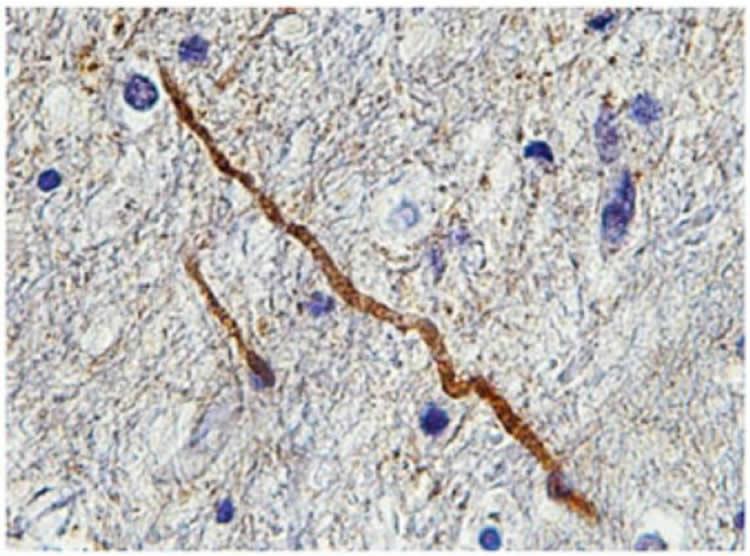
SNTF stained axons (brown) shortly after traumatic brain injury are pictured. The undulating course suggests damage to the internal skeleton, and the SNTF stain shows the high calcium concentration- activated enzymes that destroy the axon from the inside out. Credit: The laboratory of Douglas Smith, MD, Perelman School of Medicine, University of Pennsylvania.

SNTF stained axons (brown) shortly after traumatic brain injury are pictured. The undulating course suggests damage to the internal skeleton, and the SNTF stain shows the high calcium concentration- activated enzymes that destroy the axon from the inside out. Credit: The laboratory of Douglas Smith, MD, Perelman School of Medicine, University of Pennsylvania.

Physicians and others now recognize that seemingly mild, concussion-type head injuries lead to long-term cognitive impairments surprisingly often. A brain protein called SNTF, which rises in the blood after some concussions, signals the type of brain damage that is thought to be the source of these cognitive impairments, according to a new study.

About one third of people with depression have high levels of inflammation markers in their blood. New research indicates that persistent inflammation affects the brain in ways that are connected with stubborn symptoms of depression, such as anhedonia, the inability to experience pleasure.

Scientists have reported measurements of dopamine release with unprecedented temporal precision in the brains of people with Parkinson’s disease. The measurements, collected during brain surgery as the conscious patients played an investment game, demonstrate how rapid dopamine release encodes information crucial for human choice.

Scientists have uncovered a mechanism in the brain that could account for some of the neural degeneration and memory loss in people with Alzheimer’s disease.

Regardless of gender, young adults who have greater aerobic fitness also have greater volume of their entorhinal cortex, an area of the brain responsible for memory. Better aerobic fitness however does not appear to impact hippocampal volume, another area in the brain responsible for memory.

A new scientific model that incorporates the myriad drivers of depression could lead to more precise treatment for an illness that affects 350 million worldwide.

Finally this week, could staying physically active improve quality of life by delaying cognitive decline and prolonging an independent lifestyle? A new study has found that older adults who take more steps either by walking or jogging perform better on memory tasks than those who are more sedentary.


Weekly Neuroscience Update

Percentage of known neuron-, astrocyte- and oligodendrocyte-enriched genes in 32 modules, ordered by proportion of neuron-enriched gene membership. (credit: Michael Hawrylycz et al./Nature Neuroscience)

Percentage of known neuron-, astrocyte- and oligodendrocyte-enriched genes in 32 modules, ordered by proportion of neuron-enriched gene membership. (credit: Michael Hawrylycz et al./Nature Neuroscience)

Allen Institute researchers have identified a surprisingly small set of just 32 gene-expression patterns for all 20,000 genes across 132 functionally distinct human brain regions, and these patterns appear to be common to all individuals.

Evidence is mounting that gratitude makes a powerful impact on our bodies, including our immune and cardiovascular health. But how does gratitude work in the brain? A team at the University of Southern California has shed light on the neural nuts and bolts of gratitude in a new study, offering insights into the complexity of this social emotion and how it relates to other cognitive processes.

Subjective memory complaints (SMCs) are associated with cognitive impairment nearly two decades later among older women, a prospective study of aging has demonstrated.

Older adults that improved their fitness through a moderate intensity exercise program increased the thickness of their brain’s cortex, the outer layer of the brain that typically atrophies with Alzheimer’s disease, according to a new study. These effects were found in both healthy older adults and those diagnosed with mild cognitive impairment (MCI), an early stage of Alzheimer’s disease.

When it comes to the brain, “more is better” seems like an obvious assumption. But in the case of synapses, which are the connections between brain cells, too many or too few can both disrupt brain function. Research, recently published in the Journal of Neuroscience, reports  that an immune-system protein called MHCI, or major histocompatibility complex class I, moonlights in the nervous system to help regulate the number of synapses, which transmit chemical and electrical signals between neurons. MHCI could play an unexpected role in conditions such as Alzheimer’s disease, type II diabetes and autism.

Researchers have developed a simple technique to measure an individual’s visual processing speed–the speed at which an individual can comprehend visual information–in order to identify whether or not they may have cognitive issues.

Sleep is usually considered an all-or-nothing state: The brain is either entirely awake or entirely asleep. However, MIT neuroscientists have discovered a brain circuit that can trigger small regions of the brain to fall asleep or become less alert, while the rest of the brain remains awake.

The opposite of addiction is not sobriety. The opposite of addiction is connection.


Today  I want to expand on a previous post entitled Does addiction exist?  Despite decades of research on the effects of addictive drugs on the brain, neuroscience cannot yet predict who will become addicted, or how to cure it.

This begs the sobering question – Is everything we think we know about addiction wrong?

This short video really nails the lie that addictive drugs alone (e.g. alcohol, cocaine, heroin and nicotine) are the sole culprit in creating addiction and it does so by giving powerful examples of how our environment and in particular the people around us, and how we engage with them that is actually the deciding factor as to whether-or-not we become addicted.

Probably the most important message to be taken from this video is the realization that for an addiction therapy to be effective it must rely less on medication and more on compassion and inclusion, a fact known to all good addiction therapists for a long time. I look forward to developing this theme in greater detail in future posts including drug-free tips on how to beat addiction.