Weekly Neuroscience Update

sad music

Sad music might actually evoke positive emotions reveals a new study by Japanese researchers. The findings help to explain why people enjoy listening to sad music, say Ai Kawakami and colleagues from Tokyo University of the Arts and the RIKEN Brain Science Institute, Japan.

Extroverts may be more outgoing and cheerful in part because of their brain chemistry, reports a study by Cornell neuroscientists.

Researchers at Neuroscience Research Australia (NeuRA) have discovered that the region of the brain called the orbitofrontal cortex plays a key role in linking emotion and memories. The finding comes from a new study, which demonstrates that patients with frontotemporal dementia (FTD) lose the “emotional content” of their memories.

Researchers in Oxford have demonstrated a significant improvement in the treatment of advanced Parkinson’s disease with deep brain stimulation.

In a study examining how bilingual children learn the two different sound systems of languages they are acquiring simultaneously, researchers have discovered insights that indicate children can learn two native languages as easily as they can learn one.

Scientists have developed a method with which the chances of success of a surgical procedure for temporal lobe epilepsy can be accurately predicted.

Weekly Neuroscience Update

Brain and eye combined monitoring breakthrough could lead to fewer road accidents

An eye-tracking, brain monitoring experiment in progress. The infra-red camera is on the small black console on the desk in front of the main PC screen.

Latest advances in capturing data on brain activity and eye movement are being combined to open up a host of ‘mindreading’ possibilities for the future. These include the potential development of a system that can detect when drivers are in danger of falling asleep at the wheel.

Multimodal neuroimaging has confirmed that major depressive disorder is associated with a deregulation of brain regions.

Sensory processing disorders (SPD) are more prevalent in children than autism and as common as attention deficit hyperactivity disorder, yet it receives far less attention partly because it’s never been recognized as a distinct disease. In a groundbreaking new study from UC San Francisco, researchers have found that children affected with SPD have quantifiable differences in brain structure, for the first time showing a biological basis for the disease that sets it apart from other neurodevelopmental disorders.

Neuroscientists have discovered that spontaneously emerging brain activity patterns preserve traces of previous cognitive activity.

When people sing in a choir their heart beats are synchronised, so that the pulse of choir members tends to increase and decrease in unison. This has been shown by a recent study from that examined the health effects for choir members.

Weekly Neuroscience Update

reading

Keeping mentally active by reading books or writing letters helps protect the brain in old age, a study suggests.

The rate and extent of damage to the spinal cord and brain following spinal cord injury have long been a mystery. Now new research has found evidence that patients already have irreversible tissue loss in the spinal cord within 40 days of injury. The study, published in the journal Lancet Neurology, used a new imaging , developed at the Wellcome Trust Centre for Neuroimaging (UCL). This enables the impact of therapeutic treatments and rehabilitative interventions to be determined more quickly and directly.

UCSF neuroscientists have found that by training on attention tests, people young and old can improve brain performance and multitasking skills.

Researchers are striving to understand the different genetic structures that underlie at least a subset of autism spectrum disorders. In cases where the genetic code is in error, did that happen anew in the patient, perhaps through mutation or copying error, or was it inherited? A new study in the American Journal of Human Genetics finds evidence that there may often be a recessive, inherited genetic contribution in autism with significant intellectual disability.

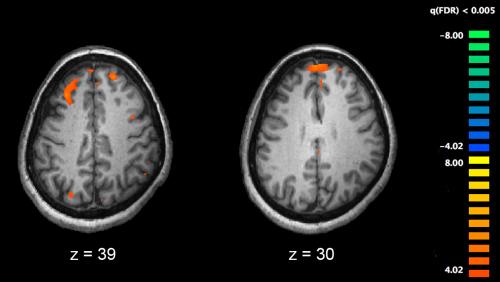
A specific brain disruption is present both in individuals diagnosed with schizophrenia and those with bipolar disorder, adding to evidence that many mental illnesses have biological similarities.

Weekly Neuroscience Update

Feeling happy or sad? Researchers have measured brain signals to accurately read emotions in individuals. (Credit: Karim S. Kassam et al PLOS ONE 10.1371/journal.pone.0066032)

For the first time, scientists at Carnegie Mellon University have identified which emotion a person is experiencing based on brain activity.

Pre-treatment scans of brain activity predicted whether depressed patients would best achieve remission with an antidepressant medication or psychotherapy, in a new study.

People who experience any stroke symptoms—but do not have a stroke—may also be more likely to develop problems with memory and thinking, according to new research published in the June 19, 2013, online issue of Neurology®, the medical journal of the American Academy of Neurology.

And finally this week, a study, led by Royal Holloway University researcher Carolyn McGettigan, has identified the brain regions and interactions involved in impersonations and accents.

Weekly Neuroscience Update

medium_3312316471

Scientists have shown that working as a piano tuner may lead to changes in the structure of the memory and navigation areas of the brain. The study, published in the Journal of Neuroscience, shows that these structural differences correlate with the number of years of experience a piano tuner has accumulated.

An unusual kind of circuit fine-tunes the brain’s control over movement and incoming sensory information, and without relying on conventional nerve pathways, according to a study published in the journal Neuron.

The reason we struggle to recall memories from our early childhood is down to high levels of neuron production during the first years of life, say Canadian researchers.

Researchers have identified mutations in several new genes that might be associated with the development of spontaneously occurring cases of the neurodegenerative disease known as amyotrophic lateral sclerosis, or ALS. Also known as Lou Gehrig’s disease, the progressive, fatal condition, in which the motor neurons that control movement and breathing gradually cease to function, has no cure.

The brains of people with depression show a reduced ability to adapt to their environment, a unique study shows.

Researchers at the Stanford University School of Medicine have found that a naturally occurring protein secreted only in discrete areas of the mammalian brain may act as a Valium-like brake on certain types of epileptic seizures.

photo credit: Chandra Marsono via photopin cc

Weekly Neuroscience Update

Different brain areas are activated when we choose to suppress an emotion, compared to when we are instructed to inhibit an emotion, according to a new study.

Researchers say signs of psychopathy could be detected as early as childhood. The conclusion was drawn from a study where psychologists scanned the brains of children with conduct problems. When the children were shown images of someone in pain, regions of the brain associated with empathy remained inactive.

Using MRI, neuroscientists have found significant differences in brain anatomy when comparing men and women with dyslexia to their non-dyslexic control groups, suggesting that the disorder may have a different brain-based manifestation based on sex.

Research into the comparative size of the frontal lobes in humans and other species has determined that they are not – as previously thought – disproportionately enlarged relative to other areas of the brain, according to the most accurate and conclusive study of this area of the brain.  It concludes that the size of our frontal lobes cannot solely account for humans’ superior cognitive abilities.

When the brain’s primary “learning center” is damaged, complex new neural circuits arise to compensate for the lost function, say researchers who have pinpointed the regions of the brain involved in creating those alternate pathways — often far from the damaged site.

Your brain often works on autopilot when it comes to grammar. That theory has been around for years, but University of Oregon neuroscientists have captured elusive hard evidence that people indeed detect and process grammatical errors with no awareness of doing so.

Image Credit: © Tryfonov / Fotolia

Weekly Neuroscience Update

A boxer utilizing the new concussion-detecting test A new tablet-based test is able to detect whether or not someone has sustained a concussion by analyzing their voice.

An international team of neuroscientists has described for the first time in exhaustive detail the underlying neurobiology of an amnesiac who suffered from profound memory loss after damage to key portions of his brain.

A fitness device created by Glasgow academics and designers helps stroke patients during their long road to recovery.

For anyone who has been affected by depression  it is no secret how devastating the disease can be for them and their families. But if the results from a small study published by a group at Germany’s Bonn University Hospital hold up, there could be a radical transformation in the treatment of depression.

An excess of the brain neurotransmitter glutamate may cause a transition to psychosis in people who are at risk for schizophrenia, reports a study from investigators at Columbia University Medical Center (CUMC) published in the current issue of Neuron.

New research finds that prisoners who are psychopaths lack the basic neurophysiological “hardwiring” that enables them to care for others.

The area of the brain that’s activated when people look at numerals such as “7” and “60” has been pinpointed by researchers. This spot is only about one-fifth of an inch across and consists of 1 million to 2 million nerve cells in the inferior temporal gyrus, the researchers said. The inferior temporal gyrus is known to be involved in the processing of visual information.

And finally this week, habitual liars’ brains differ from those of honest people, a study says. A University of Southern California team studied 49 people and found those known to be pathological liars had up to 26% more white matter than others

Weekly Neuroscience Update

Brain scan

The researchers monitored brain activity while playing volunteers new music

Listening to new music is rewarding for the brain, a study suggests. Using MRI scans, a Canadian team of scientists found that areas in the reward centre of the brain became active when people heard a song for the first time. The more the listener enjoyed what they were hearing, the stronger the connections were in the region of the brain called the nucleus accumbens. The study is published in the journal Science.

Meanwhile, an imaging study by Stanford University School of Medicine scientists reveals that the brains of different people listening to the same piece of music actually respond in the same way –  which may in part explain why music plays such a big role in our social existence.

Researchers have identified an important therapeutic target for alleviating the symptoms of Lou Gehrig’s disease, also known as amyotrophic lateral sclerosis (ALS), and other related neurodegenerative disorders such as Alzheimer’s disease, Parkinson’s disease and Huntington’s disease.

In a study published in the online version of Neurobiology of Disease, the team both confirmed the importance of this new target as well as a series of compounds that can be used to attenuate the dysregulation of one of the important cellular processes that lead to and ultimately to .

Neuroscientists have developed a method of analyzing brain activity to detect autism in children. Their findings appear in the online journal PLOS ONE.

Slow oscillations in brain activity, which occur during so-called slow-wave sleep, are critical for retaining memories. Researchers reporting online in the Cell Press journal Neuron have found that playing sounds synchronized to the rhythm of the slow brain oscillations of people who are sleeping enhances these oscillations and boosts their memory. This demonstrates an easy and noninvasive way to influence human brain activity to improve sleep and enhance memory.

Weekly Neuroscience Update

Researchers at the University of Southern California (USC) are developing SimSensei, a Kinect-driven avatar system capable of tracking and analyzing telltale signs of psychological distress. The avatar psychologist uses facial recognition technology and a depth-sensing camera to read a person’s facial movements, body movements, posture, linguistic patterns and acoustics to screen for depression.

A new functional magnetic resonance imaging (fMRI) technique may provide neurosurgeons with a non-invasive tool to help in mapping critical areas of the brain before surgery, reports a study in the April issue of Neurosurgery, official journal of the Congress of Neurological Surgeons.

For the first time, scientists have been able to predict how much pain people are feeling by looking at images of their brains, according to a new study led by the University of Colorado Boulder.The findings, published today in the New England Journal of Medicine, may lead to the development of reliable methods doctors can use to objectively quantify a patient’s pain

New research has shown that the way our minds react to and process emotions such as fear can vary according to what is happening in other parts of our bodies.

UCLA researchers have used a brain-imaging tool and stroke risk assessment to identify signs of cognitive decline early on in individuals who don’t yet show symptoms of dementia.

People with mental illnesses are more than seven times more likely to use cannabis weekly compared to people without a mental illness, according to researchers from the Centre for Addiction and Mental Health (CAMH) who studied U.S. data.

Weekly Neuroscience Update

The phrase “practice makes perfect” has a neural basis in the brain. Researchers have discovered a set of common changes in the brain upon learning a new skill. They have essentially detected a neural marker for the reorganization the brain undergoes when a person practices and become proficient at a task.

Researchers at the University of East Anglia have made a discovery in neuroscience that could offer a long-lasting solution to eating disorders such as obesity.

A new study conducted by The Mind Research Network , shows that neuroimaging data can predict the likelihood of whether a criminal will reoffend following release from prison.

The ability to communicate in multiple languages not only provides doorways to new cultural and social experiences but also apparently promotes brain growth and staves off the onset of dementia and Alzheimer’s disease.

Researchers have discovered a potential way to decode your dreams, predicting the content of the visual imagery you’ve experienced on the basis of neural activity recorded during sleep.

Brain researchers at Barrow Neurological Institute have discovered that we explore the world with our eyes in a different way than previously thought. Their results advance our understanding of how healthy observers and neurological patients interact and glean critical information from the world around them.

In a study designed to differentiate why some stroke patients recover from aphasia and others do not, investigators have found that a compensatory reorganization of language function to right hemispheric brain regions bodes poorly for language recovery. Patients who recovered from aphasia showed a return to normal left-hemispheric language activation patterns. These results, which may open up new rehabilitation strategies, are available in the current issue of Restorative Neurology and Neuroscience.