Weekly Neuroscience Update

Nucleus accumbens by The Brain from Top to Bottom

Nucleus accumbens by The Brain from Top to Bottom

A person’s intensity of Facebook use can be predicted by activity in a reward-related area of the brain, according to a new study published in the open-access journal Frontiers in Human Neuroscience.

Sleep helps the brain consolidate what we’ve learned, but scientists have struggled to determine what goes on in the brain to make that happen for different kinds of learned tasks. In a new study, researchers pinpoint the brainwave frequencies and brain region associated with sleep-enhanced learning of a sequential finger tapping task akin to typing, or playing piano.

Alcohol intoxication reduces communication between two areas of the brain that work together to properly interpret and respond to social signals, according to researchers at the University of Illinois at Chicago College of Medicine.

Brain scans of people who say they have insomnia have shown differences in brain function compared with people who get a full night’s sleep.

The age at which children learn a second language can have a significant bearing on the structure of their adult brain, according to a new study.
Weekly Neuroscience Update

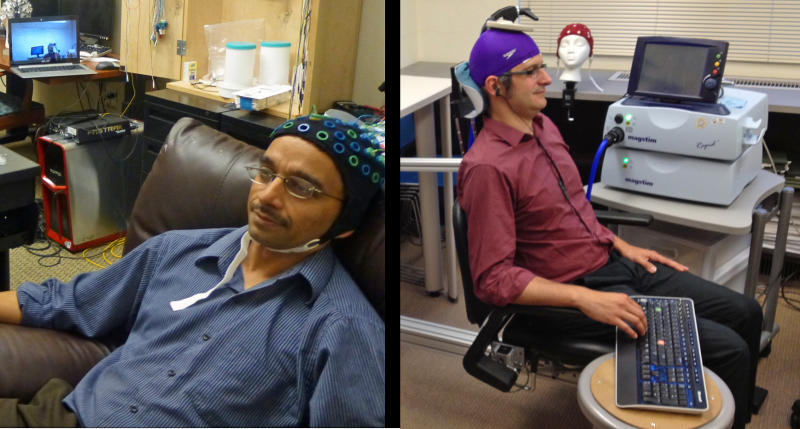
University of Washington University of Washington researcher Rajesh Rao, left, plays a computer game with his mind. Across campus, researcher Andrea Stocco, right, wears a magnetic stimulation coil over the left motor cortex region of his brain. Stocco’s right index finger moved involuntarily to hit the “fire” button as part of the first human brain-to-brain interface demonstration. (Credit: Image courtesy of University of Washington)

University of Washington University of Washington researcher Rajesh Rao, left, plays a computer game with his mind. Across campus, researcher Andrea Stocco, right, wears a magnetic stimulation coil over the left motor cortex region of his brain. Stocco’s right index finger moved involuntarily to hit the “fire” button as part of the first human brain-to-brain interface demonstration. (Credit: Image courtesy of University of Washington)

University of Washington researchers have performed what they believe is the first noninvasive human-to-human brain interface, with one researcher able to send a brain signal via the Internet to control the hand motions of a fellow researcher.

A new study strengthens the link between amyotrophic lateral sclerosis (ALS) and problems in protein production machinery of cells and identifies a possible treatment strategy.

A team of neuroscientists has found a key to the reduction of forgetting. Their findings, which appear in the journal Neuron, show that the better the coordination between two regions of the brain, the less likely we are to forget newly obtained information.

Sleep is well-known to help us better understand what we have learned. But now, researchers believe they have discovered exactly how sleep helps our brains to better learn specific motor tasks, such as typing or playing the piano.

With Magnetic Resonance Imaging (MRI), researchers have identified specific markers in the brain which could help predict whether people with psychosis will respond to antipsychotic medications.

New findings published in the journal Nature show how one component of the brain’s circuitry – inhibitory neurons – behave during critical periods of learning.

Researchers report the first biomarker results reported from the Parkinson’s Progression Markers Initiative (PPMI), showing that a comprehensive test of protein biomarkers in spinal fluid have prognostic and diagnostic value in early stages of Parkinson’s disease. The study is reported in JAMA Neurology.

Weekly Neuroscience Update

japanesesupe

Researchers in Japan have used the powerful K computer, the world’s fastest supercomputer, to simulate the complex neural structure of our brain.

Heavy drinking as a teenager is the single biggest risk factor for developing dementia unusually early, according to new research. A study of almost 500,000 Swedish men identified “alcohol intoxication” as a late adolescent as the most serious of nine separate risk factors for young onset dementia (YOD) – that is, dementia before reaching 65.

For the first time, researchers have documented irregular brain activity within the first 24 hours of a concussive injury, as well as an increased level of brain activity weeks later—suggesting that the brain may compensate for the injury during the recovery time. The findings are published in the September issue of the Journal of the International Neuropsychological Society.

New findings may help neuroscientists pinpoint better targets for anti-anxiety treatments.

The synapses in the brain act as key communication points between approximately one hundred billion neurons. They form a complex network connecting various centres in the brain through electrical impulses. New research from Lund University suggests that it is precisely here, in the synapses, that Huntington’s disease might begin.

In patients with early Alzheimer’s disease, disruptions in brain networks emerge about the same time as chemical markers of the disease appear in the spinal fluid, researchers at Washington University School of Medicine in St. Louis have shown.

New research indicates that teens with anorexia nervosa have bigger brains than teens that do not have the eating disorder.

Assessing consciousness in patients with severe brain trauma is a difficult challenge for doctors, as the injury effectively takes away any ability to blink, squeeze a hand or otherwise respond. But scientists have found a way to measure the brain’s response to a magnetic pulse, helping them determine a person’s level of awareness.


Weekly Neuroscience Update

Brain scans show a correlation between how well participants could make a connection between a new word and a sound, and the gray matter volume in the hippocampus and cerebellum. (Credit: Photo/Qinghua He)

A combination of brain scans and reading tests has revealed that several regions in the brain are responsible for allowing humans to read. The findings open up the possibility that individuals who have difficulty reading may only need additional training for specific parts of the brain — targeted therapies that could more directly address their individual weaknesses.

Children with Asperger’s syndrome show patterns of brain connectivity distinct from those of children with autism, according to a new study. 

Scientists have discovered that the brain circuits we engage when we think about social matters, such as considering other people’s views, or moral issues, inhibit the circuits that we use when we think about inanimate, analytical things, such as working on a physics problem or making sure the numbers add up when we balance our budget. And they say, the same happens the other way around: the analytic brain network inhibits the social network.

Using direct human brain recordings, a research team has identified a new type of cell in the brain that helps people to keep track of their relative location while navigating an unfamiliar environment.

A collaborative team of researchers has uncovered evidence that a specific genetic alteration appears to contribute to disorders of brain development, including schizophrenia. They also found that schizophrenia shares a common biological pathway with Fragile X mental syndrome, a disorder associated with both intellectual impairment and autism.
A team of researchers has identified 18 new genes responsible for driving glioblastoma multiforme, the most common—and most aggressive—form of brain cancer in adults. The study was published August 5, 2013, in Nature Genetics.

Johns Hopkins biophysicists have discovered that full activation of a protein ensemble essential for communication between nerve cells in the brain and spinal cord requires a lot of organized back-and-forth motion of some of the ensemble’s segments. Their research, they say, may reveal multiple sites within the protein ensemble that could be used as drug targets to normalize its activity in such neurological disorders as epilepsy, schizophrenia, Parkinson’s and Alzheimer’s disease.

A sleepless night makes us more likely to reach for doughnuts or pizza than for whole grains and leafy green vegetables, suggests a new study from UC Berkeley that examines the brain regions that control food choices. The findings shed new light on the link between poor sleep and obesity

Weekly Neuroscience Update

FASD impacts brain development throughout childhood and adolescence not just at birth

Highlighted areas are some of the white matter tracts the research group studied. Credit: U of A

Medical researchers at the University of Alberta recently published findings showing that brain development is delayed throughout childhood and adolescence for people born with Fetal Alcohol Spectrum Disorder (FASD).

Whenever we have to acquire new knowledge under stress, the brain deploys unconscious rather than conscious learning processes. Neuroscientists at the Ruhr-Universität Bochum have discovered that this switch from conscious to unconscious learning systems is triggered by the intact function of mineralocorticoid receptors.

Researchers have reverse-engineered the outlines of a disrupted prenatal gene network in schizophrenia, by tracing spontaneous mutations to where and when they likely cause damage in the brain. Some people with the brain disorder may suffer from impaired birth of new neurons, or neurogenesis, in the front of their brain during prenatal development, suggests the study.

Autism is marked by several core features — impairments in social functioning, difficulty communicating, and a restriction of interests. Though researchers have attempted to pinpoint factors that might account for all three of these characteristics, the underlying causes are still unclear. Now, a new study suggests that two key attentional abilities — moving attention fluidly and orienting to social information — can be checked off the list, as neither seems to account for the diversity of symptoms we find in people with autism.

Anemia, or low levels of red blood cells, may increase the risk of dementia, according to a study published in the July 31, 2013, online issue of Neurology, the medical journal of the American Academy of Neurology

Physicists and neuroscientists from The University of Nottingham and University of Birmingham have unlocked one of the mysteries of the human brain, thanks to new research using Functional Magnetic Resonance Imaging (fMRI) and electroencephalography (EEG). The work will enable neuroscientists to map a kind of brain function that up to now could not be studied, allowing a more accurate exploration of how both healthy and diseased brains work.

Weekly Neuroscience Update

A novel screening method makes it easier to diagnose and treat children with autism

A child with autism discovers how to evoke the onscreen video he likes best. Credit: Rutgers Sensory-Motor Integration Lab

Researchers have developed a new screening method to diagnose autism, which unlike current methods does not rely on subjective criteria. These results are published in a series of studies in the open-access journal Frontiers in Neuroscience.

Going to bed at different times every night throughout early childhood seems to curb children’s brain power, according to a large, long term study.

A computational vision scientist at the University of South Australia has just published new research describing a key advance in our understanding of how the brain perceives the physical world.

Oxytocin has long been known as the warm, fuzzy hormone that promotes feelings of love, social bonding and well-being. It’s even being tested as an anti-anxiety drug. But new research shows oxytocin also can cause emotional pain, an entirely new, darker identity for the hormone.

Ultrasound waves sent to specific brain regions can alter a person’s mood, according to a new study published in the journal Brain Stimulation.

A gene related to neural tube defects in dogs has for the first time been identified by researchers.

UCLA chemists and molecular biologists have for the first time used a “structure-based” approach to drug design to identify compounds with the potential to delay or treat Alzheimer’s disease, and possibly Parkinson’s, Lou Gehrig’s disease and other degenerative disorders.

Weekly Neuroscience Update

sad music

Sad music might actually evoke positive emotions reveals a new study by Japanese researchers. The findings help to explain why people enjoy listening to sad music, say Ai Kawakami and colleagues from Tokyo University of the Arts and the RIKEN Brain Science Institute, Japan.

Extroverts may be more outgoing and cheerful in part because of their brain chemistry, reports a study by Cornell neuroscientists.

Researchers at Neuroscience Research Australia (NeuRA) have discovered that the region of the brain called the orbitofrontal cortex plays a key role in linking emotion and memories. The finding comes from a new study, which demonstrates that patients with frontotemporal dementia (FTD) lose the “emotional content” of their memories.

Researchers in Oxford have demonstrated a significant improvement in the treatment of advanced Parkinson’s disease with deep brain stimulation.

In a study examining how bilingual children learn the two different sound systems of languages they are acquiring simultaneously, researchers have discovered insights that indicate children can learn two native languages as easily as they can learn one.

Scientists have developed a method with which the chances of success of a surgical procedure for temporal lobe epilepsy can be accurately predicted.

Weekly Neuroscience Update

Brain and eye combined monitoring breakthrough could lead to fewer road accidents

An eye-tracking, brain monitoring experiment in progress. The infra-red camera is on the small black console on the desk in front of the main PC screen.

Latest advances in capturing data on brain activity and eye movement are being combined to open up a host of ‘mindreading’ possibilities for the future. These include the potential development of a system that can detect when drivers are in danger of falling asleep at the wheel.

Multimodal neuroimaging has confirmed that major depressive disorder is associated with a deregulation of brain regions.

Sensory processing disorders (SPD) are more prevalent in children than autism and as common as attention deficit hyperactivity disorder, yet it receives far less attention partly because it’s never been recognized as a distinct disease. In a groundbreaking new study from UC San Francisco, researchers have found that children affected with SPD have quantifiable differences in brain structure, for the first time showing a biological basis for the disease that sets it apart from other neurodevelopmental disorders.

Neuroscientists have discovered that spontaneously emerging brain activity patterns preserve traces of previous cognitive activity.

When people sing in a choir their heart beats are synchronised, so that the pulse of choir members tends to increase and decrease in unison. This has been shown by a recent study from that examined the health effects for choir members.

Weekly Neuroscience Update

reading

Keeping mentally active by reading books or writing letters helps protect the brain in old age, a study suggests.

The rate and extent of damage to the spinal cord and brain following spinal cord injury have long been a mystery. Now new research has found evidence that patients already have irreversible tissue loss in the spinal cord within 40 days of injury. The study, published in the journal Lancet Neurology, used a new imaging , developed at the Wellcome Trust Centre for Neuroimaging (UCL). This enables the impact of therapeutic treatments and rehabilitative interventions to be determined more quickly and directly.

UCSF neuroscientists have found that by training on attention tests, people young and old can improve brain performance and multitasking skills.

Researchers are striving to understand the different genetic structures that underlie at least a subset of autism spectrum disorders. In cases where the genetic code is in error, did that happen anew in the patient, perhaps through mutation or copying error, or was it inherited? A new study in the American Journal of Human Genetics finds evidence that there may often be a recessive, inherited genetic contribution in autism with significant intellectual disability.

A specific brain disruption is present both in individuals diagnosed with schizophrenia and those with bipolar disorder, adding to evidence that many mental illnesses have biological similarities.

Weekly Neuroscience Update

Feeling happy or sad? Researchers have measured brain signals to accurately read emotions in individuals. (Credit: Karim S. Kassam et al PLOS ONE 10.1371/journal.pone.0066032)

For the first time, scientists at Carnegie Mellon University have identified which emotion a person is experiencing based on brain activity.

Pre-treatment scans of brain activity predicted whether depressed patients would best achieve remission with an antidepressant medication or psychotherapy, in a new study.

People who experience any stroke symptoms—but do not have a stroke—may also be more likely to develop problems with memory and thinking, according to new research published in the June 19, 2013, online issue of Neurology®, the medical journal of the American Academy of Neurology.

And finally this week, a study, led by Royal Holloway University researcher Carolyn McGettigan, has identified the brain regions and interactions involved in impersonations and accents.