Over the past three decades I have visited high schools and colleges to talk on how addictive drugs affect the brain and to explain the many theories about why certain people become addicted. There are as many reasons why someone becomes addicted as there are addicts. This situation is not helped by the fact that we cannot yet predict who will become addicted, or how to cure it.
Psychiatrist Judson Brewer studies the relationship between mindfulness and addiction — from smoking to overeating to all those other things we do even though we know they’re bad for us. In this short video, you will learn more about the mechanism of habit development and discover a simple but profound tactic that might help you beat your next urge to smoke, snack or check a text while driving.
Scientists have discovered a new genetic syndrome of obesity, over-eating, mental and behavioural problems in six families, from across the world. The study represents an important step in our understanding of how the hypothalamus and oxytocin control appetite and behaviour.
A new study published in Biological Psychiatry suggests that a brain reward centre, the striatum, may be directly affected by inflammation and that striatal change is related to the emergence of illness behaviors.
By studying stroke patients who have lost the ability to spell, researchers have pinpointed the parts of the brain that control how we write words.
A study has shown for the first time that the structure of the brain circuitry known as the corticolimbic system is more likely to be passed down from mothers to daughters than from mothers to sons or from fathers to children of either gender. The corticolimbic system governs emotional regulation and processing and plays a role in mood disorders, including depression.
New research proves that suffering repeated traumatic experiences throughout infancy and adolescence multiplies by 7 the risk of suffering psychosis during adulthood.
Researchers are using a mathematical tool to help determine which concussion patients will go on to suffer migraine headaches, according to a new study published online in the journal Radiology.
Some of the earliest nerve cells to develop in the womb shape brain circuits that process sights and sounds, but then give way to mature networks that convert this sensory information into thoughts. This is the finding of a study led by researchers at NYU Langone Medical Center and published in the February 3 edition of Neuron.
Scientists have demonstrated for the first time that it is possible to specifically modify gene expression in diseased upper motor neurons, brain cells that break down in ALS.
New research indicates that the location of receptors that transmit pain signals IS important in how big or small a pain signal will be and how effectively drugs can block those signals.
A new way of using MRI scanners to look for evidence of multiple sclerosis in the brain has been successfully tested by researchers.
A team of European researchers has found evidence that suggests that human consciousness is a state where the neural network that makes up the brain operates at an optimal degree of connectedness. In their paper published in Journal of the Royal Society Interface, the team describes their study of the human brain using volunteers undergoing fMRI scans while succumbing to the effects of an anesthetic that caused them to lose consciousness, and what was revealed in reviewing the scan data.
Researchers have determined that testing a portion of a person’s submandibular gland may be a way to diagnose early Parkinson’s disease.
Finally this week, researchers of a new study published in the current issue of Biological Psychiatry report successful reduction of depressive symptoms in patients using a novel non-invasive method of vagus nerve stimulation, or VNS.
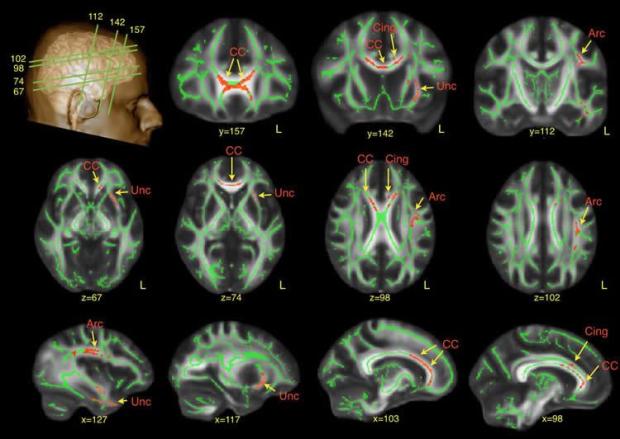
Red regions indicate reduced fractional anisotropy values in autism spectrum disorder (ASD). Credit: The researchers/King’s College London.
Research at King’s College London has revealed subtle brain differences in adult males with autism spectrum disorder (ASD), which may go some way towards explaining why symptoms persist into adulthood in some people with the disorder.
Women who take estrogen supplements from before or at the start of menopause and continue with them for a few years have better preserved brain structure, which may reduce the risk of dementia.
Scientists have taken a significant step toward understanding the cause of schizophrenia, in a landmark study that provides the first rigorously tested insight into the biology behind any common psychiatric disorder.
Stopping disruptions in cellular “trash removal” brought on by errors in molecular marks on DNA may guard against neurodegenerative diseases like Parkinson’s.
Roughly twenty years before the first symptoms of Alzheimer’s disease appear, inflammatory changes in the brain can be seen, according to a new study from Karolinska Institutet published in the medical scientific journal Brain.
In a new study, researchers reveal how brain scans could be used to identify children at high risk for later-life depression – information that could pave the way for early intervention and prevention.
Researchers have shown that graphene can be used to make electrodes that can be implanted in the brain, which could potentially be used to restore sensory functions for amputee or paralysed patients, or for individuals with motor disorders such as Parkinson’s disease.
A new study has linked stress and anxiety to the same neurocircuitry in the brain as depression and dementia.
Different regions of our brain need to work simultaneously in order for us to process emotion. But according to new research, such regions are disconnected among individuals who experience multiple episodes of major depression.
A team of international researchers have announced the discovery of a system in the brain that may underlie the development of involuntary vocalizations (commonly called vocal tics) that often occur in people with Tourette syndrome.
A new study sheds light on multiple sclerosis (MS), specifically damage in the brain caused by the disease that may explain the slow and continuous cognitive decline that many patients experience. The findings, which appear in the Journal of Neuroscience, show that the brain’s immune system is responsible for disrupting communication between nerve cells, even in parts of the brain that are not normally considered to be primary targets of the disease.
Cognitive function and health appear to be genetically linked, according to research published in Molecular Psychiatry. The study was carried out by an international team from the US, the UK and Germany.
Researchers have discovered the mechanics of how dopamine transports into and out of brain cells, a finding that could someday lead to more effective treatment of drug addictions and neurological disorders such as Parkinson’s disease.
The brains of children who are obese function differently from those of children of healthy weight, and exhibit an “imbalance” between food-seeking and food-avoiding behaviors, researchers at Vanderbilt University Medical Center have found.
Finally this week, neuroscientists have now shown that rhythmic brain waves, called theta oscillations, engage and synchronize the brain regions that support the integration of memories. The results were published in the journal Current Biology.
Salk scientists computationally reconstructed brain tissue in the hippocampus to study the sizes of connections (synapses). The larger the synapse, the more likely the neuron will send a signal to a neighboring neuron. The team found that there are actually 26 discrete sizes that can change over a span of a few minutes, meaning that the brain has a far great capacity at storing information than previously thought. Pictured here is a synapse between an axon (green) and dendrite (yellow). Credit: Salk Institute.
Scientists have achieved critical insight into the size of neural connections, putting the memory capacity of the brain far higher than common estimates. The new work also answers a longstanding question as to how the brain is so energy efficient and could help engineers build computers that are incredibly powerful but also conserve energy.
A new brain imaging study may lead to a screen that could identify children at high risk of developing depression later in life.
Children born into poverty had an increased risk for neurological impairment before they were aged 7 years, according to recent research in The International Journal of Epidemiology.
Individuals who participated in high challenge activities like quilting and photography showed enhanced brain activity, according to a new Restorative Neurology and Neuroscience report.
People with early-stage dementia benefit when they are empowered to manage their own condition, a study has found.
Learning a second language is easier for some adults than others, and innate differences in how the various parts of the brain “talk” to one another may help explain why, according to a study published January 20 in theJournal of Neuroscience.
Nerve damage from neurodegenerative disease and spinal cord injury has largely been considered irreversible, but researchers now report progress in the effort to synthesize rare natural products that promote regeneration and growth of injured nerve cells.
Columbia neuroscientists have developed new tools to safely trace brain circuits.
Finally this week, a new study finds that a sugar habit leaves a lasting imprint on certain brain circuits, making it incredibly difficult to stop eating sweet food. These marks, in turn, prime us to give into our cravings.
Greg O’Brien is the author of On Pluto: Inside the Mind of Alzheimer’s. It is the first book written by an investigative reporter embedded inside the mind of Alzheimer’s chronicling the progression of his own disease. On Pluto has won several international book awards, and has been the subject of numerous television, radio, newspaper and magazine stories.
David Bowie died this week from liver cancer. He was sixty-nine years old.
Creative genius
David was a singer, songwriter, record producer, painter and actor. He was a key figure in popular music for over five decades, and was considered by critics and other musicians as a ground-breaking innovator, particularly for his work in the 1970s. During his career, he sold an estimated 140 million records worldwide and was awarded platinum, gold and silver album certifications. Although he stopped concert touring after 2004 he remained musically active until his death. If there were a phrase to encapsulate David’s creative genius it would be the following: dare greatly, keep learning and don’t conform.
Memories full of sound. Beautiful sound.
One only needed to watch David perform on stage to see his brain effortlessly convert his concepts and ideas into the mesmerizingly creative instrumental, vocal and visual performances that transfixed a generation. His impact was enormous; he changed the nature of rock music, and changed his own approach repeatedly while staying true to his creative roots.
What makes us creative?
This question can be answered in the context that every single human being is unique because we each poses a uniquely complex brain, so complex that in all of human history no two human brains can be identical. This is because the unique combination of about 100 trillion tiny brain connections that grow and change throughout life is an ongoing work in progress from conception to death. In this way we each one of us ‘evolve’ as true individuals as we each make our journey through life.
Neurodiversity is the key to our success
The term neurodiversity has been coined to extend the finding that every single human being is neurologically unique due to infinite variations in human brain wiring. These differences in brain wiring are authentic forms of communication, self- expression and being. The ongoing gender revolution is simply recognition of the fact that human beings cannot be defined by sexual orientation alone. We are each one us, too unique to be pigeon-holed by ideology be it cultural, political or religious.David Bowie epitomized this view in this life and music.
Unique solutions, innovations and insights
What we actually need are the support-systems to allow each one of us to live our lives as we are, rather than insisting that we all conform to some clinical ideal. This is important because it is this very diversity that provides unique solutions, innovations and insights by viewing the world in a different way. Part of our fascination with David Bowie was that we were watching his unique creativity grow, develop and change in real-time over his life time.
Keep learning and don’t conform
David led a rich and varied life which epitomised the principle; keep learning and don’t conform. In this regard, he was interested in the unusual and unexplored and his music brought an enlightened understanding to many. His musical legacy including twenty six albums provides some consolation following his death and it will be cherished for many years to come.
Dare greatly. There is no other option
The evolution of the human race is not going to proceed by trying to transcend it, rather we will move forward as a race by making room for each and every individual to express their personalities to the full. In this way the evolution of the human race has everything to do with our own personal development.
In short, personality equals evolution
I look forward to developing this theme in greater detail in future posts. In the meantime, my deepest sympathy goes to the David’s loved ones at this difficult time.
Concussion from the Latin concutere, which means “to shake violently, is a temporary unconsciousness or confusion and other symptoms caused by a blow to the head. It is the most common type of traumatic brain injury but it can be tricky to diagnose. Though you may have a visible cut or bruise on your head, you can’t actually see a concussion. It is believed to result from internal shearing leading to the tearing of axon tracts (nerve pathways) within the brain.
Concussions are graded as mild (grade 1), moderate (grade 2), or severe (grade 3), depending on such factors as loss of consciousness, amnesia (loss of memory) and loss of balance.
In the event of a suspected concussion a doctor may test coordination and reflexes to check the functions of the central nervous system and may order a brain to rule out bleeding or swelling within the brain. If a concussion is sustained during athletic activity the match referee/ sports coach may ask you simple questions to check memory and concentration skills such as “Where do you live?,” or “What is your name?” and insist that you stop play and sit it out. This is because the brain needs time to properly heal, so rest is key. Recovery is good for patients with less than 24hrs post-traumatic amnesia.
Even a minor concussion is dangerous because repeat concussions have cumulative effects on the brain, resulting in brain swelling, permanent brain injury, long-term disability, personality change, epilepsy or even death.
By its very nature a concussion is unexpected, so it is difficult to prevent. Here are three common-sense precautions you can take to lessen the possibility of traumatic brain injury.
Wear protective head gear.Participation in high-contact, high-risk sports such as all types of football, hurling, hockey and boxing can increase the likelihood of a concussion. Skateboarding, snowboarding, horseback riding, cycling and roller blading are also a threat to your brain’s health. Wearing headgear, padding, and mouth and eye guards can help safeguard against traumatic head injuries. Wearing a bike helmet can lower the risk of traumatic head injury by 85%. Ensure that the equipment is properly fitted, well maintained, and worn consistently.
Drive smart. Always wear a seat belt (even as a passenger in a back seat), obey posted speed limits, and don’t use drugs or alcohol when driving, because they can impair reaction time.
Don’t fight. Concussions are often sustained during a punch-up, and more males than females report traumatic head injuries.
The research revealed that sounds that came from the left were processed in the right inferior colliculus and thalamus and vice versa. Image is for illustrative purposes only. Credit: AxelBoldt.
Some parts of our brain that process sound have a subsequent spot for each pitch, just like the keyboard on a piano. One part – the auditory part of the thalamus – even processes each sound on two ‘keyboards’ next to each other. That is one of the discoveries brain researcher Michelle Moerel of Maastricht University made while carrying out measurements into human sound processing at the Center for Magnetic Resonance Research (CMRR) in Minneapolis (USA) with Rubicon funding from NWO Social Sciences.
A new scientific model that incorporates the myriad drivers of depression could lead to more precise treatment for an illness that affects 350 million worldwide.
Targeted magnetic pulses to the brain were shown to reduce craving and substance use in cocaine-addicted patients, report scientists. The results of this pilot study suggest that this may become an effective medical treatment for patients with cocaine addiction, although a larger trial is needed to confirm the initial findings.
A gene which slows the onset of Alzheimer’s disease by 17 years has been discovered by scientists leading to hopes that its effects could be mimicked with drugs to delay the devastating condition.
A new study finds that a component of aspirin binds to an enzyme called GAPDH, which is believed to play a major role in neurodegenerative diseases, including Alzheimer’s, Parkinson’s and Huntington’s diseases.
Learning, memory, and brain repair depend on the ability of our neurons to change with experience. Now, researchers reporting in the Cell Press journalCurrent Biology on December 7 have evidence from a small study in people that exercise may enhance this essential plasticity of the adult brain.
Concentrating attention on a visual task can render you momentarily ‘deaf’ to sounds at normal levels, reports a new UCL study funded by the Wellcome Trust.
Finally, this week young people with behavioural problems, such as antisocial and aggressive behaviour, show reduced grey matter volume in a number of areas of the brain, according to a new study published in JAMA Psychiatry.