Trailblazers in neuroscience Dr. Christof Koch and Dr. John Donoghue reveal mind-blowing insights on how the brain turns thought into voluntary behaviors and how that knowledge is empowering victims of neurological trauma with regained physical abilities.
Category: Uncategorized
Inside The Brain’s Dictionary
Where exactly are the words in your head? Scientists have created an interactive map showing which brain areas respond to hearing different words. The map reveals how language is spread throughout the cortex and across both hemispheres, showing groups of words clustered together by meaning. The beautiful interactive model allows us to explore the complex organisation of the enormous dictionaries in our heads.
Weekly Neuroscience Update
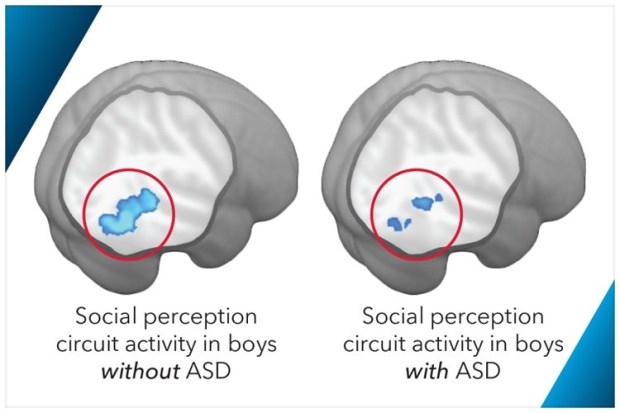
Researchers analyzed a series of 164 images from each of 114 individuals and discovered the brain scans of the social perception circuits indicated ASD only in boys. Credit: The researchers/George Washington University.
Researchers have developed a new method to map and track the function of brain circuits affected by autism spectrum disorder (ASD) in boys using brain imaging, a technique that will provide doctors with a tool that measures the progress of treatments in individual patients.
Scientists have derived a structural model of a transporter at the blood-brain barrier called Mfsd2a. This is the first molecular model of this critical transporter, and could prove important for the development of therapeutic agents that need to be delivered to the brain, across the blood-brain barrier. In future, this could help treat neurological disorders such as glioblastoma.
Research co-led by the University of Glasgow has made a potential breakthrough in the treatment of Alzheimer’s disease.
Frontotemporal dementia (FTD), the second most common cause of dementia in people under 65, may be triggered by a defect in immune cells called microglia that causes them to consume the brain’s synaptic connections, according to new research.
A new study shows that a series of play sessions with music improved 9-month-old babies’ brain processing of both music and new speech sounds.
Researchers at the RIKEN Brain Science Institute (BSI) in Japan have demonstrated that astrocytes help control the strength of connections between neurons. Published in Proceedings of the National Academy of Sciences, the study used cultured cells and brain slices to show that astrocytes in the hippocampus regulate changes in the brain brought on by neural activity.
Finally this week, people with more friends have higher pain tolerance, Oxford University researchers have found.
Is our perception of the world just an illusion?

Until recently, the task of applying what we know about the brain to the bigger question of personal human experience has been avoided by scientists. However the emergence of the new discipline of neuroscience – the scientific study of the nervous system – is helping us to bridge this gap by providing new ways to answer such old questions as – do we experience the world as it really is … or as we need it to be?
In this provocative and game changing talk, cognitive scientist Donald Hoffman goes to the very heart of what we understand to be real by showing examples that our perception of reality is faulty and that that modern science is merely a one-dimensional take on what is really going on around us.
This idea shifts our current way of thinking about what is actually real
Conclusion: we need to reach a new understanding of how the brain constructs reality the way it appears to us. Why? Because our very perception is a precursor of that self-same reality.
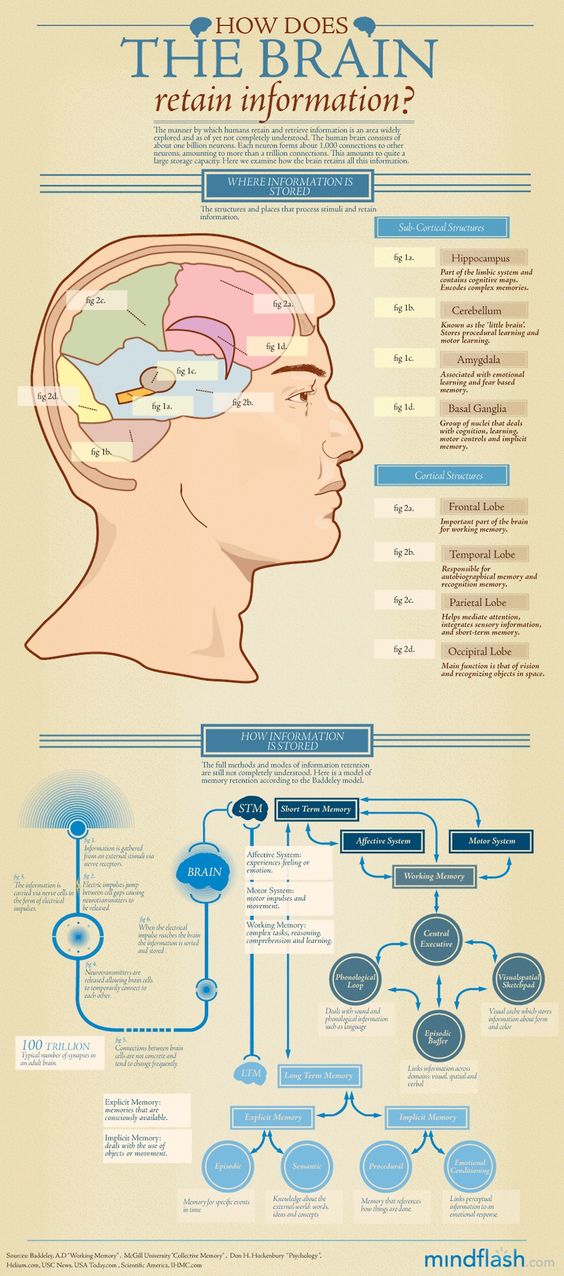
How The Brain Learns (Infographic)
You Can Grow New Brain Cells. Here’s How
Can we, as adults, grow new neurons? Neuroscientist Sandrine Thuret says that we can, and she offers research and practical advice on how we can help our brains better perform neurogenesis—improving mood, increasing memory formation and preventing the decline associated with ageing along the way.
Weekly Neuroscience Update

Consciousness seems to work as continuous stream: one image or sound or smell or touch smoothly follows the other, providing us with a continuous image of the world around us. Image adapted from the EPFL press release.
Scientists propose a new way of understanding of how the brain processes unconscious information into our consciousness. According to the model, consciousness arises only in time intervals of up to 400 milliseconds, with gaps of unconsciousness in between.
A new study finds bursts of neural activity as the brain holds information in mind, overturns a long-held model.
Why do we sometimes decide to take risks and other times choose to play it safe? In a new study, researchers explored the neural mechanisms of one possible explanation: a contagion effect.
Using imagery is an effective way to improve memory and decrease certain types of false memories.
Scientists have developed an imaging process that for the first time, they say, can identify and track the progression of Alzheimer’s disease in people’s brains, even when there are no symptoms — a development that could lead to earlier diagnosis and treatment.
People prone to seeking stimulation and acting impulsively may have differences in the structure of their brains according to a study published in the Journal of Neuroscience. What’s more, those differences may predispose them to substance abuse.
In a recent study, researchers found evidence of a compromised dopamine system in heavy users of marijuana. Lower dopamine release was found in the striatum – a region of the brain that is involved in working memory, impulsive behavior, and attention. Previous studies have shown that addiction to other drugs of abuse, such as cocaine and heroin, have similar effects on dopamine release, but such evidence for cannabis was missing until now.
Finally this week an innovative collaboration between neuroscientists and developmental psychologists that investigated how infants’ brains process other people’s action provides the first evidence that directly links neural responses from the motor system to overt social behaviour in infants.
Weekly Neuroscience Update

Dr. William Jagust explains how tau and beta amyloid, two proteins associated with Alzheimer’s disease, develop in the aging brain, which his research team has visualized using positron emission tomography, or PET, scans. Photo by Stephen McNally/University of California Berkeley
Researchers have visualized the development of Alzheimer’s disease in the brain in living people using positron emission tomography, or PET scans, which they say will aid with its diagnosis and treatment.
Researchers have also identified a drug that targets the first step in the toxic chain reaction leading to the death of brain cells, suggesting that treatments could be developed to protect against Alzheimer’s disease, in a similar way to how statins are able to reduce the risk of developing heart disease.
A new study shows that a variety of physical activities from walking to gardening and dancing can improve brain volume and cut the risk of Alzheimer’s disease by 50%.
In another study jointly led by King’s College London and the University of Southampton has found a link between gum disease and greater rates of cognitive decline in people with early stages of Alzheimer’s Disease.
Women may have a better memory for words than men despite evidence of similar levels of shrinkage in areas of the brain that show the earliest signs of Alzheimer’s disease, according to a study published in Neurology.
Refugees face a substantially higher risk of psychotic disorders, including schizophrenia, compared to non-refugee migrants from the same regions of origin, finds a study published in The BMJ.
Research on decision-making bias found that interactive training exercises using video games improved participants’ general decision-making abilities when used alongside other traditional training methods.
Reducing a person’s calorie intake can protect against the development of neurodegenerative diseases such as Parkinson’s Disease. Meanwhile, researchers may be closer to unraveling the underlying causes of Parkinson’s disease, after identifying the point at which alpha-synuclein – a protein believed to play a key role in the condition – becomes toxic to the brain.
Scientists have developed a 3D micro-scaffold technology that promotes reprogramming of stem cells into neurons, and supports growth of neuronal connections capable of transmitting electrical signals.
Finally this week, researchers in Japan have found that repetitive movements in slow-learning stages can alter an area of the brain responsible for movement, and help individuals retain these motor skills.
Inside The Brain Of A Drummer (Video)
Weekly Neuroscience Update
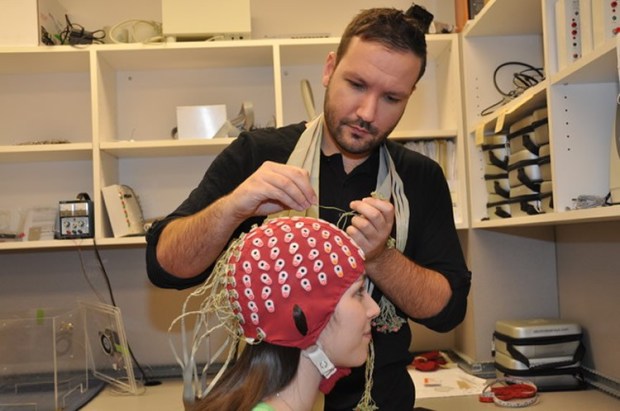
John Gaspar, an SFU psychology doctoral student, places 128 electrodes into a cap. The electrodes will pick up tiny changes in the wearer’s brain activity. Image is adapted from the SFU press release.
A new study has found that differences in an individual’s working memory capacity correlate with the brain’s ability to actively ignore distraction.
A research team has connected neurons using ultrashort laser pulses. With their study, which was published in Scientific Reports, the team became the first ever to find a way to bond neurons.
Physicians and biomedical engineers from Johns Hopkins report what they believe is the first successful effort to wiggle fingers individually and independently of each other using a mind-controlled artificial “arm” to control the movement.
Researchers have identified a gene which can be used to predict how susceptible a young person is to the mind-altering effects of smoking cannabis.
Young adults with hostile attitudes or those who don’t cope well with stress may be at increased risk for experiencing memory and thinking problems decades later, according to a study published in the March 2, 2016, online issue of Neurology.
Researchers have found how lactate, a waste product of glucose metabolism can protect neurons from damage following acute trauma such as stroke or spinal cord injury.
Neuroscientists have discovered a specific enzyme that plays a critical role in spinal muscular atrophy, and that suppressing this enzyme’s activity, could markedly reduce the disease’s severity and improve patients’ lifestyles.
Birds that migrate the greatest distances have more new neurons in the regions of the brain responsible for navigation and spatial orientation, suggests a new paper published in Scientific Reports.
Scientists have now described the engineering of a bright red fluorescent protein-based voltage indicator, providing pathways to understanding complex neurological disorders.
Children with autism and other similar conditions often have difficulties in several areas of communication. A new doctoral thesis in linguistics from the University of Gothenburg shows that these children can develop speech, gestures and a sense of rhythm and melody by listening to various speech sounds.
Finally this week, new research suggests that small numbers are processed in the right side of the brain, while large numbers are processed in the left side of the brain.
 inside-the-brain.com