Weekly Neuroscience Update

Two new research studies have identified the neural signals underlying music imagery. These neural signals are related to melodic expectations and predictions.

Short naps of up to 60 minutes in duration do not mitigate the effects of a night of sleep deprivation, a new study reports. However, the amount of slow-wave sleep achieved during a nap was related to reduced impairments associated with sleep deprivation.

30% of people reported changes in cognition, memory, and problems with information processing as a result of social isolation caused by pandemic lockdowns.

Some proteins in cells can separate into small droplets like oil droplets in water, but faults in this process may underlie neurodegenerative diseases in the brains of older people. Now, Rutgers researchers have developed a new method to quantify protein droplets involved in these diseases.

A new study reveals how dopamine may have a central role in maintaining our consciousness.

It’s long been known that opioid overdose deaths are caused by disrupted breathing, but the actual mechanism by which these drugs suppress respiration was not understood. Now, a new study by Salk scientists has identified a group of neurons in the brainstem that plays a key role in this process.

A new advanced imaging technique shows how cholesterol regulates the production of Alzheimer’s associated amyloid beta proteins in astrocytes.

A recent experimental study shows how regular physical exercise modulates iron metabolism in both the brain and the muscles. The findings also help to better understand the benefits of exercise in Alzheimer’s disease.

A new AI model can accurately classify a brain tumor of one of six common cancer types from a single MRI brain scan image.

A tiny region in the middle of the brain plays a far more important role than previously known in helping it respond to changes in the environment, a new study shows.

The brain’s white matter pathway organization during the first year of life may predict language acquisition and development at age five, researchers say.

Finally this week, mindfulness may provide modest benefits to cognition, particularly among older adults, finds a new review of evidence.

Weekly Neuroscience Update

When perceiving rhythm, the brain makes two separate decisions based on grouping and prominence. The groupings mutually inform each other to generate an overall rhythmic perception.

Face pareidolia, a phenomenon where the brain is tricked into seeing human faces in inanimate objects, may occur as a result of the brain processing the perceived facial expression in the same sequential way it perceives a human face. Neuroscientists at the University of Sydney now say how our brains identify and analyse real human faces is conducted by the same cognitive processes that identify illusory faces.

Researchers have identified a novel population of neurons in the temporal pole that links facial perception to long-term memory.

Adults with ADHD are at higher risk of a wide range of physical conditions, including nervous system, respiratory, musculoskeletal, and metabolic diseases, according to a large register-based study from Karolinska Institutet published in The Lancet Psychiatry.

A new study reveals very young infants can perceive objects that older infants, children, and adults can not see due to a phenomenon called visual backward masking.

Infant boys with a gut bacterial composition high in Bacteroidetes were found in a new study to have more advanced cognitive and language skills one year later compared to boys with lower levels of the bacteria. The finding was specific to male children.

Brain cells snap DNA in more places and in more cell types than previously realized in order to express genes for learning and memory.

Researchers have found that a component derived from turmeric essential oil, aromatic turmerone (ar-turmerone), and its derivatives act directly on dopaminergic nerves to create a neuroprotective effect on tissue cultures of a Parkinson’s disease model.

New research shows daydreaming and mind-wandering appear to occur when parts of the brain fall asleep while other areas remain awake.

Finally this week, a diet rich in fermented foods enhances the diversity of gut microbes and decreases molecular signs of inflammation, according to researchers at the Stanford School of Medicine.

Weekly Neuroscience Update

Children who are physically active have higher cognitive function and increased functional connectivity in the brain later in life than those who are less active, a new study reports.

Canadian researchers have built and validated an online calculator that empowers individuals 55 and over to better understand the health of their brain and how they can reduce their risk of being diagnosed with dementia in the next five years. Their process was published today in the Journal of Epidemiology and Community Health, and the calculator is available at projectbiglife.ca.

Researchers studying prions–misfolded proteins that cause lethal incurable diseases–have identified for the first time surface features of human prions responsible for their replication in the brain.

Middle-aged people with depressive symptoms who carry a genetic variation called apolipoprotein (APOE) ε4 may be more at risk to develop tau protein accumulations in the brain’s emotion- and memory-controlling regions, a new study suggests.

Frequent strenuous exercise increases the risk of developing motor neuron disease (MND)/ALS in certain people, new research has found.

Combining brain scans with AI technology, researchers were able to accurately predict the likelihood of a person developing schizophrenia in those with a family history of the psychiatric disorder.

A new study reveals very young infants can perceive objects that older infants, children, and adults can not see due to a phenomenon called visual backward masking.

Subtle changes in fractal motor activity regulation in cognitively healthy women may be a sign of preclinical Alzheimer’s disease, researchers report.

Deep brain stimulation appears to be safe, effective, and provides symptom improvements for at least one year in patients with treatment-resistant schizophrenia.

New research details the interplay between proteins involved in controlling the body’s stress response and points to potential therapeutic targets when this response goes awry.

A new research paper published in the American Journal of Clinical Nutrition last week showed that a low Omega-3 Index is just as powerful in predicting early death as smoking.

Finally this week, a new study sheds light on how migraines may occur and why those who are susceptible to migraines see improvements in symptoms as they age.

Weekly Neuroscience Update

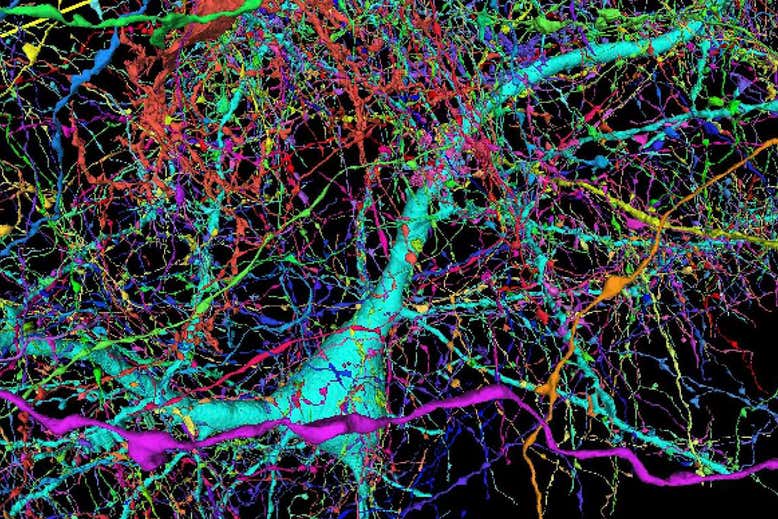
Around 4000 nerve fibres connect to this single neuron
Google/Lichtman Laboratory

Google has helped create the most detailed map yet of the connections within the human brain. It reveals a staggering amount of detail, including patterns of connections between neurons, as well as what may be a new kind of neuron.

Researchers have identified three biomarkers in blood samples that confirm the link between exercise and improved cognitive function in older adults.

A new study reveals what goes on in the brain when a person embarks on a musical collaboration project.

Chronic inflammation in the gut may propel processes in the body that give rise to Parkinson’s disease, according to new research.

The largest study of its kind has unveiled new insights into how genes are regulated in dementia, including discovering 84 new genes linked to the disease.

A new study shows that a deep neural network model can accurately predict the brain age of healthy patients based on electroencephalogram data recorded during an overnight sleep study, and EEG-predicted brain age indices display unique characteristics within populations with different diseases.

Finally this week, scientists have identified an area of the brain that drives cravings for protein-rich food.

Weekly Neuroscience Update


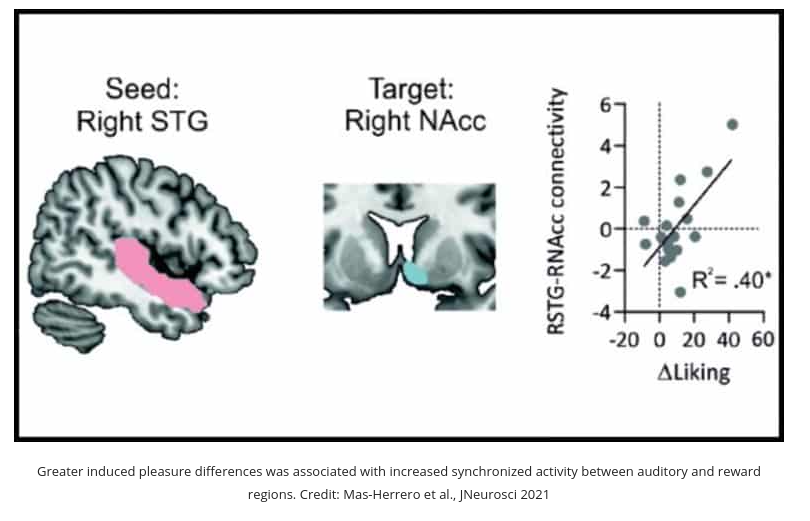
Communication between the brain’s auditory and reward circuits is the reason why humans find music rewarding, according to new research published in Journal of Neuroscience.

Multilingual people have trained their brains to learn languages, making it easier to acquire more new languages after mastering a second or third. In addition to demystifying the seemingly herculean genius of multilinguals, researchers say these results provide some of the first neuroscientific evidence that language skills are additive, a theory known as the cumulative-enhancement model of language acquisition.

A new whole-genome sequencing study has revealed thirteen novel genes associated with Alzheimer’s disease. Researchers also found a new link between Alzheimer’s and synaptic function.

For people with Parkinson’s disease, problems with thinking and memory skills are among the most common nonmotor symptoms of the disease. A new study shows that exercise may help slow cognitive decline for some people with the disease.

Computer scientists have created a ground-breaking model that could improve our understanding of developmental disorders such as autism.

Researchers have succeeded for the first time in measuring brain waves directly via a cochlear implant. These brainwaves indicate in an objective way how good or bad a person’s hearing is. The research results are important for the further development of smart hearing aids.

New research suggests that chronic viral infections have a profound and lasting impact on the human immune system in ways that are similar to those seen during aging.

A study of Japanese university students and recent graduates has revealed that writing on physical paper can lead to more brain activity when remembering the information an hour later. Researchers say that the unique, complex, spatial and tactile information associated with writing by hand on physical paper is likely what leads to improved memory.

Finally this week, a new study confirms that the processing of visual information is altered in depressed people, a phenomenon most likely linked with the processing of information in the cerebral cortex.


Weekly Neuroscience Update

Researchers have developed a new method of measuring axons using MRI neuroimaging.

People with autism spectrum disorder (ASD) appear to suffer malfunctions in a cell that produces a special coating around nerve fibers that facilitates efficient electrical communication across the brain. 

New findings about dopaminergic neurons in the striatum could have implications for treating Parkinson’s disease and Tourette syndrome.

Researchers have found that it is possible to assess a person’s ability to feel empathy by studying their brain activity while they are resting rather than while they are engaged in specific tasks.

Boys who exhibit inattention-hyperactivity by age 10 have an increased risk for traumatic brain injury later in life.

Combining fMRI and behavioral data, researchers examined gender identity in cisgender and transgender individuals using a new machine learning algorithm. The AI identified at least nine dimensions of brain-gender variation.

New research has provided insights into why people often make unrealistic plans that are doomed to fail.

Finally this week, a new study has found that dopamine — a neurotransmitter that plays an important role in our cognitive, emotional, and behavioral functioning — plays a direct role in the reward experience induced by music. The findings have been published in the Proceedings of the National Academy of Sciences.

Weekly Neuroscience Update

Is music really a “universal language”? Two articles in Science support the idea that music all around the globe shares important commonalities, despite many differences.

Researchers studying six adults who had one of their brain hemispheres removed during childhood to reduce epileptic seizures found that the remaining half of the brain formed unusually strong connections between different functional brain networks, which potentially help the body to function as if the brain were intact. 

Excessive exposure to certain antibiotics can predispose a person to Parkinson’s disease, with a delay of onset of up to 15 years.

Findings debunk the common theory that attention is the only cognitive function affected by sleep deprivation. Lack of sleep also hinders a person’s ability to complete activities that require following multiple steps.

A new study reveals how the insular cortex helps assess and predict physiological states of the body. The findings shed light on the neural basis for interoception.

Finally this week, neuroscientists have discovered how the listening brain scans speech to break it down into syllables. The findings provide for the first time a neural basis for the fundamental atoms of language and insights into our perception of the rhythmic poetry of speech. 

Weekly Neuroscience Update

associated-memory-learning-neurosciencenews.jpg

Oxford University researchers have discovered that learned knowledge is stored in different brain circuits depending on how we acquire it.

Neuroscientists say they have identified how people can have a “crash in visual processing” — a bottleneck of feedforward and feedback signals that can cause us not to be consciously aware of stimuli that our brain recognized.

A new study shows that an innovative strategy for treating Parkinson’s disease has proven successful in neurons that derive from people living with the condition.

A new study reveals the gut has a much more direct connection to the brain through a neural circuit that allows it to transmit signals in mere seconds. The findings could lead to new treatments for obesity, eating disorders, and even depression and autism—all of which have been linked to a malfunctioning gut.

New research shows musical improvisation improves cognitive flexibility and increases inhibitory control.

A UCLA-led study has found that MRI scans can help doctors distinguish whether a person’s memory loss is being caused by Alzheimer’s disease or by traumatic brain injury.

A new study suggests a longer duration of estrogen exposure hormone therapy was associated with better cognition in older adult women.

Weekly Neuroscience Update

synesthesia-enhanced-learning-neuroscienews.jpg

The image is adapted from the University of Toronto news release.

An experiment led by University of Toronto psychologists has shown for the first time that grapheme-colour synesthesia  –   a condition in which individuals sense colours associated with letters and numbers – provides a clear advantage in statistical learning – an ability to discern patterns – which is a critical aspect of learning a language. The result provides insight into how we learn, and how children and adults may learn differently.

Scientists might have found an early detection method for some forms of dementia.

Neuroimaging helps researchers observe what happens in the brain as a person is rotated. The study, which gives insight into how the brain moves after the head stops moving, also provides critical information for advancing studies of TBI.

Esketamine combined with antidepressants acts rapidly to help alleviate symptoms in those with treatment-resistant depression.

Inflammation appears to reduce reward response in females. Reduced activity in the brain’s reward system is a key component of anhedonia, the loss of enjoyment in activities, a core feature of depression. The findings may explain why depression is more prevalent in women than in men.

A new study has found that a new nerve stimulation therapy to increase blood flow could help patients with the most common type of stroke up to 24 hours after onset.

The results of a new study suggest that virtual reality could make life easier for people with dementia. The authors conclude that virtual reality helped the participants recall memories and contributed to an improvement in patients’ relationships with caregivers.

Researchers have identified average levels of biological and anatomical brain changes with Alzheimer’s disease over 30 years before symptoms appear.

Magnetic stimulation of the brain improves working memory, offering a new potential avenue of therapy for individuals living with Alzheimer’s disease and other forms of dementia, according to new research.

Sleep in teenagers can be improved by just one week of limiting their evening exposure to light-emitting screens on phones, tablets and computers,

Finally this week, using Magnetic Resonance Imaging (MRI), scientists have captured 3D images that show how infants’ brains and skulls change shape as they move through the birth canal just before delivery.


Weekly Neuroscience Update

D56BDDNUwAAxsUD.jpg

Music and mindful music listening may help people who have suffered strokes recover their impaired cognitive abilities more effectively, new research suggests.

The loss of memory and cognitive function known to afflict survivors of septic shock is the result of a sugar that is released into the bloodstream and enters the brain during the life-threatening condition. This finding, published in the Proceedings of the National Academy of Sciences, explains the premature mental aging that follows septic shock and may shed light on memory loss in other diseases.

Researchers have identified a new autoimmune disease that causes muscle pain and weakness.

Scientists used brain signals recorded from epilepsy patients to program a computer to mimic natural speech–an advancement that could one day have a profound effect on the ability of certain patients to communicate.

Scientists have created a “neural decoder” that translates brain activity into speech.

Autism diagnosis becomes stable starting at 14 months of age, researchers report. The accurate diagnosis of ASD, four months earlier than previously believed, leads to more opportunities for early interventions.

A new two-tier diagnostic blood test which evaluates both amyloid beta and tau, can help detect Alzheimer’s disease in presymptomatic patients.

Researchers are officially defining a new brain disorder that mimics Alzheimer’s disease. The disorder will be known as LATE, which stands for limbic-predominant age-related TDP-43 encephalopathy.

Finally this week, a new deep learning algorithm can reliably determine what visual stimuli neurons in the visual cortex respond best to.