Weekly Neuroscience Update

Researchers have found that neurons in a specific region of the frontal cortex, called the anterior cingulate cortex, become active during decisions involving competitive effort.

In a major breakthrough, an international team of scientists has proven that addiction to morphine and heroin can be blocked, while at the same time increasing pain relief.

Researchers have shown that activity in a certain region of the brain changes as children learn to reason about what other people might be thinking.

The human brain contains billions of neurons that are arranged in complex circuits, which enable people to function with regard to controlling movements, perceiving the world and making decisions. In order to understand how the brain works and what malfunctions occur in neurological disorders it is crucial to decipher these brain circuits. A new study, which is featured in the August 9 edition of Nature reveals that MIT neuroscientists have now come closer towards this goal, by discovering that two major classes of brain cells repress neural activity in specific mathematical ways by which one type subtracting from overall activation, whilst the other type divides it.

That fact that heavy drinking impacts the brain of developing youths is a well-known fact. However, now researchers from the University of California, San Diego School of Medicine and VA San Diego Healthcare System have discovered that certain patterns of brain activity could also help to predict which youths are at risk of becoming problem drinkers. The study is featured online in the August edition of the Journal of Studies on Alcohol and Drugs. The study involved functional magnetic resonance imaging (fMRI) of 12 to 16 year old teenagers’ brains before they started drinking and who had an fMRI three years later. About half of the teenagers started drinking heavily over the 3-year period but the researchers noted that the fMRI scans taken before these group of teenagers started drinking, they already showed less fMRI response in areas of the brain that were associated earlier with heavy drinking.

Major depression or chronic stress can cause the loss of brain volume, a condition that contributes to both emotional and cognitive impairment. Now a team of researchers led by Yale scientists has discovered one reason why this occurs — a single genetic switch that triggers loss of brain connections in humans and depression in animal models.

Neuroscientists from The Scripps Institute have identified a specialized population of stem cells that have an impressive vocational calling: higher brain functioning. It’s an important finding that holds promise for the treatments of serious cognitive disorders — including those that impact on conscious function. And it also reveals how humans and other mammals are able to have such big brains.

Neuroscientists have discovered that the universal saying of “living in the moment” may be impossible. A study published in the journal Neuron reveals that neuroscientists have identified an area in the brain, which is responsible for using past decisions and outcomes to guide future behavior. The study is the first of its kind to analyze signals linked to metacognition, known as a person’s ability to monitor and control cognition, which researchers describe as “thinking about thinking.”

Weekly Neuroscience Update

Research from the University of Southampton, which examines how dolphins might process their sonar signals, could provide a new system for man-made sonar to detect targets, such as sea mines, in bubbly water.

Evidence is mounting that exercise provides some protection from memory loss and Alzheimer’s disease, with three new studies showing that a variety of physical activities are associated with healthier brains in older adults.

Researchers  have discovered an important clue to how the human brain —important clue to how the human brain — which is constantly bombarded with millions of pieces of visual information, can filter out what’s unimportant and focus on what’s most useful.

Scientists at the California Institute of Technology (Caltech) pioneered the study of the link between irregularities in the immune system and neurodevelopmental disorders such as autism a decade ago. Since then, studies of postmortem brains and of individuals with autism, as well as epidemiological studies, have supported the correlation between alterations in the immune system and autism spectrum disorder.

Researchers at Aalto University in Finland have developed the world’s first device designed for mapping the human brain that combines whole-head magnetoencephalography (MEG) and magnetic resonance imaging (MRI) technology. MEG measures the electrical function and MRI visualizes the structure of the brain. The merging of these two technologies will produce unprecedented accuracy in locating brain electrical activity non-invasively. 

Cognition psychologists have discovered why stressed persons are more likely to lapse back into habits than to behave goal-directed. The researchers have now reported in the Journal of Neuroscience that the interaction of the stress hormones hydrocortisone and noradrenaline shut down the activity of brain regions for goal-directed behaviour. The brain regions responsible for habitual behaviour remained unaffected.

Raising levels of the neurotransmitter dopamine in the frontal cortex of the brain significantly decreased impulsivity in healthy adults, in a study conducted by researchers at the Ernest Gallo Clinic and Research Center at the University of California, San Francisco

What Stephen Covey taught us about the neuroscience of focus

I was saddened to hear of the death of Stephen Covey yesterday. He was a truly inspirational figure who studied human behaviour and drew up a set of simple instructions for human happiness – The 7 Habits of Highly Effective People.

One of these habits was –‘The main thing is to keep the main thing the main thing.’

Covey proposed that happiness in life depends not only in having a focus or goal (i.e. the main thing) but in having the discipline to stay focused on that goal (i.e. keeping the main thing the main thing). He contended that one reason why people fail to achieve their full potential was in not staying focused on that goal.

Where in the brain do we create focus and how can we strengthen it?

There are two types of focused attention in two separate regions of the brain. The prefrontal lobes are in charge of goal setting and willful concentration; if you are studying for a test or writing a novel, the impetus and the orders come from there. But if there is a sudden, riveting event – the attack of a tiger or the scream of a child – it is the parietal lobes behind each ear that are activated. Neuroscientists have learned that these two brain regions sustain concentration when neurons emit pulses of electricity at specific rates – faster frequencies for the automatic processing of the parietal cortex, slower frequencies for the deliberate, intentional work of the prefrontal.

Furthermore, studies of seasoned meditators – Tibetan Buddhist monks show that regular meditation – i.e. paying attention on purpose – generates brain wave patterns which synchronise neuronal firing in both the frontal and parietal lobes – a phenomenon which is thought to underlie the sustained concentration involved in focused attention i.e. in keeping the main thing the main thing.  In fact, the ability of mediation to strengthen the connection between these two key brain regions involved in sustained concentration explains the ability of seasoned meditators to stay calm and focused.

These finding on attention in the brain may also radically alter our understanding of attention disorders and provide new opportunities to learn how brains pay attention in real world settings and acquire healthy habits to stay focused and prevent distraction.

Inside the Brains of Bieber Fans

[image]

The symptoms include uncontrollable screaming, swooning and spending hours on Twitter and Facebook . It primarily affects preteen and teen girls, yet it is highly contagious and can infect mothers, too.

These are the opening lines of a recent Wall Street Journal article investigating the neuroscience of  “fan mania” – in this case ” “Bieber Fever”, which according to the article is approaching a global pandemic with the release of the 18-year-old pop star,  Justin Bieber’s latest album, “Believe”.

Compared with past outbreaks of fan mania, scientists now have a better understanding of why teens—girls in particular—become so passionate about some musicians, and what looks like mass hysteria is a harmless stage in adolescent development.

Hearing familiar, favorite music stimulates the release of dopamine, the neurotransmitter involved in pleasure and addiction, providing the same rush as eating chocolate or that winning does for a compulsive gambler, says neuroscientist Daniel Levitin,  author of This Is Your Brain on Music, who was a record producer before turning to neuroscience.

Dr. Levitin’s research also showed that musical tastes formed in the teen years become part of the brain’s internal wiring, as that is the time when some neural pathways are solidifying and others are being pruned away. That’s why the music adults tend to be nostalgic for is the music from their teenage years.

Weekly Neuroscience Update

Scientists have discovered that older honey bees effectively reverse brain aging when they take on nest responsibilities typically handled by much younger bees. While current research on human age-related dementia focuses on potential new drug treatments, researchers say these findings suggest that social interventions may be used to slow or treat age-related dementia.

Although many areas of the human brain are devoted to social tasks like detecting another person nearby, a new study has found that one small region carries information only for decisions during social interactions. Specifically, the area is active when we encounter a worthy opponent and decide whether to deceive them.

Scientists tracked brain activity in 40 people with new back injuries and found a pattern of activity that could predict — with 85% accuracy — which patients were destined to develop chronic pain and which weren’t.

Scientists have discovered a mechanism which stops the process of forgetting anxiety after a stress event. In experiments they showed that feelings of anxiety don’t subside if too little dynorphin is released into the brain. The results can help open up new paths in the treatment of trauma patients.

Research published in Neuron reveals that underdevelopment of an impulse control center in the brain is, at least in part, the reason children who fully understand the concept of fairness fail to act accordingly.

Researchers are developing a robotic system with ability to predict the specific action or movement that they should perform when handling an object.

The widely used diabetes drug metformin comes with a rather unexpected and  side effect: it encourages the growth of new neurons in the brain.

Researchers have long been interested in discovering the ways that human brains represent thoughts through a complex interplay of electrical signals. Recent improvements in brain recording and statistical methods have given researchers unprecedented insight into the physical processes under-lying thoughts. For example, researchers have begun to show that it is possible to use brain recordings to reconstruct aspects of an image or movie clip someone is viewing, a sound someone is hearing or even the text someone is reading.

A new brain scanner has been developed to help people who are completely paralysed speak by enabling them to spell words using their thoughts.

Weekly Neuroscience Update

Visual and auditory stimuli that elicit high levels of engagement and emotional response can be linked to reliable patterns of brain activity, a team of researchers reports. Their findings could lead to new ways for producers of films, television programs and commercials to predict what kinds of scenes their audiences will respond to.

Implants that deliver pulses of light into the brain could lead to new treatments for diseases such as epilepsy and Alzheimer’s Disease.

Post traumatic stress disorder (PTSD) is a severe type of anxiety disorder that can occur after an individual experiences a traumatic event. However, at present, doctors are unable to predict who will develop these disorders. Now, a new study seeks to identify individuals who are more susceptible to long-standing disorders if exposed to a traumatic event.

Researchers have discovered how a part of the brain helps predict future events from past experiences. The work sheds light on the function of the front-most part of the frontal lobe, known as the frontopolar cortex, an area of the cortex uniquely well developed in humans in comparison with apes and other primates.

Fish cannot display symptoms of autism, schizophrenia or other human brain disorders. However, a team of MIT biologists has shown that zebrafish can be a useful tool for studying the genes that contribute to such disorders.

Johns Hopkins researchers say they have discovered one of the most important cellular mechanisms driving the growth and progression of meningioma, the most common form of brain and spinal cord tumor. A report on the discovery, published in the journal Molecular Cancer Research, could lead the way to the discovery of better drugs to attack these crippling tumors, the scientists say.

Researchers have furthered understanding of the mechanism by which the cells that insulate the nerve cells in the peripheral nervous system, Schwann cells, protect and repair damage caused by trauma and disease.

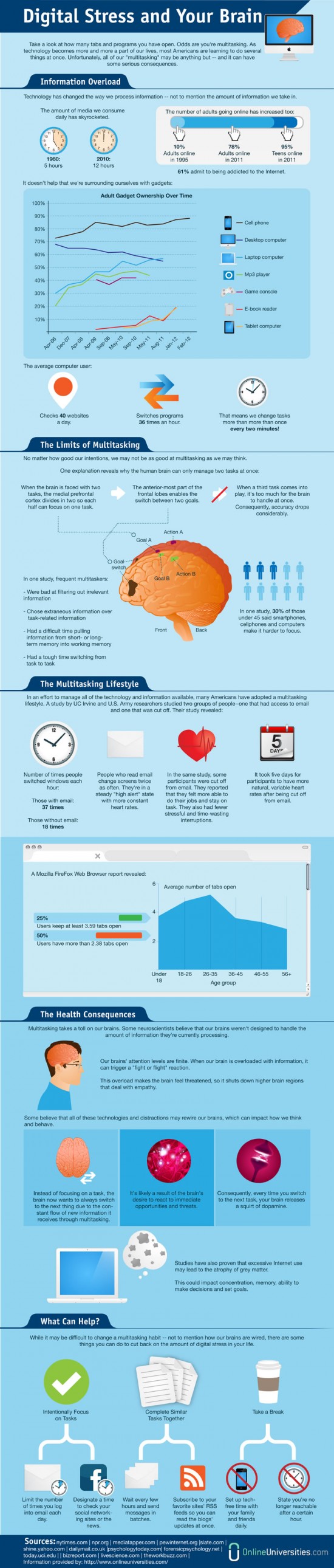
How does the brain multitask?

Dr Adam Gazzaly,  director of the Neuroscience Imaging Center at the University of California, San Francisco, answers the question of how the brain multitasks on the brainfacts.org website:

Multitasking is an attempt to engage in more than one goal at the same time. When two tasks demand competing attention, there is generally a switching that occurs between the neural processes involved, rather than concurrent processing as may be expected with true multitasking. Of note, recent research suggests that it may be possible for the brain to split two demanding tasks.

The prefrontal cortex has been frequently implicated as a brain region that mediates multitasking and the switching processes. Multitasking is commonly shown to impair cognitive performance, as each switch results in a reduction in performance compared to doing one task at a time. However, there is growing evidence that the ability to multitask can be trained with repetitive and adaptive practice. Multitasking abilities have been observed to decline as we age.

Why my ultimate exam tip is an exam sip!

As the Junior and Leaving Certificate exams kick off today, I want to wish you all good luck and to remind you not to forget to bring a bottle of water with you into your exams!

It’s that time of the year again when the two big state exams – junior and leaving certificates kick off for a generation of Irish youths.  The leaving cert is the hardest exam I’ve ever had to sit  – throughout my years as a student in University, and afterwards working in a laboratory as a neuroscientist, nothing really compared to the intensity of that exam.  

Drink water to improve your grade!

Scientists from the University of East London report that bringing a bottle of water with you into your exam boosts your grade. Students who brought water with them did better in the exam than those without water.  The researchers accounted for the 447 undergraduate students’ prior grades, so it’s not just a matter of smarter students being more likely to bring a bottle of water into the exam.

Drinking water makes you smarter

Controlling for ability from previous coursework results, scientists found those who drank water during the exam scored an average of 5% higher than those who did without.

The ultimate exam tip – is an exam sip!

Scientists explain that there may be a few reasons for this link between bringing water (and presumably drinking it) and better grades:

  1. Previous studies have shown that a dehydration level of just 1% of your body weight reduces your thinking functions, so it makes sense that drinking water improves mental performance.
  2. The desire to drink water (thirst) is driven by a small protein (a peptide) called vasopressin in the brain. Vasopressin has also been implicated in making new memories and with the positive feelings associated with social behaviour thereby leading to a better performance by reducing anxiety in an exam situation,
  3. By offering a momentary distraction – taking a sip of water – drinking water may also break a chain of thoughts and free the mind to focus on the task at hand, leading to better performance – thereby reducing anxiety during the exam.
  4. Drinking water might also just activate a placebo affect – if you believe water boosts your brain power, that belief alone could improve your performance.

The research continues – either way, don’t forget that bottle of water on your next exam.

References 

Lim MM, Young LJ (2004). “Vasopressin-dependent neural circuits underlying pair bond formation in the monogamous prairie vole”. Neuroscience 125 (1): 35–45.