In 1845, an iron rod pierced railroad construction foreman Phineas Gage’s brain, changing neuroscience forever. Now, more than 150 years later, neuroscientists have created a diagram of Gage’s brain, figuring out just which connections were changed by his accident.
Category: Brain Research
Your Weekly Neuroscience Update

Laughter with friends releases the brain's "feel-good" chemicals, and helps reduce pain
Laughing with friends releases feel-good brain chemicals, which also relieve pain, new research indicates.
Millions of tinnitus sufferers could get relief thanks to a new treatment which stops the brain creating “phantom” noises by playing matching tones over headphones
Earlier evidence out of UCLA suggested that meditating for years thickens the brain (in a good way) and strengthens the connections between brain cells. Now a further report by UCLA researchers suggests yet another benefit. have found that long-term meditators have larger amounts of gyrification (“folding” of the cortex, which may allow the brain to process information faster) than people who do not meditate. Further, a direct correlation was found between the amount of gyrification and the number of meditation years, possibly providing further proof of the brain’s neuroplasticity, or ability to adapt to environmental changes.
Brain scans of Nasa astronauts who have returned to earth after more than a month in space have revealed potentially serious abnormalities that could jeopardise long-term space missions.
Weekly Neuroscience Update
 A new study reveals for the first time that activating the brain’s visual cortex with a small amount of electrical stimulation actually improves our sense of smell. The finding revises our understanding of the complex biology of the senses in the brain.
By training birds to ‘get rhythm’, scientists uncover evidence that our capacity to move in time with music may be connected with our ability to learn speech.
Daily doses of a drug used to treat Parkinson’s disease significantly improved function in severely brain-injured people thought to be beyond the reach of treatment. Scientists have reported on the first rigorous evidence to date that any therapy reliably helps such patients.
Remembering where we left our keys requires at least three different regions of the brain to work together, a study published in the Journal of Neuroscience says.
If you’re a left brain thinker, chances are you use your right hand to hold your cell phone up to your right ear, according to a new study from Henry Ford Hospital in Detroit.
People who experience a traumatic brain injury show a marked decline in the ability to make appropriate financial decisions in the immediate aftermath and a continued impairment on complex financial skills six months later, according to new research from the University of Alabama at Birmingham.
For the first time, a team led by Carnegie Mellon University neuroscientists has identified how different neural regions communicate to determine what to visually pay attention to and what to ignore. This finding is a major discovery for visual cognition and will guide future research into visual and attention deficit disorders.
Finally this week, Ireland’s neurological charities have come together to launch a new patient information and services website in time for National Brain Awareness Week which takes place next week (05 – 11 March).
Neuroscience News

Is Angry Birds keeping your brain healthy?
A new study from the Archives of Neurology says playing brain stimulating games can improve your memory and delay or prevent the onset of Alzheimer’s disease.
A new study suggests hearing metaphors can activate brain regions involved in sensory experience.
Whether you are an athlete, a musician or a stroke patient learning to walk again, practice can make perfect, but more practice may make you more efficient, according to a surprising new University of Colorado Boulder study.
Researchers have found a way to study how our brains assess the behavior – and likely future actions – of others during competitive social interactions. Their study, described in a paper in the Proceedings of the National Academy of Sciences, is the first to use a computational approach to tease out differing patterns of brain activity during these interactions, the researchers report.
A molecular path from our body’s internal clock to cells controlling rest and activity have been revealed.
A new study looks at how our brain processes visual information to prevent collisions.
Can Brain Scans of Young Children Predict Reading Problems? Brain scientists are studying whether they can predict which young children may struggle with reading, in order to provide early help.
Virtual therapists being developed to treat depression. Scientists at a U.S. university are developing new technologies to treat depression and other disorders — including a mood-detecting smart phone that will call to check up on you.
A new study shows how to boost the power of pain relief without drugs.
Neuroscience could change the face of warfare. Soldiers could have their minds plugged directly into weapons systems, undergo brain scans during recruitment and take courses of neural stimulation to boost their learning, if the armed forces embrace the latest developments in neuroscience to hone the performance of their troops
Brain activity differs when one plays against others. Researchers have found a way to study how our brains assess the behavior – and likely future actions – of others during competitive social interactions. Their study, described in a paper in the Proceedings of the National Academy of Sciences, is the first to use a computational approach to tease out differing patterns of brain activity during these interactions, the researchers report.
Reporting in PLoS Biology, researchers write that they were able to correlate words a person was hearing to specific electrical activity in the brain. Neuroscientist Robert Knight, a co-author of the study, discusses future applications of this research and concerns that it amounts to mental wiretapping.
Brains may be wired for addiction. Abnormalities in the brain may make some people more likely to become drug addicts, according to scientists at the University of Cambridge.
Patients’ Brains May Adapt to ADHD Medication. New research reveals how the brain appears to adapt to compensate for the effects of long-term ADHD medication, suggesting why ADHD medication is more effective short-term than it is long-term.
A two-year study of high school football players suggests that concussions are likely caused by many hits over time and not from a single blow to the head, as commonly believed.
Weekly Brain Research Update

Even for healthy people, stressful moments can take a toll on the brain, a new study from Yale University suggests.
Neuroscientists at the Johns Hopkins University School of Medicine have discovered how the sense of touch is wired in the skin and nervous system.
A new study of how the brain processes unexpected events found that neurons in two important structures handle both positive and negative surprises.
New research finds that brain activity increases during delusional thinking, a finding that may allow new interventions and retraining for people with the disorder.
A new UC Davis study shows how the brain reconfigures its connections to minimize distractions and take best advantage of our knowledge of situations.
Researchers from the Medical Research Council (MRC) in the UK have found a protein made by blood vessels in the brain that could be a good candidate for regenerative therapies that stimulate the brain to repair itself after injury or disease.
Drinking alcohol leads to the release of endorphins in areas of the brain that produce feelings of pleasure and reward, according to a study led by researchers at the Ernest Gallo Clinic and Research Center at the University of California, San Francisco
Typing with brain waves
Fascinating video from the Mayo Clinic on research into communicating via brain waves.
Weekly Round Up
 Welcome to the last weekly round-up of 2011. I have enjoyed putting this together each week and look forward to updating you with lots more new and exciting research in the field of neuroscience in the coming year.
New research has shown, for the first time, that the cortex, which is the largest zone of the brain and which is generally associated with high cognitive functions, is also a key zone for emotional learning.
When you experience a new event, your brain encodes a memory of it by altering the connections between neurons. This requires turning on many genes in those neurons. Now, MIT neuroscientists have identified what may be a master gene that controls this complex process.
A new technique for color-coding nerves involved in touch gives neuroscientists a much-needed tool for studying that mysterious sense.
When accidents that involve traumatic brain injuries occur, a speedy diagnosis followed by the proper treatment can mean the difference between life and death. A research team, led by Jason D. Riley in the Section on Analytical and Functional Biophotonics at the U.S. National Institutes of Health, has created a handheld device capable of quickly detecting brain injuries such as hematomas, which occur when blood vessels become damaged and blood seeps out into surrounding tissues where it can cause significant and dangerous swelling.
Shrinkage in certain parts of the brain may herald Alzheimer’s disease long before symptoms arise, according to new research.
At UCLA’s Laboratory of Integrative Neuroimaging Technology, researchers use functional MRI brain scans to observe brain signal changes that take place during mental activity. They then employ computerized machine learning (ML) methods to study these patterns and identify the cognitive state — or sometimes the thought process — of human subjects. The technique is called “brain reading” or “brain decoding.”
Compared to our other senses, scientists don’t know much about how our skin is wired for the sensation of touch. Now, research reported in the December 23rd issue of the journal Cell, a Cell Press publication, provides the first picture of how specialized neurons feel light touches.
Both children and the elderly have slower response times when they have to make quick decisions in some settings. But recent research suggests that much of that slower response is a conscious choice to emphasize accuracy over speed. In fact, healthy older people can be trained to respond faster in some decision-making tasks without hurting their accuracy – meaning their cognitive skills in this area aren’t so different from younger adults.
Scientists at the University of Cambridge have made a significant step in the development of a novel therapy that could one day help to slow down, or even halt, the damage caused by Parkinson’s disease, one of the most common neurodegenerative disorders.
Inside the brain of a buddhist monk

Dr Josipovic has scanned the brains of more than 20 experienced meditators during the study
Since 2008, Dr Zoran Josipovic, a research scientist and adjunct professor at New York University, has been placing the minds and bodies of prominent Buddhist figures into a five-tonne (5,000kg) functional magnetic resonance imaging (fMRI) machine. He says he has been peering into the brains of monks while they meditate in an attempt to understand how their brains reorganise themselves during the exercise.
“Meditation research, particularly in the last 10 years or so, has shown to be very promising because it points to an ability of the brain to change and optimise in a way we didn’t know previously was possible.”
Dr Josipovic’s research is part of a larger effort better to understand what scientists have dubbed the default network in the brain. He says the brain appears to be organised into two networks: the extrinsic network and the intrinsic, or default, network.
The extrinsic portion of the brain becomes active when individuals are focused on external tasks, like playing sports or pouring a cup of coffee. The default network churns when people reflect on matters that involve themselves and their emotions. But the networks are rarely fully active at the same time. And like a seesaw, when one rises, the other one dips down. This neural set-up allows individuals to concentrate more easily on one task at any given time, without being consumed by distractions like daydreaming.
“What we’re trying to do is basically track the changes in the networks in the brain as the person shifts between these modes of attention,” Dr Josipovic says.
Dr Josipovic has found that some Buddhist monks and other experienced meditators have the ability to keep both neural networks active at the same time during meditation – that is to say, they have found a way to lift both sides of the seesaw simultaneously. And Dr Josipovic believes this ability to churn both the internal and external networks in the brain concurrently may lead the monks to experience a harmonious feeling of oneness with their environment.
Read more on this story at BBC Health
How social and emotional learning can affect the brain
Neuroscientist Richard Davidson‘s research is focused on cortical and subcortical substrates of emotion and affective disorders, including depression and anxiety.
Using quantitative electrophysiology, positron emission tomography and functional magnetic resonance imaging to make inferences about patterns of regional brain function, his lab studies normal adults and young children, and those with, or at risk for, affective and anxiety disorders.
A major focus of his current work is on interactions between prefrontal cortex and the amygdala in the regulation of emotion in both normal subjects and patients with affective and anxiety disorders.
In this video Professor Davidson presents his research on how social and emotional learning can affect the brain.
Is the mind modular?
Mind – n. the human consciousness that originates in the brain and is manifested especially in thought, perception, emotion, will, memory, and imagination.
Architecture of the human mind
No robot can solve a crossword, or engage in a conversation, with anything like the facility the average human being can. Somehow or other we humans are capable of performing complex cognitive tasks with minimal effort. Trying to understand how this could be is the central explanatory problem of the discipline known as cognitive psychology. There is an old but ongoing debate among cognitive psychologists concerning the architecture of the human mind.
The ‘general-purpose problem-solver’ mind
According to one view the human mind is a’ general-purpose problem-solver’. This means that the mind contains a general set of problem-solving skills or ‘general intelligence’ which it applies to an infinitely large number of different tasks. So the same set of cognitive capacities is employed, whether you are trying to count marbles, deciding what movie to see, or learning a foreign language – these tasks represent different applications of the human’s general intelligence.
The modular mind
A rival view argues that the human mind contains a number of subsystems or modules – each of which is designed to perform a very limited number of tasks and cannot do anything else. This is known as the modularity of mind hypothesis. So for example it is widely believed that there is special module for learning a language – a view deriving from the linguist Noam Chomsky. Chomsky insisted that a child does not learn to speak by overhearing adult conversation and then using ‘general intelligence’ to figure out the rules of the language being spoken; rather there is a distinct neuronal circuit – a module – which specialises in language acquisition in every human child which operates automatically and whose sole function is to enable that child to learn a language, given appropriate prompting. The fact that even those with very low ‘general intelligence’ can often learn to speak perfectly well strengthens this view.
Clues from the broken brain
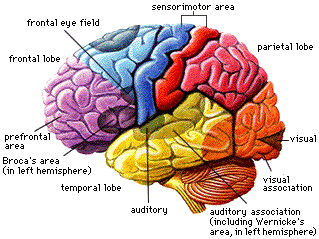
Some of the most compelling evidence for the modularity of mind hypothesis comes from studies of patients with brain damage. If the human mind were a general all-purpose problem-solver we would expect damage to the brain to affect all cognitive capacities more or less equally. But this is not what we find. On the contrary, brain damage often impairs some cognitive capacities but leaves other untouched. A good example of this is damage to a part of the brain known as Wernicke’s area – following injury or viral infection – which leaves a patient unable to understand speech although they are still able to produce fluent, grammatical sentences. This strongly suggests that there are separate modules for sentence production and comprehension. Other brain-damaged patients lose their long-term memory (amnesia) but their short-term memory and their ability to speak and understand are entirely unimpaired.
Modular or ‘general purpose problem-solver’ …or both?
The evidence for a modular mind is compelling and the philosopher Jerry Fodor published a book in 1983 titled The Modularity of Mind which explained exactly what a module is. However the modular view is controversial and is not endorsed by all philosophers. Opponents argue that even in a general purpose problem-solver brain it is still possible that distinct cognitive capacities might be differently affected by brain damage. Fodor himself even admits that the answer may not be all that clear cut and suggests that while perception and language are modular, thinking and reasoning are almost certainly not – we solve some cognitive tasks using specialised modules and others using our ‘general intelligence’. However not all psychologists agree with this.
Is the mind scientifically inexplicable?
Exactly how many modules there are and precisely what they do, are questions that cannot be answered given the current state of brain research. Most neuroscientists equate mind and brain as one and the same thing and predict that in the not-too-distant future neuroscience will deliver a radically different type of brain science, with radically different explanatory techniques what will explain the architecture of the human mind.

