Where Is Your Brain Taking You (Part II) ?

http://whyriskit.files.wordpress.com/2012/11/2012-10-23-karen-bee.jpgWhat is the point about living our lives?

Today  I want to expand on a previous post – Is there an end point to us becoming more human or the fulfilment of its potential? As a neuroscientist who has studied the origins of learning and memory it has become obvious to me that the more we learn and remember the better we can predict the future.

This question can be now be answered in the context that every single human being on
the planet is unique because they posses a uniquely complex brain. In fact, the brain is so
complex that in all of human history no two brains were the same. Furthermore, this unique
combination of about 100 trillion tiny connections grows and changes through life – a work in progress from conception to death. In this way we each evolve as we journey through life.

Neurodiversity is the key to our success

The term ‘neurodiversity’ has been coined to extend the finding that every single human being is neurologically different, to view those with attention deficit hyperactivity disorder, autism spectrum disorder, Asperger syndrome, dyscalculia, dyslexia, dyspraxia, Tourette syndrome, and others as just another variation of human brain wiring, rather than a disease – and that these differences in brain wiring are authentic forms of communication, self-
expression and being.

Vive la différence!

Rather than focus on the need for a ‘cure’ what we actually need to do is to promote support- systems that allow those who are neurologically different to live their lives as they are, rather than attempting to conform to some clinical ideal – because it is these very individuals that give the rest of us unique insights and solutions by viewing the world in a different way. Take for example Albert Einstein – considered by many to have had Asperger syndrome – who single-handedly worked out the relationship between space and time and went on to model the structure of the universe as a whole.

To bee or not to bee

The advantages of neurodiversity can be seen elsewhere in nature for instance in the thermoregulation in honey bee nests. The temperature in the nest ranges between 32 and 36 degrees. If it is getting warmer the bees ventilate with their wings until the set point is reached again. However in genetically uniform colonies the bees tend to start with ventilation about the same time – causing even greater instability by producing more temperature fluctuations, whereas the nest temperature in genetically diverse colonies is more stable.

Who is in the spotlight?

Despite what some like to think – humankind is not the centre of the world but rather a very actively growing branch of the evolutionary tree. We are not destined to ‘lift ourselves above nature’ – but rather to dramatically raise the intelligence and complexity of this thing we call ‘life’ through our intellectual and spiritual evolution.

So what’s the answer?

The evolution of the human race is not going to proceed by trying to transcend it – rather we will move forward as a race by making room for each and every individual to express their personalities to the full. In this way the evolution of the human race has everything to do with our own personal development.

In short, personality equals evolution.

Weekly Neuroscience Update

Scientists have located a specific set of neurons that indicate how time passes, confirming that the brain plays an essential role in how we experience the passage of time.

Neuroscientists have found that by training on attention tests, people young and old can improve brain performance and multitasking skills.

A gene that is associated with regeneration of injured nerve cells has been identified by scientists at Penn State University and Duke University.

When given early treatment, children with autism spectrum disorders (ASD) made significant improvements in behavior, communication, and most strikingly, brain function, Yale School of Medicine researchers report in a new study.

Researchers have found some of the earliest signs of Alzheimer’s disease, more than two decades before the first symptoms usually appear.

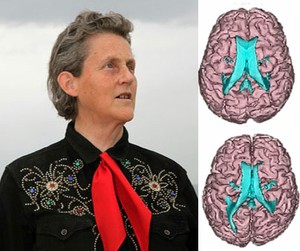
Researchers reveal first brain study of Temple Grandin

Left-leaning: Unlike controls (top), Temple Grandin has lateral ventricles (bottom) that are significantly larger on the left side of her brain than on the right.

This time of year usually sees me travelling to the US for the Society for Neuroscience annual meeting. This year for the first time in many years I am missing it, but thanks to the wonders of the internet, I am keeping abreast of the proceedings.

A presentation at the meeting in New Orleans this past weekend revealed the first study to take a close look at Temple Grandin, perhaps the world’s most famous person with autism, and one of the first to look at the brains of savants. Grandin, professor of animal sciences at Colorado State University, is an outspoken advocate for autism research and awareness. She is known as a ‘savant,’ or a person who shows characteristic social deficits of autism and yet also has some exceptional abilities.

Click here to read Virginia Hughes report for Simons Foundation Autism Research Initiative

Weekly Neuroscience Update

Research from the University of Southampton, which examines how dolphins might process their sonar signals, could provide a new system for man-made sonar to detect targets, such as sea mines, in bubbly water.

Evidence is mounting that exercise provides some protection from memory loss and Alzheimer’s disease, with three new studies showing that a variety of physical activities are associated with healthier brains in older adults.

Researchers  have discovered an important clue to how the human brain —important clue to how the human brain — which is constantly bombarded with millions of pieces of visual information, can filter out what’s unimportant and focus on what’s most useful.

Scientists at the California Institute of Technology (Caltech) pioneered the study of the link between irregularities in the immune system and neurodevelopmental disorders such as autism a decade ago. Since then, studies of postmortem brains and of individuals with autism, as well as epidemiological studies, have supported the correlation between alterations in the immune system and autism spectrum disorder.

Researchers at Aalto University in Finland have developed the world’s first device designed for mapping the human brain that combines whole-head magnetoencephalography (MEG) and magnetic resonance imaging (MRI) technology. MEG measures the electrical function and MRI visualizes the structure of the brain. The merging of these two technologies will produce unprecedented accuracy in locating brain electrical activity non-invasively. 

Cognition psychologists have discovered why stressed persons are more likely to lapse back into habits than to behave goal-directed. The researchers have now reported in the Journal of Neuroscience that the interaction of the stress hormones hydrocortisone and noradrenaline shut down the activity of brain regions for goal-directed behaviour. The brain regions responsible for habitual behaviour remained unaffected.

Raising levels of the neurotransmitter dopamine in the frontal cortex of the brain significantly decreased impulsivity in healthy adults, in a study conducted by researchers at the Ernest Gallo Clinic and Research Center at the University of California, San Francisco

Weekly Neuroscience Update

Awakening from anesthesia is often associated with an initial phase of delirious struggle before the full restoration of awareness and orientation to one’s surroundings. Scientists now know why this may occur: primitive consciousness emerges first.

The first atlas of the surface of the human brain based upon genetic information has been produced by a national team of scientists, led by researchers at the University of California, San Diego School of Medicine and the VA San Diego Healthcare System. The work is published in the journal Science.

Researchers help reveal complex role of genes in autism.

New research from scientists at the University of Milan considers the complications and new treatment challenges for elderly patients who suffer traumatic brain injury as a result of a fall.

Investigators from the University of Amsterdam, Netherlands, have shown that in most elderly patients invasive and expensive techniques, i.e. lumbar puncture and PET scan, are not useful to establish the diagnosis of Alzheimer’s disease.

Sleep plays a powerful role in preserving our memories. But while recent research shows that wakefulness may cloud memories of negative or traumatic events, a new study has found that wakefulness also degrades positive memories. Sleep, it seems, protects positive memories just as it does negative ones, and that has important implications for the treatment of post-traumatic stress disorder.

Weekly Round Up

Researchers have identified the group of neurons that mediates whether light arouses us or not.

Providing support to a loved one offers benefits to the giver, not just the recipient, a new brain-imaging study by UCLA life scientists reveals.

There’s growing evidence that the brains of autistic children are very different from the brains of other youngsters. Now a new study that found an excess of brain cells in children with autism comes closer to pinpointing the origins of the condition: in utero versus in toddlerhood.

Finally this week, scientists have found a direct link between the number of ‘Facebook friends’ a person has and the size of particular brain regions. Commenting on the study, Dr John Williams, Head of Neuroscience and Mental Health at the Wellcome Trust, said: “We cannot escape the ubiquity of the internet and its impact on our lives, yet we understand little of its impact on the brain, which we know is plastic and can change over time. This new study illustrates how well-designed investigations can help us begin to understand whether or not our brains are evolving as they adapt to the challenges posed by social media.”

Weekly Round Up

In an attempt to put matter over mind, researchers are beginning to decipher what exactly is happening in our brains when we are making decisions. 

Historically, the dyslexia label has been assigned to children who whose high IQs mismatch their low reading scores, but a new brain-imaging study challenges this understanding of dyslexia.

Twin studies have shown that people with schizophrenia and bipolar disorder have changes in gene activity caused by their environment. The finding provides the strongest evidence yet that such gene changes might cause the conditions.

The famous dictum of Henry Ford “Whether you think you can or think you can’t – you’re right,” has been put to the test in new study, which finds that people who think they can learn from their mistakes have a different brain reaction to mistakes than people who think intelligence is fixed.

Everybody has experienced a sense of “losing oneself” in an activity and now researchers have caught the brain in the act.

The brains of autistic children have a distinctive topography that a team of Stanford University scientists was able to capture using new imaging techniques, with the hope of someday creating a template for the autistic brain that could be used to diagnose children at an early age.

Finally, modern society’s increasing dependency on online tools for both work and recreation opens up unique opportunities for the study of social interactions. With this in mind, scientists at Indiana University  have put Dunbar’s Number (a theoretical cognitive limit to the number of people with whom one can maintain stable social relationships) to the test by analyzing the Twitter activity of 1.7 million individuals. Their research offers support to Dunbar’s hypothesis of a biological limit to the number of relationships than can be simultaneously maintained by a single individual.

Weekly Round-Up

Peer pressure is hard-wired into our brains

A new study explains why people take stupid chances when all of their friends are watching that they would never take by themselves. According to the study,the human brain places more value on winning in a social setting than it does on winning when you’re alone. Scientists have identified the part of the brain responsible for controlling whether we conform to expectations and group pressure.

Does a blind person reading Braille process words in the brain differently than a person who reads by sight? Mainstream neuroscience thinking implies that the answer is yes because different senses take in the information. But a recent study in Current Biology finds that the processing is the same, adding to mounting evidence that using sensory inputs as the basis for understanding the brain may paint an incomplete picture.

New research sheds light on how and why we remember dreams–and what purpose they are likely to serve.

Child neurologist and neuroscientist Dr. Tallie Z. Baram has found that maternal care and other sensory input triggers activity in a baby’s developing brain that improves cognitive function and builds resilience to stress.

University of British Columbia scientists may have uncovered a new explanation for how Alzheimer’s disease destroys the brain.

The brains of people who relapse into depression differ from those of people who maintain a recovery, a new study shows. The results may provide insight into why some people relapse and why certain therapies may help, the researchers said.

Researchers using scanning technology say they discovered physical differences in the brains of older children with autism compared to those of kids without autism.

And finally, in an effort to understand what happens in the brain when a person reads or considers such abstract ideas as love or justice, Princeton researchers have for the first time matched images of brain activity with categories of words related to the concepts a person is thinking about. The results could lead to a better understanding of how people consider meaning and context when reading or thinking.


Is the search for the cause of autism a hall of mirrors?

The ‘broken mirror’ theory is a popular theory in autism research but it seems that all is not as it appears as  a high-profile paper in Neuron reports that people with autism do not have trouble understanding others’ actions or intentions or even imitating those actions1.

Monkey see, monkey do.

Mirror neurons were discovered by neuroscientists in the 90’s while recording the activity of nerve cells or neurons in the brains of monkeys where it was noticed that certain neurons remain silent when the monkeys observe other monkeys performing the same action2 – hence the name mirror neuron.

Scientists have extended this finding in the human brain to show that nerve activity in mirror neurons also remain silent when observing another person performing an action and/or expressing an emotion3 and this silence is not observed in people with autism – hence the ‘broken mirror’ theory of autism.

Getting it “write”

However in a 2007 study 25 children with autism were compared with non-autistic ‘controls’ on several goal-directed imitation (mirror) tasks shown to activate regions of the brain believed to contain mirror neurons4. In one experiment, the children sat at a table and were asked to copy an adult as she touched a pattern of dots on the tabletop. The study showed that normal healthy children make typical errors on this task – for instance copying the adult’s goal but using the wrong hand. The children with autism made exactly the same error, meaning that they selectively imitate the goal of the action and both groups show the same pattern of brain activity in brain regions believed to contain mirror neurons. These findings suggest that there is nothing wrong with basic mirror systems in people with autism.

Hall of mirrors

Part of the problem may be that the ‘broken mirror’ theory relies on several unsupported assumptions: that the mirror system is responsible for understanding goals and imitation, that goal understanding and imitation are abnormal in autism, and that these deficits cause the social difficulties seen in autism.

It’s all about connections

One possible explanation is that the mirror neuron system itself could be normal in autism, but its projections, or the brain regions it is projecting to, could be abnormal instead.  Also, the mixed findings could be due to the broad spread of the autism spectrum disorders.

References:

  1. Dinstein, I.et al. Neuron 13, 461-469 (2010) PubMed
  2. Rizolatti G. et al. Brain Res. Cogn. Brain Res. 3, 131-141 (1996) PubMed
  3. CochinS. et al. Electroencephalogr. Clin. Neurophysiol. 107, 287-295 (1998) PubMed
  4. HamiltonA. F. et al. Neuropsychologia 45, 1859-1868 (2007) PubMed

Weekly Round Up

Pathways within the brain can be strengthened by reading and language exposure

 Recent research shows that reading  boosts brain pathways and can actually affect understanding in nearly all school subjects – a great reason to encourage the reading habit in your children.

Scientists at the University of Michigan Health System have demonstrated how memory circuits in the brain refine themselves in a living organism through two distinct types of competition between cells. Their results, published  in Neuron, mark a step forward in the search for the causes of neurological disorders associated with abnormal brain circuits, such as Alzheimer’s disease, autism and schizophrenia.

The left and right halves of the brain have separate stores for working memory, the information we actively keep in mind, suggests a study published online yesterday by the Proceedings of the National Academy of Sciences.

Over time, and with enough Internet usage, the structure of our brains can actually physically change, according to a new study.

Bringing the real world into the brain scanner, researchers at The University of Western Ontario from The Centre for Brain and Mind can now determine the action a person was planning, mere moments before that action is actually executed.

And finally good news at last for coffee addicts.For years we’ve been told that caffeinated coffee was bad for us. It’s unhealthy and addictive, doctors warned. But as vindication for all who stuck by their energizing elixir, a new study published early online in the Journal of Alzheimer’s Disease,  shows that guzzling caffeinated coffee may actually be good for our brains. In fact, it may help keep Alzheimer’s at bay.  So enjoy that cuppa joe!