Weekly Neuroscience Update

autism-boys-brain-scan

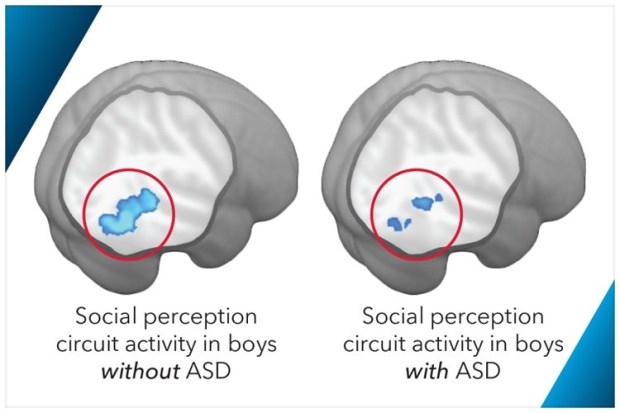
Researchers analyzed a series of 164 images from each of 114 individuals and discovered the brain scans of the social perception circuits indicated ASD only in boys. Credit: The researchers/George Washington University.

Researchers have developed a new method to map and track the function of brain circuits affected by autism spectrum disorder (ASD) in boys using brain imaging, a technique that will provide doctors with a tool that measures the progress of treatments in individual patients.

Scientists have derived a structural model of a transporter at the blood-brain barrier called Mfsd2a. This is the first molecular model of this critical transporter, and could prove important for the development of therapeutic agents that need to be delivered to the brain, across the blood-brain barrier. In future, this could help treat neurological disorders such as glioblastoma.

Research co-led by the University of Glasgow has made a potential breakthrough in the treatment of Alzheimer’s disease.

Frontotemporal dementia (FTD), the second most common cause of dementia in people under 65, may be triggered by a defect in immune cells called microglia that causes them to consume the brain’s synaptic connections, according to new research.

A new study shows that a series of play sessions with music improved 9-month-old babies’ brain processing of both music and new speech sounds.

Researchers at the RIKEN Brain Science Institute (BSI) in Japan have demonstrated that astrocytes help control the strength of connections between neurons. Published in Proceedings of the National Academy of Sciences, the study used cultured cells and brain slices to show that astrocytes in the hippocampus regulate changes in the brain brought on by neural activity.

Finally this week, people with more friends have higher pain tolerance, Oxford University researchers have found.

Weekly Neuroscience Update

short-term-memory-visual-distractions

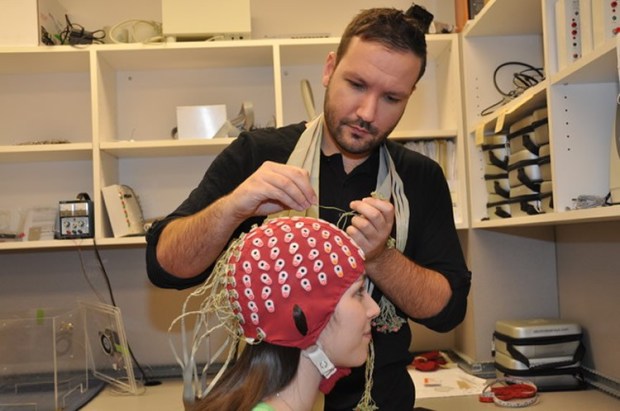
John Gaspar, an SFU psychology doctoral student, places 128 electrodes into a cap. The electrodes will pick up tiny changes in the wearer’s brain activity. Image is adapted from the SFU press release.

A new study has found that differences in an individual’s working memory capacity correlate with the brain’s ability to actively ignore distraction.

A research team has connected neurons using ultrashort laser pulses. With their study, which was published in Scientific Reports, the team became the first ever to find a way to bond neurons.

Physicians and biomedical engineers from Johns Hopkins report what they believe is the first successful effort to wiggle fingers individually and independently of each other using a mind-controlled artificial “arm” to control the movement.

Researchers have identified a gene which can be used to predict how susceptible a young person is to the mind-altering effects of smoking cannabis.

Young adults with hostile attitudes or those who don’t cope well with stress may be at increased risk for experiencing memory and thinking problems decades later, according to a study published in the March 2, 2016, online issue of Neurology.

Researchers have found how lactate, a waste product of glucose metabolism can protect neurons from damage following acute trauma such as stroke or spinal cord injury.

Neuroscientists have discovered a specific enzyme that plays a critical role in spinal muscular atrophy, and that suppressing this enzyme’s activity, could markedly reduce the disease’s severity and improve patients’ lifestyles.

Birds that migrate the greatest distances have more new neurons in the regions of the brain responsible for navigation and spatial orientation, suggests a new paper published in Scientific Reports.

Scientists have now described the engineering of a bright red fluorescent protein-based voltage indicator, providing pathways to understanding complex neurological disorders.

Children with autism and other similar conditions often have difficulties in several areas of communication. A new doctoral thesis in linguistics from the University of Gothenburg shows that these children can develop speech, gestures and a sense of rhythm and melody by listening to various speech sounds.

Finally this week,  new research suggests that small numbers are processed in the right side of the brain, while large numbers are processed in the left side of the brain.

Weekly Neuroscience Update

autism-men-neuroimaging

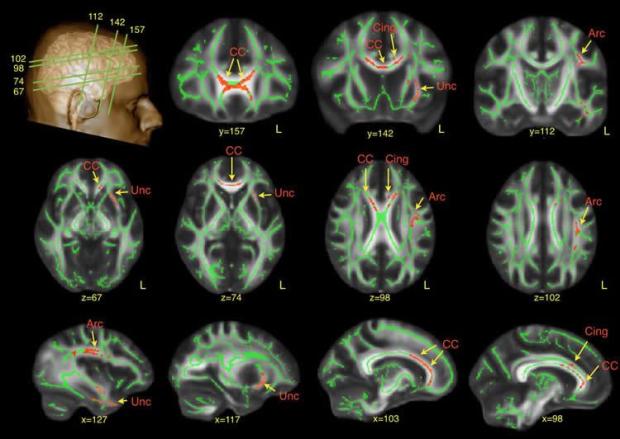
Red regions indicate reduced fractional anisotropy values in autism spectrum disorder (ASD). Credit: The researchers/King’s College London.

Research at King’s College London has revealed subtle brain differences in adult males with autism spectrum disorder (ASD), which may go some way towards explaining why symptoms persist into adulthood in some people with the disorder.

Women who take estrogen supplements from before or at the start of menopause and continue with them for a few years have better preserved brain structure, which may reduce the risk of dementia.

Scientists have taken a significant step toward understanding the cause of schizophrenia, in a landmark study that provides the first rigorously tested insight into the biology behind any common psychiatric disorder.

Stopping disruptions in cellular “trash removal” brought on by errors in molecular marks on DNA may guard against neurodegenerative diseases like Parkinson’s.

Roughly twenty years before the first symptoms of Alzheimer’s disease appear, inflammatory changes in the brain can be seen, according to a new study from Karolinska Institutet published in the medical scientific journal Brain.

In a new study, researchers reveal how brain scans could be used to identify children at high risk for later-life depression – information that could pave the way for early intervention and prevention.

Researchers have shown that graphene can be used to make electrodes that can be implanted in the brain, which could potentially be used to restore sensory functions for amputee or paralysed patients, or for individuals with motor disorders such as Parkinson’s disease.

A new study has linked stress and anxiety to the same neurocircuitry in the brain as depression and dementia.

Different regions of our brain need to work simultaneously in order for us to process emotion. But according to new research, such regions are disconnected among individuals who experience multiple episodes of major depression.

A team of international researchers have announced the discovery of a system in the brain that may underlie the development of involuntary vocalizations (commonly called vocal tics) that often occur in people with Tourette syndrome.

A new study sheds light on multiple sclerosis (MS), specifically damage in the brain caused by the disease that may explain the slow and continuous cognitive decline that many patients experience. The findings, which appear in the Journal of Neuroscience, show that the brain’s immune system is responsible for disrupting communication between nerve cells, even in parts of the brain that are not normally considered to be primary targets of the disease.

Cognitive function and health appear to be genetically linked, according to research published in Molecular Psychiatry. The study was carried out by an international team from the US, the UK and Germany.

Researchers have discovered the mechanics of how dopamine transports into and out of brain cells, a finding that could someday lead to more effective treatment of drug addictions and neurological disorders such as Parkinson’s disease.

The brains of children who are obese function differently from those of children of healthy weight, and exhibit an “imbalance” between food-seeking and food-avoiding behaviors, researchers at Vanderbilt University Medical Center have found.

Finally this week, neuroscientists have now shown that rhythmic brain waves, called theta oscillations, engage and synchronize the brain regions that support the integration of memories. The results were published in the journal Current Biology.

Weekly Neuroscience Update

Using a technique dubbed “brainbow,” the Virginia Tech Carilion Research Institute scientists tagged synaptic terminals with proteins that fluoresce different colors. The researchers thought one color, representing the single source of the many terminals, would dominate in the clusters. Instead, several different colors appeared together, intertwined but distinct. Credit: Virginia Tech.

Using a technique dubbed “brainbow,” the Virginia Tech Carilion Research Institute scientists tagged synaptic terminals with proteins that fluoresce different colors. The researchers thought one color, representing the single source of the many terminals, would dominate in the clusters. Instead, several different colors appeared together, intertwined but distinct. Image Credit: Virginia Tech.

Neuroscientists know that some connections in the brain are pruned through neural development. Function gives rise to structure, according to the textbooks. But scientists have discovered that the textbooks might be wrong. Their results were published this week in Cell Reports.

In 2011, MIT neuroscientist Rebecca Saxe and colleagues reported that in blind adults, brain regions normally dedicated to vision processing instead participate in language tasks such as speech and comprehension. Now, in a study of blind children, Saxe’s lab has found that this transformation occurs very early in life, before the age of 4. The study, appearing in the Journal of Neuroscience, suggests that the brains of young children are highly plastic, meaning that regions usually specialized for one task can adapt to new and very different roles. The findings also help to define the extent to which this type of remodeling is possible.

New research suggests individuals with autistic traits may have more advanced creativity skills than those without such traits.

Physically fit people tend to have larger brain volumes and more intact white matter than their less-fit peers. Now a new study reveals that older adults who regularly engage in moderate to vigorous physical activity have more variable brain activity at rest than those who don’t. This variability is associated with better cognitive performance, researchers say.

Young adults diagnosed with attention deficit/hyperactivity disorder (ADHD) in adolescence show differences in brain structure and perform poorly in memory tests compared to their peers, according to new research from the University of Cambridge, UK, and the University of Oulu, Finland.

People who will develop dementia may begin to lose awareness of their memory problems two to three years before the actual onset of the disease, according to a new study published in the online issue of Neurology. The study also found that several dementia-related brain changes, or pathologies, are associated with the decline in memory awareness.

People with Alzheimer’s disease have fat deposits in the brain. For the first time researchers have discovered accumulations of fat droplets in the brain of patients who died from the disease and have identified the nature of the fat.

Finally this week, a computer analyzing speech has correctly identified five individuals who would later experience a psychotic episode against 29 who would not among a group of high-risk patients in a proof-of-principle study. The findings raise the prospect of a clinical tool to aid the diagnosis and prognosis of severe mental disorders such as schizophrenia.


Weekly Neuroscience Update

Current treatment methods used are transcranial direct current simulation (tDCS) – which is application of a low intensity direct (constant) current between two electrodes on the head, and transcranial alternating current simulation (tACS) – which sees a constant electrical current flow back and forth. Image credit: Monash University.

Current treatment methods used are transcranial direct current simulation (tDCS) – which is application of a low intensity direct (constant) current between two electrodes on the head, and transcranial alternating current simulation (tACS) – which sees a constant electrical current flow back and forth. Image credit: Monash University.

Researchers have discovered a new technique to enhance brain excitability that could improve physical performance in healthy individuals such as athletes and musicians.

The constant movement of children with attention-deficit/hyperactivity disorder (ADHD) may be distracting — but the fidgeting also may improve their cognitive performance, a study has found.

It is known that sleep facilitates the formation of long-term memory in humans. In a new study, researchers show that sleep does not only help form long-term memory but also ensures access to it during times of cognitive stress.

An international team of neuroscientists has proved the uniqueness of screams for the first time. In a study, they discovered that screams possess very special acoustic properties: This makes them a specific type of vocal expression which is only used in stressful and dangerous situations.

A new study published in the journal Cerebral Cortex suggests people who speak two languages have more gray matter in the executive control region of the brain.

Structural brain abnormalities in patients with schizophrenia, providing insight into how the condition may develop and respond to treatment, have been identified in an internationally collaborative study

Memories that have been “lost” as a result of amnesia can be recalled by activating brain cells with light.

High blood levels of a growth factor known to enable new blood vessel development and brain cell protection correlate with a smaller size of brain areas key to complex thought, emotion and behavior in patients with schizophrenia, researchers report in the journal Molecular Psychiatry.

Scientists have discovered a link between autism and genetic changes in some segments of DNA that are responsible for switching on genes in the brain.

Finally this week, new research has found that types of empathy can be predicted by looking at physical differences in the brain. This raises the fascinating possibility that some kinds of empathy might be able to be increased by training or that it might be possible for people to lose their empathy over time.

Weekly Neuroscience Update

Reductions in cortical surface area and increases in cortical thickness in Down syndrome relative to typical controls. Panel A shows that the cortex surface area is lower in Down syndrome; panel B shows that the cortex is thicker in Down syndrome brains. Small red circles indicate the approximate locations where cortical surface area and thickness were most different between brains of participants with Down syndrome and brains of typically developing participants. Image credit: Lee et al., National Institute of Mental Health

Reductions in cortical surface area and increases in cortical thickness in Down syndrome relative to typical controls. Panel A shows that the cortex surface area is lower in Down syndrome; panel B shows that the cortex is thicker in Down syndrome brains. Small red circles indicate the approximate locations where cortical surface area and thickness were most different between brains of participants with Down syndrome and brains of typically developing participants. Image credit: Lee et al., National Institute of Mental Health

The thickness of the brain’s cerebral cortex could be a key to unlocking answers about intellectual development in youth with Down Syndrome. It could also provide new insights to why individuals with this genetic neurodevelopmental disorder are highly susceptible to early onset Alzheimer’s Disease later in life.

In a study published in The Journal of Experimental Medicine, researchers report a surprising finding that challenges current anatomy and histology textbook knowledge: Lymphatic vessels are found in the central nervous system where they were not known to exist.

Changes in the vaginal microbiome are associated with effects on offspring gut microbiota and on the developing brain, according to a new study published in Endocrinology, a journal of the Endocrine Society.

Researchers discover that a protein called Taranis could hold the key to a good night’s sleep.

A team of researchers has now been able to demonstrate in a study that the bonding hormone oxytocin inhibits the fear center in the brain and allows fear stimuli to subside more easily. This basic research could also usher in a new era in the treatment of anxiety disorders.

Early life stress affects cognitive functioning in low-income children.

Researchers at Monash University have found physical differences in the brains of people who respond emotionally to others’ feelings, compared to those who respond more rationally, in a study published in the journal NeuroImage.

Having a stroke ages a person’s brain function by almost eight years, new research finds — robbing them of memory and thinking speed as measured on cognitive tests. In another pilot study, women who experience more hot flashes, particularly while sleeping, during the menopause transition are more likely to have brain changes reflecting a higher risk for cerebrovascular disease, such as stroke and other brain blood flow problems.

Researchers discover the anatomic reasons for the persistence of musical memory in Alzheimer patients.

A new study on successful ageing has linked better memory performance in older age with patterns of neural compensation. The research sheds light on how memory can remain efficient in spite of common age-related neural decline.

There are more boys than girls diagnosed with autism spectrum disorder (ASD). Now, a study shows that behaviors relevant to autism are more frequently observed in boys than in girls, whether they’re at risk of autism or not. Meanwhile an early intervention program for toddlers with autism spectrum disorder improves their intellectual abilities and reduces autism symptoms – and those results persist years after the children originally received treatment, according to a recent study. And in another study, using functional magnetic resonance imaging, a team of  researchers has shown for the first time that children with autism spectrum disorder who are overly sensitive to sensory stimuli have brains that react differently than those with the disorder who don’t respond so severely to noises, visual stimulation and physical contact.

The stress hormone cortisol strengthens memories of scary experiences. 

Finally, this week, researchers have found that people who speak more than one language have twice as much brain damage as unilingual people before they exhibit symptoms of Alzheimer’s disease. It’s the first physical evidence that bilingualism delays the onset of the disease.


Weekly Neuroscience Update

This image shows an overview of the Rehabilitation Gaming System. Image credit: Rehabilitation Gaming System.

This image shows an overview of the Rehabilitation Gaming System. Image credit: Rehabilitation Gaming System.

Using virtual reality to increase a patient’s confidence in using their paralyzed arm may be critical for recovery, according to research published in the open-access Journal of  NeuroEngineering and Rehabilitation.

A pioneering study conducted by leading researchers at the University of Sheffield has revealed blood types play a role in the development of the nervous system and may cause a higher risk of developing cognitive decline. The findings  seem to indicate that people who have an ‘O’ blood type are more protected against the diseases in which volumetric reduction is seen in temporal and mediotemporal regions of the brain like with Alzheimer’s disease for instance.

A star-shaped brain cell called an astrocyte appears to help keep blood pressure and blood flow inside the brain on a healthy, even keel, scientists report.

Thanks to advances in brain imaging technology, we now know how specific concrete objects are coded in the brain, to the point where we can identify which object, such as a house or a banana, someone is thinking about from its brain activation signature.

A new study finds some people can be trained to learn absolute pitch.

Scientists have discovered a previously unknown link between the brain and the immune system that could help explain links between poor physical health and brain disorders including Alzheimer’s and depression.

A team of neuroscientists has determined how a pair of growth factor molecules contributes to long-term memory formation, a finding that appears in the journal Neuron.

Our understanding of how a key part of the human brain works may be wrong. That’s the conclusion of a team at Oxford University’s Centre for Human Brain Activity (OHBA), published in journal Trends in Cognitive Sciences. Until now, it was thought that working memory – the way in which we deal with and respond to immediate demands – was underpinned by stable brain patterns. The OHBA team discovered that instead, the areas of the brain responsible for working memory are changing all the time.

A new study finds people with higher levels of moral reasoning have greater gray matter volume in brain regions linked to social behaviour, decision-making and conflict processing, compared with those who have lower levels of moral reasoning.

Genes linked to creativity could increase the risk of developing schizophrenia and bipolar disorder, according to new research.

One of the major challenges of cocaine addiction is the high rate of relapse after periods of withdrawal and abstinence. But new research reveals that changes in our DNA during drug withdrawal may offer promising ways of developing more effective treatments for addiction.

According to a piece of research by the UPV/EHU-University of the Basque Country, the capacity to recall specific facts deteriorates with age, but other types of memory do not.

Finally, this week, a new study has found that the brain shrinks over the course of the day, ending up smaller in the evening – before returning to its full size the next morning.

Weekly Neuroscience Update

A neural network is like a social network: The strongest bonds exist between like-minded partners.  Credit: Biozentrum, University of Basel

A neural network is like a social network: The strongest bonds exist between like-minded partners.
Credit: Biozentrum, University of Basel

Neurons in the brain are wired like a social network, report researchers from Biozentrum, University of Basel. Each nerve cell has links with many others, but the strongest bonds form between the few cells most similar to each other. The results are published in the journal Nature.

Stroke survivors can have “significant” improvement in arm movements after using the Nintendo Wii as physiotherapy according to researchers.

Grasping an object involves a complex network of brain functions. First, visual cues are processed in specialized areas of the brain. Then, other areas of the brain use these signals to control the hands to reach for and manipulate the desired object. New findings suggest that the cerebellum, a region of the brain that has changed very little over time, may play a critical role. Findings could lead to advancements in assistive technologies benefiting the disabled.

A process previously thought to be mere background noise in the brain has been found to shape the growth of neurons as the brain develops, according to research published in Cell Reports.

Applying lessons learned from autism to brain cancer, researchers at The Johns Hopkins University have discovered why elevated levels of the protein NHE9 add to the lethality of the most common and aggressive form of brain cancer, glioblastoma. Their discovery suggests that drugs designed to target NHE9 could help to successfully fight the deadly disease.

Scientists at the Hebrew University of Jerusalem in Israel claim to have overturned standard thinking on how the brain is able to perform different tasks by studying brain activity in blind people.

Previously, it was thought ability to repair DNA was the same throughout the body, but new research overturns this idea and shows organs vary in the extent to which they carry out a type of DNA repair called nucleotide excision repair.

Finally this week, a major study by an international team shows new evidence that long-term smoking could cause thinning of the brain’s cortex. The cortex is the outer layer of the brain in which critical cognitive functions such as memory, language and perception take place. Interestingly, the findings also suggest that stopping smoking helps to restore at least part of the cortex’s thickness.


Weekly Neuroscience Update

The human brain using colors and shapes to show neurological differences between two people. Credit Arthur Toga, University of California, Los Angeles via NIGMS.

The human brain using colors and shapes to show neurological differences between two people. Credit Arthur Toga, University of California, Los Angeles via NIGMS.

While many different combinations of genetic traits can cause autism, brains affected by autism share a pattern of ramped-up immune responses, an analysis of data from autopsied human brains reveals. The study, published online in the journal Nature Communications, included data from 72 autism and control brains.

Teenagers who have suffered a traumatic brain injury are twice as likely to drink alcohol or use drugs when compared with whose who have never experienced a similar blow or trauma to the head.

Activating the brain’s amygdala, an almond-shaped mass that processes emotions, can create an addictive, intense desire for sugary foods, a new study found. Rewards such as sweet, tasty food or even addictive drugs like alcohol or cocaine can be extremely attractive when this brain structure is triggered. And another study, led by researchers at University of California, San Diego School of Medicine, revealed that the brains of obese children literally light up differently when tasting sugar.

Scientists have discovered a link between sleep loss and cell injury. Results of a new study find sleep deprivation causes the damage to cells, especially in the liver, lung, and small intestine. Recovery sleep following deprivation heals the damage.

Neural circuits that activate when we daydream run in the opposite direction to how we process reality, a new study finds.

Yale researchers using a new brain imaging analysis method have confirmed that smoking cigarettes activates a dopamine-driven pleasure and satisfaction response differently in men compared to women.

Whether we’re paying attention to something we see can be discerned by monitoring the firings of specific groups of brain cells. Now, new work from Johns Hopkins shows that the same holds true for the sense of touch.

Serious, long-term stress can have dire consequences for your brain. That’s because the immune system and the brain are intimately related, say researchers at the Ruhr University Bochum, Germany.

In the current issue of Psychotherapy and Psychosomatics a new study identifies biological characteristics who may predict who is going to respond to psychotherapy.

Some high school football players exhibit measurable brain changes after a single season of play even in the absence of concussion, according to a study presented at the annual meeting of the Radiological Society of North America. Meanwhile, as debate increases about whether female lacrosse players should wear headgear, a new study reports measurements of the accelerations that stick blows deliver to the head. The study also measured the dampening effect of various kinds of headgear.

Quitting smoking sets off a series of changes in the brain that researchers say may better identify smokers who will start smoking again.

Everyday events are easy to forget, but unpleasant ones can remain engraved in the brain. A new study published in the Proceedings of the National Academy of Sciences identifies a neural mechanism through which unpleasant experiences are translated into signals that trigger fear memories by changing neural connections in a part of the brain called the amygdala. The findings show that a long-standing theory on how the brain forms memories, called Hebbian plasticity, is partially correct, but not as simple as was originally proposed.