Weekly Neuroscience Update

EPNorth

A virtual reality world called EVA Park can improve the communication of those who have impaired speech and language following a stroke, according to research by academics at City University London. The study, which is published in PLOS ONE, is the first exploration of multi-user virtual reality in aphasia therapy and shows the potential for technology to play an important role in improving the everyday lives of people with the condition.

A new study will look at how brain connections mature and develop from childhood to adulthood.

Neurons communicate by sending chemical signals called neurotransmitters across synapses, specialized connections between two individual cells. This communication requires a delicate and intricate molecular architecture. A recent paper published in Nature has now shown that the structure of this intercellular space is more complicated than previously thought, and it probably helps boost the efficiency of the signaling.

A new long term study of young marijuana users tracks the brain’s response to reward over time. The findings indicate a lower response to reward in marijuana users.

Neuroscientists at the University of Pittsburgh have identified the neural networks that connect the cerebral cortex to the adrenal medulla, which is responsible for the body’s rapid response in stressful situations. These findings, reported in the online Early Edition of the journal Proceedings of the National Academy of Sciences (PNAS), provide evidence for the neural basis of a mind-body connection.

A new study provides insight into how overconfidence can lead to poor decision making.

Scientists have identified part of our brain that helps us learn to be good to other people. The discovery could help understanding of conditions like psychopathy where people’s behaviour is extremely antisocial.

Finally this week, researchers have developed a neurodevelopmental model of a rare genetic disorder that could help shed light on the workings of the human social brain.


Weekly Neuroscience Update

consciousness-time-slices

Consciousness seems to work as continuous stream: one image or sound or smell or touch smoothly follows the other, providing us with a continuous image of the world around us. Image adapted from the EPFL press release.


Scientists propose a new way of understanding of how the brain processes unconscious information into our consciousness. According to the model, consciousness arises only in time intervals of up to 400 milliseconds, with gaps of unconsciousness in between.

A new study finds bursts of neural activity as the brain holds information in mind, overturns a long-held model.

Why do we sometimes decide to take risks and other times choose to play it safe? In a new study, researchers explored the neural mechanisms of one possible explanation: a contagion effect.

Using imagery is an effective way to improve memory and decrease certain types of false memories.

Scientists have developed an imaging process that for the first time, they say, can identify and track the progression of Alzheimer’s disease in people’s brains, even when there are no symptoms — a development that could lead to earlier diagnosis and treatment.

People prone to seeking stimulation and acting impulsively may have differences in the structure of their brains according to a study published in the Journal of Neuroscience. What’s more, those differences may predispose them to substance abuse.

In a recent study, researchers found evidence of a compromised dopamine system in heavy users of marijuana. Lower dopamine release was found in the striatum – a region of the brain that is involved in working memory, impulsive behavior, and attention. Previous studies have shown that addiction to other drugs of abuse, such as cocaine and heroin, have similar effects on dopamine release, but such evidence for cannabis was missing until now.

Finally this week an innovative collaboration between neuroscientists and developmental psychologists that investigated how infants’ brains process other people’s action provides the first evidence that directly links neural responses from the motor system to overt social behaviour in infants.


Weekly Neuroscience Update

short-term-memory-visual-distractions

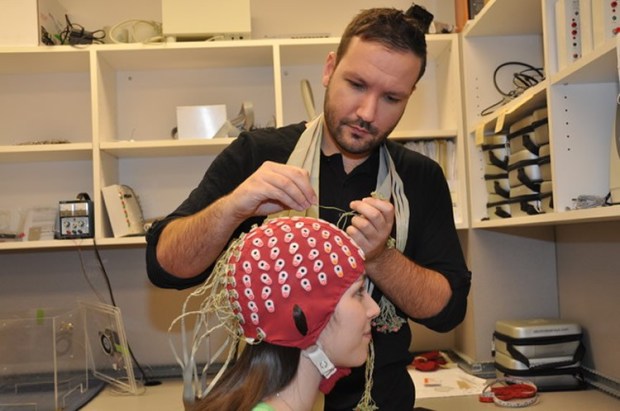
John Gaspar, an SFU psychology doctoral student, places 128 electrodes into a cap. The electrodes will pick up tiny changes in the wearer’s brain activity. Image is adapted from the SFU press release.

A new study has found that differences in an individual’s working memory capacity correlate with the brain’s ability to actively ignore distraction.

A research team has connected neurons using ultrashort laser pulses. With their study, which was published in Scientific Reports, the team became the first ever to find a way to bond neurons.

Physicians and biomedical engineers from Johns Hopkins report what they believe is the first successful effort to wiggle fingers individually and independently of each other using a mind-controlled artificial “arm” to control the movement.

Researchers have identified a gene which can be used to predict how susceptible a young person is to the mind-altering effects of smoking cannabis.

Young adults with hostile attitudes or those who don’t cope well with stress may be at increased risk for experiencing memory and thinking problems decades later, according to a study published in the March 2, 2016, online issue of Neurology.

Researchers have found how lactate, a waste product of glucose metabolism can protect neurons from damage following acute trauma such as stroke or spinal cord injury.

Neuroscientists have discovered a specific enzyme that plays a critical role in spinal muscular atrophy, and that suppressing this enzyme’s activity, could markedly reduce the disease’s severity and improve patients’ lifestyles.

Birds that migrate the greatest distances have more new neurons in the regions of the brain responsible for navigation and spatial orientation, suggests a new paper published in Scientific Reports.

Scientists have now described the engineering of a bright red fluorescent protein-based voltage indicator, providing pathways to understanding complex neurological disorders.

Children with autism and other similar conditions often have difficulties in several areas of communication. A new doctoral thesis in linguistics from the University of Gothenburg shows that these children can develop speech, gestures and a sense of rhythm and melody by listening to various speech sounds.

Finally this week,  new research suggests that small numbers are processed in the right side of the brain, while large numbers are processed in the left side of the brain.

Could this tactic help you give up smoking and other addictions?

Over the past three decades I have visited high schools and colleges to talk on how addictive drugs affect the brain and to explain the many theories about why certain people become addicted. There are as many reasons why someone becomes addicted as there are addicts. This situation is not helped by the fact that we cannot yet predict who will become addicted, or how to cure it.

Psychiatrist Judson Brewer studies the relationship between mindfulness and addiction — from smoking to overeating to all those other things we do even though we know they’re bad for us. In this short video, you will learn more about the mechanism of habit development and discover a simple but profound tactic that might help you beat your next urge to smoke, snack or check a text while driving.

Weekly Neuroscience Update

RSR_Fig1_20140627

Carnegie Mellon University neuroscientists have identified a new pathway by which several brain areas communicate within the brain’s striatum.

An over-active habit system may be at the root of many psychological problems involving repetitive behaviours like OCD, alcoholism and binge eating, new research suggests. The neuroimaging study, which is published in the American Journal of Psychiatry, found that people with Obsessive-Compulsive Disorder (OCD) had difficulty controlling their habits.

A new study suggests that the right hemisphere of the brain may be able to assist a damaged left hemisphere in protecting visual attention after a stroke.

Computer based ‘brain training’ can boost memory and thinking skills in older adults, but many programs promoted by the $1 billion brain training industry are ineffective, reveals new research by the University of Sydney.

Researchers have found that navigational brain cells that help sense direction are as electrically active during deep sleep as they are during wake time—and have visual and vestibular cues to guide them. Such information could be useful in treating navigational problems, among the first major symptoms of Alzheimer’s disease and other neurological disorders.

New technology could help researchers advance blood biomarker capabilities that show changes in low concentrations of specific proteins present following a neurological injury.

Our brains generate a constant hum of activity: As neurons fire, they produce brain waves that oscillate at different frequencies. Long thought to be merely a byproduct of neuron activity, recent studies suggest that these waves may play a critical role in communication between different parts of the brain.

Thousands of genetic “dimmer” switches, regions of DNA known as regulatory elements, were turned up high during human evolution in the developing cerebral cortex, according to new research from the Yale School of Medicine.

People with anorexia nervosa and with body dysmorphic disorder have similar abnormalities in their brains that affect their ability to process visual information, a new study reveals.

Finally this week, overall fluid intelligence — the ability to analyze information, engage in critical thinking, and solve problems — is thought to peak in early adulthood, but a new study suggests that different aspects of fluid intelligence peak at different ages.


Weekly Neuroscience Update

eeg-childhood-generosity

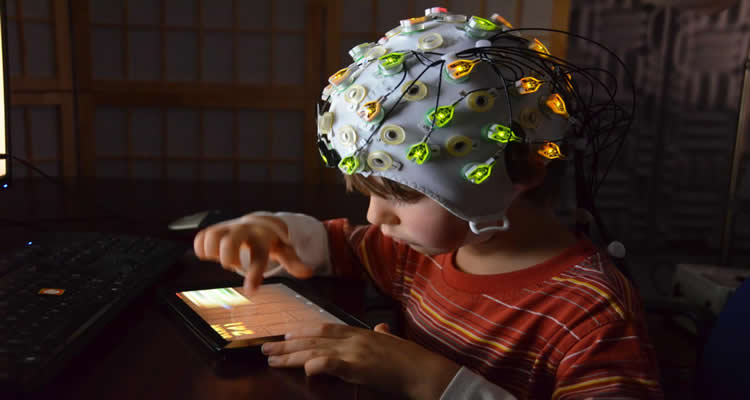
Children were monitored with EEGs while watching animated characters perform prosocial and antisocial behaviors, and later participated in a task measuring generosity. Credit Jean Decety/University of Chicago.

University of Chicago developmental neuroscientists have found specific brain markers that predict generosity in children. Those neural markers appear to be linked to both social and moral evaluation processes.

Researchers at The University of Western Australia have found that brain stimulation may help retrain unhelpful cognitive habits associated with anxiety and depression. The paper was published this week in the international journal Biological Psychiatry.

Methamphetamine users are three times more at risk for getting Parkinson’s disease than non-illicit drug users, new research shows.

Researchers have developed new technology that can assess the location and impact of a brain injury merely by tracking the eye movements of patients as they watch music videos for less than four minutes, according to a study published in the Journal of Neurosurgery.

Spending less time in slow-wave or deep sleep is linked to the loss of brain cells that can lead to dementia, a new study finds.

Scientists have discovered a new signal pathway in the brain that plays an important role in learning and the processing of sensory input.

New UCLA research indicates that lost memories can be restored. The findings offer some hope for patients in the early stages of Alzheimer’s disease.

Weekly Neuroscience Update

The human brain using colors and shapes to show neurological differences between two people. Credit Arthur Toga, University of California, Los Angeles via NIGMS.

The human brain using colors and shapes to show neurological differences between two people. Credit Arthur Toga, University of California, Los Angeles via NIGMS.

While many different combinations of genetic traits can cause autism, brains affected by autism share a pattern of ramped-up immune responses, an analysis of data from autopsied human brains reveals. The study, published online in the journal Nature Communications, included data from 72 autism and control brains.

Teenagers who have suffered a traumatic brain injury are twice as likely to drink alcohol or use drugs when compared with whose who have never experienced a similar blow or trauma to the head.

Activating the brain’s amygdala, an almond-shaped mass that processes emotions, can create an addictive, intense desire for sugary foods, a new study found. Rewards such as sweet, tasty food or even addictive drugs like alcohol or cocaine can be extremely attractive when this brain structure is triggered. And another study, led by researchers at University of California, San Diego School of Medicine, revealed that the brains of obese children literally light up differently when tasting sugar.

Scientists have discovered a link between sleep loss and cell injury. Results of a new study find sleep deprivation causes the damage to cells, especially in the liver, lung, and small intestine. Recovery sleep following deprivation heals the damage.

Neural circuits that activate when we daydream run in the opposite direction to how we process reality, a new study finds.

Yale researchers using a new brain imaging analysis method have confirmed that smoking cigarettes activates a dopamine-driven pleasure and satisfaction response differently in men compared to women.

Whether we’re paying attention to something we see can be discerned by monitoring the firings of specific groups of brain cells. Now, new work from Johns Hopkins shows that the same holds true for the sense of touch.

Serious, long-term stress can have dire consequences for your brain. That’s because the immune system and the brain are intimately related, say researchers at the Ruhr University Bochum, Germany.

In the current issue of Psychotherapy and Psychosomatics a new study identifies biological characteristics who may predict who is going to respond to psychotherapy.

Some high school football players exhibit measurable brain changes after a single season of play even in the absence of concussion, according to a study presented at the annual meeting of the Radiological Society of North America. Meanwhile, as debate increases about whether female lacrosse players should wear headgear, a new study reports measurements of the accelerations that stick blows deliver to the head. The study also measured the dampening effect of various kinds of headgear.

Quitting smoking sets off a series of changes in the brain that researchers say may better identify smokers who will start smoking again.

Everyday events are easy to forget, but unpleasant ones can remain engraved in the brain. A new study published in the Proceedings of the National Academy of Sciences identifies a neural mechanism through which unpleasant experiences are translated into signals that trigger fear memories by changing neural connections in a part of the brain called the amygdala. The findings show that a long-standing theory on how the brain forms memories, called Hebbian plasticity, is partially correct, but not as simple as was originally proposed.

Weekly Neuroscience Update

Reviewing MRI data, researchers found the brain anatomy of people with autism above the age of six was mostly indistinguishable from that of typically developing individuals. This image is for illustrative purposes only. Credit McZusatz.

Reviewing MRI data, researchers found the brain anatomy of people with autism above the age of six was mostly indistinguishable from that of typically developing individuals. This image is for illustrative purposes only. Credit McZusatz.

Brain anatomy in MRI scans of people with autism above age six is mostly indistinguishable from that of typically developing individuals and, therefore, of little clinical or scientific value.

Some types of dementia are actually a result of many tiny, unnoticed strokes damaging the brain over time, researchers at the Krembil Neuroscience Centre in Toronto, Canada, have found. This suggests that this type of dementia could be treatable — probably through lifestyle changes.

Therapists could pick up signs of depression just be listening to how their patients talk, after a study found that unhappy people speak in a different tone.

Why do we remember some things and not others? In a unique imaging study researchers have discovered how neurons in the brain might allow some experiences to be remembered while others are forgotten. It turns out, if you want to remember something about your environment, you better involve your dendrites.

Looking at the brain as a highly interactive network of nodes, rather than a collection of individual areas of activity, could offer a new way to diagnose the memory disorders that tend to affect older people.

An international study has identified genetic markers that may help in identifying individuals who could benefit from the alcoholism treatment drug acamprosate. The findings, published in the journal Translational Psychiatry, show that patients carrying these genetic variants have longer periods of abstinence during the first three months of acamprosate treatment.

New research on how the brain leads us to believe we have sharp vision.

Disturbances in the early stages of brain growth, such as preterm birth – when many of the brain’s structures have not yet fully developed – appears to affect the brain’s neuro-circuitry, which may explain premature babies’ higher risk of neurodevelopmental disorders including ADHD and autism spectrum disorder.

Data from 50 laboratories around the world has found that rare mutations in dozens of genes may be responsible for 30% or more cases of autism.

Researchers have been tracking the traces of implicit and explicit memories of fear in human. The study was published in the journal Neurobiology of Learning and Memory; it describes how, in a context of fear, our brain differently encodes contextual memory of a negative event and the emotional response associated.

A major breakthrough in the development of stem cell-derived brain cells has put researchers on a firm path towards the first ever stem cell transplantations in people with Parkinson’s disease. A new study presents the next generation of transplantable dopamine neurons produced from stem cells. These cells carry the same properties as the dopamine neurons found in the human brain.

The brain’s plasticity and its adaptability to new situations do not function the way researchers previously thought, according to a new study published in the journal Cell.

Finally this week, researchers have shown how a single neuron can perform multiple functions in a model organism, illuminating for the first time this fundamental biological mechanism and shedding light on the human brain.


Drugs, Addiction and the Brain

alcohol-addiction-brain-scan

I will be giving a talk on drugs, addiction and the brain for alcohol and drug awareness week  which is scheduled to take place November 17th – 21st 2014.

This talk will explain how the brain basically works and how and where drugs such as heroin, cocaine, alcohol and cannabis work in the brain. The concept of “reward” which is the property that is characteristic of many addictive drugs will also be discussed. The talk will be useful for those interested in learning about the diverse effects of drugs of abuse on the brain.

Details: Wednesday 19th November 7-9 pm at the Absolute Hotel, Limerick– Abbey Suite 3. Free Admission.