Weekly Round Up

Welcome to the last weekly round-up of 2011. I have enjoyed putting this together each week and look forward to updating you with lots more new and exciting research in the field of neuroscience in the coming year.

New research has shown, for the first time, that the cortex, which is the largest zone of the brain and which is generally associated with high cognitive functions, is also a key zone for emotional learning.

When you experience a new event, your brain encodes a memory of it by altering the connections between neurons. This requires turning on many genes in those neurons. Now, MIT neuroscientists have identified what may be a master gene that controls this complex process.

A new technique for color-coding nerves involved in touch gives neuroscientists a much-needed tool for studying that mysterious sense.

When accidents that involve traumatic brain injuries occur, a speedy diagnosis followed by the proper treatment can mean the difference between life and death. A research team, led by Jason D. Riley in the Section on Analytical and Functional Biophotonics at the U.S. National Institutes of Health, has created a handheld device capable of quickly detecting brain injuries such as hematomas, which occur when blood vessels become damaged and blood seeps out into surrounding tissues where it can cause significant and dangerous swelling.

Shrinkage in certain parts of the brain may herald Alzheimer’s disease long before symptoms arise, according to new research.

At UCLA’s Laboratory of Integrative Neuroimaging Technology, researchers use functional MRI brain scans to observe brain signal changes that take place during mental activity. They then employ computerized machine learning (ML) methods to study these patterns and identify the cognitive state — or sometimes the thought process — of human subjects. The technique is called “brain reading” or “brain decoding.”

Compared to our other senses, scientists don’t know much about how our skin is wired for the sensation of touch. Now, research reported in the December 23rd issue of the journal Cell, a Cell Press publication, provides the first picture of how specialized neurons feel light touches.

Both children and the elderly have slower response times when they have to make quick decisions in some settings. But recent research suggests that much of that slower response is a conscious choice to emphasize accuracy over speed. In fact, healthy older people can be trained to respond faster in some decision-making tasks without hurting their accuracy – meaning their cognitive skills in this area aren’t so different from younger adults.

Scientists at the University of Cambridge have made a significant step in the development of a novel therapy that could one day help to slow down, or even halt, the damage caused by Parkinson’s disease, one of the most common neurodegenerative disorders.

Weekly Round-Up

Researchers believe they found a link between the volume of one’s cerebellum and general intelligence. The cerebellum is involved in the coordination of voluntary motor movement, balance and equilibrium and muscle tone. It is located just above the brain stem and toward the back of the brain.

A small but promising study suggests that magnetic stimulation of the brain could aid the recovery of some stroke patients.

Treatment that increases brain levels of an important regulatory enzyme may slow the loss of brain cells that characterizes Huntington’s disease (HD) and other neurodegenerative disorders.

How much do babies remember about the world around them? New research reveals that even though infants can’t remember the details of an object that has been hidden from view, their brains have built-in “pointers” that help them retain the idea that the object still exists even though they can’t see it anymore.

Neuroscience research involving epileptic patients with brain electrodes surgically implanted in their medial temporal lobes shows that patients learned to consciously control individual neurons deep in the brain with thoughts.

Loyola University Medical Center researchers are reporting what could become the first reliable method to predict whether an antidepressant will work on a depressed patient.

How we perceive motion is a significantly more complex process than previously thought, researchers at New York University’s Center for Neural Science, Stanford University and the University of Washington have found. Their results, which appear in the journalCurrent Biology, show that the relationship between the brain and visual perception varies, depending on the type of motion we are viewing.

After birth, the developing brain is largely shaped by experiences in the environment. However, neurobiologists at Yale and elsewhere have also shown that for many functions the successful wiring of neural circuits depends upon spontaneous activity in the brain that arises before birth independent of external influences.

Revolutionary technique investigates the cause of psoriasis

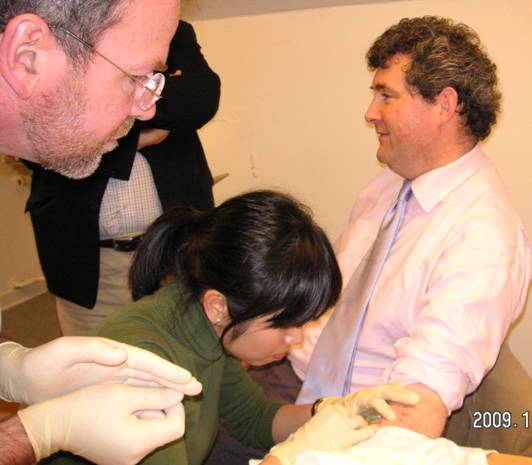
Dr. Wen Lynn Ho inserts a microdialysis catheter into the skin on my left forearm under the watchful eye of Professor Bart Ramsey. I do not suffer from psoriasis myself but I acted as a control in this study – for comparison.

Psoriasis is a chronic skin disease resulting from abnormal immune function and is characterized by the presence of scaly psoriatic plaques which are areas of inflammation and excessive skin production. The exact cause remains unknown but the brain may be involved given that stress can trigger psoriatic flares.

In my latest research at the University of Limerick (UL) Medical School, I have been leading  a team who have successfully applied a new method of monitoring chemicals in the body – a method known as microdialysis – which has the potential to revolutionise the diagnosis and treatment of this disease

Microdialysis involves the temporary insertion of microscopic hollow tubes or artificial blood vessels through the skin. Artificial blood (or Ringer) solution is then passed through the tubes at a very slow rate allowing any chemicals or biological markers to be trapped and carried away by microdialysis catheters and collected.

What is revolutionary about this technique is that it can go into the living skin. We can measure skin chemistry in real-time without any drugs. This is the first time inIreland that skin chemistry has been measured by microdialysis. Currently the only way to monitor skin chemistry is by biopsy.  However, as biopsy involves punching a hole in the skin causing damage and wound formation, it does not provide a real-time physiological picture as the skin tested is dead.

By putting these tiny artificial blood vessels into the skin and fooling the skin into thinking that these are real blood vessels, we can extract chemicals without doing any damage.

Read more:

Rapid quantification of histamine in human psoriatic plaques using microdialysis (article in press, Journal of Chromatography)

 (article in press, Journal of Chromatography)

Related Article:

UL discovery could replace biopsies

Mobile health trends for 2012

doctor using ipad

Brian Edwards, mHealth feature editor at iMedicalApps highlights five mobile trends in healthcare to look for in 2012.

1. Apps that track patient activity. Edwards said the ability to track patient data on a phone will have many benefits in the year to come. “How many phone calls they take, where they are, and … their activity level” can be “surefire” indicators of patients’ conditions, he said. “Especially with chronic conditions like diabetes; when there’s a flare-up, it’s integral to know when … it’s like a check-engine light for the body.” On his blog, Edwards explained how apps of this nature can be beneficial for other patient subsets, like autistic children. For example, body sensor technology has been developed to detect and record signs of stress in children, “by measuring slight electrical changes in the skin,” Edwards wrote. “Since autistic children have a difficult time expressing or even understanding their emotions, teachers and caregivers can have a difficult time anticipating and preventing meltdowns.”

2. Binary network apps. Binary network apps, or apps that track peripheral devices, will possibly be the biggest trend in 2012, said Edwards. “I think that’s going to be something that’ll be the first big business in mobile health,” he said. “Wearable censors, or apps that fit into the diagnostic process in an ambulatory setting. It’s the ability to take the iPhone and a patient with a T-shirt with a built-in censor and keep track of their vitals all day.” This enables techs and caregivers to “see triggers,” said Edwards, while the app sends an alarm depending on a predetermined threshold for the patient. “It’s powerful,” he added.

3. Health-focused games. “Everyone’s trying to game-ify everything,” said Edwards. He referenced Games for Health, which uses games and gaming technology to improve health and healthcare. Organizations such as the University of Southern California have also studied turning simple games into “stealth health,” said Edwards – and had success doing so. “People love to play games – it’s something across all ages and it’s more enjoyable. If the questions are in the form of a funny little game, and you don’t even realize you’re answering the questions you’re answering, it’s going to be easier to answer the question and comply.”

4. Apps that diagnose and treat patients. On his blog, Edwards mentioned a number of start-ups making progress in developing innovative body area network (BAN) technologies. For example, a device aimed at more efficient EEG data collection uses a miniature electronics box attached to a light, head harness, and electrodes to monitor a patient while he/she sleeps. “The device has HIPAA compliant security for easy transfer of data via the Internet,” he added. A similar tool, designed for the diagnosing and monitoring of epileptic patients, allows for continuous brain wave monitoring. “The patient app guides the user through the application of the body worn sensors, which can currently include up to 16-channels of EEG data. Once the patient has applied the body worn sensors, they simply pair the sensors and peripheral device via Bluetooth with the app and go about their day while the data is continuously captured and sent to remote server,” Edwards wrote.

5. Apps that empower patients. Tools that help consumers make health-related decisions will be popular in the upcoming years. On his blog, Edwards documented apps that take publicly available information from government and non-profit grounds and divide it into categories, such as healthcare facilities, medical suppliers and prescription drugs. “Using the phone’s geo-location, an individual can enter his or her ZIP code and find provider facilities in their area,” he wrote. “By utilizing the Center for Medicare and Medicaid’s Hospital Compared database, users can review ratings for all facilities, details on quality of care and patient services, as well as what coverage is provided for Medicare and Medicaid recipients.”

Source: Health Care IT News

Inside the teenage brain

In this brain video Dr. Greg Berns talks about a new study using brain imaging to study teen brain development. It turns out that adolescents who engage in dangerous activities have frontal white matter tracts that are more adult in form than their more conservative peers.

Risky Behavior in Adolescents May Signal Mature Brain 

PLoS Journal Article: “Adolescent Engagement in Dangerous Behaviors Is Associated with Increased White Matter Maturing of Frontal Cortex”

Weekly Round Up

Image Source: The Dana Foundation

Our senses of sight and hearing work closely together, perhaps more than people realize, a new UCLA psychology study shows.

A team of neurobiologists  has shown for the first time that cortex, the largest area of the brain that is typically associated with higher functions such as perception and cognition, is also a prominent site of emotional learning.

Tiny electric currents applied across regions of the brain can improve hand movements in recovering stroke patients for a short period, an Oxford University study has demonstrated.

For the first time, scientists have proven that cannabis harms the brain. But the same study challenges previously-held assumptions about use of the drug, showing that some brain irregularities predate drug use.

How might keeping patients awake during surgery lead to the more successful removal of brain tumours? James Keidel, in his shortlisted entry for the 2011 Wellcome Trust Science Writing Prize, explains.

Researchers from the University of Bristol have discovered that a chemical compound in the brain can weaken the synaptic connections between neurons in a region of the brain important for the formation of long-term memories. The findings, published in the Journal of Neuroscience, may also provide a potential explanation for the loss of memory associated with Alzheimer’s.