Weekly Neuroscience Update

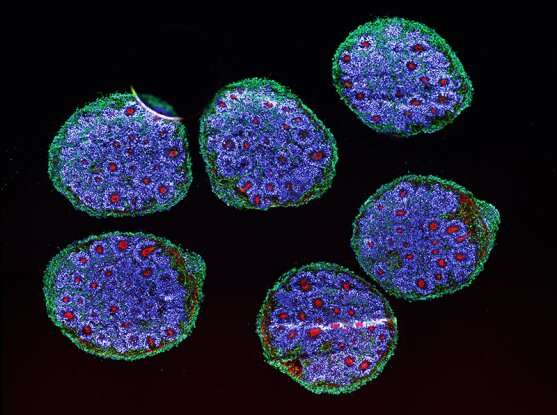
Human brain organoids showing neurons and their dendrites (green), telencephalic (forebrain) cells (blue), and a kind of cell-cell contact called tight junctions (red). By Allessandra DiCorato A single-cell analysis of 3D models of the human cerebral cortex suggests they can be used to study important brain processes that have been difficult to investigate. Credit: Noelia Anton Bolanos and Irene Faravelli

Researchers have found that human brain organoids replicate many important cellular and molecular events of the developing human cortex, the part of the brain responsible for movement, perception, and thought.

Loneliness, restless sleep, and unhappiness have a significant effect on biological aging, a new study reports.

A Brazilian study published in the journal PNAS describes some of the effects infection by SARS-CoV-2 can have on the central nervous system. A preliminary version (not yet peer-reviewed) posted in 2020 was one of the first to show that the virus that causes COVID-19 can infect brain cells, especially astrocytes. It also broke new ground by describing alterations in the structure of the cortex, the most neuron-rich brain region, even in cases of mild COVID-19.

New research reveals how changes in pupil size affect the way we perceive our surroundings.

Human Brain Project (HBP) researchers have identified a new marker for predicting the clinical outcome of patients with Amyotrophic Lateral Sclerosis (ALS) through magnetoencephalography. This marker can be measured in the brain during its resting state and highlights the importance of brain flexibility for ALS patients.

A new theory of consciousness suggests decisions are made unconsciously, then about half a second later, they become conscious.

Strenuous cognitive work leads to an accumulation of glutamate in the prefrontal cortex, according to new research published in the journal Current Biology. The new findings suggest that mental fatigue is a neuropsychological mechanism that helps to avert the build-up of potentially toxic byproducts of prolonged cognitive activity.

A research team has identified a specific cell group in the brain responsible for shifts in the sleep-wake rhythm caused by psychostimulants.

Amid much speculation and research about how our genetics affect the way we age, new research shows that individual differences in our DNA matter less as we get older and become prone to diseases of aging, such as diabetes and cancer.

Finally, this week, listening to birdsong reduces anxiety and paranoia, a new study reports.

Weekly Neuroscience Update

Researchers have presented new findings which found after one session of aerobic exercise people showed reduced cravings for alcohol, lower levels of stress, and improvements in mood.

When our eyes move during REM sleep, we’re gazing at things in the dream world our brains have created, according to a new study. The findings shed light not only into how we dream, but also into how our imaginations work.

Measuring how the eyes’ pupils change in response to light—known as the pupillary light reflex—could potentially be used to screen for autism in young children, according to a new study.

Researchers have made an important discovery about the way our brains process the sensations of sound and touch. They found that sensory systems in the brain are closely interconnected, with regions that respond to touch also involved when we listen to specific sounds connected to touching certain objects.

A study into the effect of surprise on our memory has inadvertently discovered a method that might help us to perform better in exams.

Scientists have uncovered how dopamine connects subregions of the striatum essential for habit formation, findings that may change the overall understanding of how habits are formed—and could be broken.

New research finds the brains of people playing online video games synchronize, even when there is a physical distance between the players.

By estimating people’s brain age from MRI scans using machine learning, a team of researchers has identified multiple risk factors for a prematurely aging brain. They found that worse cardiovascular health at age 36 predicted a higher brain age later in life, while men also tended to have older brains than women of the same age, as they report in The Lancet Healthy Longevity.

Young people with 22q11.2 Deletion Syndrome have distinct and marked EEG differences in brain activity during sleep, which could influence psychiatric symptoms.

Tight control of blood sugar in teens with Type 1 diabetes may help reduce the disease’s damaging effects on the brain, effects which have been shown even in younger children, according to a study published in Nature Communications.

Tests of the brain’s electrical activity have revealed fentanyl’s effects over time and indicated that the drug stops people’s breathing before other noticeable changes and before they lose consciousness.

A newly developed artificial intelligence model can detect Parkinson’s disease by reading a person’s breathing patterns. The algorithm can also discern the severity of Parkinson’s disease and track progression over time.

A new study reveals how a molecule produced by astrocytes interferes with normal neuron development in a range of neurodevelopmental disorders.

People with an obsessive urge to constantly check the news are more likely to suffer from stress, anxiety, as well as physical ill health, finds a new study published in the peer-reviewed journal Health Communication.

Finally this week, the impact of breathing diesel exhaust fumes may be more severe for females than males, according to new research.

Weekly Neuroscience Update

For the first time, a team of international scientists has studied the development of the main immune cell population residing in the human brain, called microglia, on human tissue.

Scientists have uncovered a molecular pathway that distills threatening sights, sounds and smells into a single message: Be afraid. A molecule called CGRP enables neurons in two separate areas of the brain to bundle threatening sensory cues into a unified signal, tag it as negative and convey it to the amygdala, which translates the signal into fear. The research, published in Cell Reports on August 16, 2022, may lead to new therapies for fear-related disorders such as post-traumatic stress disorder (PTSD) or hypersensitivity disorders such as autism, migraines and fibromyalgia.

Researchers have identified a new type of retinal ganglion cell, the neurons in the retina that encode the visual environment and transmit information back to the brain.

Children who sleep less than 9 hours per night have significant differences in brain regions associated with memory, intelligence, and well-being compared to their peers who sleep 9 or more hours per night. Less sleep in children was also associated with increased risks of depression, anxiety, and impulsive behaviors.

A new study finds that Alzheimer’s disease disrupts at least one form of visual memory by degrading a newly identified circuit that connects the vision processing centers of each brain hemisphere.

Leisure activities, such as reading a book, doing yoga and spending time with family and friends may help lower the risk of dementia, according to a new meta-analysis published in the August 10, 2022, online issue of Neurology.

Finally this week, a novel study reports the dynamics of consciousness may be understood by a newly developed conceptual and mathematical framework.

Weekly Neuroscience Update

 Clock proteins generating cyanobacterial circadian rhythms. Credit: NINS/IMS

Scientists want to increase their understanding of circadian rhythms, those internal 24-hour biological clock cycles of sleeping and waking that occur in organisms, ranging from humans to plants to fungi to bacteria. Now a research team has examined the complex workings of cyanobacteria and can better comprehend what drives its circadian clock.

A new study published is the first to look at multiple levels of biology within women with postpartum depression (PPD) to see how women with the condition differ from those without it.

There are five different diseases that attack the language areas in the left hemisphere of the brain and slowly cause progressive impairments of language known as primary progressive aphasia, reports a new study.

A team of scientists has discovered how working memory is “formatted”—a finding that enhances our understanding of how visual memories are stored. 

People whose brains release more of the neurochemical oxytocin are kinder to others and are more satisfied with their lives. This is the finding of new research, published in Frontiers in Behavioral Neuroscience, that also discovered that oxytocin release increases with age, showing why, on average, people are more caring as they get older.

A genetic study involving thousands of people with bipolar disorder has revealed new insight into the condition’s molecular underpinnings.  

One of the most important molecules in the brain doesn’t work quite the way scientists thought it did, according to new work by researchers. The results, published April 20 in Nature, may aid the development of a new generation of more effective neurological and psychiatric therapies with fewer side effects.

Alzheimer’s Disease could be caused by damage to a protective barrier in the body that allows fatty substances to build up in the brain, newly published research argues.

Researchers have established for the first time a link between depressive disorders and mechanical changes in blood cells.

Nearly half of all older adults now die with a diagnosis of dementia listed on their medical record, up 36% from two decades ago, a new study shows.

Finally this week, epigenetic markers of cognitive aging can predict performance on cognitive tests later in life, according to a study published in the journal Aging.

Weekly Neuroscience Update

Running may be a useful activity to undertake for better mental health. Researchers have found that only ten minutes of moderate-intensity running increases local blood flow to the various loci in the bilateral prefrontal cortex —the part of the brain that plays an important role in controlling mood and executive functions.

New research reveals how our immune cells use the body’s fat stores to fight infection. The research could help develop new approaches to treating people with bacterial infections.

Recent cannabis use is linked to extremes of nightly sleep duration—less than 6 hours or more than 9 hours—reveals a study of a large representative sample of US adults, published online in the journal Regional Anesthesia & Pain Medicine.

The risk of developing multiple sclerosis increases 32 fold following Epstein-Barr virus infection.

Living alone for several years and/or experiencing serial relationship break-ups are strongly linked to raised levels of inflammatory markers in the blood–but only in men–finds a large population study published online in the Journal of Epidemiology & Community Health.

Long before the onset of dementia, there is evidence for increased activity of the brain’s immune system. Researchers came to this conclusion based on a study of more than 1,000 older adults. 

Sleep deprivation increases the levels of serotonin 2A neurotransmitter receptors within 6 – 8 hours. Abnormal serotonin 2A receptor function is associated with hallucinations, cognitive impairment, and is linked to psychiatric disorders such as schizophrenia.

Finally this week, work plays an active role in keeping the brain healthy and retaining cognitive abilities as we age, researchers report.

Weekly Neuroscience Update

New artificial intelligence technology reveals previously unknown cell components. The findings may shed new light on human development and diseases.

A new mathematical model explains how the brain has the ability to continuously acquire new skills, specifically movement-based skills, without forgetting or degrading old ones. The theory, dubbed COIN, suggests identifying current context is key to learning how to move our bodies when acquiring skills.

Playing video games that are heavy on action can make you better at some new tasks. New research reveals that these games are helping by teaching players to be quicker learners.

The “background noise” in the brain disrupts long-memory signals by neurons. This noise interrupts the consistent rhythm of long-memory alpha wave signals in people experiencing identity confusion.

Memory errors may indicate a way in which the human cognitive system is optimally running, researchers say.

Housework is linked to sharper memory, attention span, and better leg strength, and by extension, greater protection against falls, in older adults, finds research published in the open access journal BMJ Open.

Repetitive transcranial magnetic stimulation (rTMS) can be used to modulate brain rhythms and cognitive behaviors related to “giving up” during problem-solving tasks.

New research reveals that specialized cells within neural circuitry that triggers complex learning in songbirds bears a striking resemblance to a type of neural cell associated with the development of fine motor skills in the cortex of the human brain.

Finally this week, a new study links a propensity to binge-watch TV shows with personality traits. Researchers found those who lack impulse control and emotional clarity are most likely to binge-watch a television series.


Weekly Neuroscience Update

Image Credit: Dartmouth College

Distinct information about familiar faces is encoded in a neural code that is shared across brains, according to a new study published in the Proceedings of the National Academy of Sciences.

A new study conducted in adults with a history of childhood maltreatment showed that two groups – those with a history of sexual abuse and those with posttraumatic stress disorder (PTSD) – had reduced brain connectivity in the attention systems known as the ventral and dorsal attention network (VAN-DAN).

New findings reveals dopamine neurons that play a role in learning and memory also drive motivation.

For the first time, researchers have used human data to quantify the speed of different processes that lead to Alzheimer’s disease and found that it develops in a very different way than previously thought. Their results could have important implications for the development of potential treatments.

Musical therapy can help to improve fine motor skills in patients with Parkinson’s disease according to new research. 

A genetic predisposition for depression combined with exposure to high-particulate-matter air pollution greatly elevates the risk that healthy people will experience depression, according to a first-of-its-kind study published in the Proceedings of the National Academies of Sciences (PNAS).

Recently published research found people who continued to spend a higher amount of time sitting between April and June 2020 were likely to have higher symptoms of depression.

A new study, published in the International Journal of MS Care, found that the vibration training improved not only physical symptoms associated with multiple sclerosis, such as increased walking speeds, but also cognitive functions, such as memory capacity and executive function.

A newly developed AI algorithm can directly predict eye position and movement during an MRI scan. The technology could provide new diagnostics for neurological disorders that manifest in changes in eye-movement patterns.

A team of researchers has found a possible connection between depression and anxiety for IBD patients and the vascular barrier in the brain choroid plexus closing. In their paper published in the journal Science, the group describes their study of the gut-brain axis response to inflammation and its link to psychiatric illnesses.

Researchers have created the first body map of sensations experienced during hallucinations in people experiencing psychosis.

Recent resarch reveals the severity of PTSD symptoms was associated with fewer risky choices and increased activation of the amygdala. Decreased activity in the ventral striatum, an area of the brain associated with processing positive valence such as reward, predicted more severe PTSD symptoms 14 months post-trauma.

Finally this week, people who consume a diet containing anti-inflammatory foods, including fruits, vegetables, and coffee, are less likely to develop dementia as they age, a new study reports.


Weekly Neuroscience Update

Researchers have investigated why many of us wake in the middle of the night and dwell on our fears.

In response to gut inflammation, such as that caused by inflammatory bowel disease (IBD), the vascular barrier in the brain choroid plexus closes, locking down access to the brain, according to a new study.

A multiyear study of older adults found that both short and long sleepers experienced greater cognitive decline than people who slept a moderate amount, even when the effects of early Alzheimer’s disease were taken into account.

A brain circuit that works as a “brake” on binge alcohol drinking may help explain male-female differences in vulnerability to alcohol use disorders, according to a preclinical study led by scientists at Weill Cornell Medicine.

The Mediterranean diet does not only have beneficial effects for the cardiovascular health of those who follow it, but it can allow them to improve their memory and prevent or delay the effects of cognitive deterioration connected to aging. 

People with higher levels of anxiety have altered perceptions of their breathing compared to those with lower levels of anxiety. The altered perception of respiration can lead to an increase in feelings of anxiety, researchers report.

Finally this week researchers reveal the neurobiological basis of why we often find it more difficult to find the right words as we age.


Weekly Neuroscience Update

With normal (top) and reduced SLK expression (bottom). Without SLK, dendrites branch less; moreover, the number of inhibitory synapses (green) decreases. Credit: Institut für Neuropathologie/Uni Bonn

Researchers have shed light on the function of the enzyme SLK for the development of nerve cells in the brain. Lack of the SLK protein results in less abundant dendrites. As a lack of SLK is apparent in many patients with epilepsy, the findings could pave the way for new treatments for those suffering from the neurological disorder.

Adults who experienced traumatic events, including abuse and household dysfunction, as children had an increased risk of developing neurological conditions later in life.

Researchers have designed new antibodies that might provide more effective treatment methods for Alzheimer’s disease. By designing antibodies that bind even to the smaller aggregates, or clumps, of the amyloid-beta protein, it may be possible to check the progress of the disease.

A new study traces the mechanisms that link environmental signals and our circadian clocks.

Adolescents can speed their recovery after a sport-related concussion and reduce their risk of experiencing protracted recovery if they engage in aerobic exercise within 10 days of getting injured, according to a new study.

A new study reports a reduction of atmospheric fine particulates and better air quality can reduce the risk of Alzheimer’s and other dementias.

A team of researchers has partially solved the mystery of why some people are less naturally resistant to COVID-19 than others. In their paper published in the journal Science, the group describes their study of the interferon system and the role it plays in combating the SARS-CoV-2 virus.

Finally this week, researchers have identified a brain rhythm associated with emotional conflict that appears to be a biomarker for anxiety disorder.


Weekly Neuroscience Update

Is music really a “universal language”? Two articles in Science support the idea that music all around the globe shares important commonalities, despite many differences.

Researchers studying six adults who had one of their brain hemispheres removed during childhood to reduce epileptic seizures found that the remaining half of the brain formed unusually strong connections between different functional brain networks, which potentially help the body to function as if the brain were intact. 

Excessive exposure to certain antibiotics can predispose a person to Parkinson’s disease, with a delay of onset of up to 15 years.

Findings debunk the common theory that attention is the only cognitive function affected by sleep deprivation. Lack of sleep also hinders a person’s ability to complete activities that require following multiple steps.

A new study reveals how the insular cortex helps assess and predict physiological states of the body. The findings shed light on the neural basis for interoception.

Finally this week, neuroscientists have discovered how the listening brain scans speech to break it down into syllables. The findings provide for the first time a neural basis for the fundamental atoms of language and insights into our perception of the rhythmic poetry of speech.