Weekly Neuroscience Update

Scientists have shown that the hypothalamus, a key region of the brain involved in controlling appetite, is different in the brains of people who are overweight and people with obesity when compared to people who are a healthy weight.

Researchers have shown in lab-based experiments that variants of SARS-CoV-2, the virus that causes COVID-19, can affect the blood-brain barrier and damage brain cells in different ways.

Unlike previously thought, speech production and singing are supported by the same circuitry in the brain. Observations in a new study can help develop increasingly effective rehabilitation methods for patients with aphasia.

Scientists have discovered an additional potential cause of the genetic mutations that result in rare conditions such as Huntington’s disease (HD).

Neuroscientists report the first results from experimental tests designed to explore the idea that “forgetting” might not be a bad thing, and that it may represent a form of learning—and outline results that support their core idea.

The largest-ever study of the genetics of the brain—encompassing some 36,000 brain scans—has identified more than 4,000 genetic variants linked to brain structure.

A first-in-human trial of deep brain stimulation (DBS) for post-stroke rehabilitation patients has shown that using DBS to target the dentate nucleus—which regulates fine-control of voluntary movements, cognition, language, and sensory functions in the brain—is safe and feasible.

New research finds that genetic risk for higher blood pressure even in those in their 40s and 50s may contribute to poorer cognitive function.

An obscure class of molecules, part of the vast system that helps the human body distinguish “self” from “non-self,” may also hold the key to stopping SARS-CoV-2 from commandeering healthy cells, scientists have found in a series of experiments.

Scientists have discovered how HIV hijacks intracellular processes to proliferate and contribute to neurodegeneration, according to a new study published in Nature Communications.

Researchers have discovered a potential breakthrough for people with myalgic encephalomyelitis/chronic fatigue syndrome (ME/CFS), marked by extreme exhaustion, post-exertional malaise and cognitive issues.

Finally this week, in a small, exploratory study, levels of certain types of microbes in babies’ guts have been shown to be associated with performance in tests of early cognitive development.
Weekly Neuroscience Update

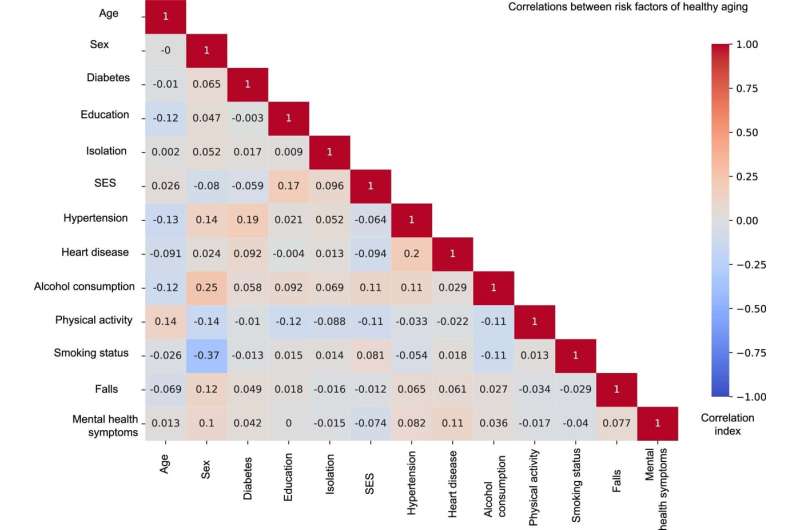
Factors associated with healthy aging in Latin American populations. Credit: Nature Medicine (2023)

Researchers at Trinity College Dublin studying the factors influencing healthy brain aging in Latin American and Caribbean (LAC) countries find the lessons learned there, can also be applied to home.

Immune cells in the brains of people who had Alzheimer’s disease appear to behave differently than those who had healthy brains for their age, according to an analysis of the cells’ gene activity. The finding suggests it might be possible to treat Alzheimer’s disease by altering the behavior of these cells.

The longer a person has type 2 diabetes, the more likely they may be to experience changes in brain structure, a new study finds.

Using human “mini-brain” models known as organoids, scientists have discovered that the roots of autism spectrum disorder may be associated with an imbalance of specific neurons that play a critical role in how the brain communicates and functions. The specific cells are known as excitatory cortical neurons.

Psilocybin, the active ingredient in psychedelic mushrooms, shows promise for the transitional treatment of episodic migraines in early clinical trials, according to a recent review.

Researchers have discovered that a neural marker of error detection in the brain’s visual system previously considered pre-attentive may actually require attention and that subtle visual irregularities may be revealed by other neural markers.

A new study has demonstrated that self-organization of neurons as they learn follows a mathematical theory called the free energy principle.

The neural network related to speech is mostly located in the left cerebral hemisphere, while singing has been primarily associated with the structures of both hemispheres. However, a new study indicates that the left hemisphere has a greater significance, including in terms of singing, than previously thought.

A new digital headset designed to measure alterations in brain function could change decisions about how quickly an athlete is ready to return to play after a concussion.

A new study suggests stimulating the sense of smell can boost memory. Older adults exposed to odors while they slept performed better on verbal memory tests and showed improved function in a brain pathway that supports memory formation, according to the study, published in the journal Frontiers in Neuroscience.

Finally this week, researchers have shown that machine learning can accurately predict subtypes of Parkinson’s disease using images of patient-derived stem cells.

Weekly Neuroscience Update

A new study sheds light on gender differences in risk-taking behavior. The research reveals women are more averse to risk than men due to heightened sensitivity to potential losses. Conversely, men, exhibiting greater optimism, are more willing to engage in risk-taking.

Researchers have identified specific brain network connections associated with anosognosia, a condition where patients are unaware of their neurological or psychiatric deficits.

Scientists have discovered children’s ability to process emotional cues is largely established by the time they start school. Analyzing brain scans from children aged five to 15, the study revealed that such brain activity becomes increasingly similar to their peers as they reach adolescence. The research emphasizes the importance of early intervention to address issues related to understanding emotional cues.

Recent neuroscience studies underscore the profound impact of sleep and sleep disorders on memory.

In a paper published in Science Advances, an international team reveal the discovery of sequence variants in the gene ABCC9 that influence the pitch of voices. The scientists found that ABCC9 variants associate with higher voice pitch in both men and women. The same sequence variants are also linked to higher pulse pressure, a cardiovascular risk factor, highlighting links between voice pitch and health-related traits.

Researchers have discovered a promising new avenue for treating glioblastoma, a deadly brain cancer.

Research led by the University of Texas Health Science Center, San Antonio, Texas, has looked into premature brain aging in individuals with type 1 diabetes. The findings of this study show an increase in brain aging among individuals with type 1 diabetes without any early signs of AD-related neurodegeneration. These increases were associated with reduced cognitive performance, but according to the authors, the abnormal patterns observed in the samples were modest.

Finally this week, intricate links between breathing and memory recall have been unraveled by recent scientific research, painting a more complex picture of our cognitive processes.

Weekly Neuroscience Update

A new study shows that walking can enhance connections within and between three critical brain networks, one of which is linked to Alzheimer’s disease. The research, involving older adults with normal cognitive function and those with mild cognitive impairment, showcased an improvement in memory recollection abilities after a 12-week walking exercise regimen. The brain activity observed was stronger and more synchronized post-exercise, providing hope for combating cognitive impairment and potentially delaying the onset of Alzheimer’s dementia.

Most antidepressants used for chronic pain are being prescribed with “insufficient” evidence of their effectiveness, scientists have warned.

Researchers have found a correlation between patients with rheumatoid arthritis and Parkinson’s disease. In their paper published in JAMA Neurology, researchers found a significantly higher risk of Parkinson’s disease (PD) in patients with rheumatoid arthritis (RA).

Researchers have delved into the brain’s grey and white matter, investigating the impacts of fibromyalgia. Using MRI, the team detected reduced grey matter volume in the pain-processing areas of fibromyalgia patients.

Neuroscientists have discovered how vitamin D deficiency impacts the development of neurons, contributing to disorders such as schizophrenia. These findings underscore the importance of vitamin D in the structural differentiation of dopaminergic neurons and suggest that maternal vitamin D deficiency might alter how early dopaminergic circuits form.

Finally this week, researchers have cracked the mystery behind how the Botulinum neurotoxin type-A, also known as Botox, infiltrates neurons. 

Weekly Neuroscience Update

Credit: Nature Communications (2023). DOI: 10.1038/s41467-023-38248-4

Scientists have found that the gut microbiome holds Parkinson’s disease markers and may indicate a method of early diagnosis.

Deep sleep, also known as non-REM slow-wave sleep, may help reduce memory loss in older adults facing a heightened burden of Alzheimer’s disease. The research indicates that superior amounts of deep sleep can act as a protective factor against memory decline in those with existing high amounts of Alzheimer’s disease pathology, potentially helping to alleviate some of dementia’s most devastating outcomes.

Researchers have discovered new genetic risk factors for non-Alzheimer’s dementia, specifically Lewy body dementia (LBD) and frontotemporal dementia (FTD).

Scientists have made strides in uncovering the mechanisms underlying memory formation and consolidation in the brain during rest or sleep. A new study focuses on the role of the hippocampus, a brain region important for memory, and its place cells which “replay” neuronal sequences. The researchers built an artificial intelligence model to better understand these processes, discovering that sequences of experiences are prioritized during replay based on familiarity and rewards. The AI agent was found to learn spatial information more effectively when replaying these prioritized sequences, offering valuable insight into the way our brains learn and process information.

New research finds that the brains of otherwise healthy military personnel who are exposed to explosions show an abnormal brain accumulation of amyloid-beta protein—a protein that plays a role in the development of Alzheimer’s disease.

A new study has found that people with a genetic risk for psychosis have an imbalance of glutamate and GABA neurotransmitters in their brains, specifically in the hippocampus. This imbalance is associated with hippocampal atrophy, which may lead to the development of psychotic symptoms.

Researchers have developed human brain organoids that contain microglia, the immune cells of the brain. These organoids allow researchers to study how microglia develop and function in a more realistic setting than previous models.

Researchers used artificial intelligence to analyze speech in Parkinson’s disease patients, revealing distinct patterns. The AI found Parkinson’s patients used more verbs but fewer nouns and fillers in their speech, even before cognitive decline typically associated with PD was evident.

A research team has found that the risk of long COVID and its symptoms present very differently across diverse populations.

A new study sheds light on the potential role of diet in preventing dementia. The analysis explored the relationship between gut health and Alzheimer’s disease, uncovering a strong link between specific types of gut bacteria and the likelihood of developing dementia. The findings highlight the significance of gut microbiota in brain health and provide insights into the underlying mechanisms of Alzheimer’s disease.

Finally this week, researchers have created a revolutionary device that emulates the human eye’s ability to see colour.


Weekly Neuroscience Update

Researchers used diffusion tensor imaging, which indicates the directionality of water diffusion in the brain, to examine how white matter connections lose integrity. These frontostriatal tracts are shown moving anterior to posterior (green), left to right (red) and superior to inferior (blue). Image is credited to the researchers.

As the human brain ages, the neural circuits that allow its different parts to communicate with each other gradually wear down, even in healthy adults.

Genetic risk score for bipolar disorder is associated with an increased risk of developing bipolar symptoms. The genetic risk factor for schizophrenia is linked to an increased risk of those with depression developing psychosis.

A new study into the causes of sensorimotor impairments prevalent among autistic people could pave the way for better treatment and management in the future, say psychologists.

New research details how the complex set of molecular and fluid dynamics that comprise the glymphatic system – the brain’s unique process of waste removal – are synchronized with the master internal clock that regulates the sleep-wake cycle. 

Future technology may be able to monitor and modify the brain to produce enhanced team performance, while increasing the efficiency and accuracy of decisions.

Parkinson’s disease can be divided into two variants that start in different places in the body. For some, the neurodegenerative disease starts in the intestines and spreads to the brain. In others, the disease begins in the brain and spreads to the intestines and other organs.

New research released from the University of Colorado Anschutz Medical Campus proposes that Alzheimer’s disease may be driven by the overactivation of fructose made in the brain.

Anticholinergic medications, commonly used for conditions including allergies, high blood pressure, Parkinson’s disease, and motion sickness, have been linked to an increased risk of cognitive decline and memory problems, especially in those with genetic risk factors for Alzheimer’s disease.

Finally this week, a new study links brain structure to color perceptual function. Microscopy revealed ‘hue maps,’ or color palettes, in the brain that are spectrally organized arrangements of hue responses.


Weekly Neuroscience Update

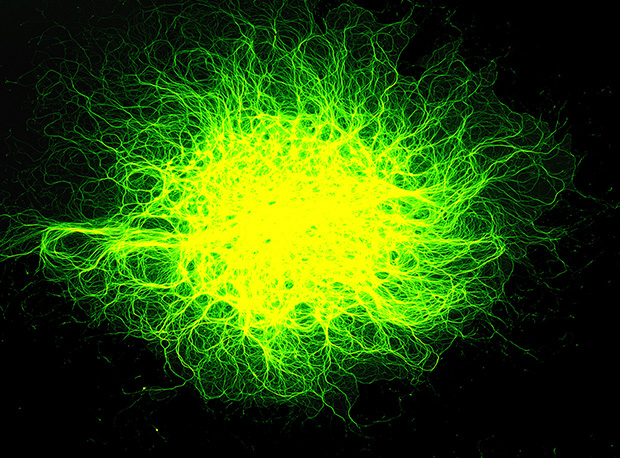
To study how nerve cells respond to injuries in their branches, Washington University researcher Valeria Cavalli grows them in “spots” like the one shown above. Cavalli recently identified a chain reaction that enables repair of these branches when they are cut. Credit Yongcheol Cho/Washington University at St. Louis.

To study how nerve cells respond to injuries in their branches, Washington University researcher Valeria Cavalli grows them in “spots” like the one shown above. Cavalli recently identified a chain reaction that enables repair of these branches when they are cut. Credit Yongcheol Cho/Washington University at St. Louis.

Researchers have identified a chain reaction that triggers the regrowth of some damaged nerve cell branches, a discovery that one day may help improve treatments for nerve injuries that can cause loss of sensation or paralysis.

Groundbreaking research nearly two decades ago linking a mother’s educational background to her children’s literacy and cognitive abilities stands out among decades of social science studies demonstrating the adverse effects of poverty. Now new research has taken that finding in a neuroscientific direction: linking poor processing of auditory information in the adolescent brain to a lower maternal educational background.

A review of new research says there is growing evidence to support the idea that the brain plays a key role in normal glucose regulation and the development of type 2 diabetes.

University of Queensland (UQ) scientists have made a fundamental breakthrough into how the brain decodes the visual world.

Cocaine addicts may become trapped in drug binges not because they are always seeking euphoric highs but rather to avoid emotional lows, says a study in Psychopharmacology.

Researchers have developed a therapeutic at-home gaming program for stroke patients who experience motor weakness affecting 80 percent of survivors.

Learning a musical instrument as a child gives the brain a boost that lasts long into adult life, say scientists.

The birth of new neurons depend upon activation of an important molecular pathway in stem cells, a new Yale School of Medicine study shows.

Researchers have taken a major step towards understanding the causes of Alzheimer’s disease with the largest study yet into the genetics of the disorder.

Light enhances brain activity during a cognitive task even in some people who are totally blind, according to a new study.

Scientists have discovered biological mechanisms that may link Parkinson’s disease to Alzheimer’s disease, according to a study published in the journal Acta Neuropathologica.


Weekly Round Up

The neuroscience of dreaming

In this week’s round-up of the latest discoveries in the field of neuroscience – the neuroscience of dreaming and eureka moments, the teenage brain and new research into Parkinson’s and Alzheimers.

Scientists have long puzzled over the many hours we spend in light, dreamless slumber. But a new study from the University of California, Berkeley, suggests we’re busy recharging our brain’s learning capacity during this traditionally undervalued phase of sleep, which can take up half the night.

Perhaps while sleeping we are gaining new insight into our problems. A new brain-imaging study looks at the neural activity associated with insight. The research, published by Cell Press in the March 10 issue of the journal Neuron, reveals specific brain activity that occurs during an “A-ha!” moment that may help encode the new information in long-term memory.

I’ve written previously about the brain of a teenager being hot-wired to take risk, but now new research shows that just when teens are faced with intensifying peer pressure to misbehave, regions of the brain are actually blossoming in a way that heighten the ability to resist risky behavior.

Brain scans are being used to spot the early stages of Alzheimer’s disease in a UK-based pilot that could revolutionise its diagnosis. Doctors are using magnetic resonance imaging (MRI) scans to look at whether particular parts of the brain have started to shrink, which is a key physiological sign of Alzheimer’s. The MRI project is an example of “translational research” – that which will have a direct benefit for patients. And in more translational research news, it emerges that in studies of more than 135,000 men and women regular users of ibuprofen were 40% less likely to develop Parkinson’s disease.