Weekly Round Up

Pathways within the brain can be strengthened by reading and language exposure

 Recent research shows that reading  boosts brain pathways and can actually affect understanding in nearly all school subjects – a great reason to encourage the reading habit in your children.

Scientists at the University of Michigan Health System have demonstrated how memory circuits in the brain refine themselves in a living organism through two distinct types of competition between cells. Their results, published  in Neuron, mark a step forward in the search for the causes of neurological disorders associated with abnormal brain circuits, such as Alzheimer’s disease, autism and schizophrenia.

The left and right halves of the brain have separate stores for working memory, the information we actively keep in mind, suggests a study published online yesterday by the Proceedings of the National Academy of Sciences.

Over time, and with enough Internet usage, the structure of our brains can actually physically change, according to a new study.

Bringing the real world into the brain scanner, researchers at The University of Western Ontario from The Centre for Brain and Mind can now determine the action a person was planning, mere moments before that action is actually executed.

And finally good news at last for coffee addicts.For years we’ve been told that caffeinated coffee was bad for us. It’s unhealthy and addictive, doctors warned. But as vindication for all who stuck by their energizing elixir, a new study published early online in the Journal of Alzheimer’s Disease,  shows that guzzling caffeinated coffee may actually be good for our brains. In fact, it may help keep Alzheimer’s at bay.  So enjoy that cuppa joe!

Weekly Round Up

Are teenage brains wired to predict the next big music hit?

The brain is constantly changing as it perceives the outside world, processing and learning about everything it encounters. In a new study, which will be published in an upcoming issue of Psychological Science, scientists find a surprising connection between two types of perception: If you’re looking at a group of objects and getting a general sense of them, it’s difficult for your brain to learn relationships between the objects.

Recent research published in the Journal of Consumer Psychology.suggests that the activity in teen brains may have some Nostradamus-like qualities when it comes to predicting the hits or misses of popular music.

Fear burns memories into our brain, and new research by University of California, Berkeley neuroscientists explains how in findings that have implications for the treatment of PTSD.

Ands speaking of memory…have you forgotten where you put your keys recently? Your brain might be in a better state to recall where you put them at some times than at others, according to new research from UC Davis.

Is the internet changing your brain?

Is the internet changing the way we think?

This Saturday, 11 June, I am looking forward to giving a talk at 3D Camp at the University of Limerick on how the internet is changing our brain. I will be exploring the question of whether our brains are being altered due to our increasing reliance on search engines, social networking sites and other digital technologies.

Using a basic understanding of brain structure (neurology) I will explain the concept of ‘brain plasticity’- the ability of the brain to constantly rewire itself – and will show how all learning changes the shape of the brain, allowing specific areas in the brain to grow or change. I will also be demonstrating how the new ‘cybertherapies’ are being used to help patients suffering from addiction and post traumatic stress disorder back to health.  I believe this new resource has the potential to dramatically improve mental health including new opportunities to learn healthy habits to lift our mood and enhance our brains longevity.

There are still places left on this themed Barcamp which looks at The Internet Beyond Web 2.0. Areas. Attendance is FREE! 

Click here to register

Where is your brain taking you?

Let me take you on a little trip..a trip to the future.

As we enter the 21st Century we need a compelling vision for the human race including our spiritual and mental evolution as understood by the evolution of our brains.  The following insights may strike you as free ranging, radical or even abstract but I believe that the question of human evolution connects perfectly with what many of us are beginning to ask of ourselves and how we might fit into a ‘bigger picture’.

Self-refection IS evolution 

Modern evolutionary theory needs to switch focus to the human mind – not just the physical brain. It is not enough to work out that we evolved from the apes – we now need to focus on how the human psyche is evolving and where it is taking us. Evidence from a branch of science called evolutionary biology shows that the size and shape of the human brain has not changed radically in thousands of years despite huge technological advances. Why is this so? Evidence is mounting that once humans learned to think in a different way by living in a state of reflectiveness our progress was inevitable. By discovering how to harness the full power of the brain – human beings did not just survive but started to enjoy an ‘ultra’ life.

The past is the key to the future

Until recently, the task of applying evolutionary science to the bigger question of human destiny has been avoided by scientists  too wary of speculation. However the emergence of the new discipline of neuroscience – the scientific study of the nervous system – is helping us to bridge this gap by providing new ways to answer old questions.  Neuroscientists have recently discovered that the same brain regions are involved in the processing of memory and in creative thought suggesting that the more we learn and remember the better we can predict the future. 

Science and true science

The great paradox of science is that while its strength is the deep analysis it uses to solve a problem – it can only really come of age when it goes beyond seeing man only in terms of the physical body. True science will see man in his wholeness and as part of a coherent picture of the world. The fact is that neither the sciences nor the humanities have yet to properly explain what it is to be human. True science will probably need to take into account all the challenges, achievements and events of human history as if they were all part of one continuum. This will require a new type of analysis – the origins of which may be seen in the new disciplines called informatics and systems analysis.

Ticket to where?

Humankind is a very young concept – only coined in the last 100 years. It is based on the recognition of unity within the human race – despite all the wars, division of wealth and racism. Contrary to what some people like to think – humankind is not the centre of the world but rather a very actively growing branch of the evolutionary tree. We are not destined to ‘lift ourselves above nature’- but rather to dramatically raise the intelligence and complexity of this thing we call ‘life’ through our intellectual and spiritual evolution. In fact, the more complex and intelligent we become the more we will free ourselves from our physical surroundings (the physical universe).

Personality equals evolution – neurolution

Just as our physical universe – space, the stars and galaxies – is expanding outwards, the same universe can – under the right conditions – also just as naturally ‘focus inwards’ from the simple to the increasingly complex and it is according to this ‘law’ that the human mind also develops.  Is there an end point to us becoming more human or the fulfilment of its potential? The evidence suggests that for us humans – personality equals evolution. 

The neuroscience of US

Every single human being on the planet is unique because they posses a uniquely complex brain. In fact, the brain is so complex that in all of human history no two brains were the same.  Furthermore this unique combination of about 100 trillion tiny connections grows and changes through life – a work in progress from conception to death. In this way we each evolve as we journey through life.

All hands on deck for human evolution

The evolution of the human race is not going to proceed by trying to transcend it – rather we will move forward as a race by making room for everyone to express their personalities to the full.  In this way the evolution of the human race has everything to do with our own personal development. Yet evolution does not happen at an even speed so don’t be alarmed when your subconscious asks you to take that leap; change job, pick a partner or just follow your dream. These great leaps of faith are part of your evolution in your journey through life and following a period of self refection just assure yourself it’s all happening for your own good (and the good of your species!) and go to the next level.

In a series of future blogs I will explore these ideas further including how mental and spiritual evolution is nourished by the network society.
 

In search of memory

Neuroscientist Eric Kandel was a recipient of the 2000 Nobel Prize for his research on the physiological basis of memory storage in neurons. He shared the prize with Arvid Carlsson and Paul Greengard.

Kandel believes that memory is everything and without it we are nothing. Memory is the glue that binds our mental life together and provides a sense of continuity in our lives.

Kandel’s book on the brain for the general public, In Search of Memory: The Emergence of a New Science of Mind, won both the Los Angeles Times and U.S. National Academy of Science Awards for best book in Science and Technology in 2008. A documentary film based on the book, also entitled In Search of Memory, was released in 2010 to critical acclaim.

Weekly Round Up

How does cigarette addiction affect the brain?

The effects of nicotine upon brain regions involved in addiction mirror those of cocaine, according to new neuroscience research.

Aspirin and other anti-inflammatory drugs taken for pain relief may reduce the effectiveness of anti-depressants such as Prozac, say US researchers.

Moments of absent mindedness such as losing your keys could be the result of tiny parts of the brain taking “naps” to recharge, a study finds.Researchers discovered that contrary to popular opinion the brain is not always entirely asleep or awake but parts of it can go “offline”.

Neuroscientists at the California Institute of Technology and their colleagues have tied the human aversion to losing money to a specific structure in the brain-the amygdala.

Music is not only able to affect your mood — listening to particularly happy or sad music can even change the way we perceive the world, according to researchers from the University of Groningen.

The positive effects of mindfulness meditation on pain and working memory may result from an improved ability to regulate a crucial brain wave called the alpha rhythm. This rhythm is thought to “turn down the volume” on distracting information, which suggests that a key value of meditation may be helping the brain deal with an often-overstimulating world. And in other  mindfulness research – fMRI shows how mindfulness meditation changes the decision making process


Anesthesia – a neuroscience phenomenon

How the brain reacts to anesthesia is a neuroscientific phenomenon that includes a dash of mystery. In this fascinating video Emery Brown, Professor of Health Sciences and Technology and Professor of Computational Neuroscience, MIT  and Warren M. Zapol Professor of Anaesthesia, Harvard Medical School Massachusetts General Hospital, sets out to demystify some of the mystery for us.

Sign your name across your brain

THE LATEST OECD survey reveals that almost one-quarter of Irish 15-year-olds are below the level of literacy needed to participate effectively in society. How can this be after unprecedented investment in Irish schools in the past decade?*

Research in neuroeducation – the brain science of learning  suggests that something is lost in switching from book to computer screen, and from pen to keyboard. Neuroeducation may help to explain the reported decline in literary – particularly writing – skills observed in students over the past decade.

When it comes to learning – the pen is mightier than the keyboard

Do you remember that diary you so assiduously kept or that pen pal you wrote to? Little did you know then, but the mere act of picking up a pen and writing makes you smarter.  The answer may be that reading and writing involves a number of the senses. When writing by hand, our brain receives feedback from our motor actions, together with the sensation of manipulating the pencil to form words on paper. This nerve activity is significantly different from those we receive when touching and typing on a keyboard. This explains why a written signature carries so much weight in the legal and business world – because it reflects the wiring unique to that brain.

The knack to learning is – learning by doing

The trick to all learning is to create an enriched physical learning environment by employing as many of the five senses as possible – seeing, hearing, touching, tasting and smelling – in your learning.  Thus, when writing by hand, the movements involved leave behind a kind of motor memory in the sensorimotor part of the brain, which helps us recognize letters. This implies a nerve connection between reading and writing, and suggests that the sensorimotor system plays a role in the process of visual recognition during reading. This nerve connection is weak or absent in keyboard typing.

Work it out – with pen and paper

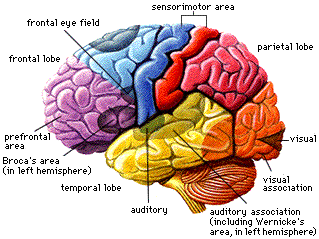
In addition, writing involves more ‘doing’ than that observed for keyboard typing and the ‘doing’ actually reinforces the learning process by helping us focus on the task at hand and strengthening the nerve connections. Furthermore, brain scans of avid writers show an activation of Brocas area – a language centre within the brain – while little or no activation of this area is observed in those who had learned by typing on keyboards.

Awaken the living roots in your head – with your pen

The poet and Nobel Laureate Seamus Heaney – a master craftsman of the written word – was not far off the mark in his poem ‘Digging’. The poem takes the form of a promise from the poet to his father and grandfather, whose lives were, spent literally digging the soil. In this short poem Heaney acknowledges that he is not a farmer, and will not follow their vocation. But at the start of his career, he vows to translate their virtues into another kind of work:

 The cold smell of potato mould, the squelch and slap
Of soggy peat, the curt cuts of an edge
Through living roots awaken in my head.
But I’ve no spade to follow men like them.
Between my finger and my thumb
The squat pen rests.
I’ll dig with it.


 *Irish students drop in rankings for literacy and maths, Irish Times, Wednesday, December 8, 2010

The neuroscience of emotions

Google Tech Talks
September 16, 2008

ABSTRACT

The ability to recognize and work with different emotions is fundamental to psychological flexibility and well-being. Neuroscience has contributed to the understanding of the neural bases of emotion, emotion regulation, and emotional intelligence, and has begun to elucidate the brain mechanisms involved in emotion processing. Of great interest is the degree to which these mechanisms demonstrate neuroplasticity in both anatomical and functional levels of the brain.

Speaker: Dr. Phillippe Goldin