Weekly Neuroscience Update

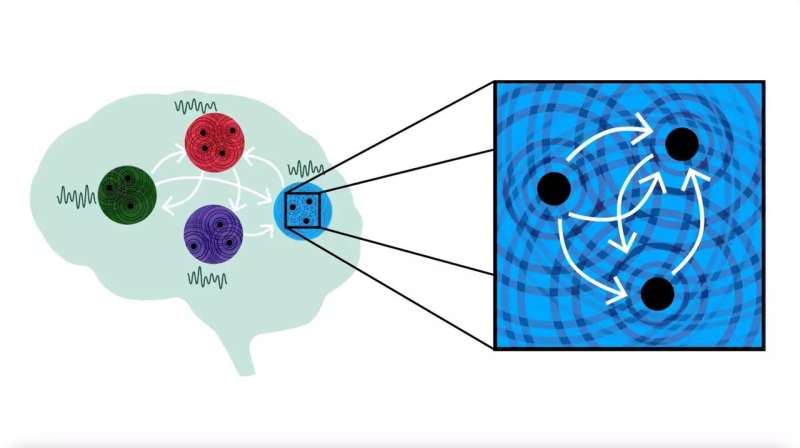
Schematic representation of the “Harmonic Oscillator Recurrent Network Model” (HORN). Credit: ESI

Researchers have made a new discovery in understanding fundamental brain processes. For the first time, the team has provided compelling evidence that the brain’s characteristic rhythmic patterns play a crucial role in information processing. While these oscillatory dynamics have long been observed in the brain, their purpose has remained mostly elusive until now.

Music has the best chance of providing pain relief when it is played at our natural rhythm, a McGill University research team has discovered.

Tiny plastic particles may accumulate at higher levels in the human brain than in the kidney and liver, with greater concentrations detected in postmortem samples from 2024 than in those from 2016, suggests a paper published in Nature Medicine. Although the potential implications for human health remain unclear, these findings may highlight a consequence of rising global concentrations of environmental plastics.

The first-ever ethics checklist developed for portable MRI brain researchers.

A team of scientists from the Center for Neuroscience Imaging Research (CNIR) at the Institute for Basic Science (IBS) has unveiled how the hippocampus orchestrates multiple memory processes, including encoding new information, forming memories, and retrieving them. The study is published in Nature Communications.

A recent study suggests that frequent treatment with intranasal oxytocin a hormone linked to empathy, may help address a key symptom in patients with frontotemporal dementia.

Researchers using intracranial electroencephalogram (EEG) recordings from deep within the brain found that meditation led to changes in activity in the amygdala and hippocampus, key brain regions involved in emotional regulation and memory.

Could the key to easing anxiety be hidden in our gut? Scientists have discovered a crucial connection between gut microbes and anxiety-related behaviour.

People’s ability to interpret emotions or focus on performing a task is reduced by short-term exposure to particulate matter air pollution, potentially making everyday activities more challenging, according to a new study.

New research has revealed clear evidence that changes in the orchestration of brain oxygenation dynamics and neuronal function in Alzheimer’s disease contribute to the neurodegeneration.

Researchers are paving the way for the design of bionic limbs that feel natural to users. They demonstrate the connection between hand movement patterns and motoneuron control patterns. The study, published in Science Robotics, also reports the application of these findings to a soft prosthetic hand, which was successfully tested by individuals with physical impairments.

Occupational exposure to noise and/or vibrations is associated with the presence of vertigo, according to a study recently published in the Journal of Clinical Medicine.

A team of researchers recently carried out a study aimed at exploring the differences among patients with OCD. Their findings, published in Translational Psychiatry, allowed them to identify two broad OCD subtypes, which are associated with different patterns in gray matter volumes and disease epicenters.

A Canadian research team has revealed important new insights into the activation dynamics of neural stem cells (NSCs). These are the stem cells that build our central nervous systems and self-renew.

New research reveals that brain cells use a muscle-like signaling mechanism to relay information over long distances. Scientists discovered that dendrites, the branch-like extensions of neurons, contain a structured network of contact sites that amplify calcium signals—similar to how muscles contract. These contact sites regulate calcium release, activating key proteins involved in learning and memory.

Finally this week, a large study has found that heavy cannabis use, both recent and lifetime, is linked to reduced brain activity during working memory tasks in over 1,000 young adults.

Weekly Neuroscience Update

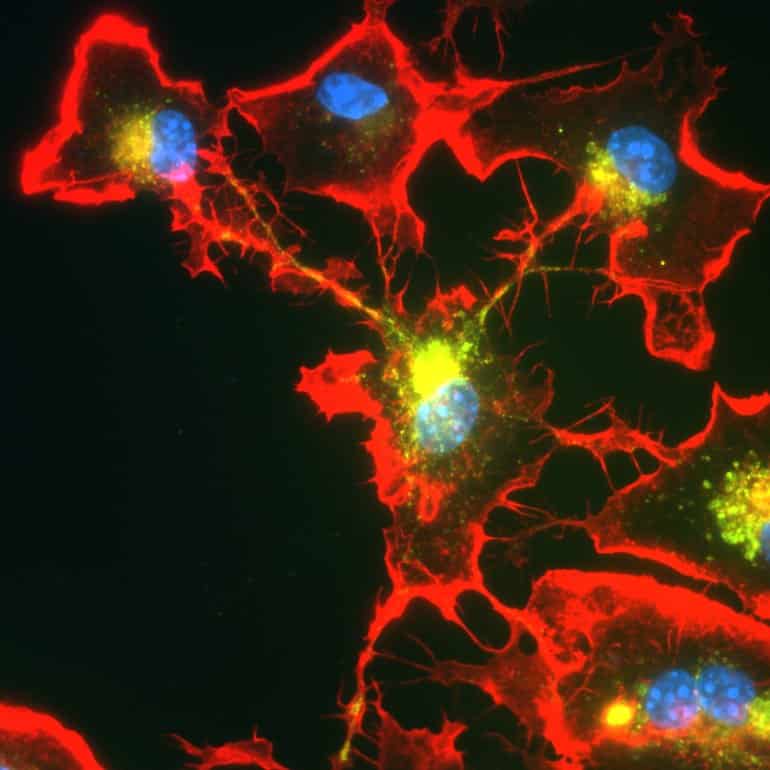
Microglial cells – (blue: the cell nuclei) can join together using tubular projections (red) to degrade dangerous proteins in a division of labor. Credit: AG Heneka/University of Bonn

To break down toxic proteins more quickly, immune cells in the brain can join together to form networks when needed. However, certain mutations associated with Parkinson’s disease can impair this process.

New work shows that neurons and other brain cells use DNA double-strand breaks, often associated with cancer, neurodegeneration and aging, to quickly express genes related to learning and memory.

New research has identified specific drug targets within the neural circuits that encode memories, paving the way for significant advances in the treatment of a broad spectrum of brain disorders.

Pioneering research shows that dopamine levels increase in response to stressful stimuli, and not just pleasurable ones, potentially rewriting facts about the “feel-good” hormone—a critical mediator of many psychiatric diseases. This discovery is cause to rethink treatment for psychiatric disease and addiction.

A new study links viral infections including mononucleosis and pneumonia experienced during adolescence with an increased risk of developing multiple sclerosis.

Researchers have discovered a new gene therapy pathway that has uncovered an important regulatory mechanism to keep our genome healthy. This pathway has the potential to protect us against serious life-limiting diseases such as cancer and dementia.

Neuroscientists have discovered specific types of neurons within the memory center of the brain that are responsible for acquiring new associative memories.

Amyloid protein made in the liver can cause neurodegeneration in the brain, according to a new study in the open-access journal PLOS Biology. Since the protein is thought to be a key contributor to development of Alzheimer’s disease (AD), the results suggest that the liver may play an important role in the onset or progression of the disease.

Higher glucose levels detected by a two-hour glucose test were an accurate predictor of poorer performance in tests of episodic memory ten years later, according to new research

A worsening cardiovascular profile after menopause may contribute to the fact that women are disproportionately affected by dementia. A new study identified a link between cardiovascular fat volume and radiodensity and cognitive function, as well as racial differences in this association.

Finally this week, a new study finds dopamine increases responses to stressful stimuli, not just pleasurable ones. The findings could have implications for the treatment of mental health disorders and addiction.


Weekly Neuroscience Update

Antwwaun Molden, Keith Toston, Julian Standord, Antwon Blake, John ChickIn a small study of former NFL players, about one quarter were found to have “mild cognitive impairment,” or problems with thinking and memory, a rate slightly higher than expected in the general population.

Research at the University of Edinburgh tracked electrical signals in the part of the brain linked to spatial awareness. The study could help us understand how, if we know a room, we can go into it with our eyes shut and find our way around. This is closely related to the way we map out how to get from one place to another.

Scientists have long wondered how nerve cell activity in the brain’s hippocampus, the epicenter for learning and memory, is controlled — too much synaptic communication between neurons can trigger a seizure, and too little impairs information processing, promoting neurodegeneration. Researchers at Georgetown University Medical Center say they now have an answer. In the January 10 issue of Neuron, they report that synapses that link two different groups of nerve cells in the hippocampus serve as a kind of “volume control,” keeping neuronal activity throughout that region at a steady, optimal level.

Seniors who have spoken two languages since childhood are faster than single-language speakers at switching from one task to another, according to a study published in the January 9 issue of The Journal of Neuroscience. Compared to their monolingual peers, lifelong bilinguals also show different patterns of brain activity when making the switch, the study found.

Repression of a single protein in ordinary fibroblasts is sufficient to directly convert the cells – abundantly found in connective tissues – into functional neurons. The findings, which could have far-reaching implications for the development of new treatments for neurodegenerative diseases like Huntington’s, Parkinson’s and Alzheimer’s, will be published online in advance of the January 17 issue of the journal Cell.

Weekly Round-Up

Transcranial magnetic stimulation can minimize forgetfulness

Memory failure is a common occurrence yet scientists have not reached a consensus as to how it happens. However, according to a new study at Beth Israel Deaconess Medical Center, Transcranial magnetic stimulation (TMS) is able to minimize forgetfulness by disrupting targeted brain regions as they compete between memories.

A new study which will be published in an upcoming issue of Psychological Science, finds changes in brain activity after only five weeks of meditation training.

In an ongoing quest to map the brain, scientists have determined how the brain works to understand others. According to a new study, the brain generates empathy in one manner for those who differ physically and in another method for those who are similar. In a paper published online by Cerebral Cortex, researcher Dr Lisa Aziz-Zadeh, suggests empathy for someone to whom you can directly relate — (for example, because they are experiencing pain in a limb that you possess) — is mostly generated by the intuitive, sensory-motor parts of the brain. However, empathy for someone to whom you cannot directly relate relies more on the rationalizing part of the brain.

The brain holds on to false facts, even after they have been retracted according to a report in Scientific American.

Psychologists have found that thought patterns used to recall the past and imagine the future are strikingly similar. Using functional magnetic resonance imaging to show the brain at work, they have observed the same regions activated in a similar pattern whenever a person remembers an event from the past or imagines himself in a future situation. This challenges long-standing beliefs that thoughts about the future develop exclusively in the frontal lobe.

Many dementia patients being prescribed antipsychotic drugs could be better treated with simple painkillers, say researchers from Kings College, London, and Norway.

Brain damage can cause significant changes in behaviour, such as loss of cognitive skills, but also reveals much about how the nervous system deals with consciousness. New findings reported in the July 2011 issue of Cortex demonstrate how the unconscious brain continues to process information even when the conscious brain is incapacitated.

Years after a single traumatic brain injury (TBI), survivors still show changes in their brains. In a new study, researchers from the Perelman School of Medicine at the University of Pennsylvania suggest that Alzheimer’s disease-like neurodegeneration may be initiated or accelerated following a single traumatic brain injury, even in young adults.