Weekly Neuroscience Update

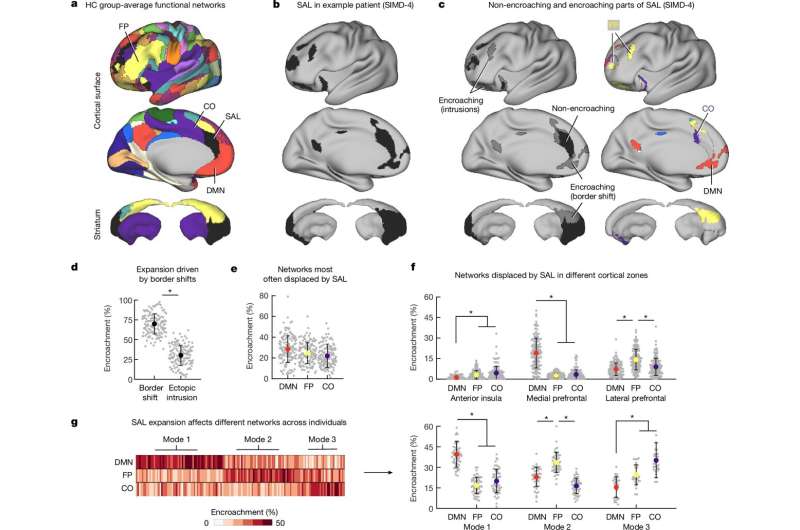
Three modes of salience network expansion in depression. Credit: Nature (2024)

By repeatedly scanning the brains of a small group of patients for a year and a half, researchers have identified a distinct pattern of neuronal interactions that appears to predispose some people to developing depression.

A new study reveals that higher levels of inequality—whether economic, environmental, or health-related—are associated with faster brain aging, particularly in countries with greater disparities

Researchers have published a new clinical protocol examining the combination of aerobic exercise and cognitive rehabilitation to improve learning and memory in individuals with multiple sclerosis (MS) who have mobility disability.

A new study reveals that the protein Tau – a key player implicated in several neurodegenerative conditions including Alzheimer’s disease – also plays a positive role in the brain.

Scientists have revealed new insights into the mechanisms behind cerebral small vessel disease, a condition that affects the smaller blood vessels in the brain and causes approximately half of all dementia cases.

Sports-related concussions may not be associated with long-term cognitive risks for non-professional athletes, a new study suggests.

Researchers have discovered that the Tau protein, often linked to neurodegenerative diseases like Alzheimer’s, also has a protective role in the brain. Tau helps combat oxidative stress by aiding in the formation of lipid droplets in glial cells, which sequester toxic lipids and protect neurons.

Scientists have developed an integrated optical sensor capable of detecting dopamine directly from an unprocessed blood sample.

A recent study has mapped genes linked to schizophrenia and uncovered a mechanism that disrupts synaptic plasticity in affected individuals. The researchers showed the role of three proteins in mediating the impairments of plasticity in schizophrenia. The findings may hold promise for the development of new treatments.

Finally this week, researchers have identified a protein called OSER1 that plays a key role in regulating longevity, offering new insights into why some people live longer than others. 

Weekly Neuroscience Update

A new study reveals that individuals with stronger ‘mindreading’ abilities, or the capacity to understand others’ feelings and intentions, are more successful in cooperative tasks. This trait, also known as ‘theory of mind,’ is not directly tied to intelligence and can potentially be improved through training programs.

Researchers have identified proteomic changes associated with forms of Alzheimer’s disease.

People in their eighties who can recall everyday events and life experiences as well as someone 20 to 30 years younger—known as superagers—are also more likely to have greater movement speed than typical older adults. They also have lower rates of anxiety and depression, according to a new study published in The Lancet Healthy Longevity journal.

A research team has developed a tool that counts brain lesions in seconds.

A new study has found that the frequency and duration of naps in infants are an indication of their cognitive needs. According to the research, infants with smaller vocabularies and poorer cognitive abilities tend to nap more frequently.

Researchers have discovered that myo-inositol, a small cyclic sugar molecule found in breast milk, plays a crucial role in promoting neuronal connections in infants’ brains.

Neuroscientists have proposed a fresh perspective on systems consolidation, the process by which certain memories are moved from the hippocampus to the neocortex for long-term storage. Their theory, backed by a mathematical neural network model, posits that the consolidation of memories depends on their generalizability, not age. This theory suggests a new memory, which is a generalization of previous memories, is created during consolidation.

Researchers have utilized artificial intelligence to uncover the promising potential of extra virgin olive oil (EVOO) in combating Alzheimer’s disease (AD).

New research heightened light sensitivity in Alzheimer’s patients to “sundowning,” a worsening of symptoms late in the day, and sleep disruptions that may advance the disease. This fresh understanding of biological clock disruptions in Alzheimer’s could aid the creation of treatments and symptom management. Light therapy could potentially regulate erratic sleep patterns caused by altered circadian rhythms.

Finally this week, scientists have identified a group of nerve cells in the midbrain, which, when stimulated, can suspend all movement, akin to setting a film on pause.

Weekly Neuroscience Update

Artificial Intelligence (AI), specifically GPT-4, was found to match the top 1% of human thinkers on a standard creativity test. The AI application ChatGPT, developed using GPT-4, excelled in fluency and originality in the Torrance Tests of Creative Thinking, a widely recognized tool for assessing creativity. This breakthrough finding indicates that AI may be developing creative ability on par with or even surpassing human capabilities. 

Researchers have identified a small structure in the brain, the anterior precuneus or aPCu, as a crucial component in establishing our physical self or “I”.

Taking good care of your teeth may be linked to better brain health, according to a study published in Neurology. The study found that gum disease and tooth loss were linked to brain shrinkage in the hippocampus, which plays a role in memory and Alzheimer’s disease. The study does not prove that gum disease or tooth loss causes Alzheimer’s disease; it only shows an association.

A new study has demonstrated for the first time that the diagnosis of multiple sclerosis (MS) can be significantly improved by additionally measuring the thickness of retinal layers in the eye.

Distinct, though neighbouring, areas of the brain are activated when processing music and language, with specific sub-regions engaged for simple melodies versus complex melodies, and for simple versus complex sentences, according to researchers.

New findings suggest that depression after traumatic brain injury (TBI) could be a clinically distinct disorder rather than traditional major depressive disorder, with implications for patient treatment.

If you’re sleep deprived, you will likely have a harder time remembering things than if you’re well-rested. But if you have good cardiorespiratory fitness, your memory may be less affected by the effects of sleep deprivation than others, according to a recent McGill study published in the journal Medicine & Science in Sports & Exercise.

Finally this week, even during sleep, the sounds that infants are exposed to can play a big role in language development, especially for babies at risk of language delays.

Weekly Neuroscience Update

Encouraging children to indulge in reading for pleasure can enhance their cognitive and mental health during adolescence, a recent study reveals. The study, involving over 10,000 young adolescents from the US, discovered that an optimal reading duration of 12 hours per week contributed to improved brain structure and mental health.

New research has investigated associations of adverse childhood experiences with changes in epigenetic age acceleration.

Researchers have discovered a new depression subtype, the ‘cognitive biotype,’ affecting 27% of patients who respond poorly to typically prescribed antidepressants. These patients struggle with planning, self-control, sustained focus, and suppressing inappropriate behavior, with brain scans revealing reduced activity in the regions responsible for these tasks.

A team of researchers has developed a predictive model to recognize patterns of persistent negative thinking, or rumination, using machine learning.

A new study involving over 22,000 people with Multiple Sclerosis (MS) has identified a genetic variant associated with the disease’s faster progression. The research discovered a genetic variant that significantly affects disease severity. This development brings us closer to understanding and combatting the progressive form of MS. The identified genetic variant accelerates disability, undermining patient mobility and independence over time.

Regularly finding time for a little snooze is good for our brain and helps keep it bigger for longer, say researchers.

Do intelligent people think faster? Researchers made the surprising finding that participants with higher intelligence scores were only quicker when tackling simple tasks, while they took longer to solve difficult problems than subjects with lower IQ scores. 

Finally this week, new research provides the first physiological evidence supporting the scientific theory of how the brain consolidates memory during sleep. 

Weekly Neuroscience Update

New artificial intelligence technology reveals previously unknown cell components. The findings may shed new light on human development and diseases.

A new mathematical model explains how the brain has the ability to continuously acquire new skills, specifically movement-based skills, without forgetting or degrading old ones. The theory, dubbed COIN, suggests identifying current context is key to learning how to move our bodies when acquiring skills.

Playing video games that are heavy on action can make you better at some new tasks. New research reveals that these games are helping by teaching players to be quicker learners.

The “background noise” in the brain disrupts long-memory signals by neurons. This noise interrupts the consistent rhythm of long-memory alpha wave signals in people experiencing identity confusion.

Memory errors may indicate a way in which the human cognitive system is optimally running, researchers say.

Housework is linked to sharper memory, attention span, and better leg strength, and by extension, greater protection against falls, in older adults, finds research published in the open access journal BMJ Open.

Repetitive transcranial magnetic stimulation (rTMS) can be used to modulate brain rhythms and cognitive behaviors related to “giving up” during problem-solving tasks.

New research reveals that specialized cells within neural circuitry that triggers complex learning in songbirds bears a striking resemblance to a type of neural cell associated with the development of fine motor skills in the cortex of the human brain.

Finally this week, a new study links a propensity to binge-watch TV shows with personality traits. Researchers found those who lack impulse control and emotional clarity are most likely to binge-watch a television series.


Weekly Neuroscience Update

Image Credit: Dartmouth College

Distinct information about familiar faces is encoded in a neural code that is shared across brains, according to a new study published in the Proceedings of the National Academy of Sciences.

A new study conducted in adults with a history of childhood maltreatment showed that two groups – those with a history of sexual abuse and those with posttraumatic stress disorder (PTSD) – had reduced brain connectivity in the attention systems known as the ventral and dorsal attention network (VAN-DAN).

New findings reveals dopamine neurons that play a role in learning and memory also drive motivation.

For the first time, researchers have used human data to quantify the speed of different processes that lead to Alzheimer’s disease and found that it develops in a very different way than previously thought. Their results could have important implications for the development of potential treatments.

Musical therapy can help to improve fine motor skills in patients with Parkinson’s disease according to new research. 

A genetic predisposition for depression combined with exposure to high-particulate-matter air pollution greatly elevates the risk that healthy people will experience depression, according to a first-of-its-kind study published in the Proceedings of the National Academies of Sciences (PNAS).

Recently published research found people who continued to spend a higher amount of time sitting between April and June 2020 were likely to have higher symptoms of depression.

A new study, published in the International Journal of MS Care, found that the vibration training improved not only physical symptoms associated with multiple sclerosis, such as increased walking speeds, but also cognitive functions, such as memory capacity and executive function.

A newly developed AI algorithm can directly predict eye position and movement during an MRI scan. The technology could provide new diagnostics for neurological disorders that manifest in changes in eye-movement patterns.

A team of researchers has found a possible connection between depression and anxiety for IBD patients and the vascular barrier in the brain choroid plexus closing. In their paper published in the journal Science, the group describes their study of the gut-brain axis response to inflammation and its link to psychiatric illnesses.

Researchers have created the first body map of sensations experienced during hallucinations in people experiencing psychosis.

Recent resarch reveals the severity of PTSD symptoms was associated with fewer risky choices and increased activation of the amygdala. Decreased activity in the ventral striatum, an area of the brain associated with processing positive valence such as reward, predicted more severe PTSD symptoms 14 months post-trauma.

Finally this week, people who consume a diet containing anti-inflammatory foods, including fruits, vegetables, and coffee, are less likely to develop dementia as they age, a new study reports.


Weekly Neuroscience Update

New research shows that sleep loss markedly exaggerates the degree to which we anticipate impending emotional events, particularly among highly anxious people, who are especially vulnerable.

Music training has a lifelong good impact on the aging process, says a new study out of Northwestern University.

New research by scientists at the University of University of North Carolina School of Medicine may have pinpointed an underlying cause of the seizures that affect 90 percent of people with Angelman syndrome (AS), a neurodevelopmental disorder.

Scientists have shown that brain levels of serotonin, the ‘happy hormone’ are regulated by the amount of bacteria in the gut during early life.

Two U.S. scientists have updated findings that link a form of Chinese meditation to positive changes in brain structure, suggesting that just 11 hours of practising the technique over a month could help prevent mental illness. In a paper to be released this week in the online version of the Proceedings of the National Academy of Sciences, researchers Yi-Yuan Tang and Michael Posner report that the practice known as integrative body-mind training (IBMT) can have a positive physical affect on the brain, boosting connectivity and efficiency.

Researchers at the University of Missouri have demonstrated the effectiveness of a potential new therapy for stroke patients in an article published in the journal Molecular Neurodegeneration. Created to target a specific enzyme known to affect important brain functions, the new compound being studied at MU is designed to stop the spread of brain bleeds and protect brain cells from further damage in the crucial hours after a stroke.

A receptor recently discovered to control the movement of immune cells across the blood-brain barrier may hold the key to treating multiple sclerosis (MS), a neuroinflammatory disease of the central nervous system.

In a pair of related studies, scientists from the Florida campus of The Scripps Research Institute have identified several proteins that help regulate cells’ response to light—and the development of night blindness, a rare disease that abolishes the ability to see in dim light.

A recent breakthrough in the development of an artificial synapse suggests that assistive devices and other prostheses won’t be limited to just missing joints and failing organs. Researchers in Japan have shown that it’s possible to mimic synaptic function with nanotechnology, a breakthrough that could result in not just artificial neural networks, but fixes for the human brain as well.

Patients vary widely in their response to concussion, but scientists haven’t understood why. Now, using a new technique for analyzing data from brain imaging studies, researchers at Albert Einstein College of Medicine of Yeshiva University and Montefiore Medical Center have found that concussion victims have unique spatial patterns of brain abnormalities that change over time.

Using a new and powerful approach to understand the origins of neurodegenerative disorders such as Alzheimer’s disease, researchers at Mayo Clinic in Florida are building the case that these diseases are primarily caused by genes that are too active or not active enough, rather than by harmful gene mutations.

Weekly Update: Brain Research

Using a sling or cast after injuring an arm may cause your brain to shift quickly to adjust, according to a study published in the January 17, 2012, print issue of Neurology®. The study found increases in the size of brain areas that were compensating for the injured side, and decreases in areas that were not being used due to the cast or sling.

A  new UC Davis study shows how the brain reconfigures its connections to minimize distractions and take best advantage of our knowledge of situations.

Neuroscientists at Kessler Foundation have documented increased cerebral activation in patients with multiple sclerosis (MS) following memory retraining using the modified Story Memory Technique (mSMT).  This is the first study to demonstrate that behavioral interventions can have a positive effect on brain function in people with cognitive disability caused by MS, an important step in validating the clinical utility of cognitive rehabilitation.

A program designed to boost cognition in older adults also increased their openness to new experiences, researchers report, demonstrating for the first time that a non-drug intervention in older adults can change a personality trait once thought to be fixed throughout the lifespan.

Researchers from the Institute of Psychiatry (IoP) at King’s College London have, for the first time, identified the facial expression of anxiety. The facial expression for the emotion of anxiety comprises an environmental scanning look that appears to aid risk assessment. The research was published this week in the Journal of Personality and Social Psychology.

New research from Uppsala University, Sweden, shows that a specific brain region that contributes to a person’s appetite sensation is more activated in response to food images after one night of sleep loss than after one night of normal sleep. Poor sleep habits can therefore affect people’s risk of becoming overweight in the long run. The findings are published in the Journal of Clinical Endocrinology & Metabolism.

Teenagers are more susceptible to developing disorders like addiction and depression, according to a paper published by Pitt researchers Jan. 16 in the Proceedings of the National Academy of Sciences.

Harvard scientists have developed the fullest picture yet of how neurons in the brain interact to reinforce behaviors ranging from learning to drug use, a finding that might open the door to possible breakthroughs in the treatment of addiction.

Virtual reality-enhanced exercise, or “exergames,” combining physical exercise with computer-simulated environments and interactive videogame features, can yield a greater cognitive benefit for older adults than traditional exercise alone, according to a new study published in the February issue of the American Journal of Preventive Medicine.

Sleeping after a traumatic event might lock in bad memories and emotions, a new study has found.

A team of researchers at the MedUni Vienna’s Department of Neurophysiology (Centre for Brain Research) has discovered a previously unknown effect of opioids – that opioids not only temporarily relieve pain, but at the right dose can also erase memory traces of pain in the spinal cord and therefore eliminate a key cause of chronic pain.


Weekly Round Up


Is the internet changing the way we think?

In this week’s round-up of the latest discoveries in the field of neuroscience – the evolutionary nature of the brain, how blind people see with their ears, the neuroscience of humour, and how the internet is changing the way we think.

Interesting post on the evolutionary nature of the brain here

Scientists say they have discovered a “maintenance” protein that helps keep nerve fibres that transmit messages in the brain operating smoothly. The University of Edinburgh team says the finding could improve understanding of disorders such as epilepsy, dementia, MS and stroke.

Neuropsychologist, Dr. Olivier Collignon has proved that some blind people can “see” with their ears.  He compared the brain activity of people who can see and people who were born blind, and discovered that the part of the brain that normally works with our eyes to process vision and space perception can actually rewire itself to process sound information instead.

A growing body of scientific evidence indicates that we have much more control over our minds, personalities and personal illnesses than was ever believed to exist before, and it is all occurring at the same time that a flood of other research is exposing the benefits of humor on brain functioning. Nichole Force has written  a post in Psych Central on Humor, Neuroplasticity and the Power To Change Your Mind.

And finally, is the internet changing the way we think? American writer Nicholas Carr believes so and his claims that the internet is not only shaping our lives but physically altering our brains has sparked a debate in the Guardian.