Weekly Neuroscience Update

Credit: Frontiers in Human Neuroscience (2024)

Scientists have determined that more than 60% of people who contracted COVID-19 have neurological symptoms that impact their cognitive function and quality of life, even two and three years after COVID-19.

Lip-read words can be decoded from the brain’s auditory regions similarly to heard speech, according to a new report that looked at how vision supports verbal perception.

Exercising is healthy, but not always appealing. Now research may have found a “switch” that activates the desire to get moving, as it shows that during exercise the muscle activates proteins which encourage further activity. The paper is published in Science Advances.

Researchers have demonstrated that a simple blood test that reflects brain health can predict which people are most at risk of suffering a stroke.

Our brain interprets visual information by combining what we see with what we already know. A study published in the journal Neuron, reveals a mechanism for learning and storing this existing knowledge about the world.

A newly developed brain-computer interface translates brain signals into speech with up to 97% accuracy, making it the most precise system of its kind.

Researchers have discovered that spontaneous brain activity during early development drives neural wiring before sensory experiences shape the brain. This spontaneous activity in neurons strengthens connections, following Hebb’s rule, where “cells that fire together wire together.”

According to new research, cognitive impairments in psychotic disorders, such as schizophrenia and bipolar disorder, are linked to brain network organization. 

A recently published study has unveiled significant findings that could enhance brain-computer interface (BCI) technologies, marking a crucial step towards more intuitive neuroprosthetic control and advanced rehabilitation therapies.

Researchers have discovered that the hippocampus stores multiple copies of a single memory, each within different neuron groups that develop at different stages.

Scientists have developed a promising preventative therapeutic approach against Alzheimer’s disease, targeting the amyloid beta biomolecule that typically triggers nerve cell hyperactivity in the early stages of the brain disease.

A new study finds that COVID-19 proteins left in the brain may lower cortisol levels, leading to heightened inflammation and an exaggerated response to stressors.

Through a large-scale brain imaging study, an international research team has identified five patterns of age-related degeneration in older people experiencing mental decline. In their study, the team conducted the multi-year study of thousands of MRI scans using machine learning applications to find patterns in brain degeneration as people age.

A new machine learning model, AutMedAI, can predict autism in children under two with nearly 80% accuracy, offering a promising tool for early detection and intervention.

Researchers have discovered the neurons responsible for “item memory,” deepening our understanding of how the brain stores and retrieves the details of “what” happened and offering a new target for treating Alzheimer’s disease.

Contrary to previous research, a new study of female participants finds no link between migraine and the risk of developing Parkinson’s disease.

Children who have persistently raised inflammation are at a higher risk of experiencing serious mental health disorders including psychosis and depression in early adulthood, according to a study published today in JAMA Psychiatry.

Researchers have identified a link between brain overgrowth and the severity of social and communication symptoms in children with autism spectrum disorder. 

People with multiple sclerosis (MS) are far less likely than those without the condition to have the molecular hallmarks of Alzheimer’s disease, according to new research. The discovery suggests a new avenue of research through which to seek Alzheimer’s treatment.

Scientists have discovered a new method to regulate the receptors responsible for the sense of touch, potentially leading to more effective treatments for chronic pain.

Researchers have found that nondeceptive placebos—placebos given with the full knowledge that they are placebos—can effectively manage stress, even when administered remotely. In a two-week randomized controlled trial, participants experiencing prolonged stress were divided into two groups: one group received nondeceptive placebos, while the other served as a control.

Return to work two years after a breast cancer diagnosis is associated with higher cognitive speed performance before and after treatment, according to a study published in JAMA Network Open.

Researchers have discovered a mutation in the SARS-CoV-2 spike protein that enhances its ability to infect the central nervous system, potentially explaining neurological symptoms and long COVID. The mutation was found to allow the virus to better infiltrate the brain, with implications for future treatments targeting COVID-19’s effects on the brain. 

Finally, this week, while everyone knows that a good night’s sleep restores energy, a new study finds it resets another vital function: memory.
Weekly Neuroscience Update

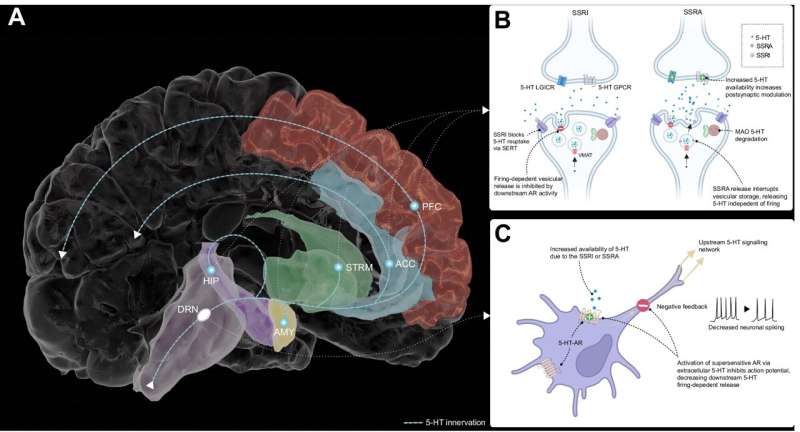
Serotonin changes how people learn and respond to negative information

Selective serotonin releasing agent is not negated by 5-HT1A supersensitivity, resulting in a rapid onset of pro-serotonergic activity. Credit: Nature Communications (2024).

Increasing serotonin can change how people learn from negative information, as well as improving how they respond to it, according to a new study published in the journal Nature Communications.

A recent review outlines the genetic complexity of schizophrenia, highlighting nearly 300 common genetic variants and over 20 rare variants linked to the disorder. Researchers emphasize that schizophrenia’s genetic basis is multifaceted, involving multiple genes rather than a single cause. Environmental factors like lifestyle and stress also play crucial roles.

Researchers have conducted a study examining the impact of alcohol on the electrical conductivity of the brain, highlighting its sedative effects.

New research indicates that 20% of children with an older sibling diagnosed with autism are also likely to be diagnosed with autism spectrum disorder (ASD), with this rate increasing to 36% when there are multiple siblings with ASD.

A new study suggests that the risk of developing dementia in Parkinson’s disease patients may be lower or occur later than previously reported.

An international team of researchers has investigated the neural mechanisms underlying imitative behavior: a phenomenon that facilitates interaction and social cohesion and allows people to engage spontaneously with others. The study—published in Proceedings of the National Academy of Sciences (PNAS)—has uncovered new insights into how the brain regulates this behavior, opening up new perspectives for clinical and therapeutic applications.

Advanced MRI scans, particularly diffusion tensor imaging (DTI), have shown promise in predicting which concussion patients are at risk for long-term symptoms. 

A significant breakthrough in the understanding of sleep mechanism opens new promise for treating sleep disorders and associated neuropsychiatric conditions: Scientists have pinpointed the melatonin receptor MT1 as a crucial regulator of REM (Rapid Eye Movement) sleep.

Innovative new research has revealed that the activity of different versions of genes expressed in the brain is associated with the accumulation of the protein tau, which is a hallmark of Alzheimer’s disease.

Finally this week, western classical music can significantly affect brain activity, particularly in people with treatment-resistant depression. By measuring brainwaves and neural imaging, scientists discovered that music synchronizes neural oscillations between brain regions associated with sensory and emotional processing, enhancing mood.

Weekly Neuroscience Update

Credit: Nature Mental Health (2023)

Researchers have identified important new methods for accurately identifying possible biomarkers in adolescent brains that can reliably predict cognitive developments and psychiatric issues.

A new study has examined the neural processes underlying odor processing in the human olfactory system and how the brain handles odor information from different nostrils and details the finding that each nostril has its own sense of smell, recording a distinct representation of the odor information it encounters.

A groundbreaking discovery suggests that dendrites could be pivotal in learning processes and may even influence our understanding of brain states and degenerative diseases.

A new study reveals the brain’s swift response to human errors compared to unintended outcomes. The study found that the brain recognizes an error within one second and then engages in a longer process to prevent future errors. This process was absent when the outcome wasn’t a direct result of an action, indicating a specialized error-awareness mechanism in the brain.

Researchers have identified new therapeutic targets for progressive supranuclear palsy (PSP), an incurable brain disorder with symptoms mimicking Parkinson’s and dementia.

A speech prosthetic developed by a collaborative team of neuroscientists, neurosurgeons, and engineers can translate a person’s brain signals into what they’re trying to say. The new technology might one day help people unable to talk due to neurological disorders regain the ability to communicate through a brain-computer interface.

It’s been debated for decades, but now researchers have suggested that left-handedness is not linked to better spatial skills.

A new study sheds light on when adolescents start thinking like adults. Researchers found that executive function, critical for task-switching and focus, typically matures around 18 years old. Drawing from over 10,000 participants and multiple datasets, this large-scale study offers a developmental chart for teen cognitive growth. These findings are invaluable for education, psychiatry, and the judicial system.

Emerging research underscores the profound connection between mental health and heart disease, with depression and anxiety hastening the onset of cardiovascular risk factors.

Researchers have discovered a potential link between the microbe C. perfringens and the progression of multiple sclerosis (MS). The study hints at the prospect of developing a vaccine or alternative treatments in the near future.

In a new study, researchers use a very large dataset to identify predictive brain imaging-based biomarkers of mental illness in adolescents.

Using advanced brain scanning technology, a research team has revealed insights into what happens in the brain during an advanced form of meditation called jhana. By uncovering distinct patterns of activity in different regions of the brain during jhana, the research suggests exciting possibilities for innovative therapies merging ancient meditation practices with modern neuroscience to improve well-being.

Finally this week, new research suggests your biological age, more than the years you’ve lived, may predict your risk of dementia and stroke in the future.

How To Learn Fast In Challenging Times

As part of this year’s Limerick Lifelong Learning Festival, I will be hosting an online session on optimal ways for the brain to learn in difficult times.

Advancements in brain science are revealing new perspectives on how the brain learns. This talk will describe optimal ways for the brain to learn and will provide you with the tools and techniques to help you develop your own learning toolkit.

All are welcome to attend.

Registration is free via Eventbrite

What Songbirds Can Teach Us About Learning and the Brain

All known languages require the following features: 

1.  Sufficient brain space to house the dictionary and grammar.

2. Specific features of the vocal apparatus including the vocal cords, the muscles of the tongue and mouth enabling articulation.

3. An ability to control breathing which allows for long fluent articulate phrases and the ability to modulate intonation subtly over the length of a single breadth.

Our nearest primate relatives (i.e. monkeys and apes) do not have any such control which explains why attempts to train them to speak have been so unsuccessful.

Birds alone can imitate human speech. The birds brain, vocal apparatus, or syrinx (literally, ‘flute’) and their ability to control their breathing explains why.


Weekly Neuroscience Update

A new study shows that sleeping after processing new information is most effective. Titled “Memory for Semantically Related and Unrelated Declarative Information: The Benefit of Sleep, the Cost of Wake,” the study was published March 22 in PLOSOne.

Snorting, gasping, or short interruptions in breathing during sleep (sleep apnea) may be linked to depression symptoms, new research shows.

Like the mute button on the TV remote control, our brains filter out unwanted noise so we can focus on what we’re listening to. But when it comes to following our own speech, a new brain study from the University of California, Berkeley, shows that instead of one homogenous mute button, we have a network of volume settings that can selectively silence and amplify the sounds we make and hear.

Just as the familiar sugar in food can be bad for the teeth and waistline, another sugar has been implicated as a health menace and blocking its action may have benefits that include improving long-term memory in older people and treating cancer. Progress toward finding such a blocker for the sugar — with the appropriately malicious-sounding name “oh-glick-nack” — was the topic of a report at the 243rd National Meeting & Exposition of the American Chemical Society (ACS), the world’s largest scientific society.

A hidden and never before recognized layer of information in the genetic code has been uncovered by a team of scientists at the University of California, San Francisco (UCSF) thanks to a technique developed at UCSF called ribosome profiling, which enables the measurement of gene activity inside living cells — including the speed with which proteins are made.