Weekly Neuroscience Update

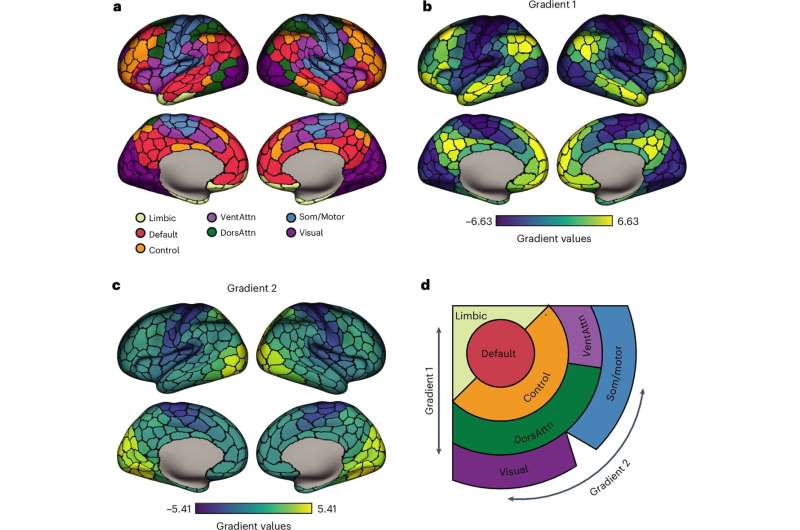
Large-scale functional networks are embedded along two principal gradients. Credit: Nature Neuroscience (2024).

Scientists have uncovered how different types of brain cells work together to form large-scale functional networks in the human brain—interconnected systems that support everything from sensory processing to complex decision-making—paving the way for new insights into brain health and disease.

A new neuroimaging marker of cerebral small vessel disease is related to general cognition and may serve to identify persons at risk of dementia in future clinical trials, a landmark study has found.

A recent study reveals that the genetic mutation causing Huntington’s disease (HD) enhances brain development and intelligence in early life, but leads to degeneration in adulthood. Children with the HD gene exhibit larger brains and higher IQs than those without the mutation.

In what could one day become a new treatment for epilepsy, researchers have used pulses of light to prevent seizure-like activity in neurons.

A team of researchers has found that certain factors are linked to faster brain shrinkage and quicker progression from normal thinking abilities to mild cognitive impairment (MCI). People with type 2 diabetes and low levels of specific proteins in their cerebrospinal fluid showed more rapid brain changes and developed MCI sooner than others.

A new study explores how brain waves reflect melody predictions while listening to music.

Neuroscientists have identified the binding site of low-dose ketamine, providing critical insight into how the medication, often described as a wonder drug, alleviates symptoms of major depression in as little as a few hours with effects lasting for several days.

New research indicates that cannabis use causes cellular damage that increases the risk of highly cancerous tumors by disrupting mitochondria and damaging DNA. 

Fampridine, used for improving walking in multiple sclerosis, may also enhance working memory in individuals with schizophrenia or depression. A study found that the drug significantly improved working memory in participants with initially poor performance, but had no effect on those with strong baseline memory.

A recent study links satellite and brain imaging data to identify how environmental factors can impact mental health, cognition and brain development in young people.

A new Alzheimer’s test collects just a few drops of blood from a finger prick, which can be mailed to a lab for analysis. The test measures biomarkers like pTau217 and has shown similar accuracy to traditional venous blood sampling.

Children born to mothers who take antiseizure medications during pregnancy may face increased risks of neurodevelopmental conditions, according to new data.

Researchers have shed light on the puzzling relationship between dopamine and rest tremor in Parkinson’s disease, finding that preserved dopamine in certain brain regions may actually contribute to tremor symptoms, challenging common beliefs.

New research has revealed the diverse assembly and regulation of Type-A GABA receptors (GABAARs), which are crucial for balancing brain activity. 

A recent study has found fascinating similarities in how the human brain and artificial intelligence models process language. The research, published in Nature Communications, suggests that the brain, like AI systems such as GPT-2, may use a continuous, context-sensitive embedding space to derive meaning from language, a breakthrough that could reshape our understanding of neural language processing.

A team of researchers has investigated the composition and communication of cells in so-called subcortical lesions, tissue damage to deep brain structures at different stages of multiple sclerosis.

Care for stroke survivors urgently needs to focus on non-motor skill outcomes such as fatigue, anxiety and reduced social participation to improve survivors’ quality of life and minimize care needs, according to a new study.

An international research collaboration has discovered how unusual spherical structures form in the brains of people with a mutation that causes a form of inherited Alzheimer’s disease. 

A new study identifies previously hidden brain network patterns in schizophrenia by focusing on nonlinear connectivity, offering potential biomarkers for early diagnosis. Traditional imaging methods often overlook these patterns, but researchers developed advanced statistical tools to uncover this new dimension of brain organization.

Finally this week, research published in the Journal of the American Geriatrics Society has identified several community-level factors that may increase people’s risk of experiencing cognitive impairment.


Weekly Neuroscience Update

recognition-id-neuroscinews

Image showing a map of the brain surface showing regions that preferentially activate during face (blue) and scene (red) identification. Image is credited to Oscar Woolnough, PhD, postdoctoral research fellow in the Department of Neurosurgery at McGovern Medical School at UTHealth in Houston.

A new study reveals areas of brain where recognition and identification occur.

Researchers have identified a hippocampal neural network that activates during stress. Activity in a hippocampal-hypothalamus network predicts greater feelings of stress, while connectivity between the hippocampus and dorsolateral prefrontal cortex predicts less stress.

Researchers have identified27 protein biomarkers that can predict whether a patient with COVID-19 is likely to develop severe coronavirus symptoms.

While the amount of antibodies generated varies widely in patients who have recovered from coronavirus, most people generate at least some antibodies which are intrinsically capable of neutralizing the SARS-CoV-2 virus according to a new study.

Twenty-nine genes have now been identified as being linked to problematic alcohol use. 

Toxic versions of the protein tau are believed to cause death of neurons of the brain in Alzheimer’s disease. A new study published in Nature Communications shows that the spread of toxic tau in the human brain in elderly individuals may occur via connected neurons. The researchers could see that beta-amyloid facilitates the spread of toxic tau.

Certain personality traits could increase the risk of developing mild cognitive impairment, a new study reports.

The anesthetic drug ketamine has been shown, in low doses, to have a rapid effect on difficult-to-treat depression. Researchers at Karolinska Institutet now report that they have identified a key target for the drug: specific serotonin receptors in the brain. Their findings, which are published in Translational Psychiatry, give hope of new, effective antidepressants.

Finally this week, a new study shows some infants can identify differences in musical tones at six months.


Weekly Neuroscience Update

Neuroscientists have announced a longitudinal research collaboration to investigate the emotional, social and cognitive effects of musical training on childhood brain development. The five-year research project, Effects of Early Childhood Musical Training on Brain and Cognitive Development, will offer USC researchers an important opportunity to provide new insights and add rigorous data to an emerging discussion about the role of early music engagement in learning and brain function.

UCLA researchers have for the first time measured the activity of a brain region known to be involved in learning, memory and Alzheimer’s disease during sleep. They discovered that this part of the brain behaves as if it’s remembering something, even under anesthesia, a finding that counters conventional theories about memory consolidation during sleep.

New research reveals that stroke may be affecting people at a younger age. The study is published in the October 10, 2012, online issue of Neurology, the medical journal of the American Academy of Neurology.

Scientists studying a rare genetic disorder have identified a molecular pathway that may play a role in schizophrenia, according to new research in the October 10 issue of The Journal of Neuroscience. The findings may one day guide researchers to new treatment options for people with schizophrenia — a devastating disease that affects approximately 1 percent of the world’s population.

Researchers from the University of Exeter Medical School have for the first time identified the mechanism that protects us from developing uncontrollable fear.

Small amounts of the drug ketamine can immediately relieve the symptoms of chronic depression, as well as those of treatment-resistant patients within a few hours, say Yale scientists.

Scientists find that competition between two brain regions influences the ability to make healthy choices.

A compassion-based meditation program can significantly improve a person’s ability to read the facial expressions of others, finds a study published by Social Cognitive and Affective Neuroscience. This boost in empathic accuracy was detected through both behavioral testing of the study participants and through functional magnetic resonance imaging (fMRI) scans of their brain activity.

A study in PLOS ONE shows that whether or not you like the person you’re watching can actually have an effect on brain activity related to motor actions and lead to “differential processing” – for example, thinking the person you dislike is moving more slowly than they actually are.