Weekly Neuroscience Update

short-term-memory-visual-distractions

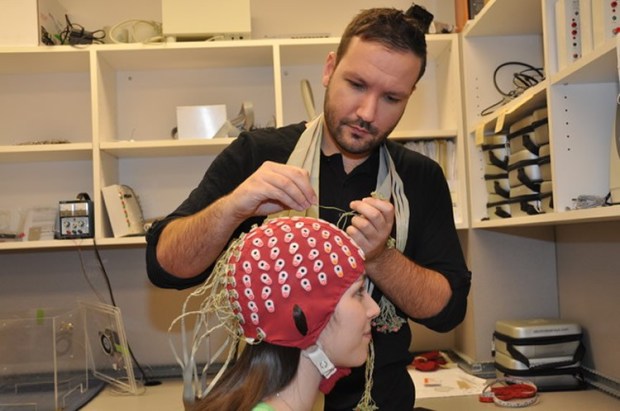
John Gaspar, an SFU psychology doctoral student, places 128 electrodes into a cap. The electrodes will pick up tiny changes in the wearer’s brain activity. Image is adapted from the SFU press release.

A new study has found that differences in an individual’s working memory capacity correlate with the brain’s ability to actively ignore distraction.

A research team has connected neurons using ultrashort laser pulses. With their study, which was published in Scientific Reports, the team became the first ever to find a way to bond neurons.

Physicians and biomedical engineers from Johns Hopkins report what they believe is the first successful effort to wiggle fingers individually and independently of each other using a mind-controlled artificial “arm” to control the movement.

Researchers have identified a gene which can be used to predict how susceptible a young person is to the mind-altering effects of smoking cannabis.

Young adults with hostile attitudes or those who don’t cope well with stress may be at increased risk for experiencing memory and thinking problems decades later, according to a study published in the March 2, 2016, online issue of Neurology.

Researchers have found how lactate, a waste product of glucose metabolism can protect neurons from damage following acute trauma such as stroke or spinal cord injury.

Neuroscientists have discovered a specific enzyme that plays a critical role in spinal muscular atrophy, and that suppressing this enzyme’s activity, could markedly reduce the disease’s severity and improve patients’ lifestyles.

Birds that migrate the greatest distances have more new neurons in the regions of the brain responsible for navigation and spatial orientation, suggests a new paper published in Scientific Reports.

Scientists have now described the engineering of a bright red fluorescent protein-based voltage indicator, providing pathways to understanding complex neurological disorders.

Children with autism and other similar conditions often have difficulties in several areas of communication. A new doctoral thesis in linguistics from the University of Gothenburg shows that these children can develop speech, gestures and a sense of rhythm and melody by listening to various speech sounds.

Finally this week,  new research suggests that small numbers are processed in the right side of the brain, while large numbers are processed in the left side of the brain.
Your Brain On Cannabis: Part Two

This a follow on post from last month’s Your Brain On Cannabis, which has become one of the most widely read posts on Inside the Brain.

The effects of marijuana on your brain

The drug acts in areas of the brain involved in memory and emotion by interacting with two receptors – the so-called CB1 and CB2 cannabinoid receptors – to cause a profound effect on recent memory. Long term memories are not affected. One brain region called the hippocampus has receptors for endogenous “marijuana” (anandamide). Hippocampal damage is associated with failure to make new memories and if the CB1 and CB2 receptors are stimulated activity decreases in this brain region.  Interestingly, with repeated use, tolerance to loss of memory develops but this is often associated with a further increase in drug intake.

Learning and marijuana don’t mix

Marijuana also changes the way sensory information is processed in the brain and is associated with poor performance in school and increased delinquency. There is impairment in the ability to learn. Listening and repetition learning is also compromised. Heavy marijuana use is associated with deficits in mathematical skill and verbal expression. Taken together these effects can lead to catastrophic social and psychological consequences particularly for the young abuser – not to mention the lost employee productivity, public health care costs, accidents and crashes and loss of income – Americans spent $10.6 billion on marijuana purchases in 1999.

Marijuana is addictive

Marijuana addicts experience withdrawal and an animal model for dependence has been developed by scientists to understand how this happens. Withdrawal has been described after 21 days of heavy use and starts 10 hours after stopping and includes insomnia, nausea, anorexia, agitation, restlessness, irritability, depression and shaking (tremor). The symptoms peak within 48 hours and gradually wear off by the fifth day of abstinence.

The war on marijuana starts with spreading the word

During the 1970s in the US it was decided that a liberal approach be adopted to marijuana use and 11 states decriminalized marijuana, 30,000 head shops were allowed to spring up and “responsible-use” messages were promoted. The drinking age was lowered to 18 years and the sale of cigarettes and alcohol to teens was tolerated. By 1979 35% of adolescents, 65%of high school seniors and 70%of young adults had tried an illicit drug. These facts and the increase in drug-related crime prompted universal outrage and the laws were tightened up. As a result – from 1979 to 1992 marijuana use has dropped by 2/3 among adolescents, and young adults and daily marijuana use has dropped by 500%. However, it has taken over 20 years to undo the damage in the US.

In tackling the marijuana problem head-on  – the following common myths need to be debunked (i) marijuana is harmless, (ii) marijuana is not addictive (iii) youth experimentation is inevitable and (iv) the criminalization of marijuana use is what leads to crime, not the drug itself.

In the final part of this series on the effects of cannabis on your brain, we will take a look at the possible medicinal uses of marijuana.